SUBSCRIBE TO OUR FREE NEWSLETTER
Daily news & progressive opinion—funded by the people, not the corporations—delivered straight to your inbox.
5
#000000
#FFFFFF
To donate by check, phone, or other method, see our More Ways to Give page.
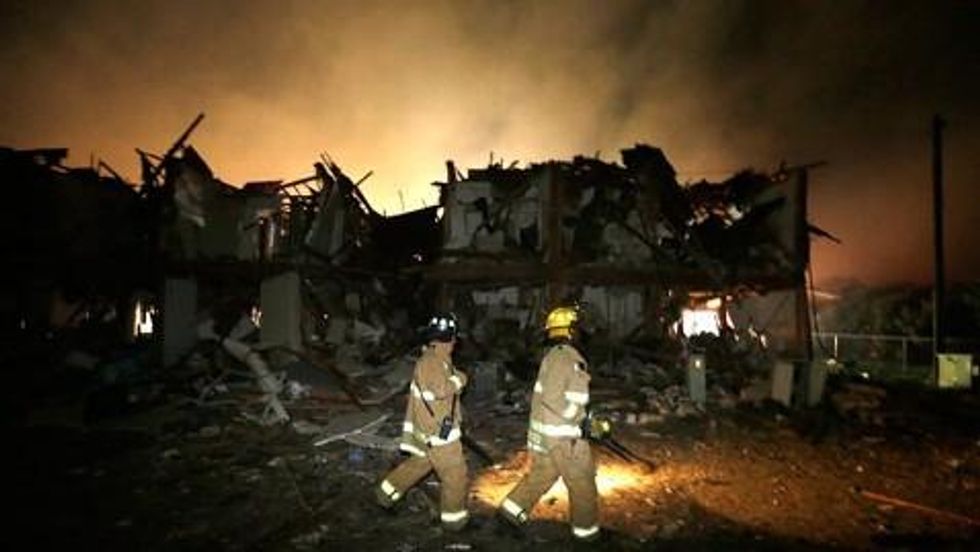
The first call came in to the 911 dispatcher at 7:29 p.m. on Wednesday, April 17. A woman at a playground noticed a fire across the railroad tracks, at the West Fertilizer Co. facility, in the small town of West, Texas, near Waco. The local volunteer fire department was mobilized. Less than 25 minutes later, a massive explosion leveled the plant, sending shock waves, debris and fire across West, ultimately killing 15 people, among them a local EMT, eight volunteer firefighters and a Dallas fire captain who was visiting his sons and joined the firefighting effort.
The call came over the emergency radio system: "We need every ambulance we can get at this point. A bomb just went off inside here. It's pretty bad. We've got a lot of firemen down."
Another call followed, with moaning in the background: "The rest home has been seriously damaged. We have many people down. Please respond."
A mushroom cloud climbed high into the sky. The explosion registered 2.1 on the Richter scale, the same as a small earthquake. 911 calls flooded in, with people reporting a bomb, many injured and others engulfed in a toxic cloud. Sixty to 80 houses were leveled.
One week later, the fires are out, most of the funerals have been held, but major questions remain unanswered. A team of up to 70 investigators is probing the source of the explosion. Reuters reported last Saturday that the plant had on site 2,700 tons of ammonium nitrate. This is 1,350 times the amount that would require a facility to self-report its stockpile to the Department of Homeland Security (DHS). Ammonium nitrate is a fertilizer used in industrial farming worldwide, and is stable when properly stored. It can be highly explosive when ignited, especially when mixed with fuel, as Timothy McVeigh demonstrated with the 1995 bombing of the Murrah Federal Building in Oklahoma City. West Fertilizer Co. never reported its ammonium nitrate to DHS.
The concern with theft of ammonium nitrate by potential bombers is the basis for this reporting requirement. Numerous other federal and state agencies are supposed to regulate fertilizer plants, chemical storage facilities and workplaces in general. Yet OSHA, the Occupational Safety and Health Administration, last inspected the facility in 1985. An inspection report filed with the Environmental Protection Agency in June 2011 listed 54,000 pounds of anhydrous ammonia, a different fertilizer, but claimed there was no serious hazard.
The West Fertilizer explosion happened just a day after the 66th anniversary of the Texas City disaster, said to be the worst industrial accident in U.S. history. Two thousand, three hundred tons of ammonium nitrate bound for France, as part of the Marshall Plan for European reconstruction and aid, caught fire aboard the ship, the SS Grandcamp. The explosion that followed killed at least 581 people, wounded 5,000 and destroyed 500 homes. You would think Texas would be sensitive to the potential hazards of this dangerous chemical. Yet Gov. Rick Perry told The Associated Press, "Through their elected officials [people] clearly send the message of their comfort with the amount of oversight." He recently touted the lax regulatory environment in Texas while trying to lure businesses there from states like California and Illinois.
April 28 is Workers' Memorial Day, commemorating the 4,500 workers who die on the job annually in the U.S. Thirteen workers, on average, go to work each day and never come home. Tom O'Connor, executive director of National Council for Occupational Safety and Health, said, "As companies decry regulations and emphasize profits over safety, workers pay the ultimate price."
Those who died in West, Texas, were workers, volunteer first responders, retirees and neighbors. Unsafe workplaces cause injury and death on a daily basis in this country, but seem to be tolerated as simply the cost of doing business. Gov. Perry declared West a disaster area and asked for prayers. But that's not enough. As legendary labor organizer Mother Jones said, "Pray for the dead, and fight like hell for the living."
Denis Moynihan contributed research to this column.
The first call came in to the 911 dispatcher at 7:29 p.m. on Wednesday, April 17. A woman at a playground noticed a fire across the railroad tracks, at the West Fertilizer Co. facility, in the small town of West, Texas, near Waco. The local volunteer fire department was mobilized. Less than 25 minutes later, a massive explosion leveled the plant, sending shock waves, debris and fire across West, ultimately killing 15 people, among them a local EMT, eight volunteer firefighters and a Dallas fire captain who was visiting his sons and joined the firefighting effort.
The call came over the emergency radio system: "We need every ambulance we can get at this point. A bomb just went off inside here. It's pretty bad. We've got a lot of firemen down."
Another call followed, with moaning in the background: "The rest home has been seriously damaged. We have many people down. Please respond."
A mushroom cloud climbed high into the sky. The explosion registered 2.1 on the Richter scale, the same as a small earthquake. 911 calls flooded in, with people reporting a bomb, many injured and others engulfed in a toxic cloud. Sixty to 80 houses were leveled.
One week later, the fires are out, most of the funerals have been held, but major questions remain unanswered. A team of up to 70 investigators is probing the source of the explosion. Reuters reported last Saturday that the plant had on site 2,700 tons of ammonium nitrate. This is 1,350 times the amount that would require a facility to self-report its stockpile to the Department of Homeland Security (DHS). Ammonium nitrate is a fertilizer used in industrial farming worldwide, and is stable when properly stored. It can be highly explosive when ignited, especially when mixed with fuel, as Timothy McVeigh demonstrated with the 1995 bombing of the Murrah Federal Building in Oklahoma City. West Fertilizer Co. never reported its ammonium nitrate to DHS.
The concern with theft of ammonium nitrate by potential bombers is the basis for this reporting requirement. Numerous other federal and state agencies are supposed to regulate fertilizer plants, chemical storage facilities and workplaces in general. Yet OSHA, the Occupational Safety and Health Administration, last inspected the facility in 1985. An inspection report filed with the Environmental Protection Agency in June 2011 listed 54,000 pounds of anhydrous ammonia, a different fertilizer, but claimed there was no serious hazard.
The West Fertilizer explosion happened just a day after the 66th anniversary of the Texas City disaster, said to be the worst industrial accident in U.S. history. Two thousand, three hundred tons of ammonium nitrate bound for France, as part of the Marshall Plan for European reconstruction and aid, caught fire aboard the ship, the SS Grandcamp. The explosion that followed killed at least 581 people, wounded 5,000 and destroyed 500 homes. You would think Texas would be sensitive to the potential hazards of this dangerous chemical. Yet Gov. Rick Perry told The Associated Press, "Through their elected officials [people] clearly send the message of their comfort with the amount of oversight." He recently touted the lax regulatory environment in Texas while trying to lure businesses there from states like California and Illinois.
April 28 is Workers' Memorial Day, commemorating the 4,500 workers who die on the job annually in the U.S. Thirteen workers, on average, go to work each day and never come home. Tom O'Connor, executive director of National Council for Occupational Safety and Health, said, "As companies decry regulations and emphasize profits over safety, workers pay the ultimate price."
Those who died in West, Texas, were workers, volunteer first responders, retirees and neighbors. Unsafe workplaces cause injury and death on a daily basis in this country, but seem to be tolerated as simply the cost of doing business. Gov. Perry declared West a disaster area and asked for prayers. But that's not enough. As legendary labor organizer Mother Jones said, "Pray for the dead, and fight like hell for the living."
Denis Moynihan contributed research to this column.
The first call came in to the 911 dispatcher at 7:29 p.m. on Wednesday, April 17. A woman at a playground noticed a fire across the railroad tracks, at the West Fertilizer Co. facility, in the small town of West, Texas, near Waco. The local volunteer fire department was mobilized. Less than 25 minutes later, a massive explosion leveled the plant, sending shock waves, debris and fire across West, ultimately killing 15 people, among them a local EMT, eight volunteer firefighters and a Dallas fire captain who was visiting his sons and joined the firefighting effort.
The call came over the emergency radio system: "We need every ambulance we can get at this point. A bomb just went off inside here. It's pretty bad. We've got a lot of firemen down."
Another call followed, with moaning in the background: "The rest home has been seriously damaged. We have many people down. Please respond."
A mushroom cloud climbed high into the sky. The explosion registered 2.1 on the Richter scale, the same as a small earthquake. 911 calls flooded in, with people reporting a bomb, many injured and others engulfed in a toxic cloud. Sixty to 80 houses were leveled.
One week later, the fires are out, most of the funerals have been held, but major questions remain unanswered. A team of up to 70 investigators is probing the source of the explosion. Reuters reported last Saturday that the plant had on site 2,700 tons of ammonium nitrate. This is 1,350 times the amount that would require a facility to self-report its stockpile to the Department of Homeland Security (DHS). Ammonium nitrate is a fertilizer used in industrial farming worldwide, and is stable when properly stored. It can be highly explosive when ignited, especially when mixed with fuel, as Timothy McVeigh demonstrated with the 1995 bombing of the Murrah Federal Building in Oklahoma City. West Fertilizer Co. never reported its ammonium nitrate to DHS.
The concern with theft of ammonium nitrate by potential bombers is the basis for this reporting requirement. Numerous other federal and state agencies are supposed to regulate fertilizer plants, chemical storage facilities and workplaces in general. Yet OSHA, the Occupational Safety and Health Administration, last inspected the facility in 1985. An inspection report filed with the Environmental Protection Agency in June 2011 listed 54,000 pounds of anhydrous ammonia, a different fertilizer, but claimed there was no serious hazard.
The West Fertilizer explosion happened just a day after the 66th anniversary of the Texas City disaster, said to be the worst industrial accident in U.S. history. Two thousand, three hundred tons of ammonium nitrate bound for France, as part of the Marshall Plan for European reconstruction and aid, caught fire aboard the ship, the SS Grandcamp. The explosion that followed killed at least 581 people, wounded 5,000 and destroyed 500 homes. You would think Texas would be sensitive to the potential hazards of this dangerous chemical. Yet Gov. Rick Perry told The Associated Press, "Through their elected officials [people] clearly send the message of their comfort with the amount of oversight." He recently touted the lax regulatory environment in Texas while trying to lure businesses there from states like California and Illinois.
April 28 is Workers' Memorial Day, commemorating the 4,500 workers who die on the job annually in the U.S. Thirteen workers, on average, go to work each day and never come home. Tom O'Connor, executive director of National Council for Occupational Safety and Health, said, "As companies decry regulations and emphasize profits over safety, workers pay the ultimate price."
Those who died in West, Texas, were workers, volunteer first responders, retirees and neighbors. Unsafe workplaces cause injury and death on a daily basis in this country, but seem to be tolerated as simply the cost of doing business. Gov. Perry declared West a disaster area and asked for prayers. But that's not enough. As legendary labor organizer Mother Jones said, "Pray for the dead, and fight like hell for the living."
Denis Moynihan contributed research to this column.