SUBSCRIBE TO OUR FREE NEWSLETTER
Daily news & progressive opinion—funded by the people, not the corporations—delivered straight to your inbox.
5
#000000
#FFFFFF
To donate by check, phone, or other method, see our More Ways to Give page.
Inequality hurts us all.
Imagine if you could go back 45 years to 1968. That year, after three decades of creative policy from President Franklin D. Roosevelt's New Deal through President Lyndon B. Johnson's Great Society, the United States was one of the world's most equal nations.
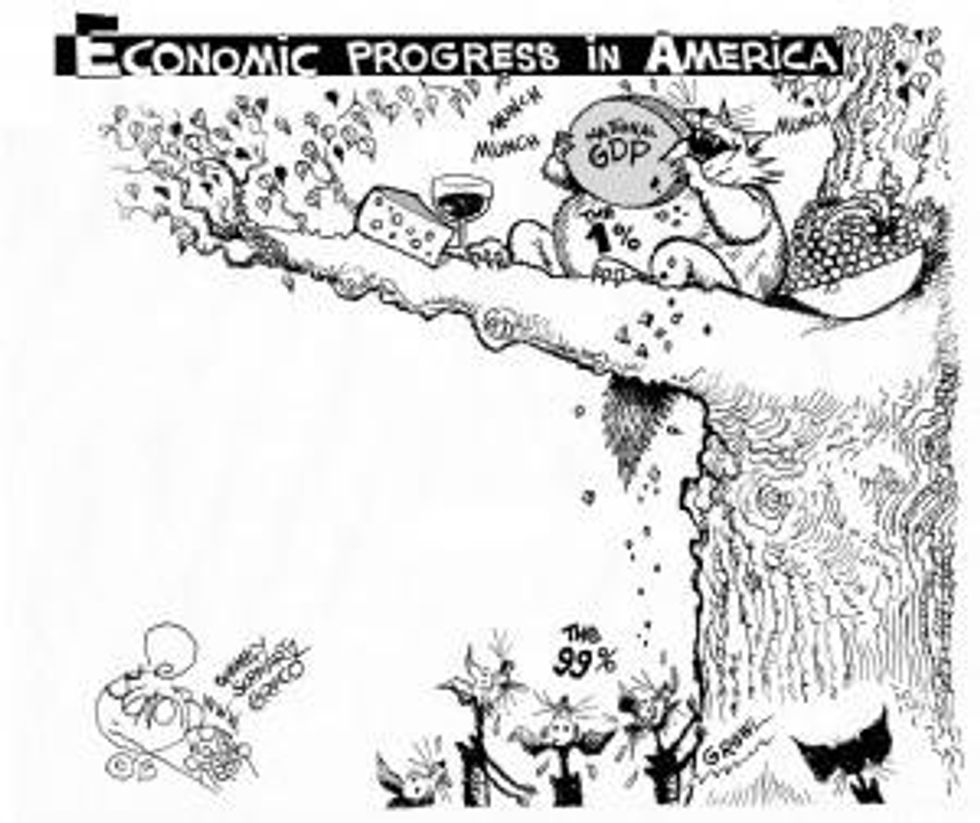
Now imagine that instead of falling into the extreme inequality of today, the United States had stayed at the levels of greater equality of that era. What would be the benefits?
There would be a lot of them. This is the finding of a new study, "Closing the Inequality Divide," that my organization, the Institute for Policy Studies, recently released with the Center for Sustainable Economy.
Our report looks at the world from the vantage point of the poorest fifth of people in my relatively affluent state of Maryland. Today, on average, the poorest fifth of the state earns about $15,000 a year. Maryland ranks among the country's top-five states in terms of per-capita income. Yet many Marylanders work hard to earn the minimum wage, which remains painfully low at $7.25/hour, barely enough for them and their families to scrape by.
Consider this: If the levels of greater income equality of 1968 still prevailed today, that same poorest fifth of Marylanders would be earning twice what they take home now. Imagine the differences. They'd be able to purchase more goods and services, which would generate more jobs and income throughout the state.
We'd also be a lot healthier. We'd suffer less crime. Fewer of us would be injured and killed in car crashes. We'd suffer fewer divorces. We'd get the benefits of more education. Since a higher percentage of African-Americans and Latinos are poorer than whites, greater income equality would also reduce race inequality.
How do my colleagues and I who wrote this report know all of this? Well, thanks to a bold move by Maryland Gov. Martin O'Malley in 2009, that state now collects information on 26 measures of social, environmental, and economic well-being known as the Genuine Progress Indicator (GPI). In addition to measuring inequality, each year employees of the Maryland government are charting critical things such as the costs of pollution and crime, as well as the value of volunteer work and higher education.
In other words, measure what you treasure.
The idea is that these broader measures of well-being offer a better sense of how a state and its people are doing than the traditional economic measure of gross domestic product (GDP). That traditional measure only counts the increase in production of goods and services and doesn't distinguish between the growth of "bad" things -- like cancer or polluting industries -- versus "good" things -- like wind energy and sustainable farming.
Are there steps we can take to move in the direction of the greater equality we enjoyed a couple of generations ago?
Yes. Our research points to the good work of a wide range of Maryland organizations that have practical ideas on how to reduce inequality. A broad coalition has come together to raise Maryland's minimum wage to $10.00 an hour by 2015, with an increase for restaurant workers and others who make tips as well. This state-level momentum is strengthening the efforts to pass a national bill introduced by Senator Tom Harkin and Representative George Miller to increase the minimum wage to $10.10 across the country.
President Barack Obama backed an increase in his February State of the Union address, and polls show strong public support. In early March, a Gallup poll showed 71 percent of Americans supporting an increase in the minimum wage to $9 an hour, the level Obama recommended.
We know how to make both Maryland and this country more equal, in part because we've done it before, from the 1930s to the 1960s. And we would all benefit from this shift.
Inequality hurts us all.
Imagine if you could go back 45 years to 1968. That year, after three decades of creative policy from President Franklin D. Roosevelt's New Deal through President Lyndon B. Johnson's Great Society, the United States was one of the world's most equal nations.
Now imagine that instead of falling into the extreme inequality of today, the United States had stayed at the levels of greater equality of that era. What would be the benefits?
There would be a lot of them. This is the finding of a new study, "Closing the Inequality Divide," that my organization, the Institute for Policy Studies, recently released with the Center for Sustainable Economy.
Our report looks at the world from the vantage point of the poorest fifth of people in my relatively affluent state of Maryland. Today, on average, the poorest fifth of the state earns about $15,000 a year. Maryland ranks among the country's top-five states in terms of per-capita income. Yet many Marylanders work hard to earn the minimum wage, which remains painfully low at $7.25/hour, barely enough for them and their families to scrape by.
Consider this: If the levels of greater income equality of 1968 still prevailed today, that same poorest fifth of Marylanders would be earning twice what they take home now. Imagine the differences. They'd be able to purchase more goods and services, which would generate more jobs and income throughout the state.
We'd also be a lot healthier. We'd suffer less crime. Fewer of us would be injured and killed in car crashes. We'd suffer fewer divorces. We'd get the benefits of more education. Since a higher percentage of African-Americans and Latinos are poorer than whites, greater income equality would also reduce race inequality.
How do my colleagues and I who wrote this report know all of this? Well, thanks to a bold move by Maryland Gov. Martin O'Malley in 2009, that state now collects information on 26 measures of social, environmental, and economic well-being known as the Genuine Progress Indicator (GPI). In addition to measuring inequality, each year employees of the Maryland government are charting critical things such as the costs of pollution and crime, as well as the value of volunteer work and higher education.
In other words, measure what you treasure.
The idea is that these broader measures of well-being offer a better sense of how a state and its people are doing than the traditional economic measure of gross domestic product (GDP). That traditional measure only counts the increase in production of goods and services and doesn't distinguish between the growth of "bad" things -- like cancer or polluting industries -- versus "good" things -- like wind energy and sustainable farming.
Are there steps we can take to move in the direction of the greater equality we enjoyed a couple of generations ago?
Yes. Our research points to the good work of a wide range of Maryland organizations that have practical ideas on how to reduce inequality. A broad coalition has come together to raise Maryland's minimum wage to $10.00 an hour by 2015, with an increase for restaurant workers and others who make tips as well. This state-level momentum is strengthening the efforts to pass a national bill introduced by Senator Tom Harkin and Representative George Miller to increase the minimum wage to $10.10 across the country.
President Barack Obama backed an increase in his February State of the Union address, and polls show strong public support. In early March, a Gallup poll showed 71 percent of Americans supporting an increase in the minimum wage to $9 an hour, the level Obama recommended.
We know how to make both Maryland and this country more equal, in part because we've done it before, from the 1930s to the 1960s. And we would all benefit from this shift.
Inequality hurts us all.
Imagine if you could go back 45 years to 1968. That year, after three decades of creative policy from President Franklin D. Roosevelt's New Deal through President Lyndon B. Johnson's Great Society, the United States was one of the world's most equal nations.
Now imagine that instead of falling into the extreme inequality of today, the United States had stayed at the levels of greater equality of that era. What would be the benefits?
There would be a lot of them. This is the finding of a new study, "Closing the Inequality Divide," that my organization, the Institute for Policy Studies, recently released with the Center for Sustainable Economy.
Our report looks at the world from the vantage point of the poorest fifth of people in my relatively affluent state of Maryland. Today, on average, the poorest fifth of the state earns about $15,000 a year. Maryland ranks among the country's top-five states in terms of per-capita income. Yet many Marylanders work hard to earn the minimum wage, which remains painfully low at $7.25/hour, barely enough for them and their families to scrape by.
Consider this: If the levels of greater income equality of 1968 still prevailed today, that same poorest fifth of Marylanders would be earning twice what they take home now. Imagine the differences. They'd be able to purchase more goods and services, which would generate more jobs and income throughout the state.
We'd also be a lot healthier. We'd suffer less crime. Fewer of us would be injured and killed in car crashes. We'd suffer fewer divorces. We'd get the benefits of more education. Since a higher percentage of African-Americans and Latinos are poorer than whites, greater income equality would also reduce race inequality.
How do my colleagues and I who wrote this report know all of this? Well, thanks to a bold move by Maryland Gov. Martin O'Malley in 2009, that state now collects information on 26 measures of social, environmental, and economic well-being known as the Genuine Progress Indicator (GPI). In addition to measuring inequality, each year employees of the Maryland government are charting critical things such as the costs of pollution and crime, as well as the value of volunteer work and higher education.
In other words, measure what you treasure.
The idea is that these broader measures of well-being offer a better sense of how a state and its people are doing than the traditional economic measure of gross domestic product (GDP). That traditional measure only counts the increase in production of goods and services and doesn't distinguish between the growth of "bad" things -- like cancer or polluting industries -- versus "good" things -- like wind energy and sustainable farming.
Are there steps we can take to move in the direction of the greater equality we enjoyed a couple of generations ago?
Yes. Our research points to the good work of a wide range of Maryland organizations that have practical ideas on how to reduce inequality. A broad coalition has come together to raise Maryland's minimum wage to $10.00 an hour by 2015, with an increase for restaurant workers and others who make tips as well. This state-level momentum is strengthening the efforts to pass a national bill introduced by Senator Tom Harkin and Representative George Miller to increase the minimum wage to $10.10 across the country.
President Barack Obama backed an increase in his February State of the Union address, and polls show strong public support. In early March, a Gallup poll showed 71 percent of Americans supporting an increase in the minimum wage to $9 an hour, the level Obama recommended.
We know how to make both Maryland and this country more equal, in part because we've done it before, from the 1930s to the 1960s. And we would all benefit from this shift.