SUBSCRIBE TO OUR FREE NEWSLETTER
Daily news & progressive opinion—funded by the people, not the corporations—delivered straight to your inbox.
5
#000000
#FFFFFF
To donate by check, phone, or other method, see our More Ways to Give page.
A half century ago America's largest private-sector employer was General Motors, whose full-time workers earned an average hourly wage of around $50, in today's dollars, including health and pension benefits.
Walmart earned $16 billion last year (it just reported a 9 percent increase in earnings in the third quarter of 2012, to $3.6 billion), the lion's share of which went instead to Walmart's shareholders -- including the family of its founder, Sam Walton, who earned on their Walmart stock more than the combined earnings of the bottom 40 percent of American workers.
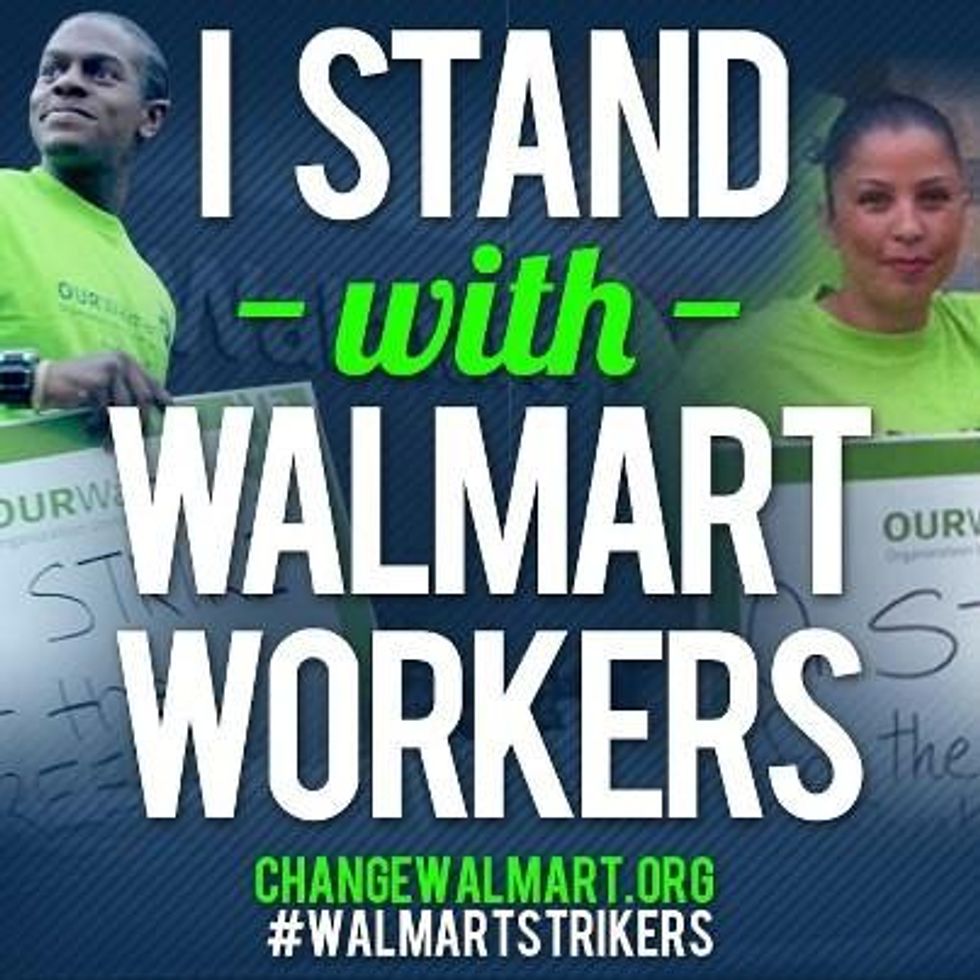
Is this about to change? Despite decades of failed unionization attempts, Walmart workers are planning to strike or conduct some other form of protest outside at least 1,000 locations across the United States this Friday - so-called "Black Friday," the biggest shopping day in America when the Christmas holiday buying season begins.
At the very least, the action gives Walmart employees a chance to air their grievances in public - not only lousy wages (as low at $8 an hour) but also unsafe and unsanitary working conditions, excessive hours, and sexual harassment. The result is bad publicity for the company exactly when it wants the public to think of it as Santa Claus. And the threatened strike, the first in 50 years, is gaining steam.
The company is fighting back. It has filed a complaint with the National Labor Relations Board to preemptively ban the Black Friday strikes. The complaint alleges that the pickets are illegal "representational" picketing designed to win recognition for the United Food & Commercial Workers (UFCW) union. Walmart's workers say they're protesting unfair labor practices rather than acting on behalf of the UFCW. If a court sides with Walmart, it could possibly issue an injunction blocking Black Friday's pickets.
What happens at Walmart will have consequences extending far beyond the company. Other big box retailers are watching carefully. Walmart is their major competitor. Its pay scale and working conditions set the standard.
More broadly, the widening inequality reflected in the gap between the pay of Walmart workers and the returns to Walmart investors, including the Walton fammily, haunts the American economy.
Consumer spending is 70 percent of economic activity, but consumers are also workers. And as income and wealth continue to concentrate at the top, and the median wage continues to drop - it's now 8 percent lower than it was in 2000 - a growing portion of the American workforce lacks the purchasing power to get the economy back to speed. Without a vibrant and growing middle class, Walmart itself won't have the customers it needs.
Most new jobs in America are in personal services like retail, with low pay and bad hours. According to the Bureau of Labor and Statistics, the average full-time retail worker earns between $18,000 and $21,000 per year.
But if retail workers got a raise, would consumers have to pay higher prices to make up for it? A new study by the think tank Demos reports that raising the salary of all full-time workers at large retailers to $25,000 per year would lift more than 700,000 people out of poverty, at a cost of only a 1 percent price increase for customers.
And, in the end, retailers would benefit. According to the study, the cost of the wage increases to major retailers would be $20.8 billion -- about one percent of the sector's $2.17 trillion in total annual sales. But the study also estimates the increased purchasing power of lower-wage workers as a result of the pay raises would generate $4 billion to $5 billion in additional retail sales.
This seems like a good deal all around.
A half century ago America's largest private-sector employer was General Motors, whose full-time workers earned an average hourly wage of around $50, in today's dollars, including health and pension benefits.
Walmart earned $16 billion last year (it just reported a 9 percent increase in earnings in the third quarter of 2012, to $3.6 billion), the lion's share of which went instead to Walmart's shareholders -- including the family of its founder, Sam Walton, who earned on their Walmart stock more than the combined earnings of the bottom 40 percent of American workers.
Is this about to change? Despite decades of failed unionization attempts, Walmart workers are planning to strike or conduct some other form of protest outside at least 1,000 locations across the United States this Friday - so-called "Black Friday," the biggest shopping day in America when the Christmas holiday buying season begins.
At the very least, the action gives Walmart employees a chance to air their grievances in public - not only lousy wages (as low at $8 an hour) but also unsafe and unsanitary working conditions, excessive hours, and sexual harassment. The result is bad publicity for the company exactly when it wants the public to think of it as Santa Claus. And the threatened strike, the first in 50 years, is gaining steam.
The company is fighting back. It has filed a complaint with the National Labor Relations Board to preemptively ban the Black Friday strikes. The complaint alleges that the pickets are illegal "representational" picketing designed to win recognition for the United Food & Commercial Workers (UFCW) union. Walmart's workers say they're protesting unfair labor practices rather than acting on behalf of the UFCW. If a court sides with Walmart, it could possibly issue an injunction blocking Black Friday's pickets.
What happens at Walmart will have consequences extending far beyond the company. Other big box retailers are watching carefully. Walmart is their major competitor. Its pay scale and working conditions set the standard.
More broadly, the widening inequality reflected in the gap between the pay of Walmart workers and the returns to Walmart investors, including the Walton fammily, haunts the American economy.
Consumer spending is 70 percent of economic activity, but consumers are also workers. And as income and wealth continue to concentrate at the top, and the median wage continues to drop - it's now 8 percent lower than it was in 2000 - a growing portion of the American workforce lacks the purchasing power to get the economy back to speed. Without a vibrant and growing middle class, Walmart itself won't have the customers it needs.
Most new jobs in America are in personal services like retail, with low pay and bad hours. According to the Bureau of Labor and Statistics, the average full-time retail worker earns between $18,000 and $21,000 per year.
But if retail workers got a raise, would consumers have to pay higher prices to make up for it? A new study by the think tank Demos reports that raising the salary of all full-time workers at large retailers to $25,000 per year would lift more than 700,000 people out of poverty, at a cost of only a 1 percent price increase for customers.
And, in the end, retailers would benefit. According to the study, the cost of the wage increases to major retailers would be $20.8 billion -- about one percent of the sector's $2.17 trillion in total annual sales. But the study also estimates the increased purchasing power of lower-wage workers as a result of the pay raises would generate $4 billion to $5 billion in additional retail sales.
This seems like a good deal all around.
A half century ago America's largest private-sector employer was General Motors, whose full-time workers earned an average hourly wage of around $50, in today's dollars, including health and pension benefits.
Walmart earned $16 billion last year (it just reported a 9 percent increase in earnings in the third quarter of 2012, to $3.6 billion), the lion's share of which went instead to Walmart's shareholders -- including the family of its founder, Sam Walton, who earned on their Walmart stock more than the combined earnings of the bottom 40 percent of American workers.
Is this about to change? Despite decades of failed unionization attempts, Walmart workers are planning to strike or conduct some other form of protest outside at least 1,000 locations across the United States this Friday - so-called "Black Friday," the biggest shopping day in America when the Christmas holiday buying season begins.
At the very least, the action gives Walmart employees a chance to air their grievances in public - not only lousy wages (as low at $8 an hour) but also unsafe and unsanitary working conditions, excessive hours, and sexual harassment. The result is bad publicity for the company exactly when it wants the public to think of it as Santa Claus. And the threatened strike, the first in 50 years, is gaining steam.
The company is fighting back. It has filed a complaint with the National Labor Relations Board to preemptively ban the Black Friday strikes. The complaint alleges that the pickets are illegal "representational" picketing designed to win recognition for the United Food & Commercial Workers (UFCW) union. Walmart's workers say they're protesting unfair labor practices rather than acting on behalf of the UFCW. If a court sides with Walmart, it could possibly issue an injunction blocking Black Friday's pickets.
What happens at Walmart will have consequences extending far beyond the company. Other big box retailers are watching carefully. Walmart is their major competitor. Its pay scale and working conditions set the standard.
More broadly, the widening inequality reflected in the gap between the pay of Walmart workers and the returns to Walmart investors, including the Walton fammily, haunts the American economy.
Consumer spending is 70 percent of economic activity, but consumers are also workers. And as income and wealth continue to concentrate at the top, and the median wage continues to drop - it's now 8 percent lower than it was in 2000 - a growing portion of the American workforce lacks the purchasing power to get the economy back to speed. Without a vibrant and growing middle class, Walmart itself won't have the customers it needs.
Most new jobs in America are in personal services like retail, with low pay and bad hours. According to the Bureau of Labor and Statistics, the average full-time retail worker earns between $18,000 and $21,000 per year.
But if retail workers got a raise, would consumers have to pay higher prices to make up for it? A new study by the think tank Demos reports that raising the salary of all full-time workers at large retailers to $25,000 per year would lift more than 700,000 people out of poverty, at a cost of only a 1 percent price increase for customers.
And, in the end, retailers would benefit. According to the study, the cost of the wage increases to major retailers would be $20.8 billion -- about one percent of the sector's $2.17 trillion in total annual sales. But the study also estimates the increased purchasing power of lower-wage workers as a result of the pay raises would generate $4 billion to $5 billion in additional retail sales.
This seems like a good deal all around.