SUBSCRIBE TO OUR FREE NEWSLETTER
Daily news & progressive opinion—funded by the people, not the corporations—delivered straight to your inbox.
5
#000000
#FFFFFF
To donate by check, phone, or other method, see our More Ways to Give page.
The Commodity Futures Trading Commission, the main regular of derivatives (bets on bets), wants to extend Dodd-Frank regulations to the foreign branches and subsidiaries of Wall Street banks.
Horror of horrors, say the banks.
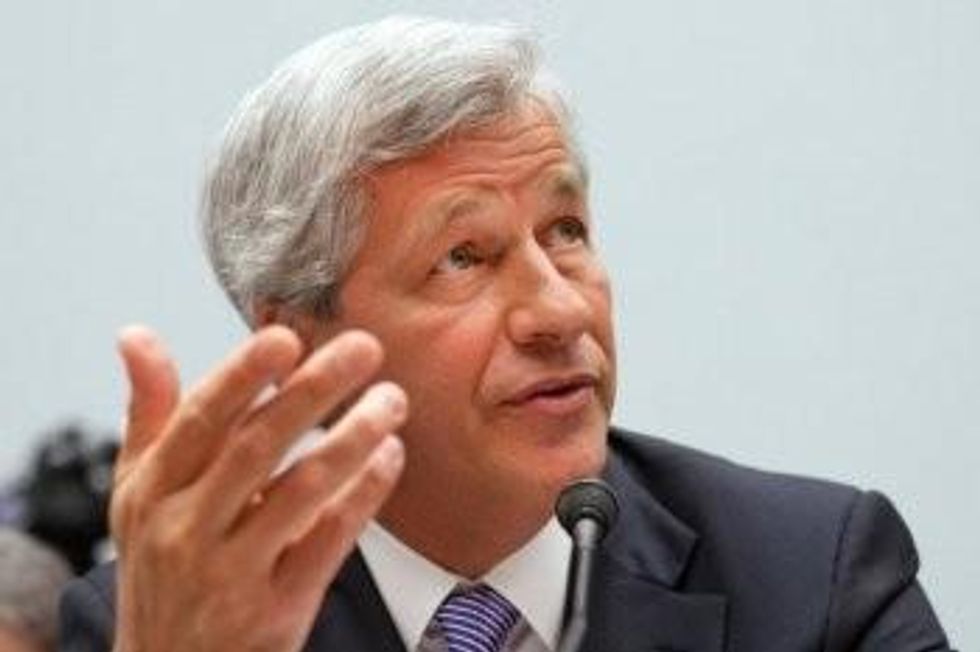
"If JPMorgan overseas operates under different rules than our foreign competitors," warned Jamie Dimon, chair and CEO of JP Morgan, Wall Street would lose financial business to the banks of nations with fewer regulations, allowing "Deutsche Bank to make the better deal."
This is the same Jamie Dimon who chose London as the place to make highly-risky derivatives trades that have lost the firm upwards of $2 billion so far - and could leave American taxpayers holding the bag if JPMorgan's exposure to tottering European banks gets much worse.
Dimon's foreign affair is itself proof that unless the overseas operations of Wall Street banks are covered by U.S. regulations, giant banks like JPMorgan will just move more of their betting abroad - hiding their wildly-risky bets overseas so U.S. regulators can't control them. Even now no one knows how badly JPMorgan or any other Wall Street bank will be shaken if major banks in Spain or elsewhere in Europe go down.
Call it the Dimon loophole.
This is the same Jamie Dimon, by the way, who at a financial conference a year ago told Fed chief Ben Bernanke there was no longer any reason to crack down on Wall Street. "Most of the bad actors are gone," he said. "[O]ff-balance-sheet businesses are virtually obliterated, ... money market funds are far more transparent" and "most very exotic derivatives are gone."
One advantage of being a huge Wall Street bank is you get bailed out by the federal government when you make dumb bets. Another is you can choose where around the world to make the dumb bets, thereby dodging U.S. regulations. It's a win-win.
Wall Street would like to keep it that way.
For two years now, squadrons of Wall Street lawyers and lobbyists have been pressing the Treasury, Comptroller of the Currency, Commodity Futures Trading Commission, SEC, and the Fed to go easier on the Street for fear that if regulations are too tight, the big banks will be less competitive internationally.
Translated: They'll move more of their business to London and Frankfurt, where regulations are looser.
Meanwhile, the Street has been warning Europeans that if their financial regulations are too tight, the big banks will move more of their business to the US, where regulations will (they hope) be looser.
After the Basel Committee on Banking Supervision (a global financial regulatory oversight body) came up with a new set of rules to toughen bank capital and liquidity requirements, European officials threatened to get even tougher. They approved a new system of European regulatory bodies with added powers to ban certain financial products or activities in times of market stress.
This prompted Lloyd Blankfein, CEO of Goldman Sachs, to issue -- in the words of the Financial Times -- "a clear warning that the bank could shift its operations around the world if the regulatory crackdown becomes too tough."
Blankfein told a European financial conference that while Europe remains of vital importance to Goldman, with less than half of the bank's business now generated in the U.S., the introduction of "mismatched regulation" across different regions (that is, tougher regulations in Europe than in the U.S.) would tempt banks to search out the cheapest and least intrusive jurisdiction in which to operate.
"Operations can be moved globally and capital can be accessed globally," he warned.
Someone should remind Dimon and Blankfein that a few years ago they and their colleagues on the Street almost eviscerated the American economy, and that of much of the rest of the world. The Street's antics required a giant taxpayer-funded bailout. Most Americans are still living with the results, as are millions of Europeans.
Wall Street can't have it both ways - too big to fail, and also able to make wild bets anywhere around the world.
If Wall Street banks demand a free rein overseas, the least we should demand is they be broken up here.
The Commodity Futures Trading Commission, the main regular of derivatives (bets on bets), wants to extend Dodd-Frank regulations to the foreign branches and subsidiaries of Wall Street banks.
Horror of horrors, say the banks.
"If JPMorgan overseas operates under different rules than our foreign competitors," warned Jamie Dimon, chair and CEO of JP Morgan, Wall Street would lose financial business to the banks of nations with fewer regulations, allowing "Deutsche Bank to make the better deal."
This is the same Jamie Dimon who chose London as the place to make highly-risky derivatives trades that have lost the firm upwards of $2 billion so far - and could leave American taxpayers holding the bag if JPMorgan's exposure to tottering European banks gets much worse.
Dimon's foreign affair is itself proof that unless the overseas operations of Wall Street banks are covered by U.S. regulations, giant banks like JPMorgan will just move more of their betting abroad - hiding their wildly-risky bets overseas so U.S. regulators can't control them. Even now no one knows how badly JPMorgan or any other Wall Street bank will be shaken if major banks in Spain or elsewhere in Europe go down.
Call it the Dimon loophole.
This is the same Jamie Dimon, by the way, who at a financial conference a year ago told Fed chief Ben Bernanke there was no longer any reason to crack down on Wall Street. "Most of the bad actors are gone," he said. "[O]ff-balance-sheet businesses are virtually obliterated, ... money market funds are far more transparent" and "most very exotic derivatives are gone."
One advantage of being a huge Wall Street bank is you get bailed out by the federal government when you make dumb bets. Another is you can choose where around the world to make the dumb bets, thereby dodging U.S. regulations. It's a win-win.
Wall Street would like to keep it that way.
For two years now, squadrons of Wall Street lawyers and lobbyists have been pressing the Treasury, Comptroller of the Currency, Commodity Futures Trading Commission, SEC, and the Fed to go easier on the Street for fear that if regulations are too tight, the big banks will be less competitive internationally.
Translated: They'll move more of their business to London and Frankfurt, where regulations are looser.
Meanwhile, the Street has been warning Europeans that if their financial regulations are too tight, the big banks will move more of their business to the US, where regulations will (they hope) be looser.
After the Basel Committee on Banking Supervision (a global financial regulatory oversight body) came up with a new set of rules to toughen bank capital and liquidity requirements, European officials threatened to get even tougher. They approved a new system of European regulatory bodies with added powers to ban certain financial products or activities in times of market stress.
This prompted Lloyd Blankfein, CEO of Goldman Sachs, to issue -- in the words of the Financial Times -- "a clear warning that the bank could shift its operations around the world if the regulatory crackdown becomes too tough."
Blankfein told a European financial conference that while Europe remains of vital importance to Goldman, with less than half of the bank's business now generated in the U.S., the introduction of "mismatched regulation" across different regions (that is, tougher regulations in Europe than in the U.S.) would tempt banks to search out the cheapest and least intrusive jurisdiction in which to operate.
"Operations can be moved globally and capital can be accessed globally," he warned.
Someone should remind Dimon and Blankfein that a few years ago they and their colleagues on the Street almost eviscerated the American economy, and that of much of the rest of the world. The Street's antics required a giant taxpayer-funded bailout. Most Americans are still living with the results, as are millions of Europeans.
Wall Street can't have it both ways - too big to fail, and also able to make wild bets anywhere around the world.
If Wall Street banks demand a free rein overseas, the least we should demand is they be broken up here.
The Commodity Futures Trading Commission, the main regular of derivatives (bets on bets), wants to extend Dodd-Frank regulations to the foreign branches and subsidiaries of Wall Street banks.
Horror of horrors, say the banks.
"If JPMorgan overseas operates under different rules than our foreign competitors," warned Jamie Dimon, chair and CEO of JP Morgan, Wall Street would lose financial business to the banks of nations with fewer regulations, allowing "Deutsche Bank to make the better deal."
This is the same Jamie Dimon who chose London as the place to make highly-risky derivatives trades that have lost the firm upwards of $2 billion so far - and could leave American taxpayers holding the bag if JPMorgan's exposure to tottering European banks gets much worse.
Dimon's foreign affair is itself proof that unless the overseas operations of Wall Street banks are covered by U.S. regulations, giant banks like JPMorgan will just move more of their betting abroad - hiding their wildly-risky bets overseas so U.S. regulators can't control them. Even now no one knows how badly JPMorgan or any other Wall Street bank will be shaken if major banks in Spain or elsewhere in Europe go down.
Call it the Dimon loophole.
This is the same Jamie Dimon, by the way, who at a financial conference a year ago told Fed chief Ben Bernanke there was no longer any reason to crack down on Wall Street. "Most of the bad actors are gone," he said. "[O]ff-balance-sheet businesses are virtually obliterated, ... money market funds are far more transparent" and "most very exotic derivatives are gone."
One advantage of being a huge Wall Street bank is you get bailed out by the federal government when you make dumb bets. Another is you can choose where around the world to make the dumb bets, thereby dodging U.S. regulations. It's a win-win.
Wall Street would like to keep it that way.
For two years now, squadrons of Wall Street lawyers and lobbyists have been pressing the Treasury, Comptroller of the Currency, Commodity Futures Trading Commission, SEC, and the Fed to go easier on the Street for fear that if regulations are too tight, the big banks will be less competitive internationally.
Translated: They'll move more of their business to London and Frankfurt, where regulations are looser.
Meanwhile, the Street has been warning Europeans that if their financial regulations are too tight, the big banks will move more of their business to the US, where regulations will (they hope) be looser.
After the Basel Committee on Banking Supervision (a global financial regulatory oversight body) came up with a new set of rules to toughen bank capital and liquidity requirements, European officials threatened to get even tougher. They approved a new system of European regulatory bodies with added powers to ban certain financial products or activities in times of market stress.
This prompted Lloyd Blankfein, CEO of Goldman Sachs, to issue -- in the words of the Financial Times -- "a clear warning that the bank could shift its operations around the world if the regulatory crackdown becomes too tough."
Blankfein told a European financial conference that while Europe remains of vital importance to Goldman, with less than half of the bank's business now generated in the U.S., the introduction of "mismatched regulation" across different regions (that is, tougher regulations in Europe than in the U.S.) would tempt banks to search out the cheapest and least intrusive jurisdiction in which to operate.
"Operations can be moved globally and capital can be accessed globally," he warned.
Someone should remind Dimon and Blankfein that a few years ago they and their colleagues on the Street almost eviscerated the American economy, and that of much of the rest of the world. The Street's antics required a giant taxpayer-funded bailout. Most Americans are still living with the results, as are millions of Europeans.
Wall Street can't have it both ways - too big to fail, and also able to make wild bets anywhere around the world.
If Wall Street banks demand a free rein overseas, the least we should demand is they be broken up here.