

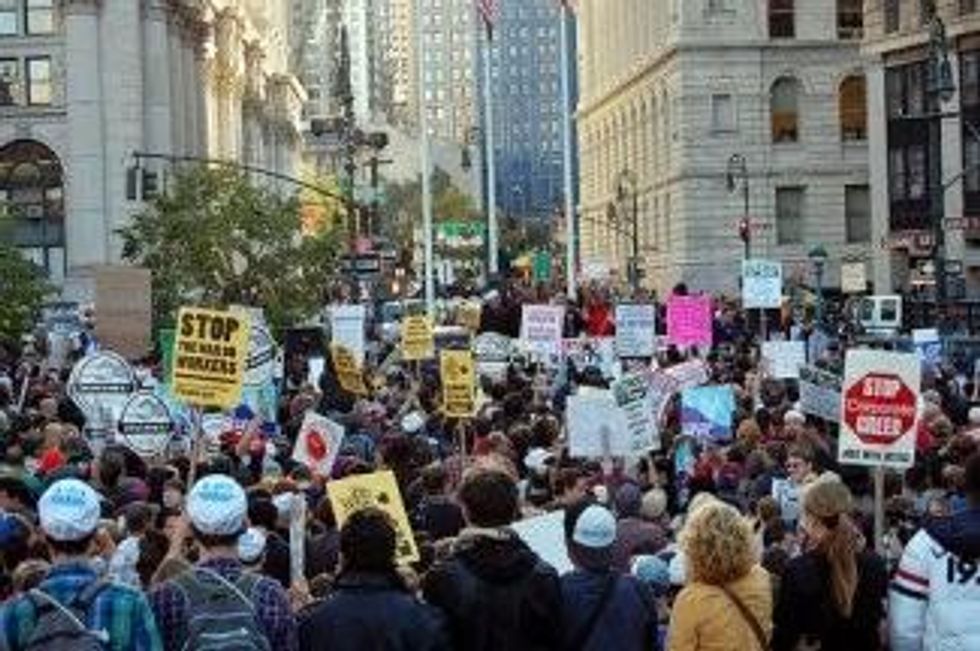
In some ways, Zuccotti Park, the campsite, the Ground Zero, for the Occupy Wall Street protests couldn't be more modest. It's no Tahrir Square, but a postage-stamp-sized plaza at the bottom of Manhattan only blocks from Wall Street. And if you arrive before noon, you're greeted not by vast crowds, but by air mattresses, a sea of blue and green tarps, a couple of information tables, some enthusiastic drummers, enough signs with slogans for anything you care to support ("Too big to fail is too big to allow," "The American Dream: You have to be asleep to believe it," "There's no state like no state," etc.), and small groups of polite, eager, well-organized young people, wandering, cleaning, doling out contributed food, dealing with the press, or sitting in circles on the concrete, backpacks strewn about, discussing. If it were the 1960s, it might easily be a hippie encampment.
But don't be fooled. Not only does the park begin to fill fast and the conversation become ever more animated, but this movement already spreading across the country (and even globally) looks like the real McCoy, something new and hopeful in degraded times. Of the demonstrators I spoke with, several had hitchhiked to New York -- one had simply quit her job -- to be present. Inspired by Tunisians, Egyptians, Spaniards, and Wisconsinites, in a country largely demobilized these last years, they recognized what matters when they saw it. As one young woman told me, "A lot of people in my generation felt we were going to witness something really big -- and I think this is it!"
It may be. The last time we saw a moment like this globally was 1968. (Other dates, like 1848 in Europe and 1919 in China, when the young took the lead in a previously dead world, also come to mind.) It's the moment when the blood stirs and the young, unable to bear the state of their country or the world, hit the streets with the urge to take the fate of humankind in their own hands.
It's always unexpected. No one predicted Tahrir Square. No one imagined tens of thousands of young Syrians, weaponless, facing the military might of the state. No one expected the protests in Wisconsin. No one, myself included, imagined that young Americans, so seemingly somnolent as things went from bad to worse, would launch such a spreading movement, and -- most important of all -- decide not to go home. (At the last demonstration I attended in New York City in the spring, the median age was probably 55.)
The Tea Party movement has, until now, gotten the headlines for its anger, in part because the well-funded right wing poured money into the Tea Party name, but it's an aging movement. Whatever it does, in pure actuarial terms it's likely to represent an ending, not a beginning. Occupy Wall Street could, on the other hand, be the beginning of something, even if no one in it knows what the future has in store or perhaps what their movement is all about -- a strength of theirs, by the way, not their weakness.
It's true, as many have pointed out, that they don't have a list of well thought out demands, but the demand to have such a list is just their elders trying to bring them to heel. The fact is, they don't have to know just what they're doing, any more than a writer or filmmaker has to understand the book being written or the film shot. It's not a necessity. It's not the price of admission. If there's one thing that's obvious and heartening, as my friend, the novelist Beverly Gologorsky, said to me while we oldsters circumnavigated the park, "The overwhelming feeling I have is that no one here is planning to go home any time soon."
Never have they been more needed. Theirs is certainly a movement, like the ones in the Middle East, inspired in part by economic disaster and aimed at an airless political as well as corporate/financial system controlled by the 1% left out of the signs in the park hailing the 99% of Americans whom Occupy Wall Street hopes to represent. It's a world set on screwing just about everyone in that vast cohort of Americans without compunction, shame, or even, these days, plausible deniability.
The young face a failing world -- and if you want the proof of just how thoroughly it's failed all of us in recent years, check out TomDispatch Associate Editor Andy Kroll's "Flat-Lining the Middle Class, Economic Numbers to Die For." Nowhere else can you find assembled such a range of evidence of an American world on the decline, one which doesn't work and shows no sign of being capable of righting itself.
If, on a planet in crisis, their government has repeatedly failed them, the Wall Street demonstrators deserve a small, hopeful cheer for their efforts. They may not be the perfect size and shape for the movement of everyone's dreams, but they're here and, right now, that says the world.
In some ways, Zuccotti Park, the campsite, the Ground Zero, for the Occupy Wall Street protests couldn't be more modest. It's no Tahrir Square, but a postage-stamp-sized plaza at the bottom of Manhattan only blocks from Wall Street. And if you arrive before noon, you're greeted not by vast crowds, but by air mattresses, a sea of blue and green tarps, a couple of information tables, some enthusiastic drummers, enough signs with slogans for anything you care to support ("Too big to fail is too big to allow," "The American Dream: You have to be asleep to believe it," "There's no state like no state," etc.), and small groups of polite, eager, well-organized young people, wandering, cleaning, doling out contributed food, dealing with the press, or sitting in circles on the concrete, backpacks strewn about, discussing. If it were the 1960s, it might easily be a hippie encampment.
But don't be fooled. Not only does the park begin to fill fast and the conversation become ever more animated, but this movement already spreading across the country (and even globally) looks like the real McCoy, something new and hopeful in degraded times. Of the demonstrators I spoke with, several had hitchhiked to New York -- one had simply quit her job -- to be present. Inspired by Tunisians, Egyptians, Spaniards, and Wisconsinites, in a country largely demobilized these last years, they recognized what matters when they saw it. As one young woman told me, "A lot of people in my generation felt we were going to witness something really big -- and I think this is it!"
It may be. The last time we saw a moment like this globally was 1968. (Other dates, like 1848 in Europe and 1919 in China, when the young took the lead in a previously dead world, also come to mind.) It's the moment when the blood stirs and the young, unable to bear the state of their country or the world, hit the streets with the urge to take the fate of humankind in their own hands.
It's always unexpected. No one predicted Tahrir Square. No one imagined tens of thousands of young Syrians, weaponless, facing the military might of the state. No one expected the protests in Wisconsin. No one, myself included, imagined that young Americans, so seemingly somnolent as things went from bad to worse, would launch such a spreading movement, and -- most important of all -- decide not to go home. (At the last demonstration I attended in New York City in the spring, the median age was probably 55.)
The Tea Party movement has, until now, gotten the headlines for its anger, in part because the well-funded right wing poured money into the Tea Party name, but it's an aging movement. Whatever it does, in pure actuarial terms it's likely to represent an ending, not a beginning. Occupy Wall Street could, on the other hand, be the beginning of something, even if no one in it knows what the future has in store or perhaps what their movement is all about -- a strength of theirs, by the way, not their weakness.
It's true, as many have pointed out, that they don't have a list of well thought out demands, but the demand to have such a list is just their elders trying to bring them to heel. The fact is, they don't have to know just what they're doing, any more than a writer or filmmaker has to understand the book being written or the film shot. It's not a necessity. It's not the price of admission. If there's one thing that's obvious and heartening, as my friend, the novelist Beverly Gologorsky, said to me while we oldsters circumnavigated the park, "The overwhelming feeling I have is that no one here is planning to go home any time soon."
Never have they been more needed. Theirs is certainly a movement, like the ones in the Middle East, inspired in part by economic disaster and aimed at an airless political as well as corporate/financial system controlled by the 1% left out of the signs in the park hailing the 99% of Americans whom Occupy Wall Street hopes to represent. It's a world set on screwing just about everyone in that vast cohort of Americans without compunction, shame, or even, these days, plausible deniability.
The young face a failing world -- and if you want the proof of just how thoroughly it's failed all of us in recent years, check out TomDispatch Associate Editor Andy Kroll's "Flat-Lining the Middle Class, Economic Numbers to Die For." Nowhere else can you find assembled such a range of evidence of an American world on the decline, one which doesn't work and shows no sign of being capable of righting itself.
If, on a planet in crisis, their government has repeatedly failed them, the Wall Street demonstrators deserve a small, hopeful cheer for their efforts. They may not be the perfect size and shape for the movement of everyone's dreams, but they're here and, right now, that says the world.
In some ways, Zuccotti Park, the campsite, the Ground Zero, for the Occupy Wall Street protests couldn't be more modest. It's no Tahrir Square, but a postage-stamp-sized plaza at the bottom of Manhattan only blocks from Wall Street. And if you arrive before noon, you're greeted not by vast crowds, but by air mattresses, a sea of blue and green tarps, a couple of information tables, some enthusiastic drummers, enough signs with slogans for anything you care to support ("Too big to fail is too big to allow," "The American Dream: You have to be asleep to believe it," "There's no state like no state," etc.), and small groups of polite, eager, well-organized young people, wandering, cleaning, doling out contributed food, dealing with the press, or sitting in circles on the concrete, backpacks strewn about, discussing. If it were the 1960s, it might easily be a hippie encampment.
But don't be fooled. Not only does the park begin to fill fast and the conversation become ever more animated, but this movement already spreading across the country (and even globally) looks like the real McCoy, something new and hopeful in degraded times. Of the demonstrators I spoke with, several had hitchhiked to New York -- one had simply quit her job -- to be present. Inspired by Tunisians, Egyptians, Spaniards, and Wisconsinites, in a country largely demobilized these last years, they recognized what matters when they saw it. As one young woman told me, "A lot of people in my generation felt we were going to witness something really big -- and I think this is it!"
It may be. The last time we saw a moment like this globally was 1968. (Other dates, like 1848 in Europe and 1919 in China, when the young took the lead in a previously dead world, also come to mind.) It's the moment when the blood stirs and the young, unable to bear the state of their country or the world, hit the streets with the urge to take the fate of humankind in their own hands.
It's always unexpected. No one predicted Tahrir Square. No one imagined tens of thousands of young Syrians, weaponless, facing the military might of the state. No one expected the protests in Wisconsin. No one, myself included, imagined that young Americans, so seemingly somnolent as things went from bad to worse, would launch such a spreading movement, and -- most important of all -- decide not to go home. (At the last demonstration I attended in New York City in the spring, the median age was probably 55.)
The Tea Party movement has, until now, gotten the headlines for its anger, in part because the well-funded right wing poured money into the Tea Party name, but it's an aging movement. Whatever it does, in pure actuarial terms it's likely to represent an ending, not a beginning. Occupy Wall Street could, on the other hand, be the beginning of something, even if no one in it knows what the future has in store or perhaps what their movement is all about -- a strength of theirs, by the way, not their weakness.
It's true, as many have pointed out, that they don't have a list of well thought out demands, but the demand to have such a list is just their elders trying to bring them to heel. The fact is, they don't have to know just what they're doing, any more than a writer or filmmaker has to understand the book being written or the film shot. It's not a necessity. It's not the price of admission. If there's one thing that's obvious and heartening, as my friend, the novelist Beverly Gologorsky, said to me while we oldsters circumnavigated the park, "The overwhelming feeling I have is that no one here is planning to go home any time soon."
Never have they been more needed. Theirs is certainly a movement, like the ones in the Middle East, inspired in part by economic disaster and aimed at an airless political as well as corporate/financial system controlled by the 1% left out of the signs in the park hailing the 99% of Americans whom Occupy Wall Street hopes to represent. It's a world set on screwing just about everyone in that vast cohort of Americans without compunction, shame, or even, these days, plausible deniability.
The young face a failing world -- and if you want the proof of just how thoroughly it's failed all of us in recent years, check out TomDispatch Associate Editor Andy Kroll's "Flat-Lining the Middle Class, Economic Numbers to Die For." Nowhere else can you find assembled such a range of evidence of an American world on the decline, one which doesn't work and shows no sign of being capable of righting itself.
If, on a planet in crisis, their government has repeatedly failed them, the Wall Street demonstrators deserve a small, hopeful cheer for their efforts. They may not be the perfect size and shape for the movement of everyone's dreams, but they're here and, right now, that says the world.