

SUBSCRIBE TO OUR FREE NEWSLETTER
Daily news & progressive opinion—funded by the people, not the corporations—delivered straight to your inbox.
5
#000000
#FFFFFF
To donate by check, phone, or other method, see our More Ways to Give page.
Daily news & progressive opinion—funded by the people, not the corporations—delivered straight to your inbox.
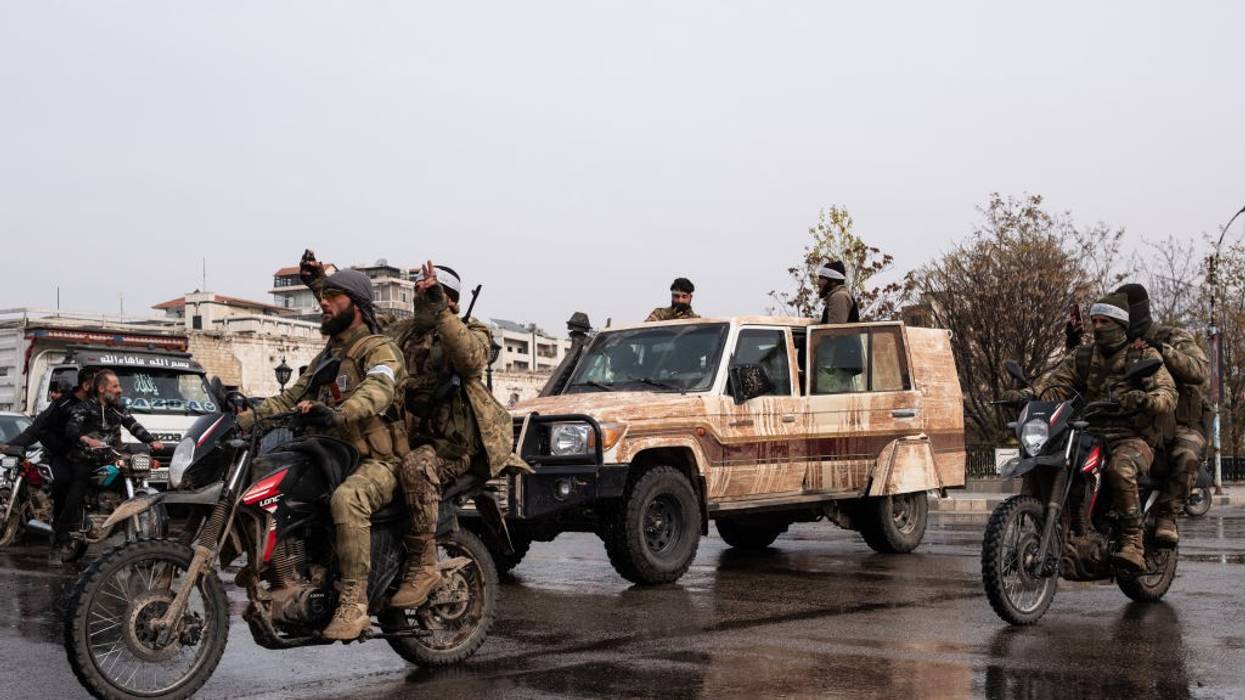
"Whether the Pentagon wants to admit it or not," U.S. troops "are likely involved in the broader conflict unfolding there right now," warned one analyst.
Syrian rebel groups' rapid advance on the nation's capital city of Damascus and the possible collapse of President Bashar al-Assad's government after more than a decade of civil war has brought renewed attention to the continued presence of U.S. forces in the country, despite the absence of a clear legal authorization.
The U.S. is believed to have around 900 troops deployed to Syria, mostly in the northeast, as well as an unknown number of private contractors. Nick Turse, a contributing writer for The Intercept, observed Thursday that American forces in Syria "have, on average, come under fire multiple times each week since last October," according to internal Pentagon statistics.
"Keeping military personnel in harm's way for the sake of foreign policy credibility has become increasingly risky with the Gaza war and the flare-up of the Syrian civil war," Turse wrote.
Kelley Vlahos, senior adviser to the Quincy Institute for Responsible Statecraft, wrote Saturday morning that "whether the Pentagon wants to admit it or not," U.S. troops "are likely involved in the broader conflict unfolding there right now."
Reuters reported Tuesday that as rebels advanced toward the city of Hama, "fighters from a U.S.-backed, Kurdish-led coalition battled government forces in the northeast, both sides said, opening a new front along a vital supply route" and "compounding Assad's problems."
As the coalition of groups led by the Islamist organization Hayat Tahrir al-Sham (HTS) and factions of the Turkey-backed Syrian National Army has quickly seized control of large swaths of territory, the White House National Security Council (NSC) said in a statement last weekend that the U.S.—which has previously armed and trained Syrian rebels—"has nothing to do with this offensive."
"The United States, together with its partners and allies, urge de-escalation, protection of civilians and minority groups, and a serious and credible political process that can end this civil war once and for all with a political settlement consistent with UNSCR 2254," said NSC spokesperson Sean Savett. "We will also continue to fully defend and protect U.S. personnel and U.S. military positions, which remain essential to ensuring that ISIS can never again resurge in Syria."
On Friday, the White House said in a letter to Congress that "a small presence of United States Armed Forces remains in strategically significant locations in Syria to conduct operations, in partnership with local, vetted ground forces, to address continuing terrorist threats emanating from Syria."
President-elect Donald Trump, who during his first term opted to keep U.S. troops in Syria for the openly stated purpose of exploiting the country's oil fields, wrote in a social media post on Saturday that "the United States should have nothing to do with" the current conflict.
"This is not our fight," he wrote in all caps. "Let it play out. Do not get involved!"
Trump's post, as The Associated Press reported, came as rebels' "stunning march across Syria gained speed... with news that they had reached the suburbs of the capital and with the government forced to deny rumors that President Bashar al-Assad had fled the country."
Hassan Abdul-Ghani, an insurgent commander, said in a Telegram post that rebels are entering the "final stage" of their offensive as they began to encircle Syria's capital. Citing unnamed local sources, Al Jazeera reported that "a state of panic has spread as army troops withdraw from their positions around Damascus."
"They also confirmed that opposition forces had advanced in the western Damascus countryside and the withdrawal of army forces from cities and towns in Eastern Ghouta," the outlet added. "There was a rush for food items in markets in the capital."
Government forces have been backed by Russian airstrikes, Hezbollah, and Iraqi militia fighters.
Reuters reported that "Iranian Foreign Minister Abbas Araqchi said in an Arabic-language interview that Tehran would consider sending troops to Syria if Damascus asked, and Russian President Vladimir Putin urged an end to 'terrorist aggression' in Syria."
In a video statement on Saturday, a Syrian military commander said that "our valiant army continues to carry out its operations against terrorist gatherings at high rates in the directions of the Hama and Homs countrysides and the northern Daraa countryside, inflicting hundreds of deaths and injuries on the terrorists."
Anti-war lawmakers in the U.S. have repeatedly questioned the role of American troops in Syria in recent years and launched efforts to force their withdrawal.
In March 2023, a bipartisan group of lawmakers in the U.S. House put forth a resolution that would have required full withdrawal of American forces from Syria within 180 days of passage in the absence of congressional action authorizing their continued presence.
The resolution was voted down by 170 Republicans and 150 Democrats.
Months later, the U.S. Senate tanked a similar effort.
Erik Sperling, executive director of the advocacy group Just Foreign Policy, told The Intercept on Thursday that the Biden administration hasn't "put the war in Syria up for debate because they know the American people don't want another war in the Middle East."
"They know there is no popular support for putting U.S. troops at risk for this," said Sperling, who warned that "many of Trump's advisers will try to drag him deeper into this regional conflict in the Middle East."
The explosion of Syria's civil war in recent days has been disastrous for civilians in the crossfire.
Human Rights Watch (HRW) said Wednesday that "the outbreak of major hostilities... raises concerns that civilians face a real risk of serious abuses at the hands of opposition armed groups and the Syrian government."
"The bloody record of atrocities by all parties to the conflict in Syria is bound to persist until leaders go beyond words and support accountability efforts," said Adam Coogle, HRW's deputy Middle East director. "Without credible justice, there will be no end in sight to the suffering Syrians have endured, no matter who controls the land."
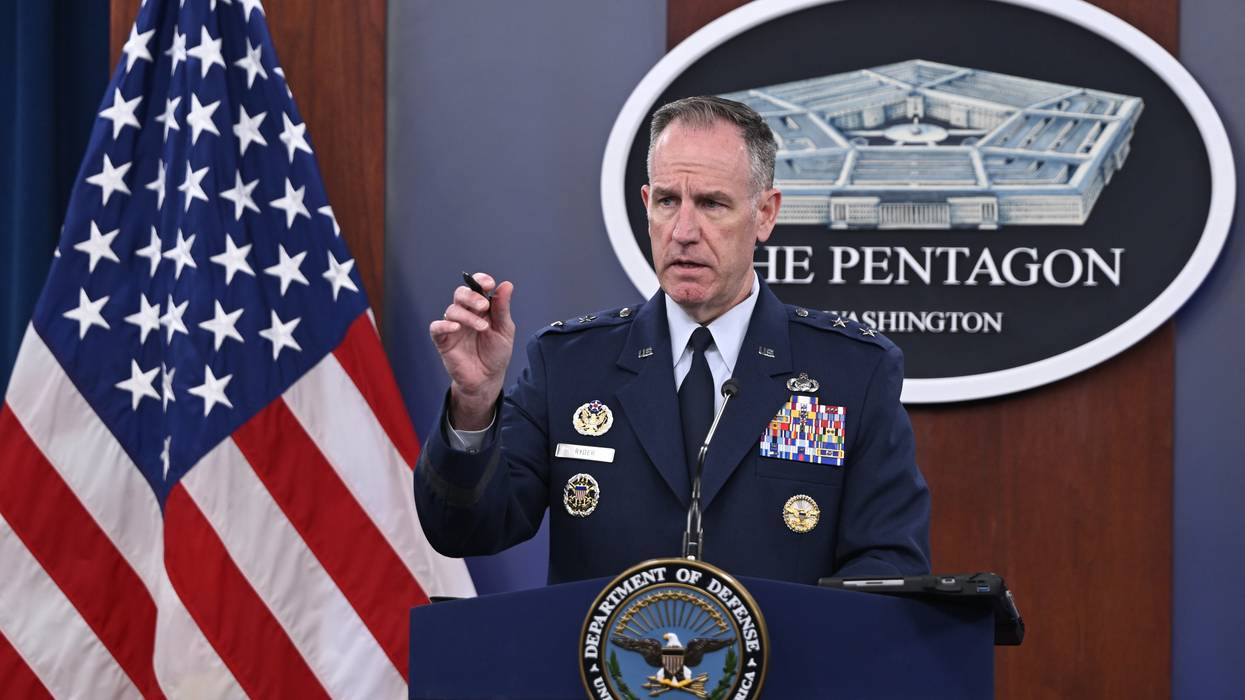
"Netanyahu is as close as he has ever been to his ultimate wish: making the U.S. fight Iran on Israel's behalf," wrote one journalist.
The Pentagon confirmed Sunday that it has authorized the deployment of an advanced antimissile system and around 100 U.S. troops to Israel as the Netanyahu government prepares to attack Iran—a move that's expected to provoke an Iranian response.
Maj. Gen. Pat Ryder, press secretary for the U.S. Defense Department, said in a statement that at President Joe Biden's direction, the Pentagon approved the "deployment of a Terminal High-Altitude Area Defense (THAAD) battery and associated crew of U.S. military personnel to Israel to help bolster Israel's air defenses" in the wake of Iran's ballistic missile attack earlier this month.
"The THAAD Battery will augment Israel's integrated air defense system," said Ryder. "This action underscores the United States' ironclad commitment to the defense of Israel, and to defend Americans in Israel, from any further ballistic missile attacks by Iran."
The Pentagon's statement came shortly after The Wall Street Journal and other outlets reported on the Biden administration's plans.
It is not clear when the U.S. troops are set to arrive in Israel. The U.S. currently has some 40,000 soldiers stationed across the Middle East.
"We risk becoming entangled in another catastrophic war that will inevitably harm innocent civilians and may cost billions of U.S. taxpayer dollars."
Iran fired roughly 200 ballistic missiles at Israel on October 1 in response to the assassinations of Hezbollah's leader and Hamas' political chief. Most of the Iranian missiles were shot down with the help of the U.S., whose Navy fired interceptors at the missiles.
Journalist Séamus Malekafzali argued the U.S. deployment of troops and the THAAD system shows that "the Israelis are clearly planning something for Iran that is going to cause a retaliation they know their own systems are unable to take."
"U.S. troops being deployed to Israel in this matter is seismic," Malekafzali added. "The U.S. military is now inextricably involved in this war, directly, without any illusions of barriers. Netanyahu is as close as he has ever been to his ultimate wish: making the U.S. fight Iran on Israel's behalf."
Israel's cabinet met Thursday to discuss a potential response to Iran's October 1 missile barrage. One unnamed Israeli source told The Times of Israel that "no big decisions" were made at the cabinet meeting. Speaking to reporters earlier this month, Biden said that U.S. and Israeli officials were "discussing" the possibility of an attack on Iranian oil infrastructure.
Iran has warned of a "crushing" response to any Israeli attack.
In a statement Sunday, progressive U.S. Reps. Pramila Jayapal (D-Wash.), Barbara Lee (D-Calif.), James McGovern (D-Mass.), and Greg Casar (D-Texas) said that "military force will not solve the challenge posed by Iran."
"We need meaningful de-escalation and diplomacy—not a wider war," the lawmakers added. "Nothing in current law authorizes the United States to conduct offensive military action against Iran. We risk becoming entangled in another catastrophic war that will inevitably harm innocent civilians and may cost billions of U.S. taxpayer dollars."
After President Obama announced on Monday that he would deploy 250 additional special operations troops to Syria, State Department spokesperson John Kirby tried to deny that Obama had ever promised not to send "boots on the ground" there.
"There was never this 'no boots on the ground,'" said Kirby. "I don't know where this keeps coming from."
After President Obama announced on Monday that he would deploy 250 additional special operations troops to Syria, State Department spokesperson John Kirby tried to deny that Obama had ever promised not to send "boots on the ground" there.
"There was never this 'no boots on the ground,'" said Kirby. "I don't know where this keeps coming from."
The problem for Kirby was that Obama had repeated the promise at least 16 times since 2013:
For instance, on August 30, 2013, Obama said: "We're not considering any boots-on-the-ground approach."
On September 10, 2013, he said: "Many of you have asked, won't this put us on a slippery slope to another war? One man wrote to me that we are 'still recovering from our involvement in Iraq.' A veteran put it more bluntly: 'This nation is sick and tired of war.' My answer is simple: I will not put American boots on the ground in Syria."
On September 7, 2014, he said: "In Syria, the boots on the ground have to be Syrian."
After reporters pointed out the mistake, Kirby tried to walk back his claim by defining the phrase "boots on the ground" to exclude special forces.
"When we talk about boots on the ground, in the context that you have heard people in the administration speak to, we are talking about conventional, large-scale ground troops," said Kirby. "I'm not disputing the fact that we have troops on the ground, and they're wearing boots."
The new deployment will result in a six-fold increase to the 50 U.S. special forces troops already in Syria. There are also 4,000 U.S. troops in Iraq. The White House has insisted that its forces "do not have a combat mission" and are deployed in an "advise and assist" capacity only, helping to train local militias that engage ISIS directly.
There is, as Kirby indicated, a distinction between a large-scale ground invasion and, say, a small group of advisers hanging back from the front. But the line between "combat" and "assist" missions is not always so clear.
Read the full article at The Intercept
The United States does not formally acknowledge the existence of Delta Force and rarely mentions the names of any of its members, even after they leave the service.
Unlike the SEALs, who seem to be prolific writers, Delta operators keep to themselves. Most of the unit's actions abroad are never mentioned publicly, and when an operator is killed in combat, often the death goes unmentioned in the press, or attributed sometime later to a training accident.
So the very public attention given at the highest levels in Washington to the combat death of Master Sergeant Joshua Wheeler was more than a little significant.
Wheeler was not only acknowledged as having fought with Delta, but his photo was widely published. That is usually a no-no, for fear of linking him to others and outing active duty Delta. His place of death, on the ground, deep inside Iraq, on a strike mission, was explicit, with only a little b.s. thrown in about how Delta was present to provide security for the Kurdish raiding forces seeking to free some hostages. Well, well, nobody in their right mind believes America's finest special forces are sent out to provide security for a bunch of gussied-up militiamen.
That all within the context that the president of the United States has made it explicit that his war against Islamic State would not involve any American "boots on the ground." Well, Sergeant Wheeler was an example of boots on the ground. There were an awful lot of reasons to have said nothing about Wheeler, and instead much has been said.
So why all the public attention to Wheeler's death, and why now?
One reason stands out: we, the public, are being readied for a larger U.S. combat role in Iraq and Syria, one big enough that it will be hard to keep hidden.
The circumstances of Wheeler's death are picture-perfect for such a plan. He was a revered hero simply by the nature of the unit he served with. He was fighting with about the only competent and pro-American force left in the Middle East, the Kurds. He was fighting the most evil enemy of America (for now), the Islamic State. He was on a successful rescue mission; hostages were freed, prisoners released, some IS bad guys dispatched. And the whole thing was conveniently videotaped -- a videotaped special forces raid. How often do you see that? You don't.
The whole could not be more palatable to an American public, perhaps just a little bit weary of war in the Middle East.
Now hear this: in an "exclusive," meaning the entire story was handed intact to a single reporter to jot down and print, The Hill reports "top leaders at the Pentagon are considering a range of options to bolster the military campaign against the Islamic State in Iraq and Syria (ISIS), including embedding some U.S. troops with Iraqi forces... A second option sent to Pentagon leaders would embed U.S. forces with Iraqis closer to the battlefield, at the level of a brigade or a battalion. Some of the options sent to Pentagon leaders would entail high risk for U.S. troops in Iraq and require more personnel."
Timing? Couldn't be better. Defense Secretary Ashton Carter and Chairman of the Joint Chiefs of Staff Marine General Joseph Dunford (himself just back from Iraq) will discuss the options when they testify today, October 27, in front of the Senate Armed Services Committee. They will no doubt raise Wheeler's name.
I don't like to traffic in conspiracy theories, but if you can put these pieces together in another way without having to use the word "coincidence" a couple of times, I'd be interested in what you have to say. Otherwise, hang on, the United States is doubling down in the quagmire of Iraq. Again.
The U.S. Department of Defense announced on Tuesday that it is indeed planning to bring tanks and other heavy weaponry to Russia's doorstep, in a move observers say is likely to further stoke Cold War tensions as NATO regional war games commence.
Speaking in Tallinn, Estonia, U.S. Secretary of Defense Ashton Carter said the Pentagon would fortify the Baltic states—Estonia, Lithuania, and Latvia—as well as Bulgaria, Romania, and Poland, each with a military arsenal large enough to support 150 to 750 troops.
"The U.S. decision to stage heavy equipment closer to Russia's borders aims to speed deployment of rotating U.S. forces," Reuters reports.
Rumors of the pending mobilization were first reported earlier this month when anonymous military officials revealed the plan to pre-position 250 tanks, infantry fighting vehicles, and self-propelled howitzers in a bid to "reassure" NATO countries and likely intimidate Russia amidst growing regional tensions.
Russian defense ministry official General Yuri Yakubov said last week that such a move would be interpreted as a clear provocation from the U.S. "If heavy U.S. military equipment, including tanks, artillery batteries, and other equipment really does turn up in countries in Eastern Europe and the Baltics, that will be the most aggressive step by the Pentagon and NATO since the Cold War," he said, according to the Interfax news agency.
During his European trip this week, Carter also announced that the U.S. would provide NATO's new "rapid reaction force" with "intelligence and surveillance capabilities, special operations forces, logistics, transport aircraft, and a range of weapons support that could include bombers, fighters, and ship-based missiles."
According to anonymous officials, the force, which would be activated in the event of a regional "crisis," may also include mobilizing U.S. troops.
AP reports:
No final decisions have been made on the number of troops that could participate, or where they could come from.
The officials said many of the forces could come from among the 65,000 U.S. military personnel already stationed in Europe.
But the plan could result in a temporary increase in U.S. forces in Europe in the event of a crisis, said U.S. officials, who spoke on condition of anonymity because they weren't authorized to discuss details of the agreement publicly.
No U.S. troops or equipment will move immediately, but instead they would be made available within 48-72 hours if requested, and approved by American leaders, in response to a crisis.
The announcements come as Eastern European NATO countries began a series of months-long military exercises designed to "demonstrate their readiness to confront Russia." Later this week, Carter is expected to meet with European defense ministers in Brussels to discuss the military escalation.