SUBSCRIBE TO OUR FREE NEWSLETTER
Daily news & progressive opinion—funded by the people, not the corporations—delivered straight to your inbox.
5
#000000
#FFFFFF
To donate by check, phone, or other method, see our More Ways to Give page.
Daily news & progressive opinion—funded by the people, not the corporations—delivered straight to your inbox.
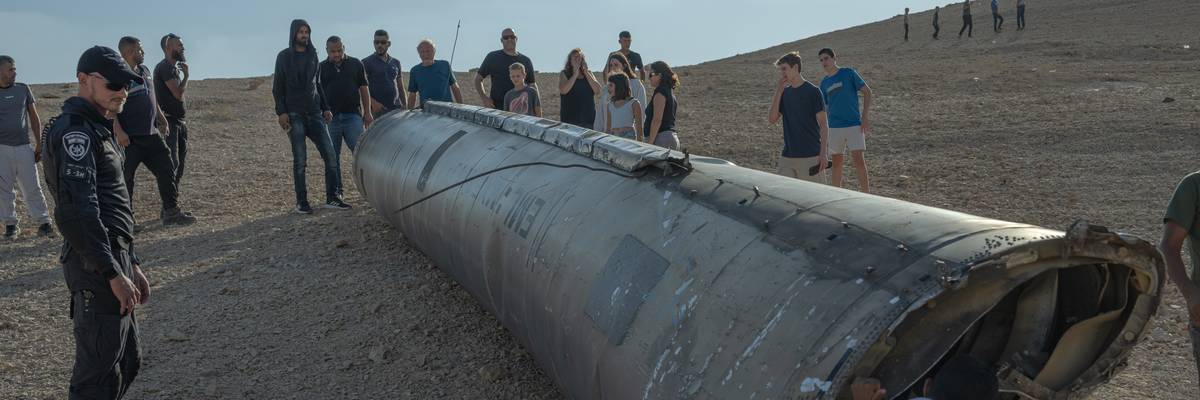
A group of people look at the remains of a missile on October 2, 2024 near the Dead Sea, Israel.
Some supporters of Israel, said one observer, "are so enamored by war crimes they seem to think the entire purpose of retaliatory action is to kill civilians rather than target military infrastructure."
Iran's armed forces on Tuesday night said it had hit its intended military targets with its ballistic missile strikes in Israel, and dismissed Israeli and U.S. claims that the operation was a failure—claims that critics said displayed the view of Israel and its biggest military funder that civilian casualties are an acceptable part of warfare.
Maj. Gen. Mohammad Bagheri, chief of staff of the Islamic Revolutionary Guard Corps, said that Israel's three main airbases, radar sites, armored Israel Defense Forces (IDF) vehicles around the Gaza Strip, and the headquarters of Mossad, the Israeli intelligence agency, were among the targets.
"Only military sites were targeted. If Israel is not contained by U.S. and Europe, and takes action against our sovereignty and territorial integrity, tonight's operation will be repeated in much greater size," said Bagheri.
Sameh al-Asali, a Palestinian laborer from Gaza who was in the West Bank city of Jericho, was hit by a missile fragment and killed.
The missile strikes were carried out in retaliation for Israel's killing of Hezbollah leader Hassan Nasrallah and as a warning to Israel not to escalate against Iran. They followed the IDF's invasion of Lebanon in a widening conflict that began last year after Israel retaliated for a Hamas-led attack on October 7, 2023 by launching a full-scale assault on Gaza as well as numerous attacks on the West Bank.
While downplaying the effectiveness of Iran's missile barrage, the U.S. and Israel also classified the attack as a "significant escalation," with Israeli Prime Minister Benjamin Netanyahu saying Iran had "made a big mistake... and it will pay for it."
Israel vowed to respond to the attack, with IDF spokesperson Lt. Col. Peter Lerner saying, "There will be consequences."
Iranian government spokesperson Fatemeh Mohajerani said Iran's military actions had been taken in self-defense and were carried out "within national interests and in line with international regulations."
Israel has been accused of blatantly violating international humanitarian law in Gaza by targeting civilian infrastructure and collectively punishing the population of 2.3 million people with what United Nations experts have called a "targeted starvation campaign." Netanyahu's government faces a genocide case brought by South Africa and other countries at the International Court of Justice, and has been ordered by the court to protect civilians in Gaza.
Philip Proudfoot, an anthropologist and researcher at the Institute of Development Studies at the University of Sussex in the United Kingdom, said supporters of Israel seemed to see the lack of Israeli civilian casualties from Iran's attack on Tuesday as worthy of mockery rather than evidence of a targeted and strategic military strike.
"These are people are so enamored by war crimes they seem to think the entire purpose of retaliatory action is to kill civilians rather than target military infrastructure," said Proudfoot. "Iran warned of the impending response, targeted military infrastructure, didn't kill a single Israeli civilian, and demonstrated that the Iron Dome is not impervious, restoring a sense of regional deterrence. I don't see why Tehran would see this as a failure."
In the 24 hours after Iran's missile strikes, Gaza's Health Ministry reported on Wednesday that 51 people in the enclave were killed in Israeli attacks, including at least nine at the Muscat School and the Al-Amal Orphanage in Gaza City. Israel said the school and orphanage were being used as Hamas command centers—a frequent claim the IDF has used to rationalize its attacks on civilian infrastructure and residential areas while blaming Hamas for civilian casualties that result.
CNN reporter Jim Sciutto noted Tuesday that Mossad's headquarters is in a "densely populated area" of Tel Aviv, and said the targeting of the building added "one more layer of escalation."
"This really brings rampant, shameless Western media racism to the fore," said U.K. journalist Owen Jones. "If that was a Hamas or Hezbollah target, 'human shields' is exactly what we'd hear."
Dear Common Dreams reader, It’s been nearly 30 years since I co-founded Common Dreams with my late wife, Lina Newhouser. We had the radical notion that journalism should serve the public good, not corporate profits. It was clear to us from the outset what it would take to build such a project. No paid advertisements. No corporate sponsors. No millionaire publisher telling us what to think or do. Many people said we wouldn't last a year, but we proved those doubters wrong. Together with a tremendous team of journalists and dedicated staff, we built an independent media outlet free from the constraints of profits and corporate control. Our mission has always been simple: To inform. To inspire. To ignite change for the common good. Building Common Dreams was not easy. Our survival was never guaranteed. When you take on the most powerful forces—Wall Street greed, fossil fuel industry destruction, Big Tech lobbyists, and uber-rich oligarchs who have spent billions upon billions rigging the economy and democracy in their favor—the only bulwark you have is supporters who believe in your work. But here’s the urgent message from me today. It's never been this bad out there. And it's never been this hard to keep us going. At the very moment Common Dreams is most needed, the threats we face are intensifying. We need your support now more than ever. We don't accept corporate advertising and never will. We don't have a paywall because we don't think people should be blocked from critical news based on their ability to pay. Everything we do is funded by the donations of readers like you. When everyone does the little they can afford, we are strong. But if that support retreats or dries up, so do we. Will you donate now to make sure Common Dreams not only survives but thrives? —Craig Brown, Co-founder |
Iran's armed forces on Tuesday night said it had hit its intended military targets with its ballistic missile strikes in Israel, and dismissed Israeli and U.S. claims that the operation was a failure—claims that critics said displayed the view of Israel and its biggest military funder that civilian casualties are an acceptable part of warfare.
Maj. Gen. Mohammad Bagheri, chief of staff of the Islamic Revolutionary Guard Corps, said that Israel's three main airbases, radar sites, armored Israel Defense Forces (IDF) vehicles around the Gaza Strip, and the headquarters of Mossad, the Israeli intelligence agency, were among the targets.
"Only military sites were targeted. If Israel is not contained by U.S. and Europe, and takes action against our sovereignty and territorial integrity, tonight's operation will be repeated in much greater size," said Bagheri.
Sameh al-Asali, a Palestinian laborer from Gaza who was in the West Bank city of Jericho, was hit by a missile fragment and killed.
The missile strikes were carried out in retaliation for Israel's killing of Hezbollah leader Hassan Nasrallah and as a warning to Israel not to escalate against Iran. They followed the IDF's invasion of Lebanon in a widening conflict that began last year after Israel retaliated for a Hamas-led attack on October 7, 2023 by launching a full-scale assault on Gaza as well as numerous attacks on the West Bank.
While downplaying the effectiveness of Iran's missile barrage, the U.S. and Israel also classified the attack as a "significant escalation," with Israeli Prime Minister Benjamin Netanyahu saying Iran had "made a big mistake... and it will pay for it."
Israel vowed to respond to the attack, with IDF spokesperson Lt. Col. Peter Lerner saying, "There will be consequences."
Iranian government spokesperson Fatemeh Mohajerani said Iran's military actions had been taken in self-defense and were carried out "within national interests and in line with international regulations."
Israel has been accused of blatantly violating international humanitarian law in Gaza by targeting civilian infrastructure and collectively punishing the population of 2.3 million people with what United Nations experts have called a "targeted starvation campaign." Netanyahu's government faces a genocide case brought by South Africa and other countries at the International Court of Justice, and has been ordered by the court to protect civilians in Gaza.
Philip Proudfoot, an anthropologist and researcher at the Institute of Development Studies at the University of Sussex in the United Kingdom, said supporters of Israel seemed to see the lack of Israeli civilian casualties from Iran's attack on Tuesday as worthy of mockery rather than evidence of a targeted and strategic military strike.
"These are people are so enamored by war crimes they seem to think the entire purpose of retaliatory action is to kill civilians rather than target military infrastructure," said Proudfoot. "Iran warned of the impending response, targeted military infrastructure, didn't kill a single Israeli civilian, and demonstrated that the Iron Dome is not impervious, restoring a sense of regional deterrence. I don't see why Tehran would see this as a failure."
In the 24 hours after Iran's missile strikes, Gaza's Health Ministry reported on Wednesday that 51 people in the enclave were killed in Israeli attacks, including at least nine at the Muscat School and the Al-Amal Orphanage in Gaza City. Israel said the school and orphanage were being used as Hamas command centers—a frequent claim the IDF has used to rationalize its attacks on civilian infrastructure and residential areas while blaming Hamas for civilian casualties that result.
CNN reporter Jim Sciutto noted Tuesday that Mossad's headquarters is in a "densely populated area" of Tel Aviv, and said the targeting of the building added "one more layer of escalation."
"This really brings rampant, shameless Western media racism to the fore," said U.K. journalist Owen Jones. "If that was a Hamas or Hezbollah target, 'human shields' is exactly what we'd hear."
Iran's armed forces on Tuesday night said it had hit its intended military targets with its ballistic missile strikes in Israel, and dismissed Israeli and U.S. claims that the operation was a failure—claims that critics said displayed the view of Israel and its biggest military funder that civilian casualties are an acceptable part of warfare.
Maj. Gen. Mohammad Bagheri, chief of staff of the Islamic Revolutionary Guard Corps, said that Israel's three main airbases, radar sites, armored Israel Defense Forces (IDF) vehicles around the Gaza Strip, and the headquarters of Mossad, the Israeli intelligence agency, were among the targets.
"Only military sites were targeted. If Israel is not contained by U.S. and Europe, and takes action against our sovereignty and territorial integrity, tonight's operation will be repeated in much greater size," said Bagheri.
Sameh al-Asali, a Palestinian laborer from Gaza who was in the West Bank city of Jericho, was hit by a missile fragment and killed.
The missile strikes were carried out in retaliation for Israel's killing of Hezbollah leader Hassan Nasrallah and as a warning to Israel not to escalate against Iran. They followed the IDF's invasion of Lebanon in a widening conflict that began last year after Israel retaliated for a Hamas-led attack on October 7, 2023 by launching a full-scale assault on Gaza as well as numerous attacks on the West Bank.
While downplaying the effectiveness of Iran's missile barrage, the U.S. and Israel also classified the attack as a "significant escalation," with Israeli Prime Minister Benjamin Netanyahu saying Iran had "made a big mistake... and it will pay for it."
Israel vowed to respond to the attack, with IDF spokesperson Lt. Col. Peter Lerner saying, "There will be consequences."
Iranian government spokesperson Fatemeh Mohajerani said Iran's military actions had been taken in self-defense and were carried out "within national interests and in line with international regulations."
Israel has been accused of blatantly violating international humanitarian law in Gaza by targeting civilian infrastructure and collectively punishing the population of 2.3 million people with what United Nations experts have called a "targeted starvation campaign." Netanyahu's government faces a genocide case brought by South Africa and other countries at the International Court of Justice, and has been ordered by the court to protect civilians in Gaza.
Philip Proudfoot, an anthropologist and researcher at the Institute of Development Studies at the University of Sussex in the United Kingdom, said supporters of Israel seemed to see the lack of Israeli civilian casualties from Iran's attack on Tuesday as worthy of mockery rather than evidence of a targeted and strategic military strike.
"These are people are so enamored by war crimes they seem to think the entire purpose of retaliatory action is to kill civilians rather than target military infrastructure," said Proudfoot. "Iran warned of the impending response, targeted military infrastructure, didn't kill a single Israeli civilian, and demonstrated that the Iron Dome is not impervious, restoring a sense of regional deterrence. I don't see why Tehran would see this as a failure."
In the 24 hours after Iran's missile strikes, Gaza's Health Ministry reported on Wednesday that 51 people in the enclave were killed in Israeli attacks, including at least nine at the Muscat School and the Al-Amal Orphanage in Gaza City. Israel said the school and orphanage were being used as Hamas command centers—a frequent claim the IDF has used to rationalize its attacks on civilian infrastructure and residential areas while blaming Hamas for civilian casualties that result.
CNN reporter Jim Sciutto noted Tuesday that Mossad's headquarters is in a "densely populated area" of Tel Aviv, and said the targeting of the building added "one more layer of escalation."
"This really brings rampant, shameless Western media racism to the fore," said U.K. journalist Owen Jones. "If that was a Hamas or Hezbollah target, 'human shields' is exactly what we'd hear."