SUBSCRIBE TO OUR FREE NEWSLETTER
Daily news & progressive opinion—funded by the people, not the corporations—delivered straight to your inbox.
5
#000000
#FFFFFF
To donate by check, phone, or other method, see our More Ways to Give page.
Daily news & progressive opinion—funded by the people, not the corporations—delivered straight to your inbox.
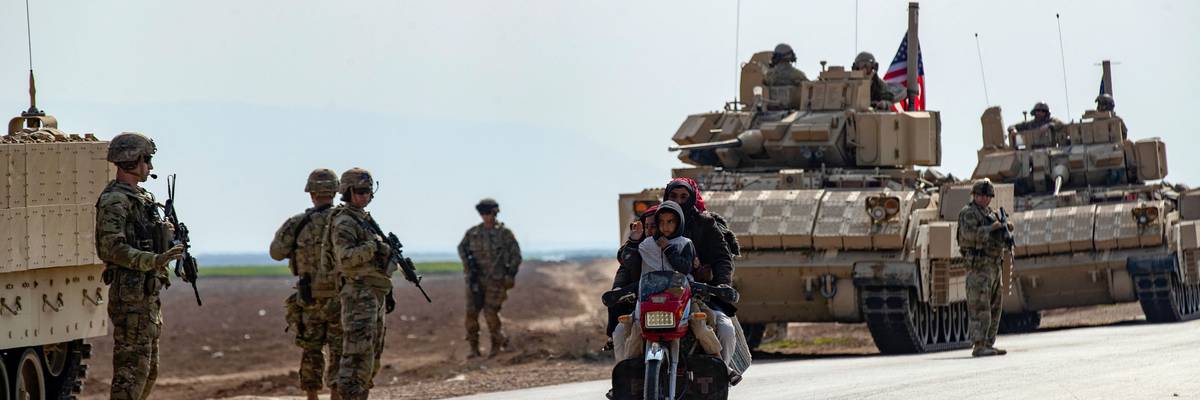
Members of a family ride a motorcycle as a U.S. military convoy patrols the area near the town of Tal Hamis, southeast of the city of Qameshli in Syria's northeastern Hasakeh governorate on January 26, 2023.
House Minority Leader Hakeem Jeffries and Speaker Kevin McCarthy were among the no votes on the resolution led by Rep. Matt Gaetz and backed by progressives.
More than 170 House Republicans and 150 Democrats teamed up Wednesday to defeat a resolution aimed at withdrawing all remaining U.S. troops from Syria, a proposal led by right-wing Rep. Matt Gaetz and supported by members of the Congressional Progressive Caucus.
The measure, just the latest House push to bring the nation's yearslong military presence in Syria to an end, failed by a vote of 103 to 321, with Democratic House Minority Leader Hakeem Jeffries of New York and Republican Speaker Kevin McCarthy of California among the no votes.
The resolution would have required the president to remove 900-plus U.S. troops from Syria within 180 days of passage, barring congressional action to authorize their continued presence.
Opponents of the resolution who support prolonging the occupation echoed the Pentagon claim that U.S. forces are needed in Syria to prevent a resurgence of ISIS and to ensure "stability" in the region.
"Either we fight 'em in Syria, or we'll fight 'em here," said Republican Rep. Ryan Zinke of Montana.
While lamenting the proposal's defeat, peace advocates noted that it garnered more Republican support than any previous war powers resolution, with 47 GOP yes votes. Fifty-six House Democrats—including Reps. Ilhan Omar of Minnesota, Ro Khanna of California, Alexandria Ocasio-Cortez of New York, and Cori Bush of Missouri—voted for the resolution.
“There is a new generation of thinking on two central issues," Khanna told The Intercept following Wednesday's vote. "A concern about wars and entanglements over the last 20 years that have not made us safer, and a concern over the offshoring of our domestic production over bad trade deals that have left the working class and middle class poorer."
"I believe that this new generation of political leaders can help fix those two mistakes that the country has made, and that there is an emerging consensus that we should not have our troops fighting overseas without congressional authorization," Khanna added. "If the president wants to make the case for a certain presence that is required for America to protect the Kurds, then he should come to Congress and work with us to make that case."
As The Intercept's Ryan Grim and Daniel Boguslaw noted, "the legal rationale for U.S. occupation" of Syria is "dubious at best."
Opponents of the Syria war powers resolution, including Zinke, pointed to the 2001 Authorization for Use of Military Force (AUMF)—a law that U.S. presidents have cited to give legal cover for airstrikes and ground operations in Afghanistan, Iraq, Yemen, Somalia, and elsewhere.
"With ISIS suppressed," Grim and Boguslaw wrote, the Biden administration "has suggested the purpose of the occupation is to act as a bulwark against Iran."
Pointing to U.S. officials' claim that the presence of American troops prevents Iranian forces from establishing a "land bridge" to shuttle weapons to allies in Lebanon, Grim and Boguslaw observed that Iran "already has a direct 'land bridge' through eastern Syria to Lebanon; the U.S. occupation merely adds some time to the Iranian truckers' journey."
Critics of the U.S. troop presence in Syria have stressed that Congress did not specifically authorize a military operation to confront "Iran-backed militias" in Syria.
Dear Common Dreams reader, It’s been nearly 30 years since I co-founded Common Dreams with my late wife, Lina Newhouser. We had the radical notion that journalism should serve the public good, not corporate profits. It was clear to us from the outset what it would take to build such a project. No paid advertisements. No corporate sponsors. No millionaire publisher telling us what to think or do. Many people said we wouldn't last a year, but we proved those doubters wrong. Together with a tremendous team of journalists and dedicated staff, we built an independent media outlet free from the constraints of profits and corporate control. Our mission has always been simple: To inform. To inspire. To ignite change for the common good. Building Common Dreams was not easy. Our survival was never guaranteed. When you take on the most powerful forces—Wall Street greed, fossil fuel industry destruction, Big Tech lobbyists, and uber-rich oligarchs who have spent billions upon billions rigging the economy and democracy in their favor—the only bulwark you have is supporters who believe in your work. But here’s the urgent message from me today. It's never been this bad out there. And it's never been this hard to keep us going. At the very moment Common Dreams is most needed, the threats we face are intensifying. We need your support now more than ever. We don't accept corporate advertising and never will. We don't have a paywall because we don't think people should be blocked from critical news based on their ability to pay. Everything we do is funded by the donations of readers like you. When everyone does the little they can afford, we are strong. But if that support retreats or dries up, so do we. Will you donate now to make sure Common Dreams not only survives but thrives? —Craig Brown, Co-founder |
More than 170 House Republicans and 150 Democrats teamed up Wednesday to defeat a resolution aimed at withdrawing all remaining U.S. troops from Syria, a proposal led by right-wing Rep. Matt Gaetz and supported by members of the Congressional Progressive Caucus.
The measure, just the latest House push to bring the nation's yearslong military presence in Syria to an end, failed by a vote of 103 to 321, with Democratic House Minority Leader Hakeem Jeffries of New York and Republican Speaker Kevin McCarthy of California among the no votes.
The resolution would have required the president to remove 900-plus U.S. troops from Syria within 180 days of passage, barring congressional action to authorize their continued presence.
Opponents of the resolution who support prolonging the occupation echoed the Pentagon claim that U.S. forces are needed in Syria to prevent a resurgence of ISIS and to ensure "stability" in the region.
"Either we fight 'em in Syria, or we'll fight 'em here," said Republican Rep. Ryan Zinke of Montana.
While lamenting the proposal's defeat, peace advocates noted that it garnered more Republican support than any previous war powers resolution, with 47 GOP yes votes. Fifty-six House Democrats—including Reps. Ilhan Omar of Minnesota, Ro Khanna of California, Alexandria Ocasio-Cortez of New York, and Cori Bush of Missouri—voted for the resolution.
“There is a new generation of thinking on two central issues," Khanna told The Intercept following Wednesday's vote. "A concern about wars and entanglements over the last 20 years that have not made us safer, and a concern over the offshoring of our domestic production over bad trade deals that have left the working class and middle class poorer."
"I believe that this new generation of political leaders can help fix those two mistakes that the country has made, and that there is an emerging consensus that we should not have our troops fighting overseas without congressional authorization," Khanna added. "If the president wants to make the case for a certain presence that is required for America to protect the Kurds, then he should come to Congress and work with us to make that case."
As The Intercept's Ryan Grim and Daniel Boguslaw noted, "the legal rationale for U.S. occupation" of Syria is "dubious at best."
Opponents of the Syria war powers resolution, including Zinke, pointed to the 2001 Authorization for Use of Military Force (AUMF)—a law that U.S. presidents have cited to give legal cover for airstrikes and ground operations in Afghanistan, Iraq, Yemen, Somalia, and elsewhere.
"With ISIS suppressed," Grim and Boguslaw wrote, the Biden administration "has suggested the purpose of the occupation is to act as a bulwark against Iran."
Pointing to U.S. officials' claim that the presence of American troops prevents Iranian forces from establishing a "land bridge" to shuttle weapons to allies in Lebanon, Grim and Boguslaw observed that Iran "already has a direct 'land bridge' through eastern Syria to Lebanon; the U.S. occupation merely adds some time to the Iranian truckers' journey."
Critics of the U.S. troop presence in Syria have stressed that Congress did not specifically authorize a military operation to confront "Iran-backed militias" in Syria.
More than 170 House Republicans and 150 Democrats teamed up Wednesday to defeat a resolution aimed at withdrawing all remaining U.S. troops from Syria, a proposal led by right-wing Rep. Matt Gaetz and supported by members of the Congressional Progressive Caucus.
The measure, just the latest House push to bring the nation's yearslong military presence in Syria to an end, failed by a vote of 103 to 321, with Democratic House Minority Leader Hakeem Jeffries of New York and Republican Speaker Kevin McCarthy of California among the no votes.
The resolution would have required the president to remove 900-plus U.S. troops from Syria within 180 days of passage, barring congressional action to authorize their continued presence.
Opponents of the resolution who support prolonging the occupation echoed the Pentagon claim that U.S. forces are needed in Syria to prevent a resurgence of ISIS and to ensure "stability" in the region.
"Either we fight 'em in Syria, or we'll fight 'em here," said Republican Rep. Ryan Zinke of Montana.
While lamenting the proposal's defeat, peace advocates noted that it garnered more Republican support than any previous war powers resolution, with 47 GOP yes votes. Fifty-six House Democrats—including Reps. Ilhan Omar of Minnesota, Ro Khanna of California, Alexandria Ocasio-Cortez of New York, and Cori Bush of Missouri—voted for the resolution.
“There is a new generation of thinking on two central issues," Khanna told The Intercept following Wednesday's vote. "A concern about wars and entanglements over the last 20 years that have not made us safer, and a concern over the offshoring of our domestic production over bad trade deals that have left the working class and middle class poorer."
"I believe that this new generation of political leaders can help fix those two mistakes that the country has made, and that there is an emerging consensus that we should not have our troops fighting overseas without congressional authorization," Khanna added. "If the president wants to make the case for a certain presence that is required for America to protect the Kurds, then he should come to Congress and work with us to make that case."
As The Intercept's Ryan Grim and Daniel Boguslaw noted, "the legal rationale for U.S. occupation" of Syria is "dubious at best."
Opponents of the Syria war powers resolution, including Zinke, pointed to the 2001 Authorization for Use of Military Force (AUMF)—a law that U.S. presidents have cited to give legal cover for airstrikes and ground operations in Afghanistan, Iraq, Yemen, Somalia, and elsewhere.
"With ISIS suppressed," Grim and Boguslaw wrote, the Biden administration "has suggested the purpose of the occupation is to act as a bulwark against Iran."
Pointing to U.S. officials' claim that the presence of American troops prevents Iranian forces from establishing a "land bridge" to shuttle weapons to allies in Lebanon, Grim and Boguslaw observed that Iran "already has a direct 'land bridge' through eastern Syria to Lebanon; the U.S. occupation merely adds some time to the Iranian truckers' journey."
Critics of the U.S. troop presence in Syria have stressed that Congress did not specifically authorize a military operation to confront "Iran-backed militias" in Syria.