SUBSCRIBE TO OUR FREE NEWSLETTER
Daily news & progressive opinion—funded by the people, not the corporations—delivered straight to your inbox.
5
#000000
#FFFFFF
To donate by check, phone, or other method, see our More Ways to Give page.
Daily news & progressive opinion—funded by the people, not the corporations—delivered straight to your inbox.
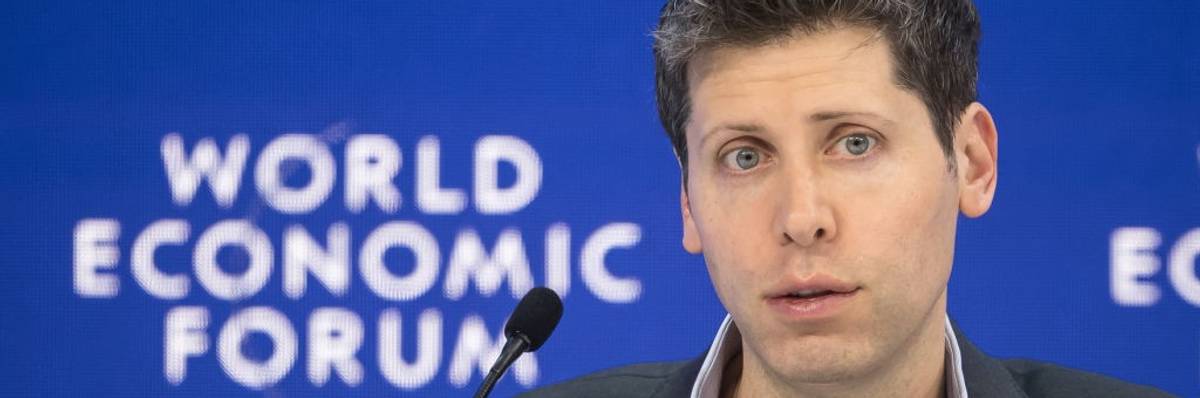
OpenAI CEO Sam Altman attends a session of the World Economic Forum (WEF) meeting in Davos on January 18, 2024.
The media outlets claim the company violated copyright laws.
The Intercept, Raw Story, and Alternet joined forces on Wednesday to sue OpenAI for using copyrighted content to train its generative artificial intelligence tool ChatGPT.
The law firm Loevy + Loevy is representing the publications, and it has filed the lawsuit in the Southern District of New York. The firm claims OpenAI violated the Digital Millennium Copyright Act (DMCA) by using copyrighted content from news organizations to train ChatGPT.
"Had OpenAI trained ChatGPT using these works as they were published, including author, title, and copyright information, ChatGPT may have learned to respect third-party copyrights, or at least inform ChatGPT users that it was providing responses that were based on the copyrighted works of others. Instead, OpenAI removed that information from its ChatGPT training sets, in violation of the DMCA," the firm said in a statement.
NEWS: @RawStory is suing @OpenAI, creator of #ChatGPT.
“I think it's time for tech companies to be proactive in compensating publishers for their work,” Raw Story CEO @JohnByrnester told @corbinbolies of @TheDailyBeasthttps://t.co/dVX1q1qsvA
— Raw Story (@RawStory) February 28, 2024
OpenAI is facing multiple lawsuits over its use of copyrighted material, including from comedian Sarah Silverman and The New York Times. The Times lawsuit also references violations of the DMCA. OpenAI recently claimed the Times "hacked" ChatGPT to get it to reproduce its copyrighted content.
Publications like the The Associated Press have formed partnerships with OpenAI where they license their work to the company, rather than suing them over the use of copyrighted content. According to the AI-based text analysis company Copyleaks, approximately 60% of the content generated by ChatGPT-3.5 is plagiarized.
OpenAI argues its actions fall under "fair use." In 2016, the U.S. Supreme Court let a lower court ruling stand that said Google had not violated copyright laws by digitizing millions of books, so OpenAI may have a shot at winning with that kind of argument. It remains to be seen if any of the lawsuits against the company will make their way to the Supreme Court.
"Developers like OpenAI have garnered billions in investment and revenue because of AI products fundamentally created with and trained on copyright-protected material," said Loevy + Loevy partner Matt Topic, who represents the news organizations in the suits."The Digital Millennium Copyright Act prohibits the removal of author, title, and copyright notice when there is reason to know it would conceal or facilitate copyright infringement, and unlike traditional copyright infringement claims, it does not require creators to incur the copyright registration fees that often make traditional copyright infringement suits cost prohibitive given the massive scale of OpenAI's infringement."
Dear Common Dreams reader, It’s been nearly 30 years since I co-founded Common Dreams with my late wife, Lina Newhouser. We had the radical notion that journalism should serve the public good, not corporate profits. It was clear to us from the outset what it would take to build such a project. No paid advertisements. No corporate sponsors. No millionaire publisher telling us what to think or do. Many people said we wouldn't last a year, but we proved those doubters wrong. Together with a tremendous team of journalists and dedicated staff, we built an independent media outlet free from the constraints of profits and corporate control. Our mission has always been simple: To inform. To inspire. To ignite change for the common good. Building Common Dreams was not easy. Our survival was never guaranteed. When you take on the most powerful forces—Wall Street greed, fossil fuel industry destruction, Big Tech lobbyists, and uber-rich oligarchs who have spent billions upon billions rigging the economy and democracy in their favor—the only bulwark you have is supporters who believe in your work. But here’s the urgent message from me today. It's never been this bad out there. And it's never been this hard to keep us going. At the very moment Common Dreams is most needed, the threats we face are intensifying. We need your support now more than ever. We don't accept corporate advertising and never will. We don't have a paywall because we don't think people should be blocked from critical news based on their ability to pay. Everything we do is funded by the donations of readers like you. When everyone does the little they can afford, we are strong. But if that support retreats or dries up, so do we. Will you donate now to make sure Common Dreams not only survives but thrives? —Craig Brown, Co-founder |
The Intercept, Raw Story, and Alternet joined forces on Wednesday to sue OpenAI for using copyrighted content to train its generative artificial intelligence tool ChatGPT.
The law firm Loevy + Loevy is representing the publications, and it has filed the lawsuit in the Southern District of New York. The firm claims OpenAI violated the Digital Millennium Copyright Act (DMCA) by using copyrighted content from news organizations to train ChatGPT.
"Had OpenAI trained ChatGPT using these works as they were published, including author, title, and copyright information, ChatGPT may have learned to respect third-party copyrights, or at least inform ChatGPT users that it was providing responses that were based on the copyrighted works of others. Instead, OpenAI removed that information from its ChatGPT training sets, in violation of the DMCA," the firm said in a statement.
NEWS: @RawStory is suing @OpenAI, creator of #ChatGPT.
“I think it's time for tech companies to be proactive in compensating publishers for their work,” Raw Story CEO @JohnByrnester told @corbinbolies of @TheDailyBeasthttps://t.co/dVX1q1qsvA
— Raw Story (@RawStory) February 28, 2024
OpenAI is facing multiple lawsuits over its use of copyrighted material, including from comedian Sarah Silverman and The New York Times. The Times lawsuit also references violations of the DMCA. OpenAI recently claimed the Times "hacked" ChatGPT to get it to reproduce its copyrighted content.
Publications like the The Associated Press have formed partnerships with OpenAI where they license their work to the company, rather than suing them over the use of copyrighted content. According to the AI-based text analysis company Copyleaks, approximately 60% of the content generated by ChatGPT-3.5 is plagiarized.
OpenAI argues its actions fall under "fair use." In 2016, the U.S. Supreme Court let a lower court ruling stand that said Google had not violated copyright laws by digitizing millions of books, so OpenAI may have a shot at winning with that kind of argument. It remains to be seen if any of the lawsuits against the company will make their way to the Supreme Court.
"Developers like OpenAI have garnered billions in investment and revenue because of AI products fundamentally created with and trained on copyright-protected material," said Loevy + Loevy partner Matt Topic, who represents the news organizations in the suits."The Digital Millennium Copyright Act prohibits the removal of author, title, and copyright notice when there is reason to know it would conceal or facilitate copyright infringement, and unlike traditional copyright infringement claims, it does not require creators to incur the copyright registration fees that often make traditional copyright infringement suits cost prohibitive given the massive scale of OpenAI's infringement."
The Intercept, Raw Story, and Alternet joined forces on Wednesday to sue OpenAI for using copyrighted content to train its generative artificial intelligence tool ChatGPT.
The law firm Loevy + Loevy is representing the publications, and it has filed the lawsuit in the Southern District of New York. The firm claims OpenAI violated the Digital Millennium Copyright Act (DMCA) by using copyrighted content from news organizations to train ChatGPT.
"Had OpenAI trained ChatGPT using these works as they were published, including author, title, and copyright information, ChatGPT may have learned to respect third-party copyrights, or at least inform ChatGPT users that it was providing responses that were based on the copyrighted works of others. Instead, OpenAI removed that information from its ChatGPT training sets, in violation of the DMCA," the firm said in a statement.
NEWS: @RawStory is suing @OpenAI, creator of #ChatGPT.
“I think it's time for tech companies to be proactive in compensating publishers for their work,” Raw Story CEO @JohnByrnester told @corbinbolies of @TheDailyBeasthttps://t.co/dVX1q1qsvA
— Raw Story (@RawStory) February 28, 2024
OpenAI is facing multiple lawsuits over its use of copyrighted material, including from comedian Sarah Silverman and The New York Times. The Times lawsuit also references violations of the DMCA. OpenAI recently claimed the Times "hacked" ChatGPT to get it to reproduce its copyrighted content.
Publications like the The Associated Press have formed partnerships with OpenAI where they license their work to the company, rather than suing them over the use of copyrighted content. According to the AI-based text analysis company Copyleaks, approximately 60% of the content generated by ChatGPT-3.5 is plagiarized.
OpenAI argues its actions fall under "fair use." In 2016, the U.S. Supreme Court let a lower court ruling stand that said Google had not violated copyright laws by digitizing millions of books, so OpenAI may have a shot at winning with that kind of argument. It remains to be seen if any of the lawsuits against the company will make their way to the Supreme Court.
"Developers like OpenAI have garnered billions in investment and revenue because of AI products fundamentally created with and trained on copyright-protected material," said Loevy + Loevy partner Matt Topic, who represents the news organizations in the suits."The Digital Millennium Copyright Act prohibits the removal of author, title, and copyright notice when there is reason to know it would conceal or facilitate copyright infringement, and unlike traditional copyright infringement claims, it does not require creators to incur the copyright registration fees that often make traditional copyright infringement suits cost prohibitive given the massive scale of OpenAI's infringement."