SUBSCRIBE TO OUR FREE NEWSLETTER
Daily news & progressive opinion—funded by the people, not the corporations—delivered straight to your inbox.
5
#000000
#FFFFFF
To donate by check, phone, or other method, see our More Ways to Give page.
Daily news & progressive opinion—funded by the people, not the corporations—delivered straight to your inbox.
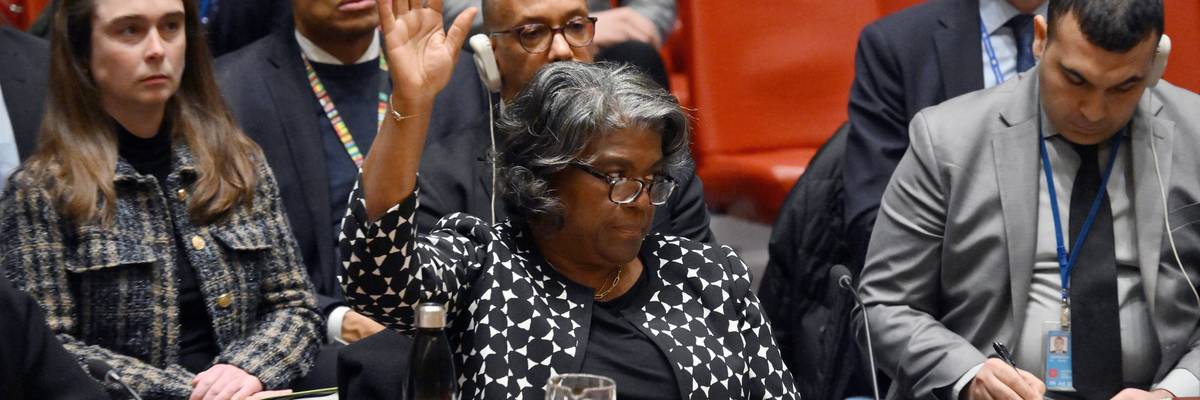
U.S. Ambassador to the United Nations Linda Thomas-Greenfield casts a veto vote during a U.N. Security Council meeting on the Israel-Hamas war, at U.N. headquarters in New York City on February 20, 2024.
"This is the evidence that President Biden's talk about a two-state solution is nothing but idle talk," said one former Lebanese diplomat.
As the United Nations Security Council prepares to vote Thursday on Palestine's bid to become a full U.N. member, the Biden administration—which claims to support Palestinian statehood—is lobbying UNSC nations in an effort to wrangle enough "no" votes so that the United States can avoid resorting to a veto.
Leaked cables obtained by The Intercept show U.S. pressure on Security Council members including Malta—which currently presides over the body—and Ecuador.
While claiming that President Joe Biden backs "Palestinian aspirations for statehood," one of the cables asserts that "it remains the U.S. view that the most expeditious path toward a political horizon for the Palestinian people is in the context of a normalization agreement between Israel and its neighbors."
"We therefore urge you not to support any potential Security Council resolution recommending the admission of 'Palestine' as a U.N. member state, should such a resolution be presented to the Security Council for a decision in the coming days and weeks," the document advises.
The U.S. argument essentially is that the U.N. should not create an independent Palestinian state by fiat—even though that's precisely how the world body voted in 1947 to establish the modern state of Israel.
The renewed push for Palestine's U.N. membership comes as Israel wages a genocidal war on the Gaza Strip. The Palestinian Authority, which hasn't controlled Gaza for nearly two decades, rejected the Biden administration's requests to hold off on seeking full membership.
"We wanted the U.S. to provide a substantive alternative to U.N. recognition. They didn't," one unnamed Palestinian official told Axios on Wednesday. "We believe full membership in the U.N. for Palestine is way overdue. We have waited more than 12 years since our initial request."
As The Intercept's Ken Klippenstein and Daniel Boguslaw noted:
Since 2011, the U.N. Security Council has rejected the Palestinian Authority's request for full member status. On April 2, the Palestinian Observer Mission to the U.N. requested that the council once again take up consideration of its membership application. According to the first State Department cable, U.N. meetings since the beginning of April suggest that Algeria, China, Guyana, Mozambique, Russia, Slovenia, Sierra Leone, and Malta support granting Palestine full membership to the U.N. It also says that France, Japan, and Korea are undecided, while the United Kingdom will likely abstain from a vote.
Along with the United States, China, France, Russia, and the United Kingdom are permanent members of the UNSC, so they also have veto power.
Ahead of Thursday's planned vote, Spain has been doing its own lobbying in Europe to build greater support for Palestinian statehood. At a joint Tuesday press conference with Spanish Prime Minister Pedro Sánchez, Slovenian Prime Minister Robert Golob said the question is "when, not if, but when is the best moment to recognize Palestine."
Belgium—which is seeking economic sanctions against Israel in response to its genocidal war on Gaza—is expected to join Spain's push for Palestinian statehood after the country's European Union presidency expires in June.
Currently, 139 of the U.N.'s 193 member states recognize Palestine as an independent state.
Israeli Prime Minister Benjamin Netanyahu—who has also claimed to support a so-called "two-state solution"—has alternately boasted about thwarting Palestinian statehood.
Critics pointed to the leaked cables as more proof of U.S. duplicity and double standards on the Israel-Palestine issue.
"This is the evidence that President Biden's talk about a two-state solution is nothing but idle talk," Massoud Maalouf, a former Lebanese ambassador to Canada, Chile, and Poland, said on social media.
Dear Common Dreams reader, It’s been nearly 30 years since I co-founded Common Dreams with my late wife, Lina Newhouser. We had the radical notion that journalism should serve the public good, not corporate profits. It was clear to us from the outset what it would take to build such a project. No paid advertisements. No corporate sponsors. No millionaire publisher telling us what to think or do. Many people said we wouldn't last a year, but we proved those doubters wrong. Together with a tremendous team of journalists and dedicated staff, we built an independent media outlet free from the constraints of profits and corporate control. Our mission has always been simple: To inform. To inspire. To ignite change for the common good. Building Common Dreams was not easy. Our survival was never guaranteed. When you take on the most powerful forces—Wall Street greed, fossil fuel industry destruction, Big Tech lobbyists, and uber-rich oligarchs who have spent billions upon billions rigging the economy and democracy in their favor—the only bulwark you have is supporters who believe in your work. But here’s the urgent message from me today. It's never been this bad out there. And it's never been this hard to keep us going. At the very moment Common Dreams is most needed, the threats we face are intensifying. We need your support now more than ever. We don't accept corporate advertising and never will. We don't have a paywall because we don't think people should be blocked from critical news based on their ability to pay. Everything we do is funded by the donations of readers like you. When everyone does the little they can afford, we are strong. But if that support retreats or dries up, so do we. Will you donate now to make sure Common Dreams not only survives but thrives? —Craig Brown, Co-founder |
As the United Nations Security Council prepares to vote Thursday on Palestine's bid to become a full U.N. member, the Biden administration—which claims to support Palestinian statehood—is lobbying UNSC nations in an effort to wrangle enough "no" votes so that the United States can avoid resorting to a veto.
Leaked cables obtained by The Intercept show U.S. pressure on Security Council members including Malta—which currently presides over the body—and Ecuador.
While claiming that President Joe Biden backs "Palestinian aspirations for statehood," one of the cables asserts that "it remains the U.S. view that the most expeditious path toward a political horizon for the Palestinian people is in the context of a normalization agreement between Israel and its neighbors."
"We therefore urge you not to support any potential Security Council resolution recommending the admission of 'Palestine' as a U.N. member state, should such a resolution be presented to the Security Council for a decision in the coming days and weeks," the document advises.
The U.S. argument essentially is that the U.N. should not create an independent Palestinian state by fiat—even though that's precisely how the world body voted in 1947 to establish the modern state of Israel.
The renewed push for Palestine's U.N. membership comes as Israel wages a genocidal war on the Gaza Strip. The Palestinian Authority, which hasn't controlled Gaza for nearly two decades, rejected the Biden administration's requests to hold off on seeking full membership.
"We wanted the U.S. to provide a substantive alternative to U.N. recognition. They didn't," one unnamed Palestinian official told Axios on Wednesday. "We believe full membership in the U.N. for Palestine is way overdue. We have waited more than 12 years since our initial request."
As The Intercept's Ken Klippenstein and Daniel Boguslaw noted:
Since 2011, the U.N. Security Council has rejected the Palestinian Authority's request for full member status. On April 2, the Palestinian Observer Mission to the U.N. requested that the council once again take up consideration of its membership application. According to the first State Department cable, U.N. meetings since the beginning of April suggest that Algeria, China, Guyana, Mozambique, Russia, Slovenia, Sierra Leone, and Malta support granting Palestine full membership to the U.N. It also says that France, Japan, and Korea are undecided, while the United Kingdom will likely abstain from a vote.
Along with the United States, China, France, Russia, and the United Kingdom are permanent members of the UNSC, so they also have veto power.
Ahead of Thursday's planned vote, Spain has been doing its own lobbying in Europe to build greater support for Palestinian statehood. At a joint Tuesday press conference with Spanish Prime Minister Pedro Sánchez, Slovenian Prime Minister Robert Golob said the question is "when, not if, but when is the best moment to recognize Palestine."
Belgium—which is seeking economic sanctions against Israel in response to its genocidal war on Gaza—is expected to join Spain's push for Palestinian statehood after the country's European Union presidency expires in June.
Currently, 139 of the U.N.'s 193 member states recognize Palestine as an independent state.
Israeli Prime Minister Benjamin Netanyahu—who has also claimed to support a so-called "two-state solution"—has alternately boasted about thwarting Palestinian statehood.
Critics pointed to the leaked cables as more proof of U.S. duplicity and double standards on the Israel-Palestine issue.
"This is the evidence that President Biden's talk about a two-state solution is nothing but idle talk," Massoud Maalouf, a former Lebanese ambassador to Canada, Chile, and Poland, said on social media.
As the United Nations Security Council prepares to vote Thursday on Palestine's bid to become a full U.N. member, the Biden administration—which claims to support Palestinian statehood—is lobbying UNSC nations in an effort to wrangle enough "no" votes so that the United States can avoid resorting to a veto.
Leaked cables obtained by The Intercept show U.S. pressure on Security Council members including Malta—which currently presides over the body—and Ecuador.
While claiming that President Joe Biden backs "Palestinian aspirations for statehood," one of the cables asserts that "it remains the U.S. view that the most expeditious path toward a political horizon for the Palestinian people is in the context of a normalization agreement between Israel and its neighbors."
"We therefore urge you not to support any potential Security Council resolution recommending the admission of 'Palestine' as a U.N. member state, should such a resolution be presented to the Security Council for a decision in the coming days and weeks," the document advises.
The U.S. argument essentially is that the U.N. should not create an independent Palestinian state by fiat—even though that's precisely how the world body voted in 1947 to establish the modern state of Israel.
The renewed push for Palestine's U.N. membership comes as Israel wages a genocidal war on the Gaza Strip. The Palestinian Authority, which hasn't controlled Gaza for nearly two decades, rejected the Biden administration's requests to hold off on seeking full membership.
"We wanted the U.S. to provide a substantive alternative to U.N. recognition. They didn't," one unnamed Palestinian official told Axios on Wednesday. "We believe full membership in the U.N. for Palestine is way overdue. We have waited more than 12 years since our initial request."
As The Intercept's Ken Klippenstein and Daniel Boguslaw noted:
Since 2011, the U.N. Security Council has rejected the Palestinian Authority's request for full member status. On April 2, the Palestinian Observer Mission to the U.N. requested that the council once again take up consideration of its membership application. According to the first State Department cable, U.N. meetings since the beginning of April suggest that Algeria, China, Guyana, Mozambique, Russia, Slovenia, Sierra Leone, and Malta support granting Palestine full membership to the U.N. It also says that France, Japan, and Korea are undecided, while the United Kingdom will likely abstain from a vote.
Along with the United States, China, France, Russia, and the United Kingdom are permanent members of the UNSC, so they also have veto power.
Ahead of Thursday's planned vote, Spain has been doing its own lobbying in Europe to build greater support for Palestinian statehood. At a joint Tuesday press conference with Spanish Prime Minister Pedro Sánchez, Slovenian Prime Minister Robert Golob said the question is "when, not if, but when is the best moment to recognize Palestine."
Belgium—which is seeking economic sanctions against Israel in response to its genocidal war on Gaza—is expected to join Spain's push for Palestinian statehood after the country's European Union presidency expires in June.
Currently, 139 of the U.N.'s 193 member states recognize Palestine as an independent state.
Israeli Prime Minister Benjamin Netanyahu—who has also claimed to support a so-called "two-state solution"—has alternately boasted about thwarting Palestinian statehood.
Critics pointed to the leaked cables as more proof of U.S. duplicity and double standards on the Israel-Palestine issue.
"This is the evidence that President Biden's talk about a two-state solution is nothing but idle talk," Massoud Maalouf, a former Lebanese ambassador to Canada, Chile, and Poland, said on social media.