

5
#000000
#FFFFFF
To donate by check, phone, or other method, see our More Ways to Give page.
Daily news & progressive opinion—funded by the people, not the corporations—delivered straight to your inbox.

“Transforming an exceptionally dangerous mass surveillance system into one that is fully protective of civil rights and civil liberties is a difficult, if not impossible task.”
The ACLU on Thursday largely dismissed new privacy measures announced by surveillance tech company Flock Safety, arguing the changes do little to address mounting concerns about the company’s sprawling automated license plate reader network and abuses of its technology by law enforcement agencies and other malicious actors.
Flock on Thursday unveiled new guardrails for its law enforcement customers, including a reduction in default license plate data retention from 30 days to seven, mandatory auditing tools designed to flag suspicious searches, and requirements that officers associate searches with case numbers.
The ACLU said the changes "seem to be a thinly veiled PR attempt to counter communities’ genuine privacy concerns with its mass surveillance system with largely hollow security promises, rather than an earnest effort to address them."
ACLU senior policy counsel Chad Marlow asserted that “transforming an exceptionally dangerous mass surveillance system into one that is fully protective of civil rights and civil liberties is a difficult, if not impossible task."
"That is even more the case with a company like Flock, whose nearly $1 billion in venture capitalist funding has locked it into an operational model that seeks to trade our privacy for massive profits," he continued. “Given that Flock’s latest announcement still appears more focused on addressing a PR problem than the significant privacy and other harms its products create, we will continue to analyze the company’s proposals fairly and honestly."
Flock Safety's new guardrails come amid growing nationwide backlash against automated license plate readers (ALPRs). As more and more instances of alleged police abuse emerge—including use of Flock cameras to stalk exes, track abortion patients, target undocumented immigrants, and spy on protesters—an increasing number of law enforcement agencies are canceling or not renewing contracts with the company.
"Abuse of Flock technology, at any level, is unacceptable," Flock Safety said in its statement Thursday. "We have strengthened safeguards over the past nine years, from basic audit logs to proactive monitoring. Sixteen weeks ago, we introduced audit assistance, which detects abnormal activity and flags it for administrator review. In recent weeks, those reviews have been associated with arrests of several law enforcement officers who allegedly abused the system."
"We will now require all law enforcement customers to adopt this feature by the end of this year," the company continued. "In addition, we will institute proactive lockout. When a user’s activity meets defined criteria for abnormal behavior, Flock will automatically suspend access pending administrator review. The goal is to intervene before misuse becomes recurring or widespread."
"In July 2025, we introduced an optional case code requirement for searches," Flock noted. "Results from participating agencies have been promising, so we will now require case codes for all law enforcement searches by the end of the year. Agencies may bypass the requirement in emergencies, but every exigent search will be flagged for administrator review."
"We are not perfect," the firm added, "so we will keep listening, improving, and building a better standard for public safety technology together."
However, the ACLU analyzed Flock's announced changes and found that "the devil will be in the details":
For example, an exception to the data retention policy is something called evidence mode, which is “when a search is tied to a case number, that data is preserved instead of aging out after seven days.”... “If ‘evidence mode’ only retains hit result data that police determine may be evidence in an active investigation of a specific case, then the change may be a positive one. But if evidence mode triggers the retention of any ALPR data that is searched, then the new mode could indefinitely retain all the ALPR data Flock collects and shares nationally.”
Another “change” the company is implementing is that local police will be able to decide what types of offenses other Flock customers can search their data for... Flock has attempted this before, and the security measure failed because police were easily able to circumvent the system’s requirement that they input the purpose of their search.
Finally, Flock announced that in response to the reports of police abuse, they will now require reasons for a search, and that they plan to universally roll out its audit assistance tool to detect police misuse. Flock’s announcement fails to note how easily users have circumvented “search reason” security measures in the past or how its new policy improves the quality of the feature.
"Change may still come as Flock faces this ever-growing threat to its corporate viability," the ACLU said, "but we certainly won’t be holding our breath."
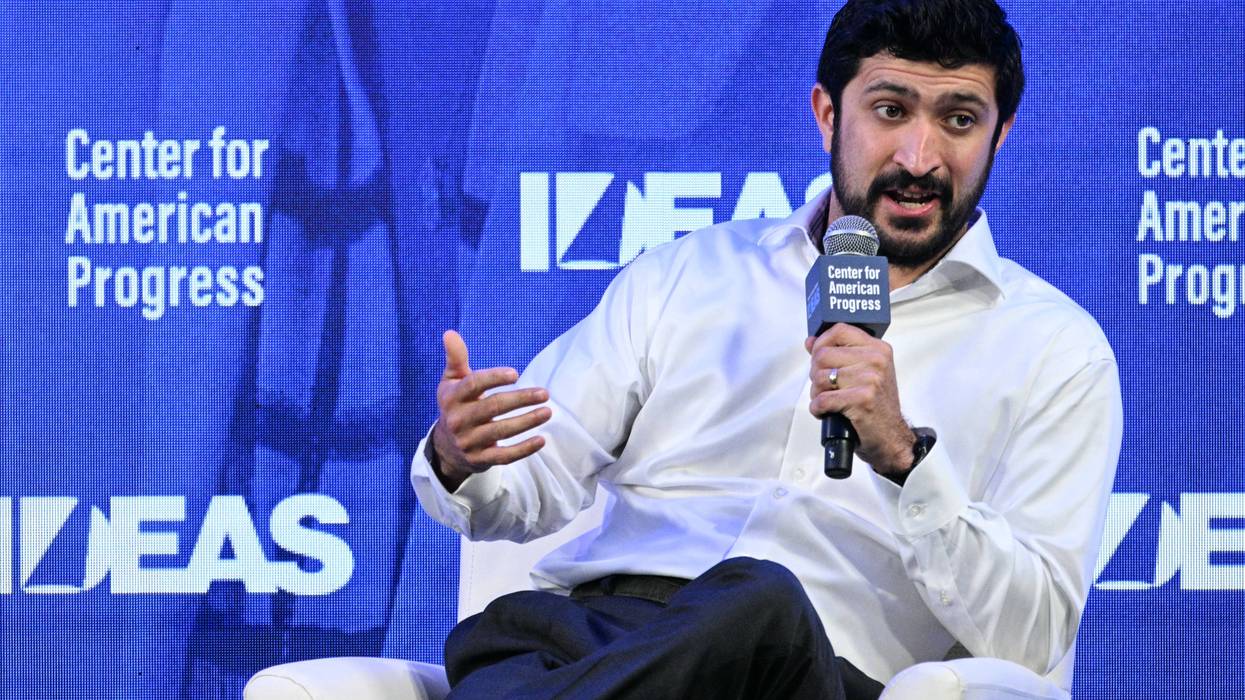
"We need to clearly be 100% on the side of workers who are vulnerable, kids who are vulnerable, everyday people who are vulnerable to mass surveillance."
Congressional Progressive Caucus Chair Greg Casar this week urged fellow Democrats to reject campaign support from artificial intelligence industry lobbyists and unveiled a bill intended to help protect workers from AI-related mass unemployment.
The Texas congressman took aim at Leading the Future (LTF), a pro-industry super political action committee (PAC), and "AI billionaires that are lobbying for no regulation," during a Thursday interview with MS NOW. He argued that "we need to clearly be 100% on the side of workers who are vulnerable, kids who are vulnerable, everyday people who are vulnerable to mass surveillance."
Casar drew a comparison to the American Israel Public Affairs Committee, whose super PAC is spending millions against Democratic candidates critical of the Israeli government and its forces' genocidal violence in the Gaza Strip. He predicted that LTF and the "big anti-AI regulation donors" would soon be "as toxic as AIPAC is today."
According to AI Money Watch, a project launched in June by the progressive advocacy group Demand Progress, "LTF entered 2026 with $70 million cash on hand and operates through affiliated super PACs (Think Big PAC in New York, American Mission PAC in Texas) and a dark-money 501(c)(4) arm called Build American AI."
AI Money Watch found that the two candidates with the most LTF money spent on them so far during this cycle are both former congressional Democrats from Illinois. The group poured over $1 million into supporting Jesse Jackson Jr., who lost the primary for the 2nd District, and AIPAC-backed Melissa Bean, who beat a progressive in the state's 8th District.
LTF also spent over $1 million each on Ben McAdams, a former Democratic congressman running in Utah's 1st District, and Congressman Ritchie Torres (D-NY), who is formally endorsed by the group. Rounding out the top 5 is James Kingston, a Georgia Republican who won the 1st District primary, with over $960,000 spent on him.
Casar told MS NOW that rejecting such support could help his party earn the trust of voters: "If Democrats clearly stand with the 75% plus of Americans that want sensible AI regulations to prevent mass unemployment, mass surveillance, or mass national security risks, I think we should win over the voters... Even if it means we don't win over all the money."
Gallup found last September that 80% of US adults believe the government should prioritize "maintaining rules for AI safety and data security, even if it means developing AI capabilities at a slower rate." In March, 76% of respondents to a Americans for Responsible Innovation poll said that they had concerns about AI tools enabling unprecedented government surveillance of citizens.
A June poll conducted by Justice Research Group for Working Families Power found that 85% of working-class voters support large-scale retraining and apprenticeship programs for workers whose jobs are changed by artificial intelligence, 73% worry that AI will lead to job losses, and 62% fear the rapidly developing technology would personally affect them or people close to them.
Casar partnered with Reps. Valerie Foushee (D-NC) and Sara Jacobs (D-Calif.) on Thursday to introduce the AI Tax and Work Protection Act, a bill that would tax industry giants to fund a Work Protection Administration charged with creating jobs to offset layoffs.
"This bill says: We will not let AI billionaires get rich by putting you out of work," said Casar. "Right now, the path we are on is clear: AI will turn a couple of billionaires into trillionaires but leave millions without work. That is unacceptable. And right now, the federal government is doing nothing to protect workers from the threat of AI mass unemployment. Our bill would protect American workers by making big AI companies pay their fair share."
The bill is backed by various policy experts and advocacy organizations, including the American Federation of State, County, and Municipal Employees; Groundwork Action; and Demand Progress Action—whose executive director, Sean Vitka, applauded Casar's "continued leadership on artificial intelligence."
"Serious, resilient proposals to address the unfolding impacts of this rapidly advancing technology are far too hard to find in Congress," said Vitka. "Some policymakers don't take AI seriously enough, and some don't understand it at all. With this legislation, Rep. Casar is instead demonstrating the kind of policymaking vision needed to meet the moments ahead."
Related legislation recently introduced by progressives in Congress includes the American AI Sovereign Wealth Fund Act proposed in June by Sen. Bernie Sanders (I-Vt.), which would give the public "a direct ownership stake" in the largest artificial intelligence companies in the country, and the landmark data center moratorium bill unveiled in March by Sanders and Rep. Alexandria Ocasio-Cortez (D-NY).
In a sign of how the public is feeling about "AI taking our jobs," data centers driving up utility bills, and "surveillance tech tracking our every move," a coalition of groups is planning a week of action from August 9-16 "to demand that our elected officials stand with the people—not Big Tech billionaires."

"The ability to compose viral genomes using generative AI now exists; the governance to safely steer it does not," a pair of researchers said.
As scientists confirmed the first-ever biological viruses generated by artificial intelligence, experts warned Thursday that governments have failed to keep pace with a rapidly advancing and largely unregulated technology that, while having tremendous potential for medical breakthroughs, could also pose existential threats to humanity in the foreseeable future.
Research published Thursday in Science, available in full only to subscribers, describes how scientists at Stanford University and the Arc Institute used a genome language model, roughly the genetic equivalent of the technology behind AI chatbots, to generate hundreds of novel bacteriophage genomes—viruses that infect bacteria rather than humans. After synthesizing and testing the AI-generated designs, researchers found that 16 functioned successfully in laboratory experiments, infecting and killing E. coli.
While the researchers said that the new viruses pose no danger to humans because they only infect bacteria, experts have warned of the risks of AI creating novel bioweapons—either prompted by scientists or, in a future when superintelligent AI is achieved, independently—that could, in a worst-case scenario, threaten the existence of humanity.
"Although this is promising for life sciences applications, it also raises urgent biosafety and biosecurity questions," Johns Hopkins University School of Public Health Center for Health Security researchers Thomas Inglesby and Moritz Hanke wrote in a related article, also published Thursday in Science behind a paywall. "The ability to compose viral genomes using generative AI now exists; the governance to safely steer it does not."
The Stanford and Arc Institute study authors themselves noted the “important biosafety, biocontainment, and biosecurity considerations” accompanying such advances, urging researchers to “consult both safety and security professionals" during their work.
Calls for more robust regulatory guardrails have mounted in recent weeks amid revelations that one of ChatGPT maker OpenAI's models autonomously broke into the systems of other companies during testing. As AI advances to the point where it will likely outsmart humans, the challenge of ensuring that advanced systems reliably pursue goals that match what humans actually want—known as alignment—becomes increasingly difficult and, experts say, dangerous.
A misaligned, superintelligence could take uncontrolled autonomous actions at massive scale to achieve its goals, with industry pioneers warning of potentially catastrophic outcomes like AI-launched nuclear war or bioattack with existing or AI-generated pathogens.
While advocacy groups, the United Nations, and dozens of national governments are urging more robust regulation of AI development, the United States under President Donald Trump, the Republican-controlled Congress, and Big Tech’s army of lobbyists is strongly opposed to guardrails.
In fact, Trump—who Congressional Progressive Caucus Chair Greg Casar (D-Texas) on Monday accused of being "too busy cashing in" on AI—has rolled back regulations, including some meager steps taken during the Biden administration to bolster safety.
“There’s just a huge disconnect," Hanke told The New York Times on Thursday.

"One brutal kick sent the robot's head hanging loose."
Amid warnings from experts and political leaders about "killer robots," a Chinese robotics company on Thursday hosted an unprecedented combat tournament in which one humanoid robot decapitated another.
The fight featuring the decapitation—footage of which quickly circulated online—was part of the opening night of the Ultimate Robot Knock-out Legend (URKL) competition in Shenzhen, organized by the company EngineAI, which developed the humanoid.
The Chinese Embassy in Ireland was among the accounts on the social media platform X that highlighted the moment when one robot's "head" was dislodged.
The "white humanoid robot, named 'White Eagle' landed a high kick to the head of its black opponent, 'Matador,' which made the robot's head rock precariously in its socket before rolling completely out of place," according to Newsweek. "The two continued to spar as Matador's head was swinging from its socket until eventually the robot fell, crushing its head underneath its body."
Unveiled last year, the humanoid is called T800, a nod to the Terminator franchise. EngineAI's website features videos of T800 executing various mixed martial arts (MMA) moves, from a combination punch and a roundhouse kick to punch-kick combos.
EngineAI announced UKRL, the "world's first" humanoid robot combat league, early this year, seeking 32 teams from universities, enterprises, and research institutions worldwide to compete using its robots. The first round of competition is scheduled for July-August, followed by another round in September-October, and the grand finals in November-December.
As the Chinese tabloid Global Times reported when the tournament was announced in February:
Pan Helin, a Beijing-based veteran analyst, told the Global Times on Monday that such competitions help enhance public awareness of humanoid robots and expand potential application scenarios.
Pan noted that humanoid robots still face technological and practical limitations, and real-world application is key to their further development. Such events could yield positive effects in the entertainment and performance market, which is a necessary step forward in paving the way for further applications in factories or households, Pan said.
Tian Feng, former dean of SenseTime's Intelligence Industry Research Institute, said that the free provision of T800 robots will lower research and development barriers for smaller companies and promote the integration of applications involving industry, academia, and research bodies.
The tournament's opening night came on the heels of a series of artificial intelligence events hosted by the United Nations earlier this month, during which Secretary-General António Guterres said that "if AI is to be powerful, it must be governed," and "my main concern is with 'lethal autonomous weapon systems.'"
"Let us call them what they are: killer robots," Guterres continued. "Machines selecting and engaging their target and taking a life—without human control and judgment. That is morally repugnant. It is politically unacceptable. And it must be banned by international law."
"States are already at the discussion table. But let us not wait for atrocity to act. Some decisions must remain forever human—none more than taking a human life," he added. "Some might claim that governance is the enemy of innovation. But innovation needs guardrails. The technologies we trust most—in aviation, in medicine, in nuclear energy and beyond—earned that trust because we acted to hold their makers to account."
As Wired detailed in Friday reporting, "the US military has a long-standing interest in humanoids," and Sankaet Pathak's startup Foundation Future Industries aims to "produce an all-American robot supersoldier."
The startup's "unique in its targeting of the military market, and so far it's been lucrative," the outlet added. "The company has government contracts worth millions of dollars and high-profile backers to spread its message: Eric Trump, the president's son, is both an investor and the company's chief strategy adviser."
This article has been updated to include the Wired reporting.

Civil society groups and experts said that "the EU must act now to defend independent oversight, protect fundamental rights, and ensure that spyware abuse in Europe is met with accountability, not impunity."
The European Parliament narrowly voted Monday to hold a debate on spyware after recent revelations that the phone of Stelios Kouloglou, a Greek journalist and former member of the European Parliament, "was repeatedly hacked with NSO Group's Pegasus" while he sat on the body's committee investigating abuses of the technology.
The vote came amid a fresh wave of calls for action. Elina Castillo Jiménez, advocacy and policy adviser for Amnesty International's Security Lab, said in a Monday statement that "the brazen targeting of someone in his position underlines how inadequate the current system is, and is yet another wake-up call that the protections that were put in place to prevent this kind of abuse are still not being implemented in Europe."
"Three years ago, the European Parliament's PEGA Committee, on which Stelios Kouloglou sat, issued clear and detailed recommendations for how to close the gaps that allow this abuse to continue. We are still waiting for implementation. Delaying it sends the wrong message about impunity in the surveillance industry."
Castillo Jiménez argued that "European leaders must find the political will needed to protect people from spyware abuse. An independent and impartial investigation into this attack, together with a roadmap for implementing PEGA recommendations, is urgently needed. If an elected member of parliament is not safe from unlawful surveillance, then no one is."
Amnesty was also part of a Monday joint statement with individual experts and organizations including Access Now, Center for Democracy and Technology Europe, Committee to Protect Journalists, Reporters Without Borders, and more, calling out the European Union for failing "to deliver a meaningful, EU-wide response to the proliferation and abuse of commercial spyware."
Global calls for restrictions on surveillance technology have mounted since the Pegasus Project—an international media consortium led by the media nonprofit Forbidden Stories, with tech assistance from Amnesty—published a 2021 exposé of the Israeli firm's software that was developed to secretly infiltrate mobile phones.
Kouloglou, who left the European Parliament two years ago, was appointed to serve as a substitute member of its PEGA Committee on March 24, 2022. That October, his Apple iPhone was infected with the spyware, according to research released Friday by the Citizen Lab at the University of Toronto in Canada.
The first documented hacking occurred while Kouloglou was at a hospital, where he was visited by Greek journalist Thanasis Koukakis—who, as the Citizen Lab explained, "has worked closely on mercenary spyware issues in Greece, has testified to the PEGA committee, and was himself targeted with Intellexa's Predator spyware."
The following March, as Kouloglou left Athens for Brussels, his phone was again infected with Pegasus. The lab noted that the second hacking happened as he and Koukakis were making tentative plans to meet over WhatsApp, "the PEGA Committee was engaged in intense discussions related to the final drafting process," and PEGA Rapporteur MEP Sophie in 't Veld was in Greece with another committee delegation that questioned Greek officials on the country's scandal involving other spyware.
The forensic analysis also found that "Kouloglou received multiple Apple threat notifications about targeting with mercenary spyware on three occasions: March 2, 2023, August 29, 2023, and April 10, 2024," the lab said. "It is important to note that threat notifications from Apple and other companies are not real-time alerts. They are typically sent to users in batches, often months or more after targeting takes place. Kouloglou reports to us that he did not recall receiving the Apple notifications we observed."
The Citizen Lab acknowledged that "we have no indications that this hacking was the work of the Greek government," though it does appear to be the same operator who targeted seven Russian- and Belarusian-speaking independent journalists and opposition activists based in Europe, whose experiences were detailed in its May 2024 joint report with Access Now.
Although there were some known cases of MEPs being targeted with Pegasus before the European Parliament's panel was created, the lab stressed, "this is the first time a member of the PEGA Committee has been publicly identified as a victim" of this particular spyware while serving on it.
Reuters reported that while NSO did not respond to requests for comment, Apple said the vulnerability referred to in the Citizen Lab report has been patched. The European Parliament told the news outlet that its spyware screening tools had been available to all lawmakers since 2022 and its information technology security services "constantly monitor cybersecurity threats as well as potential cyberattacks against its working environment."
However, that's not enough for critics like In 't Veld, who is also no longer an MEP and pointed out to Politico that hundreds of politicians, including European Parliament President Roberta Metsola, have been targeted by various tech.
"If attempts to target the phone of the president of the European Parliament, or members of the European Commission, does not trigger sufficient reaction, [and] is not enough to break the deadlock, then what is?" she asked
The coalition of groups and tech experts similarly said in their Monday statement: "These incidents all point to a structural failure to adequately and seriously respond to the spyware crisis in Europe. This latest revelation should be treated as a rule of law emergency, threatening the very foundations of our society."
"Europe cannot continue moving from scandal to scandal without consequence. The targeting of a member of the European Parliament involved in investigating spyware abuse should mark a turning point," the coalition said. "The EU must act now to defend independent oversight, protect fundamental rights, and ensure that spyware abuse in Europe is met with accountability, not impunity."
John Scott-Railton, a senior researcher at the lab, told The Guardian last week that "this case is the ultimate irony of Europe's spyware crisis. Someone on the very committee tasked with investigating Pegasus gets infected by it. And what has happened since? The parliament looks the other way when new European spyware abuses emerge."
"I can tell you how the next chapter will go: more hacked parliamentarians," he warned. "In fact, I suspect there are members voting and attending high-level meetings with no idea that their phone has been turned into a spy in their pocket."
Scott-Railton welcomed Monday's vote to hold a debate later this week, and listed some key questions on social media:
In addition to urging investigations by European Union institutions, the Citizen Lab recommended that other members and their staff immediately seek forensic screening of their devices, exercise vigilance for state-sponsored attack warnings, and enable Lockdown mode on iPhones and Advanced Protect for Android.

The commission's upcoming first meeting will focus on "strengthening AI infrastructure, accelerating AI's impact on health, education, food security, and disaster response, and ensuring trust and safety," said its CEO co-chair.
A week after United Nations Secretary-General António Guterres called on artificial intelligence companies to "come clean" about the full costs of power-sucking data centers, and as a UN panel on Wednesday released a report detailing the risks and impacts of AI, Axios revealed the creation of a related commission that's full of Big Tech executives.
"The UN and its International Telecommunication Union (ITU) are convening the AI for Good Global Commission, which will hold its first meeting on July 8 in Geneva, Switzerland," according to the outlet. It will be co-chaired by Salesforce CEO Marc Benioff and Rwandan President Paul Kagame, with other tech and policy leaders joining as members.
So far, Axios reported, they include ITU Secretary-General Doreen Bogdan-Martin, Estonian President Alar Karis, Amazon CEO Andy Jassy, Anthropic co-founder Jack Clark, Cohere co-founder Aidan Gomez, Microsoft president Brad Smith, Nvidia founder and CEO Jensen Huang, and AI and tech policymakers from Kazakhstan, Namibia, Nigeria, Saudi Arabia, and Singapore.
"AI is the most profound technological transition in history. And our values have to guide every step, because responsibility is the core of AI ethics," Benioff said. The commission will bring together "the people who build AI, deploy it, shape policy, and represent communities."
He added that "our inaugural meeting will focus on where this group is uniquely positioned to act together: strengthening AI infrastructure, accelerating AI's impact on health, education, food security, and disaster response, and ensuring trust and safety."
However, given recent polls showing that the public has limited confidence in large technology companies, opposes constructing data centers for artificial intelligence in their local area, is wary of AI’s impact on daily life, and has concerns about politicians having a "cozy relationship" with Big Tech, the commission may be met with skepticism or even backlash.
In the lead-up to the commission's meeting next week at the ITU's AI for Good Global Summit, the UN plans to hold the inaugural Global Dialogue on AI Governance, featuring a presentation of the "Preliminary Report of the Independent International Scientific Panel on Artificial Intelligence," published Wednesday.
Established with a UN resolution last August, the panel is the first global scientific body on AI—and, as Guterres said in a statement about its new report, "the panel is intended to help the world separate fact from fakes, and science from slop."
"We are looking to them to provide an authoritative reference point at a moment when reliable, unbiased understanding of AI has never been more critical," the UN chief explained. "I am pleased to say that they have delivered a down payment on that commitment—in record time."
The panel's co-chair, Canadian computer scientist Yoshua Bengio, noted that "AI capabilities are outpacing both scientific understanding and governments' ability to adapt. With growing evidence of deceptive AI behavior, science currently cannot guarantee that as capabilities continue to increase, AI will not cause catastrophic harm, either on its own or due to malicious users."
"To act effectively, global policymakers must understand these systems," he asserted. "This panel provides exactly that: a rigorous, shared scientific foundation to guide our collective way forward."
The report discusses AI's recent advances and expected trajectories; societal applications, from agriculture to education to healthcare; economic implications; security and environmental concerns; impacts on democracy, human rights, and information; potential harms to child safety and culture; and governance of the rapidly developing technology.
"The technology is transformative, but if the world keeps moving along this trajectory, humanity will fail to realize the gains it promises. The risks—to societies, to security, and to our species—are too high, and the forces driving AI forward are not the forces that will deliver its benefits," said Maria Ressa, a panel's co-chair and Nobel Peace Prize-winning Filipino-American journalist.
Guterres, whose term ends this year, similarly stressed the need for urgent action on a global scale. He said that the "single lesson" he wanted to highlight from the multifaceted report is that "the more AI advances without shared rules, the less say governments and people will have in the outcome. So my message to governments is simple: Do not wait."
"Next week in Geneva, the first Global Dialogue on AI Governance will begin to turn science into shared action—with every nation at the same table," he said. "I look forward to joining member states there to help carry this work forward. And soon, I will set out proposals to help countries build the capacity to adequately deal with this technology—and share in its rewards."
Guterres' Wednesday comments came after he publicly took aim at artificial intelligence companies last week, proposing the AI Environmental Transparency Initiative during London Climate Action Week, as the second heatwave in as many months scorched the United Kingdom and various other European countries, killing at least hundreds of people.
"I am calling on every major AI company to measure and publicly disclose the full environmental impact of its systems—carbon, water, and land footprints—and to commit to power every data center with renewable energy by 2030," he declared. "No more hidden costs. No more shifting the burden onto those least able to bear it."

"Age verification requirements will help the Trump administration carry out its vendetta against the press by creating new avenues to identify journalists’ confidential sources," warned two press freedom advocates.
Opponents of a bill that is purported to protect children online said Monday night, after the legislation passed in the US House, that laws are "urgently" needed to stop Big Tech companies from preying on kids' vulnerabilities.
"The KIDS Act is not that piece of legislation," said Rep. Pramila Jayapal (D-Wash.), who was one of 117 lawmakers who voted against the Kids Internet and Digital Safety (KIDS) Act, which passed with 267 votes, while 47 members of Congress did not vote.
The bipartisan bill requires online platforms to use new safety features and parental controls, restricts the use of minors' personal data to target ads, and establishes new restrictions for AI chatbots and online games.
But ahead of the bill's passage, the Electronic Frontier Foundation (EFF) was among the opponents raising alarm about other provisions "buried inside the KIDS Act" that would "push online services to verify all users’ ages, require government-directed moderation policies for online speech, and even create new rules about private and encrypted communications."
The legislation, drawing from portions of 14 different online safety bills, "is a mess, with different age-gating schemes for different services, using different standards," wrote EFF senior policy analyst Joe Mullin. "It’s a lot of complexity, and a lot of legal risk. Faced with that, many companies will conclude that the safest option is restrictive age-checking practices across their entire platforms."
As Mullin explained:
Throughout the KOSA section of the legislation, special protections, controls, messaging settings, and parental tools are required whenever a website or app “knows or should have known” a user is a child (defined in the bill as anyone under 13) or a teen (defined as anyone between 13 and 16 years old).
The problem is a website operator doesn’t need actual knowledge that a user is a minor to get in legal trouble. It applies when a platform “knows or should have known” a user’s age—a low, negligence-style standard of knowledge. If an online service gets it wrong, it’s going to be up to courts and regulators to decide, after the fact, if an online service “should” have known a user was 16.
To try to avoid liability, services will have to determine which users are teenagers and which are not. Most won’t be able to simply trust their users. They’ll have to collect more information about age, before any lawsuit or government action arises. Some companies may respond by requesting driver's licenses or passports. Others will rely on age-estimation systems that attempt to guess users' ages by looking at existing activity or doing facial scans.
At The Intercept, Caitlin Vogus of the Freedom of the Press Foundation and Aliya Bhatia of the Center for Democracy and Technology’s Free Expression Project warned ahead of the bill's passage that while the legislation is ostensibly meant to protect children, the age verification requirement could impact all users' ability to access social media platforms without revealing their identities—chilling anonymous speech and threatening would-be whistleblowers.
"Threats to online anonymity harm everyone, but one group is often overlooked: journalists and the sources who talk to them," wrote Vogus and Bhatia. "Age verification requirements will help the Trump administration carry out its vendetta against the press by creating new avenues to identify journalists’ confidential sources."
While the KIDS Act says it won't require online platforms to collect government IDs for age verification, they said, "at least some platforms will likely choose this route to comply with the law or offer it as a fallback approach when other methods inevitably fail."
Former Republican congressman Justin Amash, a libertarian, accused the lawmakers who voted "yes" on the legislation of betraying "the Constitution and the American people."
Other opponents of the legislation, including Jayapal, argued that the bill would allow tech companies to continue targeting children with algorithms that send harmful content to the youngest users.
The legislation omits a "duty of care" provision that was included in the Kids Online Safety Act (KOSA), which was passed by the US Senate in 2024—a requirement that tech firms "exercise reasonable care” to prevent harms to children.
Jayapal noted that the bill, which faces an uphill battle in the Senate, leaves "suicide, depression, addiction, substance use disorders, and eating disorders from the list of harms" that tech companies like Meta must address in their algorithms.
The "duty of care" provision has been criticized as too vague by several digital rights groups, while some child safety groups said its omission in the KIDS Act would "let Big Tech off the hook."
"We have seen time and again that these corporations cannot be trusted to put children's safety over their own profit margins," said Jayapal. "We cannot keep exposing our kids to platforms that are either completely indifferent to their safety or a direct threat to it."
The KIDS Act, Jayapal said, also includes provisions "that do not do enough to actually address the harms of" artificial intelligence.
"I voted no," said Jayapal, "because we have a real opportunity to pass bipartisan legislation that holds these companies to not just be transparent about the harms and mitigate them, but to actually prevent them."

"Banning under-16s risks treating children as the problem rather than addressing the companies and systems that create the risks in the first place."
It's not yet clear whether Australia's ban on social media for children under age 16 has had a positive impact on kids' mental health and safety, but British Prime Minister Keir Starmer said Monday that the country's law is being used as a model for the United Kingdom's own blanket ban—leading critics, including the parent of a child who died by suicide after viewing harmful content on social media, to question whether Starmer was simply opting for a "politically expedient" solution to the harms of online platforms.
Banning young teenagers and children from using social media, said advocacy groups, does nothing to ensure powerful tech companies will make their products safer by design for all users.
Starmer announced the ban online in a video in which he highlighted his support for the policy "as a parent as much as a prime minister," and noted that in public comments, "thousands of parents" said their children "are addicted to social media."
We are banning social media access for under 16s.
These days kids must find their feet in a world where technology intrudes into every area of their life.
I just can’t let that go on anymore. So we’re giving children their childhoods back. pic.twitter.com/jn7iQrcwk8
— Keir Starmer (@Keir_Starmer) June 15, 2026
"It can leave them trapped in a cycle of endless scrolling that displaces play, sleep, and time with the family," said the prime minister, who leads the Labour Party and is facing threats to his leadership following the party's major losses in May's elections. "It can harm their mental health, and frankly, parents need our support on this. That is why today the government has decided to ban social media access for children under 16."
Starmer said new age-related regulations for social media platforms including TikTok, Instagram, and Snapchat, as well as gaming and livestreaming platforms, will be introduced by the end of this year, with the new laws going into effect in early 2027. The government also said it was examining restrictions for users under 18, such as "overnight curfews" and mandated blocking of "infinite scrolling."
More details about the ban are expected to be released next month.
But Kerry Moscoguiri, chief executive of Amnesty International UK, said that removing children from platforms that broadcast harmful content is "a case of the right diagnosis but the wrong prescription."
“The UK government is right to recognize that many children face serious harms online," said Moscoguiri. "Too many social media companies have built products and business models that prioritize keeping children engaged for longer, often at the expense of their well-being, privacy, and rights."
“But the problem is not that children exist on social media; it’s that social media companies have built platforms that are unsafe by design," she added. "Banning under-16s risks treating children as the problem rather than addressing the companies and systems that create the risks in the first place."
The ban comes after mounting reports of Big Tech companies' efforts to keep all users, including young people, on their platforms for as long as possible using algorithms and "infinite scrolling." Numerous cases have linked children's suicides to their exposure to thousands of posts regarding self-harm and suicidal ideation, as well as to cyberbullying through social media. And reporting by Reuters last year revealed that Meta's artificial intelligence chatbots were permitted by the company to have sexually provocative conversations with minors.
Advocacy groups like Amnesty have called for restrictions on social media platforms' most addictive and manipulative features, such as infinite scrolling, autoplay, and hyper-personalized recommendations.
Moscoguiri warned that bans like the one imposed by Australia last year will force children "to surrender their privacy in order to participate in modern digital life." In Australia, companies are required to perform age verification by collecting data from bank accounts or scanning users' photo IDs.
Instead of a blanket ban, she said, "we need strong regulation that tackles surveillance-based business models, protects children’s data, and puts safety ahead of profit.”
“The responsibility for children’s safety should rest first and foremost with the companies that build and profit from these platforms," said Moscoguiri. "Government action should focus on ending invasive profiling of children, [and] tackling addictive and manipulative design features."
As children's safety groups in the UK were expecting Starmer's announcement in recent days, Ian Russell, chair of the Molly Rose Foundation and the father of a 14-year-old girl who died by suicide in 2017 after viewing content related to self-harm and suicide on social media, told the BBC that he was, "quite frankly, dismayed" that a blanket ban was likely coming to the UK.
"Keir Starmer promised to tighten up the online safety world by regulating better," said Russell, who has called for social media giants like Meta to remove and regulate content that's harmful to young users' mental health. "If he's playing politics, what he's doing is gambling with young people's lives, and I find that deplorable."
https://t.co/oqDAdFFI8p
Very strong words ahead of expected social media ban from @mollyroseorg -
Ian Russell tells us govt is rushing in a blanket ban, rather than more sophisticated controls, under political pressure, in a 'deplorable way' pic.twitter.com/AMxcleLixU
— Laura Kuenssberg (@bbclaurak) June 13, 2026
In Australia, which last year became the first country to impose a nationwide blanket ban on kids under 16 using social media, the law has had unclear benefits, with many young teens still managing to use the platforms—where Big Tech has not been forced to place controls that would make it safer for young users to be there.
Carole Cadwalladr, an investigative journalist, said that imposing a ban that includes age verification, as Australia's does, "looks like rushed populist techsolutionism that will hand more power to the platforms."
"This is going to hand even more surveillance powers to the very companies that already know way too much about us. Do you want [X executive chair] Elon [Musk] to have a copy of your biometrics? Do you want [Meta CEO Mark Zuckerberg] to scan your face? That’s what we will all be doing," Cadwalladr added. "This isn’t reining in Silicon Valley power. It’s gifting them even more power. Of course, parents want these companies safe and regulated but that’s a job for government, not the end user."
Sadiq Khan, the mayor of London, acknowledged that he has advocated for a ban on social media for children under 16 and called it "the right step to protect young people"—but said the UK government must impose restrictions on social media giants themselves, not just their most vulnerable users.
"Bans only treat the symptom, not the problem," said Khan. "Social media companies need to reimagine their platforms so they can offer a safe and healthy environment for all users, where restricting access wouldn’t be necessary."
"There’s nothing inevitable about algorithms which feed us a diet of dangerous content," he added. "Londoners deserve platforms which prioritize people, not just profit."

"Over a year later, I'm still picking up the pieces of my life, all because the police relied on this dangerous technology instead of doing their jobs and actually investigating," said Robert Dillon.
A federal lawsuit filed Wednesday in the Middle District of Florida by a Fort Myers resident wrongfully arrested nearly two years ago highlights the risks of police agencies relying on facial recognition tools.
"This case is about what happens when police let an error-prone artificial intelligence (AI) system stand in for an investigation," explains the complaint, filed by attorneys with the state and national ACLU as well as the firm Hoguet Newman Regal & Kenney. "A facial recognition algorithm flagged Robert Dillon as the man who tried to lure or entice a child under 12 years old at a Jacksonville Beach McDonald's. It was wrong."
The 52-year-old "lives more than 300 miles from" and "had never set foot in Jacksonville Beach," the complaint continues. "But rather than test the machine's answer against the evidence that would have cleared him, the officers built a case to confirm it. Mr. Dillon was arrested and prosecuted for one of the most stigmatizing crimes a person can face."
Dillon—one of at least 15 people wrongfully arrested in the United States due to police reliance on incorrect facial recognition results—is suing the city of Jacksonville Beach as well as law enforcement officers from the Jacksonville Beach Police Department, Jacksonville Sheriff's Office (JSO), and Pinellas County Sheriff's Office.
Reporting on the case Wednesday, Wired noted that while the Pinellas agency did not respond to a request for comment, a JSO spokesperson simply said that "due to pending litigation, we would be unable to comment further on the incident."
The actual suspect allegedly approached a girl at the McDonald's shortly before midnight on November 2, 2023. The following month, Dillon was flagged as a possible match by the Face Analysis Comparison and Examination System (FACES)—which "has been operated by the Pinellas County Sheriff's Office since 2001, making it one of the oldest police face-recognition systems in the country," according to Wired. "At its peak in 2021, its tens of millions of Florida mug shots and driver's license photos were accessible to more than 260 agencies."
After denying any involvement in the case in December, Dillon was arrested at his home in front of his wife the next August, "held overnight in jail, forced to borrow money and pledge the title to his truck to post bond, subjected to months of criminal prosecution, and publicly branded with a mugshot that remains accessible online, long after the charges were dropped," the complaint states. "Community members still approach him in public to ask about the case. He no longer feels comfortable being friendly to children."
"He had no connection to the McDonald's, to the child who was targeted, or to anyone involved in the crime. He became a suspect for one reason: a facial recognition algorithm included him in a list of possible matches to a suspect captured on grainy surveillance footage at the restaurant," the document emphasizes. "The investigating officer treated that algorithmic output as a near-certain identification, omitted critical exculpatory evidence from his arrest warrant application, and failed to pursue routine investigative steps that would have immediately excluded Mr. Dillon as a suspect."
"The arrest warrant that deprived Mr. Dillon of his liberty was the product of a cascade of investigative failures by the lead investigator, Jacksonville Beach Police Department officer (now corporal) Scott O'Connell," according to the filing. Among them was the officer's "complete failure to consider that the suspect was alleged to have been a 'regular' customer."
The complaint also notes that "O'Connell is an officer with a documented history of volatility and poor judgment, having previously been terminated from the St. Johns County Sheriff's Office for threatening to 'blow up' the agency, later reinstated, then arrested for domestic battery before resigning under the weight of those charges. Jacksonville Beach PD hired him anyway, assigned him as lead investigator on a sensitive child-luring case, and later promoted him to corporal after his investigation resulted in the wrongful arrest and prosecution of an innocent man."
Dillon said in a Wednesday statement that "the night I spent in jail after they arrested me for a crime I did not commit still haunts me to this day. I will never get over how terrified and worried I was, wondering if I'd ever go home to my wife and daughter again."
"Over a year later, I'm still picking up the pieces of my life, all because the police relied on this dangerous technology instead of doing their jobs and actually investigating," Dillon added. "Florida police must implement safeguards and ensure this never happens to anyone else, because until they do, nobody is safe."
Nate Freed Wessler, deputy director of the ACLU’s Speech, Privacy, and Technology Project, stressed that "no one should lose their freedom or be scared to leave their house because an algorithm got it wrong."
"These Florida police departments owe it to Mr. Dillon to make amends and to take serious steps to make sure this doesn't happen to anyone else," he argued. "Police across the country are on notice: Unreliable face recognition technology is hurting people, and we will keep fighting to hold them accountable for these abuses."
The ACLU has previously sounded the alarm over other cases, including those of Robert Williams, a Black man wrongfully arrested in 2020 after software owned by Michigan State Police misidentified him as a shoplifting suspect, and Randal Reid, who spent nearly a week in jail in 2022 after he was falsely identified as a luxury purse thief by Louisiana authorities.
The legal group on Wednesday also pointed to the reported role of FACES in the 2025 wrongful arrest of New Smyrna Beach resident Beau Burgess, as well as another case involving the Jacksonville Sheriff's Office: Jalil Richardson told Action News Jax earlier this month that after being misidentified as a vehicle thief, he "sat in there for over 50 days, in the most worst jail ever."
"There was no proper investigation done... to even reach out to me or to see if I was even in Florida," said Richardson, whose charges were dropped after he provided time sheets showing that he was at work in North Carolina when the vehicle was stolen.
In his case, JSO provided a lengthy statement, saying in part that "facial recognition software is just one tool in a large toolbox for investigators," and "calling the arrest the result 'police AI misidentification' is a catchy headline but does not provide accurate context," including that "the victim chose Mr. Richardson out of a photographic lineup to include other potential suspects."
Nicholas Warren, staff attorney at the ACLU of Florida, said Wednesday that "one wrongful arrest is one too many."
"Florida's growing reliance on facial recognition technology threatens us all," he warned. "We must stop this dangerous pattern before it traps more innocent people. No one should have their freedom taken away because the police rely on faulty technology."

"The pursuit of greater profits cannot justify choices that systematically sacrifice jobs, because the human person is an end, not a means."
Pope Leo XIV on Monday released a 42,000-word encyclical calling for government regulation of artificial intelligence and implored world leaders to ensure the burgeoning technology is used for the benefit of all humankind—not concentrated in the hands of a powerful, profit-seeking few.
Leo warned in the first major theological document of his papacy that unrestrained AI and its potentially far-reaching impacts—including mass job loss, environmental degradation, and increasingly catastrophic warfare—heightens the "risk of dehumanization," subjugating much of humanity in the name of "greater efficiency" and technological advancement.
"As with every major technological shift, AI tends to amplify the power of those who already possess economic resources, expertise, and access to data," Leo wrote in the document, titled Magnifica Humanitas. "In light of the common good and the universal destination of goods, this raises serious concerns, since small but highly influential groups can shape information and consumption patterns, influence democratic processes, and steer economic dynamics to their own advantage, undermining social justice and solidarity among peoples."
Leo warned that eliminating jobs en masse by replacing human beings with robots—an aim of some of the most powerful companies in the world, including the e-commerce behemoth Amazon—without adequate protections and compensation for impacted workers would be morally obscene and calamitous to social order.
"A society that guarantees employment to only a small fraction of the population, despite having a high level of technical development, risks exposing many to forced inactivity, a lack of responsibility, and the absence of daily tasks and stimuli, resulting in human and cultural impoverishment," the pope wrote. "This creates a paradox of material progress and anthropological regression that undermines the foundations of a just and stable social peace."
In the era of #ArtificialIntelligence, when human dignity is threatened by new forms of dehumanization, ours is the pressing duty to remain profoundly human. We must lovingly safeguard the grandeur of humanity bestowed upon us and revealed in its fullness in Christ, the splendor…
— Pope Leo XIV (@Pontifex) May 25, 2026
Leo cautioned against the growing use of AI in military conflict, a warning delivered alongside the CEO of the artificial intelligence firm Anthropic, which was embroiled in a tense and public dispute with the Trump administration earlier this year over the use of the company's technology for military purposes and mass surveillance. The pontiff has also clashed with the Trump administration, which has attacked Leo for publicly criticizing the US-Israeli war on Iran.
"No algorithm can make war morally acceptable," reads the pope's encyclical. "AI does not remove the intrinsic inhumanity of conflict; indeed it can only bring about conflict more quickly and render it more impersonal, lowering the threshold for resorting to violence, transforming defense into threat prediction and thus reducing victims to data. In this way, it will accustom us to the idea that violence is inevitable and needs only to be optimized."
Leo, whose warnings about the implications of rapid advancements in AI technology echoed concerns expressed by progressive lawmakers in the US and around the world, made clear that he doesn't view new technology, including AI, as inherently "antagonistic to humanity," noting that "technological development has significantly improved the living conditions of humanity."
"At the same time, each phase of progress has also revealed the ambiguity of tools that can cause harm when not oriented toward the good," Leo wrote. "It is necessary to establish adequate regulatory tools capable of upholding justice and curbing the distorting effects of technological power."
"Crucial questions impose themselves on our conscience," he added, "and can no longer be avoided: Where are we going? Toward what goal do we wish to orient ourselves? What direction should we choose as a people and as a human community?"