

SUBSCRIBE TO OUR FREE NEWSLETTER
Daily news & progressive opinion—funded by the people, not the corporations—delivered straight to your inbox.
5
#000000
#FFFFFF
To donate by check, phone, or other method, see our More Ways to Give page.
Daily news & progressive opinion—funded by the people, not the corporations—delivered straight to your inbox.
"Taylor Farms’ repeated connection to major outbreaks and recalls warrants a closer look at whether these are unrelated incidents or signs of recurring weaknesses."
An agricultural industry watchdog on Tuesday released a report examining how corporate consolidation enabled this summer's widespread outbreak of Cyclosporiasis, a foodborne illness that causes explosive diarrhea.
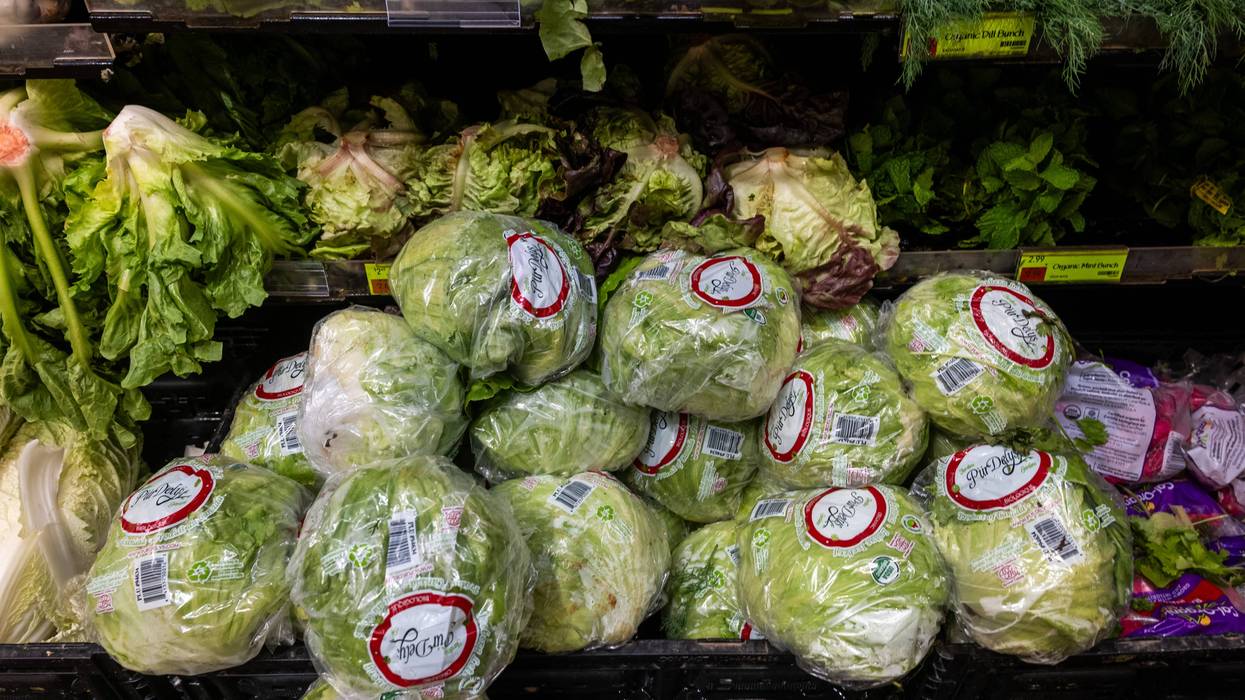
The report, published by Farm Action, argues that the wide reach of produce giant Taylor Farms, which is the source of the outbreak, spread food contaminated by the Cyclospora parasite far and wide before an issue was detected.
One problem with Taylor Farms' reach, the report states, is that it is often hidden, leaving people unaware of the source of certain products.
"Taylor Farms produces 40% of the salad kits sold in the country and grows about one-quarter of its own vegetables, sourcing the rest through partner farms," the report says. "That makes it a major link between farms and some of the nation’s largest food buyers."
The company's produce is used at popular fast-food chains such as Taco Bell, McDonald's, and Chipotle, and is sold at big-name grocery stories including Whole Foods, Target, Safeway, and Costco.
Beyond that, its produce is bought by foodservice distribution giants Sysco and US Foods, who send it to assorted schools, hospitals, and hotels.
The report says that the consolidation of the produce production industry was itself enabled by the industry consolidation of grocery stores, restaurant chains, and foodservice distributors, which found it more efficient to buy from conglomerates such as Taylor Farms, which the report categorizes as "grower-shipper-packers (GSPs)."
"Like other large GSPs, Taylor Farms sources produce through regional and international networks rather than relying primarily on nearby farms," writes Farm Action. "That helps explain why investigators traced lettuce implicated in the 2026 Cyclospora outbreak to Mexico, even in the middle of summer when much of the US is capable of growing lettuce."
Because Taylor distributes its produce to so many places under so many different brands, the report continues, consumers have a hard time avoiding them even if they are actively trying.
What's more, the 2026 Cyclospora outbreak isn't the first time Taylor has been linked to a food safety event, as Farm Action found that it was connected to "the 2026 Salmonella outbreak linked to jalapeño products, previous Cyclospora outbreaks, the 2024 E. coli outbreak linked to McDonald’s onions, the 2021 E. coli cluster involving romaine lettuce, and numerous recalls for allergens, labeling errors, contamination risks, and processing defects."
"These incidents do not by themselves prove a pattern of systemic problems," the report adds. "But Taylor Farms’ repeated connection to major outbreaks and recalls warrants a closer look at whether these are unrelated incidents or signs of recurring weaknesses."
The report concludes by recommending stronger enforcement of US antitrust laws to break up big distributors, as well as stronger food safety and traceability policies.
Sarah Carden, senior director of research and policy at Farm Action, said the report on Taylor Farms should be a wakeup call to food safety regulators about the dangers of corporate centralization.
"Taylor Farms has extraordinary reach across the produce supply chain, a history of connections to major food safety events, significant political spending and access, and a workplace record that raises serious questions," said Carden. "Its growth also shows how consolidation has left farmers with fewer buyers and made our food supply increasingly dependent on a small number of powerful companies."