

SUBSCRIBE TO OUR FREE NEWSLETTER
Daily news & progressive opinion—funded by the people, not the corporations—delivered straight to your inbox.
5
#000000
#FFFFFF
To donate by check, phone, or other method, see our More Ways to Give page.
Daily news & progressive opinion—funded by the people, not the corporations—delivered straight to your inbox.
"The use of false charges and criminal prosecutions to deflect blame away from politically powerful leaders and their allies is an abuse of the justice system that cannot be tolerated," said another critic.
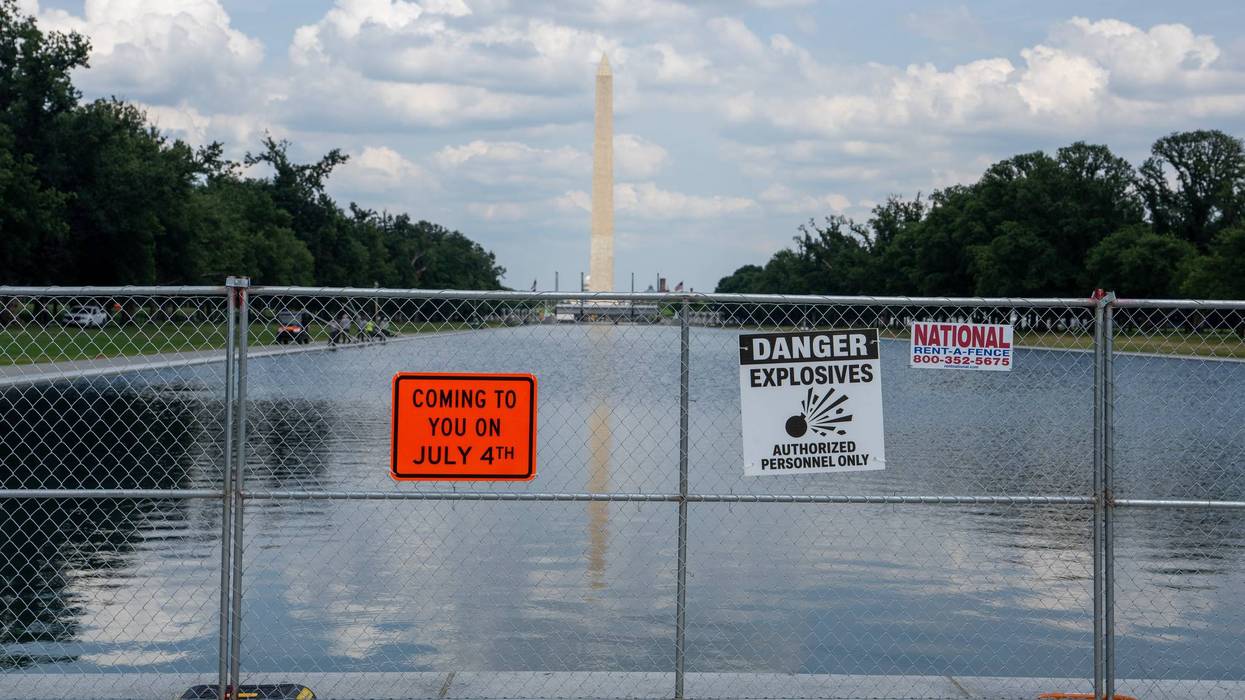
The US Department of Justice on Friday moved to throw out its criminal case against David Hearn, the Olympian it accused of vandalizing the Lincoln Memorial Reflecting Pool in Washington, DC, sparking demands for, at minimum, an apology from the DOJ.
"The Trump administration's case against Davey Hearn should have never been brought," said his attorneys, Norm Eisen of Democracy Defenders Fund, Mary Dohrmann of Washington Litigation Group, and Steve Levin of Steptoe LLP, in a joint statement.
"Its dismissal today does not erase the abuse of government power in arresting and charging a patriotic American who did nothing wrong," they continued. "The government's approach was ready, fire, aim. The administration owes Mr. Hearn an apology."
President Donald Trump in April announced plans to renovate the Reflecting Pool for the country's 250th anniversary. Two months later, despite the administration spending millions of dollars on resurfacing, the water turned green from algae. That led to a hydrogen peroxide treatment and a $1.7 million no-bid contract for a company whose owner is a Trump donor, after which multiple ducks were found dead.
Hearn, one of several people accused of tampering with the pool, was arrested in June. Early last month, Jeanine Pirro, the Trump-appointed US attorney for the District of Columbia, revealed that her office had secured a felony indictment against him. The 67-year-old, who faced up to a decade in prison, pleaded not guilty and had a trial scheduled for September.
"I didn't vandalize anything," Hearn, an Olympic canoeist, said in an interview with The Washington Post, explaining that he had touched a piece of pool lining that was already peeling off. "I didn't destroy or break or peel anything. By the time I realized what was going on, I was being put in handcuffs."
In its Friday motion to dismiss the case, Pirro's office said that after the return of the indictment, the US Department of the Interior (DOI) provided information indicating that the damage "was the result of flawed installation by the contractor, Atlantic Industrial Coatings (AIC), and the rush to complete the project prior to events associated with the America 250 celebration in the weeks surrounding Independence Day 2026."
"It is difficult to attribute the widespread damage to the Reflecting Pool to vandalism, let alone to establish that fact beyond a reasonable doubt," the document also states.
MS NOW legal analyst Lisa Rubin highlighted Pirro's previous promise to "prove beyond a reasonable doubt" that Hearn caused the damage.
NBC News noted that "a spokesperson for Pirro said the filing spoke for itself. Her office also moved to dismiss at least one of the other three misdemeanor cases that had been brought in connection with the Reflecting Pool."
It's not just Pirro's office and the DOJ under fire for this debacle. While welcoming the motion to dismiss, Tim Whitehouse, executive director of the nonprofit Public Employees for Environmental Responsibility (PEER), took aim at DOI in a Saturday statement.
"This project has become a poster child for corruption and why competitive bidding and transparency in federal contracting matter," Whitehouse said. "Transparency in contracting prevents waste, self-dealing, and exactly the kind of expensive, embarrassing failure this project has become. Decisions about the best way to repair public infrastructure should rest with engineers and career experts following open, competitive bidding, not with political officials chasing a photo-op deadline ordered by the president while steering money to favored contractors."
"The use of false charges and criminal prosecutions to deflect blame away from politically powerful leaders and their allies is an abuse of the justice system that cannot be tolerated," he added. "The Interior Department officials responsible for this failure—the no-bid contract, the botched renovation, lying to the public and the rush to blame an innocent man—owe the public a full accounting. PEER calls on Congress to investigate and demands that those responsible face real consequences."
Meanwhile, Trump took to his Truth Social platform to make clear that he "100%" disagrees with Pirro, sparking speculation about whether he may fire her.
Interior Secretary Doug Burgum then claimed that "the evidence is clear, vandals have repeatedly caused damage to the Reflecting Pool," in a post on the platform X that New York Times reporter Trip Gabriel described as "repeating the boss."
Hearn's attorneys said that "Trump and Burgum are attacking Pirro because she admitted what we established in our legal filings all along: Trump's botched renovation was responsible for the damage—not Davey Hearn. However, Pirro's claim that she and her office were previously duped by Interior is nonsense."
"Starting immediately after arraignment, our motions repeatedly proved that the administration was to blame for the Reflecting Pool failures, not Davey," they added. "This is far from over, as we consider all legal remedies."
This article has been updated with new comments from President Donald Trump, Interior Secretary Doug Burgum, and Davey Hearn's attorneys.
"America’s 250th anniversary celebration is supposed to be an occasion for strengthening public trust in our democratic institutions," said one advocate. "Freedom 250 is a privately managed slush fund."
As the 250th anniversary of the United States' independence approaches, a government watchdog group is warning that the Trump administration has refused to release key documents regarding President Donald Trump's Freedom 250 project, in which the White House has partnered with corporations including Palantir and ExxonMobil to organize what it's called "a celebration of America like no other."
Public Employees for Environmental Responsibility (PEER) filed a lawsuit Monday against the Department of Interior (DOI) in the US District Court for the District of Columbia, more than two months after the group filed multiple Freedom of Information Act (FOIA) requests regarding the funding of the "controversial and secretive" Freedom 250 initiative.
As the agency that oversees the National Parks Service, DOI and Interior Secretary Doug Burgum are playing a major role in the organization of Freedom 250, with the celebration including projects like the National Garden of American Heroes, the proposed Freedom 250 Grand Prix at the National Mall, and the proposed Independence Arch.
In late February, PEER's FOIA requests sought information from DOI on reports that public funds are being directed to Freedom 250 through the congressionally chartered National Park Foundation, "with no transparency, no accountability, and no guardrails."
“America’s 250th anniversary celebration is supposed to be an occasion for strengthening public trust in our democratic institutions, not eroding it,” Tim Whitehouse, PEER’s executive director, said late Monday. “In contrast, Freedom 250 is a privately managed slush fund... It epitomizes what is wrong with politics today."
In its lawsuit, PEER said the DOI "has failed to make a final determination on any of PEER’s FOIA requests and has failed to disclose any of the requested records within the time stipulated under FOIA."
The department has failed to respond to the requests as reports have mounted that Trump is using Freedom 250 to:
In its lawsuit, PEER noted that the DOI was required to respond to the FOIA requests by March 20, but communications from the department have indicated officials plan to respond no sooner than August 3—after the main 250th anniversary celebrations occur.
Whitehouse said DOI's failure disclose information about the funding mechanisms for Freedom 250 continue "a pattern of Secretary Doug Burgum dispensing with a variety of legal safeguards to improperly facilitate Trump projects—particularly around the nation’s capital."
"Just look no further than his more than $1 billion ballroom or vanity projects, such as the arch," said Whitehouse.
Burgum has pushed for the construction of a 250-foot arch in Washington, saying it "embodies American freedom." Trump has said the project could be paid for by private donors, while veterans groups and historians have filed legal challenges over the proposed project, arguing Congress needs to approve its construction.
“Burgum’s actions on offshore wind appear to be motivated by the personal financial interests of those in the administration, not our collective national interests."
A week after the US Department of the Interior said it was immediately halting five offshore wind projects in the interest of "national security," a watchdog group told congressional committees Monday that the move is "not legally defensible" and raises "significant" questions about conflicts of interest concerning a top DOI official's investments in fossil gas.
Timothy Whitehouse, executive director of Public Employees for Environmental Responsibility (PEER), wrote to the top members of the Senate Energy and Natural Resources Committee and the House Committee on Natural Resources regarding the pause on projects off the coasts of Virginia, New York, Rhode Island, Connecticut, and Massachusetts—projects that account for billions of dollars in investment, employ thousands of people, and generate sustainable energy for roughly 2.5 million homes and businesses.
The announcement made by Interior Secretary Doug Burgum last week pertained to "five vague, perfunctory, cookie-cutter orders" halting the projects, wrote Whitehouse, but PEER is concerned that the orders were issued to evade the Congressional Review Act (CRA), under which the action to halt the projects likely constitutes a "major rule."
Whitehouse explained:
Under the CRA, a rule that meets any one of three criteria (an annual effect on the economy of $100,000,000 or more; a major increase in costs or prices for consumers, individual industries, federal, state, or local government agencies, or geographic regions; or in pertinent part significant adverse effects on competition, employment, investment, productivity, or innovation) is a major rule. Interior’s pause likely meets all three.
As a major rule under the CRA, the pause cannot take effect until at least 60 days after BOEM provides Congress the requisite notification and report under the CRA, which, according to GAO’s database, has not yet occurred. Congress must use its oversight authority to unveil the truth and, as appropriate, and to enforce the rule of law.
He said in a statement that “Burgum’s move is designed to bypass all congressional and public input."
The CRA states that a rule is "the whole or a part of an agency statement of general or particular applicability and future effect designed to implement, interpret, or prescribe law or policy or describing the organization, procedure, or practice requirements of an agency.”
Press statements by the DOI and by Burgum last week were "statements of general applicability and imminent future effect, designed to implement policy," wrote Whitehouse, who also said the interior secretary embarked on "a coordinated rollout with Fox News entities."
On December 22, Fox anchor Maria Bartiromo asked Burgum at 8:00 am Eastern, “What next action did you want to tell us about this morning?” Five minutes later, FoxNews.com published its first story on Burgum's orders, citing a press release that had not yet been made public and including a quote from the secretary about the "emerging national security risk" posed by the offshore wind projects.
"If last week’s actions are allowed to stand, future presidents will have unchecked authority under the guise of national security to target federal leases related to entire disfavored energy industries for political purposes."
Burgum's announcement to Fox came at least one to two hours before Bureau of Ocean Energy Management (BOEM) acting Director Matthew Giacona provided the orders to the lessees running the five wind projects.
Further, wrote Whitehouse, "Burgum’s voluminous public comments in the hours and days since the pause further show the true purpose of Interior’s singular action."
"The national security pretext quickly gives way to broad and spurious talking points about the 'Green New Scam,' how 'wind doesn’t blow 24-7' (evincing Burgum’s seeming unfamiliarity with energy storage technologies), and unyielding promotion of liquified natural gas projects," wrote Whitehouse.
Aside from the alleged illegality of Burgum's order, PEER pointed to Giacona's potential conflicts of interest with BOEM operations and specifically with halting wind projects. Giacona is a "diligent filer" of financial disclosure forms required by the Ethics in Government Act, noted Whitehouse—but those forms point to potential benefits he may reap from shutting down offshore wind infrastructure.
Giacona reported his purchase of interests in the United States Natural Gas Fund (UNG) on September 16. The fund tracks daily price movements of "natural" gas delivered at the Henry Hub in Louisiana and is subject to regulation by the Commodity Futures Trading Commission.
"Accordingly, a government employee who has an interest in UNG also has a potential conflict of interest with the underlying holdings of UNG (currently primarily natural gas futures contracts at the Henry Hub)," wrote Whitehouse.
PEER does not know whether Giacona continues to hold a financial interest in UNG or whether the offshore wind pause will have a "direct and predictable effect on a financial interest in UNG," but Whitehouse noted that Burgum and DIO have entwined the pause with the promotion of liquefied natural gas.
"It is disconcerting that Mr. Giacona temporarily had even a de minimis financial interest in natural gas futures while also leading the agency that manages the development of natural gas resources on the outer continental shelf," wrote Whitehouse, adding that Giacona also sold interests in the United States Oil Fund on September 3, while overseeing BOEM.
Based on Giacona's investments, said Whitehouse, “Burgum’s actions on offshore wind appear to be motivated by the personal financial interests of those in the administration, not our collective national interests. This is another misguided step in transforming the federal government into a franchise of the fossil fuel industry.”
“On public lands across the United States, the Department of the Interior has tens of thousands of additional active leases related to oil, gas, wind, solar, and geothermal production and mining for energy-related minerals," he added. "If last week’s actions are allowed to stand, future presidents will have unchecked authority under the guise of national security to target federal leases related to entire disfavored energy industries for political purposes."
The warning of litigation to plastics makers comes as EPA is accused of failing to adequately test for "forever chemicals" in pesticides.
A newly reported warning to the plastics industry and a complaint filed by an environmental nonprofit this week highlighted how companies and the U.S. government have endangered the public with "forever chemical" contamination.
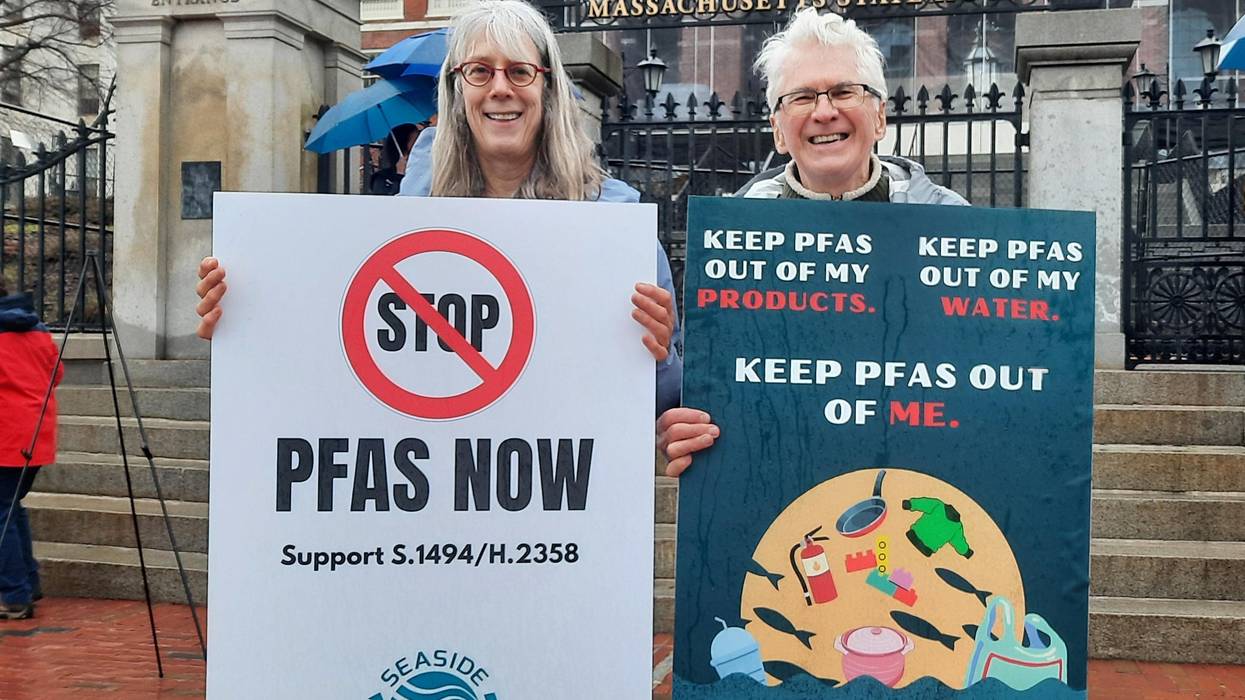
Per- and polyfluoroalkyl substances (PFAS) are commonly called forever chemicals because they remain in the human body and environment for long periods. They have been used in products such as firefighting foam, food packaging, stain-resistant fabrics, and pesticides, and linked to various health problems including cancers and issues with reproduction.
The New York Times reported Tuesday that attorney Brian Gross recently told plastics executives that looming corporate liability litigation related to PFAS—some of which has already begun—could "dwarf anything related to asbestos," and lead to "astronomical" costs.
As the newspaper detailed:
"Do what you can, while you can, before you get sued," Mr. Gross said at the February session, according to a recording of the event made by a participant and examined by The New York Times. "Review any marketing materials or other communications that you've had with your customers, with your suppliers, see whether there's anything in those documents that's problematic to your defense," he said. "Weed out people and find the right witness to represent your company."
A spokesman for Mr. Gross' employer, MG+M The Law Firm, which defends companies in high-stakes litigation, didn't respond to questions about Mr. Gross' remarks and said he was unavailable to discuss them.
While Gross declined to comment, Emily M. Lamond, who focuses on environmental law at the firm Cole Schotz, told the Times that "to say that the floodgates are opening is an understatement."
"Take tobacco, asbestos, MTBE, combine them, and I think we're still going to see more PFAS-related litigation," Lamond said, referring to methyl tert-butyl ether. The newspaper noted that "together, the trio led to claims totaling hundreds of billions of dollars."
Back in 2005, the U.S. Environmental Protection Agency announced that DuPont would "pay $10.25 million—the largest civil administrative penalty EPA has ever obtained under any federal environmental statute—to settle violations alleged by EPA" related to PFAS and commit to $6.25 million for supplemental environmental projects.
The EPA has also taken more recent actions under President Joe Biden's "PFAS Strategic Roadmap," including designating perfluorooctanoic acid (PFOA) and perfluorooctanesulfonic acid (PFOS) as hazardous substances under the Superfund law and setting the country's first-ever drinking water standards for those and other forever chemicals.
The Biden administration's steps, as the Times pointed out, are expected to fuel future litigation. Green groups have called the EPA's recent moves progress but not nearly enough—and as Capital B reported earlier this month, there are concerns that PFAS cleanup could disproportionately burden communities home to the working class and people of color.
On top of calls to go further with regulation and cleanup efforts, the EPA is facing pressure to retract what Public Employees for Environmental Responsibility (PEER) called "false statements" in a 2023 agency research memo and press release. The group filed a formal complaint with the EPA on Tuesday demanding a correction.
"This memo is some of the worst science I have seen come out of the agency," said PEER science policy director Kyla Bennett, a scientist and former EPA attorney, in a statement. "The fact that EPA claimed it could not find any PFAS in samples deliberately spiked is incredibly troubling."
"Scientists around the world are finding PFAS in pesticides from active and inert ingredients, contamination from fluorinated containers, and unknown sources," she continued. "EPA's claim that it 'did not find any PFAS' in these pesticides is not only untrue but lulls the public into a false sense of security that these products are PFAS-free."
Asked about PEER's submission by journalist Carey Gillam, the agency—which has 90 days to respond—said that "because these issues relate to a pending formal complaint process, EPA has no further information to provide."
Gillam reported that "joining in the allegations is environmental toxicologist Steven Lasee, who authored the 2022 study that the EPA challenged. Lasee is a consultant for state and federal government agencies on PFAS contamination projects and participated as a research fellow for the EPA's Office of Research and Development from February 2021 to February 2023."
As Gillam detailed at New Lede and The Guardian:
Amid the uproar over his paper and the subsequent EPA testing, Lasee sought to reproduce his initial results but was unable to do so. That created enough doubt about his own methodology that he sought to retract his paper.
Now, after seeing the EPA's internal testing data showing the agency did find PFOS and other types of PFAS in pesticides but failed to disclose those results, he has a new level of doubt—over the credibility of the agency.
"When you cherrypick data, you can make it say whatever you want it to say," Lasee said.
PEER's Bennett similarly said that "you don't get to just ignore the stuff that doesn't support your hypothesis. That is not science. That is corruption. I can only think that they were getting pressure from pesticide companies."
Public health groups are "fully committed to taking all steps available to assure that the Inhance fluorination no longer produces dangerous PFAS which put workers, consumers, and communities at risk."
As public health experts raise alarm over the prevalence of highly toxic "forever chemicals," as per- and polyfluoroalkyl substances or PFAS are commonly known, one nonprofit investigative journalism outlet warned Saturday that a recent ruling could further tie up the regulatory process for the chemicals and other harmful substances.
"This ruling is likely to impede already excruciatingly slow efforts to regulate the presence of health harming chemicals in products people use in every part of their lives," said Watershed Investigations of a decision handed down earlier this month by the right-wing Fifth Circuit Court of Appeals in New Orleans.
The case is one of several involving Inhance Technologies, a Houston-based company that manufactures an estimated 200 million plastic containers each year using the fluorination process, which creates perfluorooctanoic acid (PFOA), a toxic PFAS compound.
In 2020, the Environmental Protection Agency (EPA) began requiring companies to submit notices regarding "significant new uses" of PFAS under Section 5 of the Toxic Substances Control Act (TSCA), as officials identified the chemicals as an "urgent public health and environmental issue" due to their links to cancer, liver and kidney disease, reproductive harms, and other serious health problems.
The agency found that PFAS were leaching into pesticides held in containers produced by Inhance.
In December, the agency prohibited Inhance from using the fluorination process because it had identified PFAS as an "unavoidable aspect" of its operations. Inhance sued the EPA soon after.
Inhance said that ending its fluorination practices would ultimately force the company to shut down and fought the EPA's order, arguing that it had created its plastic containers in the same way for decades, and therefore was not subject to the TSCA provision regarding "significant new use."
The EPA argued it only became aware of Inhance's process in 2020, but the conservative court disagreed that it could regulate the company under the "new use" rule—even as the judges acknowledged the company's products are harmful.
"The court did not dispute EPA's underlying decision that this is a danger to human health, what they did was say it's not a new use, which I think is wrong... but this case isn't over by any stretch," Kyla Bennett, a former EPA official who is now director of science policy for Public Employees for Environmental Responsibility (PEER), told The Guardian Saturday.
The judges said the EPA would have to regulate Inhance's containers under Section 6 of the TSCA, which it said requires the EPA to take into account the economic impact any regulations would have on Inhance.
PEER noted that Section 6 also states that health risks should be considered.
"The court erroneously limits EPA's authority to issue significant new use rules (SNURs) under the TSCA, seriously weakening this important tool for managing chemical risks to health and the environment which has been a mainstay of the TSCA program since the law's enactment in 1976," the group said.
Another case is playing out in the U.S. District Court for the Eastern District of Pennsylvania, where the EPA sued Inhance in 2022 for violating the TSCA. The Center for Environmental Health and PEER also took legal action against Inhance for the same reason, and against the EPA last month for withholding test data regarding PFAS in plastic containers.
"There are several paths forward," said PEER, "and our groups are fully committed to taking all steps available to assure that the Inhance fluorination no longer produces dangerous PFAS which put workers, consumers, and communities at risk."
There is good reason to fear that a new Biden administration policy will create a broad chilling effect on scientific work involving hot button topics, such as birth control, climate change, and fetal tissue research. We must do better.
Laurance J. Peter, author of the “Peter Principle” that theorized in any hierarchy every employee tends to rise to his or her level of incompetence, once remarked that “Bureaucracy defends the status quo long past the time when the quo has lost its status.” This ingrained institutional resistance to change often induces bureaucracies to seek to suppress facts that challenge underlying assumptions of the current political agenda.
So, it was distressing to see the Biden White House issue a “Model Scientific Integrity Policy” earlier this year containing a provision that would forbid any federal from scientist “making or publishing” any statements “that could be construed as being judgments of, or recommendations on,” any federal policy without permission. It was doubly ironic that this new prohibition is contained in the section that purports to promote transparency and the “free flow of scientific information.”
This provision was based upon a similar bar contained within the U.S. Department of Agriculture’s scientific integrity policy adopted in 2014. USDA’s is the only federal scientific integrity policy with such a prohibition.
USDA has used this provision mainly to assuage concerns expressed by agrochemical companies and other “stakeholders.” In this regard, this provision has been invoked to order a staff entomologist to remove his name from a peer-reviewed journal article on how monoculture farming reduces diversity in insect populations, thus limiting beneficial pollinators. That same provision was also cited as the basis for barring a scientist from speaking at a conference about the effects on pollinators from genetically modified crops and the insecticides used to treat them. That scientist later resigned in frustration after concluding that groundbreaking research would be impossible to pursue inside USDA.
Unfortunately, the early indications are that with White House support, other agencies will adopt this gag order in their scientific integrity policies. This summer, the Department of Health & Human Services proposed to add this prohibition in its policy. It is now in its final stage of approval, meaning that it may soon apply across the entire $1.7 trillion HHS, its 12 divisions, and nine separate public health agencies, including the Centers for Disease Control & Prevention (CDC), National Institutes of Health, and Food & Drug Administration. Altogether, these agencies have roughly 78,000 employees, most of whom perform scientific or technical work that would be covered by the new policy.
There is good reason to fear that this new policy will create a broad chilling effect on scientific work involving hot button topics, such as birth control, climate change, and fetal tissue research. For example, a far more limited Congressional ban on the use of research funds “to advocate or promote gun control” caused the CDC to cease all gun violence research for more than 20 years until that legislative language, called the Dickey Amendment, was finally narrowed in 2019. Applying a broad prohibition on anything that “could be construed as” a comment or recommendation on any federal policy in all research at HHS would be tantamount to putting the Dickey Amendment on steroids.
It is especially galling that a ban on discussing the implications of research is part of a scientific integrity policy.
The further irony is that the Biden directive driving the revision of all federal scientific integrity policies was motivated by the censorship and suppression of science that occurred during the Trump years, during which the current scientific integrity policies inaugurated under President Obama proved useless. It does not take much imagination to envision how this Biden-sponsored language could be weaponized during a DeSantis or second Trump presidency.
Rather than serving any explicit political agenda from the White House or HHS Secretary Xavier Becerra, this provision appears to be the product of mid-level bureaucrats seeking to maintain some control of the clearance process for research publications. Under the guise of scientific integrity, the bureaucratic need to control information appears to have prevailed in the construction of a new generation of federal policies.
It is especially galling that a ban on discussing the implications of research is part of a scientific integrity policy. Scientific research with policy implications is often most at risk of suppression or political manipulation – and thus in greater need of protection rather than condemnation.
Nonetheless, this prohibition on statements that could be perceived as a comment or recommendation on any federal policy may spread across a score of agencies that are now in the process of revising their scientific integrity policies. It is easily foreseeable that this provision could be used to punish scientists or stifle research deemed controversial, such as –
On top of everything else, such a prohibition is patently unconstitutional as applied to government scientists speaking or writing as private citizens, since the public interest in the issue would almost always outweigh any potential disruption of efficient government operations.
Even if expressing these views is legally protected, government scientists should not need to cast a profile in courage to discuss the implications of their research openly. Federal bureaucracies do not need more opportunities to quash controversial findings or dissenting views. The Biden White House should pull the plug on this ill-considered restriction.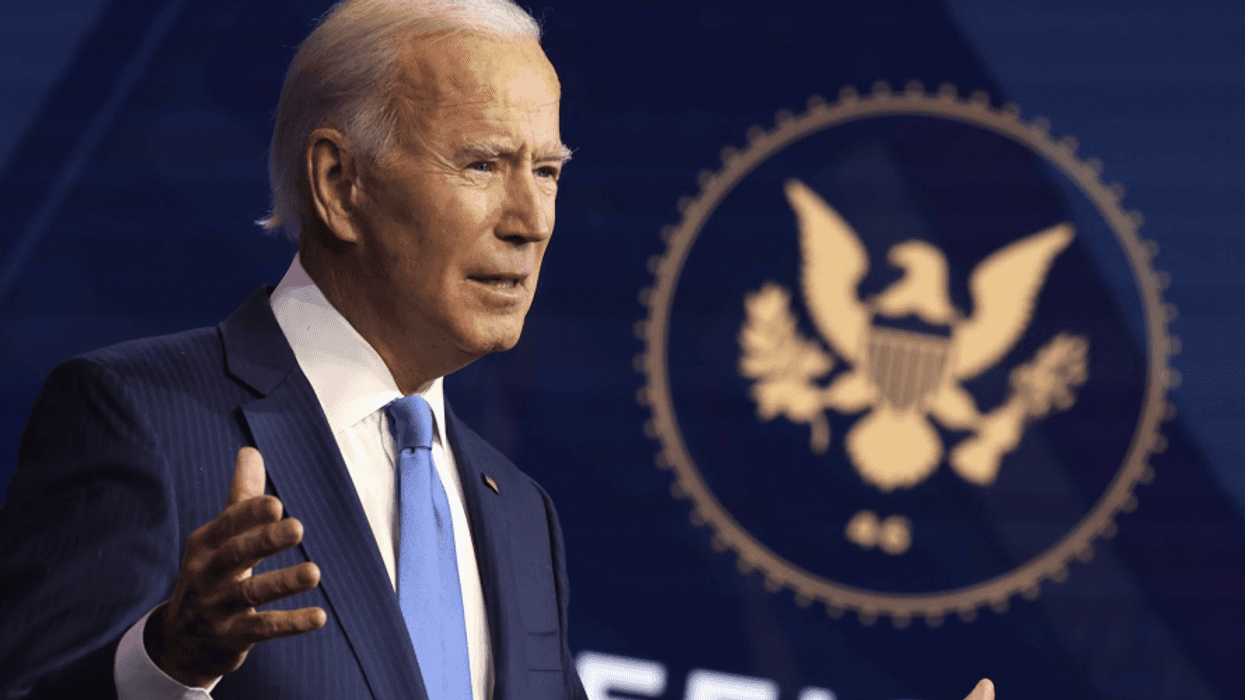
"Nothing about this proposed policy would prevent a return to the reign of 'alternative facts' should Trump be reelected," said one critic.
A coalition of public health and science advocacy groups on Tuesday called on the Biden administration to strengthen its proposed scientific integrity policy, warning that the proposal does little to solve the problem of the political interference that was rampant in the federal government under former Republican President Donald Trump.
Shortly after taking office, President Joe Biden signed an executive order pledging to "protect scientists from political interference and ensure they can think, research, and speak freely to provide valuable information and insights to the American people," followed by a requirement for federal agencies to review how such interference can be avoided through policy changes.
More than two years later, the White House Office of Science and Data Policy joined the U.S. Department of Health and Human Services (HHS) in releasing a draft policy which, if finalized, would cover all scientists working within the department and could serve as a template for other federal agencies.
But without provisions for independent investigations into alleged misconduct, legal protections for scientists doing certain types of work, and with "few safeguards against scientific work being altered or suppressed," the coalition said the draft "leaves a lot to be desired."
"Scientific integrity problems at HHS have ranged from unwarranted age restrictions on emergency contraception during the Obama administration to halting important research and interfering with Covid-19 guidance during the Trump administration."
Groups including Public Employees for Environmental Responsibility (PEER), the Government Accountability Project, and the Center for Reproductive Rightswrote to the administration to warn that both Democratic and Republican administrations have stood in the way of scientific integrity, calling for vigilance from the Biden White House.
"Scientific integrity problems at HHS have ranged from unwarranted age restrictions on emergency contraception during the Obama administration to halting important research and interfering with Covid-19 guidance during the Trump administration," wrote the groups in their public comments on the policy. "HHS should design its scientific integrity policy to provide protections against such meddling and effective avenues for correction when interference occurs. HHS should also consider the possibility of individuals acting in bad faith using the policy to harass scientists who are doing their jobs, and HHS should erect barriers to such bad-faith attempts."
The groups listed a number of areas in which they believe the new draft policy is lacking, including:
PEER pointed out that the lack of specific guidance for grantees is a "major gap" in the policy, as much of the scientific work at agencies such as the National Institutes of Health is completed by scientists who receive grants.
The group's comments notes that the right-wing Trump administration canceled teen pregnancy prevention grants and terminated federally funded research using fetal tissue, yet the policy draft does not include "specific protections against early termination of both research and service grants for political reasons."
The policy's "'Protecting Scientific Processes' section could include a prohibition against terminating intramural or extramural research funding for reasons other than breach of contract, abusive behavior, or gross mismanagement," the groups said.
"Nothing about this proposed policy would prevent a return to the reign of 'alternative facts' should Trump be reelected," said Pacific PEER director Jeff Ruch. "Under this proposed policy, every aspect of enforcing scientific integrity principles would remain a captive of the political process inside the agencies."
The policy also includes "the extremely broad statement that HHS scientists 'shall refrain from making or publishing statements that could be construed as being judgments of, or recommendations on, HHS or any other federal government policy,'" reads the letter. "A bad-faith actor seeking to harass a scientist whose work they find distasteful could claim to have 'construed' virtually any statement as a judgment of government policy."
"For instance," the groups added, "a scientist who makes a factual statement about the effect of a policy—for instance, explaining how a Trump administration directive to stop procuring fetal tissue halted work on an HIV study—could be accused of criticizing that policy decision. We recommend that HHS remove this text from its scientific integrity policy to avoid creating a weapon for bad-faith actors."
The watchdogs applauded the administration for taking steps to protect government scientists from retaliation, "rather than relying on existing whistleblower protections alone."
But the policy, they said, should include language assuring scientists that they can work "free from reprisal or concern for reprisal" and should "specifically provide protections against blocklisting/blacklisting and retaliatory investigations and offer an affirmative defense to whistleblowers who are subjected to civil or criminal lawsuits."
When Biden announced an overhaul of scientific integrity policies to protect scientists in 2021, groups including PEER said the move was a "welcome change from the Trump administration."
On Tuesday, however, Ruch warned that "little about this proposed policy would restore public faith in the credibility of government science."
International law recognizes the interest of nations in protection of its living marine resources, including rare and endangered species, and the U.S. has the legal ability to impose speed restrictions.
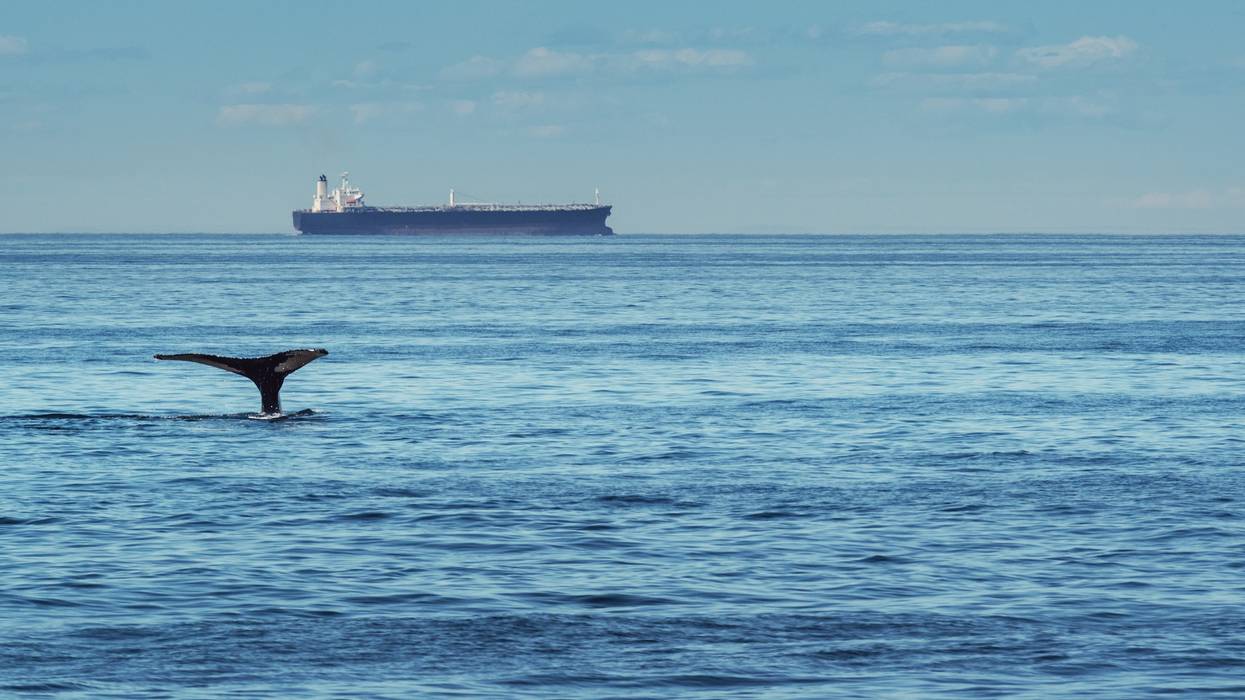
Whales are the biggest creatures on earth, but they are no match for a supertanker. In recent months there has been a rash of whales washed up on U.S. shores, with broken backs or other mortal injury.
These known deaths are only a fraction of the true toll. Most of the carcasses sink at sea and are never discovered.
But, by all indications, collisions between whales and ships are on the rise, devastating whale populations. At least three large whale species in U.S. waters are on the brink of extinction, with more listed as endangered. These would be the planet’s first large whale species lost in modern history.
The leading cause of death for many of these species is preventable ship strikes. And these deaths are expected to continue growing due to a number of causes. First, global trade has grown almost exponentially driving a huge growth in ship traffic in the world's oceans. Today, there are an estimated four times as many ships at sea than just three decades ago.
Second, this increasing cargo traffic is carried by bigger ships travelling through coastal waters that are primary whale habitats. Since 2006, the size of the largest container ships has more than doubled. Many of today’s ships are so big that they do not know that they have struck a whale. Both the size of ships and cargo volume are both projected to continue spiraling upward
At the same time, containership speeds have steadily grown with speeds now averaging between 20 to 25 knots.
These factors combine to devastating effect. Whales seem to rely on last‐second avoidance. Almost all ships are quieter at lower speeds. Quieter seas allow marine life more leeway to communicate for their essential life functions. The cumulative probability of detecting one of the available “cues” of whale’s presence (and direction of travel) decreases with increased ship-to-whale distances. Moreover, a big ship creates a “bow null effect” that blocks engine noise by the bow, creating a quiet zone in front of the vessel, leaving a whale unaware of the pending threat.
The net result of thousands of massive ships crisscrossing waters which are prime whale habitat is that many of our busiest coastal shipping routes have become death traps. For example, the Southern California shipping lanes to San Francisco cover the two busiest hubs in California and, not coincidentally, are also two epicenters of whale mortality from ship strikes.
Despite looming extinctions of whale populations and increasing vulnerability of whales to ship strikes in U.S. waters, the National Oceanic & Atmospheric Administration lacks a coherent strategy for avoidance of these collisions. Instead, the U.S. has a piecemeal approach, limited by certain species and in certain areas.
In the absence of mandatory restrictions in much of U.S. waters, NOAA and other authorities have depended on voluntary measures, with mixed success. For example, a new analysis of automated ship tracking data shows that nearly 90 percent of vessels transiting mandatory speed zones to protect the highly endangered North Atlantic right whales are violating the speed limits.
In the San Francisco area, cooperation rates with NOAA’s voluntary speed limits have been hovering around 62 percent for the last three years, with compliance varying by company. Maersk, one of the world’s largest shipping companies, has slowed down 79 percent of the time in the Santa Barbara Channel. But ships operated by Matson, a major Pacific shipper, slowed only 16 percent of the time.
Similarly, collision avoidance techniques are mostly voluntary, and these programs are widely ignored by shippers. But these voluntary efforts do demonstrate that application of active whale avoidance techniques by large ships is feasible. Yet the effectiveness of these measures requires some form of mandatory enforcement to ensure widespread compliance.
Last year, Congress directed NOAA to establish a near real-time monitoring and mitigation program to reduce the risk to large cetaceans posed by vessel strikes. My organization is proposing a plan to NOAA that directly responds to this congressional direction. We urge the creation of Whale Safety Zones for all large ships entering or leaving U.S. ports or transiting marine sanctuaries and monuments. While in these Whales Safety Zones, these ships must reduce their speed and take other whale avoidance measures that studies show sharply reduces whale mortality when applied.
International law recognizes the interest of nations in protection of its living marine resources, including rare and endangered species, and the U.S. has the legal ability to impose speed restrictions.
What is required, however, is the political will to adopt mandatory safety measures that will be effective in stemming the rising tide of preventable whale deaths. Unless NOAA acts in a comprehensive fashion we fear the nation will witness the onset of a cascade of whale extinctions.