SUBSCRIBE TO OUR FREE NEWSLETTER
Daily news & progressive opinion—funded by the people, not the corporations—delivered straight to your inbox.
5
#000000
#FFFFFF
To donate by check, phone, or other method, see our More Ways to Give page.
Daily news & progressive opinion—funded by the people, not the corporations—delivered straight to your inbox.
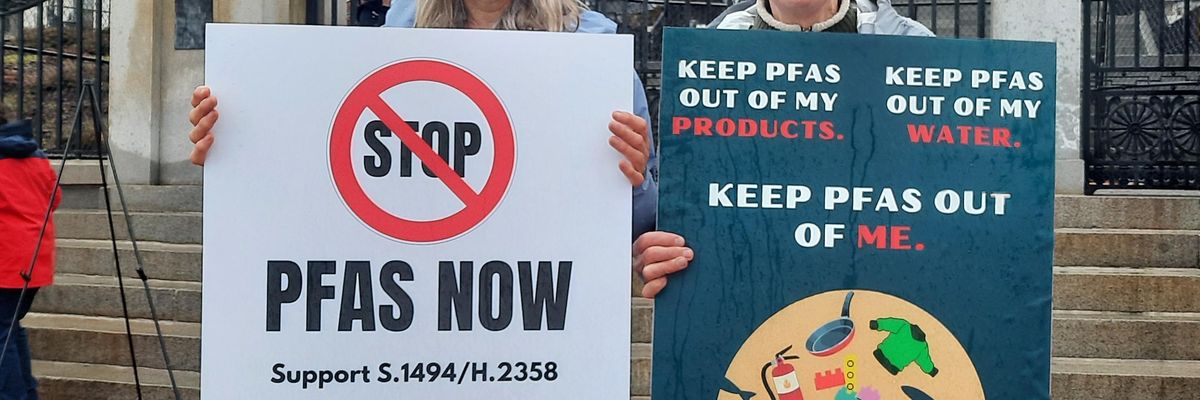
Activists protest PFAS outside the Massachusetts State House in Boston on June 16, 2022.
Public health groups are "fully committed to taking all steps available to assure that the Inhance fluorination no longer produces dangerous PFAS which put workers, consumers, and communities at risk."
As public health experts raise alarm over the prevalence of highly toxic "forever chemicals," as per- and polyfluoroalkyl substances or PFAS are commonly known, one nonprofit investigative journalism outlet warned Saturday that a recent ruling could further tie up the regulatory process for the chemicals and other harmful substances.
"This ruling is likely to impede already excruciatingly slow efforts to regulate the presence of health harming chemicals in products people use in every part of their lives," said Watershed Investigations of a decision handed down earlier this month by the right-wing Fifth Circuit Court of Appeals in New Orleans.
The case is one of several involving Inhance Technologies, a Houston-based company that manufactures an estimated 200 million plastic containers each year using the fluorination process, which creates perfluorooctanoic acid (PFOA), a toxic PFAS compound.
In 2020, the Environmental Protection Agency (EPA) began requiring companies to submit notices regarding "significant new uses" of PFAS under Section 5 of the Toxic Substances Control Act (TSCA), as officials identified the chemicals as an "urgent public health and environmental issue" due to their links to cancer, liver and kidney disease, reproductive harms, and other serious health problems.
The agency found that PFAS were leaching into pesticides held in containers produced by Inhance.
In December, the agency prohibited Inhance from using the fluorination process because it had identified PFAS as an "unavoidable aspect" of its operations. Inhance sued the EPA soon after.
Inhance said that ending its fluorination practices would ultimately force the company to shut down and fought the EPA's order, arguing that it had created its plastic containers in the same way for decades, and therefore was not subject to the TSCA provision regarding "significant new use."
The EPA argued it only became aware of Inhance's process in 2020, but the conservative court disagreed that it could regulate the company under the "new use" rule—even as the judges acknowledged the company's products are harmful.
"The court did not dispute EPA's underlying decision that this is a danger to human health, what they did was say it's not a new use, which I think is wrong... but this case isn't over by any stretch," Kyla Bennett, a former EPA official who is now director of science policy for Public Employees for Environmental Responsibility (PEER), told The Guardian Saturday.
The judges said the EPA would have to regulate Inhance's containers under Section 6 of the TSCA, which it said requires the EPA to take into account the economic impact any regulations would have on Inhance.
PEER noted that Section 6 also states that health risks should be considered.
"The court erroneously limits EPA's authority to issue significant new use rules (SNURs) under the TSCA, seriously weakening this important tool for managing chemical risks to health and the environment which has been a mainstay of the TSCA program since the law's enactment in 1976," the group said.
Another case is playing out in the U.S. District Court for the Eastern District of Pennsylvania, where the EPA sued Inhance in 2022 for violating the TSCA. The Center for Environmental Health and PEER also took legal action against Inhance for the same reason, and against the EPA last month for withholding test data regarding PFAS in plastic containers.
"There are several paths forward," said PEER, "and our groups are fully committed to taking all steps available to assure that the Inhance fluorination no longer produces dangerous PFAS which put workers, consumers, and communities at risk."
Dear Common Dreams reader, It’s been nearly 30 years since I co-founded Common Dreams with my late wife, Lina Newhouser. We had the radical notion that journalism should serve the public good, not corporate profits. It was clear to us from the outset what it would take to build such a project. No paid advertisements. No corporate sponsors. No millionaire publisher telling us what to think or do. Many people said we wouldn't last a year, but we proved those doubters wrong. Together with a tremendous team of journalists and dedicated staff, we built an independent media outlet free from the constraints of profits and corporate control. Our mission has always been simple: To inform. To inspire. To ignite change for the common good. Building Common Dreams was not easy. Our survival was never guaranteed. When you take on the most powerful forces—Wall Street greed, fossil fuel industry destruction, Big Tech lobbyists, and uber-rich oligarchs who have spent billions upon billions rigging the economy and democracy in their favor—the only bulwark you have is supporters who believe in your work. But here’s the urgent message from me today. It's never been this bad out there. And it's never been this hard to keep us going. At the very moment Common Dreams is most needed, the threats we face are intensifying. We need your support now more than ever. We don't accept corporate advertising and never will. We don't have a paywall because we don't think people should be blocked from critical news based on their ability to pay. Everything we do is funded by the donations of readers like you. When everyone does the little they can afford, we are strong. But if that support retreats or dries up, so do we. Will you donate now to make sure Common Dreams not only survives but thrives? —Craig Brown, Co-founder |
As public health experts raise alarm over the prevalence of highly toxic "forever chemicals," as per- and polyfluoroalkyl substances or PFAS are commonly known, one nonprofit investigative journalism outlet warned Saturday that a recent ruling could further tie up the regulatory process for the chemicals and other harmful substances.
"This ruling is likely to impede already excruciatingly slow efforts to regulate the presence of health harming chemicals in products people use in every part of their lives," said Watershed Investigations of a decision handed down earlier this month by the right-wing Fifth Circuit Court of Appeals in New Orleans.
The case is one of several involving Inhance Technologies, a Houston-based company that manufactures an estimated 200 million plastic containers each year using the fluorination process, which creates perfluorooctanoic acid (PFOA), a toxic PFAS compound.
In 2020, the Environmental Protection Agency (EPA) began requiring companies to submit notices regarding "significant new uses" of PFAS under Section 5 of the Toxic Substances Control Act (TSCA), as officials identified the chemicals as an "urgent public health and environmental issue" due to their links to cancer, liver and kidney disease, reproductive harms, and other serious health problems.
The agency found that PFAS were leaching into pesticides held in containers produced by Inhance.
In December, the agency prohibited Inhance from using the fluorination process because it had identified PFAS as an "unavoidable aspect" of its operations. Inhance sued the EPA soon after.
Inhance said that ending its fluorination practices would ultimately force the company to shut down and fought the EPA's order, arguing that it had created its plastic containers in the same way for decades, and therefore was not subject to the TSCA provision regarding "significant new use."
The EPA argued it only became aware of Inhance's process in 2020, but the conservative court disagreed that it could regulate the company under the "new use" rule—even as the judges acknowledged the company's products are harmful.
"The court did not dispute EPA's underlying decision that this is a danger to human health, what they did was say it's not a new use, which I think is wrong... but this case isn't over by any stretch," Kyla Bennett, a former EPA official who is now director of science policy for Public Employees for Environmental Responsibility (PEER), told The Guardian Saturday.
The judges said the EPA would have to regulate Inhance's containers under Section 6 of the TSCA, which it said requires the EPA to take into account the economic impact any regulations would have on Inhance.
PEER noted that Section 6 also states that health risks should be considered.
"The court erroneously limits EPA's authority to issue significant new use rules (SNURs) under the TSCA, seriously weakening this important tool for managing chemical risks to health and the environment which has been a mainstay of the TSCA program since the law's enactment in 1976," the group said.
Another case is playing out in the U.S. District Court for the Eastern District of Pennsylvania, where the EPA sued Inhance in 2022 for violating the TSCA. The Center for Environmental Health and PEER also took legal action against Inhance for the same reason, and against the EPA last month for withholding test data regarding PFAS in plastic containers.
"There are several paths forward," said PEER, "and our groups are fully committed to taking all steps available to assure that the Inhance fluorination no longer produces dangerous PFAS which put workers, consumers, and communities at risk."
As public health experts raise alarm over the prevalence of highly toxic "forever chemicals," as per- and polyfluoroalkyl substances or PFAS are commonly known, one nonprofit investigative journalism outlet warned Saturday that a recent ruling could further tie up the regulatory process for the chemicals and other harmful substances.
"This ruling is likely to impede already excruciatingly slow efforts to regulate the presence of health harming chemicals in products people use in every part of their lives," said Watershed Investigations of a decision handed down earlier this month by the right-wing Fifth Circuit Court of Appeals in New Orleans.
The case is one of several involving Inhance Technologies, a Houston-based company that manufactures an estimated 200 million plastic containers each year using the fluorination process, which creates perfluorooctanoic acid (PFOA), a toxic PFAS compound.
In 2020, the Environmental Protection Agency (EPA) began requiring companies to submit notices regarding "significant new uses" of PFAS under Section 5 of the Toxic Substances Control Act (TSCA), as officials identified the chemicals as an "urgent public health and environmental issue" due to their links to cancer, liver and kidney disease, reproductive harms, and other serious health problems.
The agency found that PFAS were leaching into pesticides held in containers produced by Inhance.
In December, the agency prohibited Inhance from using the fluorination process because it had identified PFAS as an "unavoidable aspect" of its operations. Inhance sued the EPA soon after.
Inhance said that ending its fluorination practices would ultimately force the company to shut down and fought the EPA's order, arguing that it had created its plastic containers in the same way for decades, and therefore was not subject to the TSCA provision regarding "significant new use."
The EPA argued it only became aware of Inhance's process in 2020, but the conservative court disagreed that it could regulate the company under the "new use" rule—even as the judges acknowledged the company's products are harmful.
"The court did not dispute EPA's underlying decision that this is a danger to human health, what they did was say it's not a new use, which I think is wrong... but this case isn't over by any stretch," Kyla Bennett, a former EPA official who is now director of science policy for Public Employees for Environmental Responsibility (PEER), told The Guardian Saturday.
The judges said the EPA would have to regulate Inhance's containers under Section 6 of the TSCA, which it said requires the EPA to take into account the economic impact any regulations would have on Inhance.
PEER noted that Section 6 also states that health risks should be considered.
"The court erroneously limits EPA's authority to issue significant new use rules (SNURs) under the TSCA, seriously weakening this important tool for managing chemical risks to health and the environment which has been a mainstay of the TSCA program since the law's enactment in 1976," the group said.
Another case is playing out in the U.S. District Court for the Eastern District of Pennsylvania, where the EPA sued Inhance in 2022 for violating the TSCA. The Center for Environmental Health and PEER also took legal action against Inhance for the same reason, and against the EPA last month for withholding test data regarding PFAS in plastic containers.
"There are several paths forward," said PEER, "and our groups are fully committed to taking all steps available to assure that the Inhance fluorination no longer produces dangerous PFAS which put workers, consumers, and communities at risk."