

SUBSCRIBE TO OUR FREE NEWSLETTER
Daily news & progressive opinion—funded by the people, not the corporations—delivered straight to your inbox.
5
#000000
#FFFFFF
To donate by check, phone, or other method, see our More Ways to Give page.

Daily news & progressive opinion—funded by the people, not the corporations—delivered straight to your inbox.
The polling follow a Republican push to change Nebraska rules to boost GOP nominee Donald Trump's chances of winning in November.
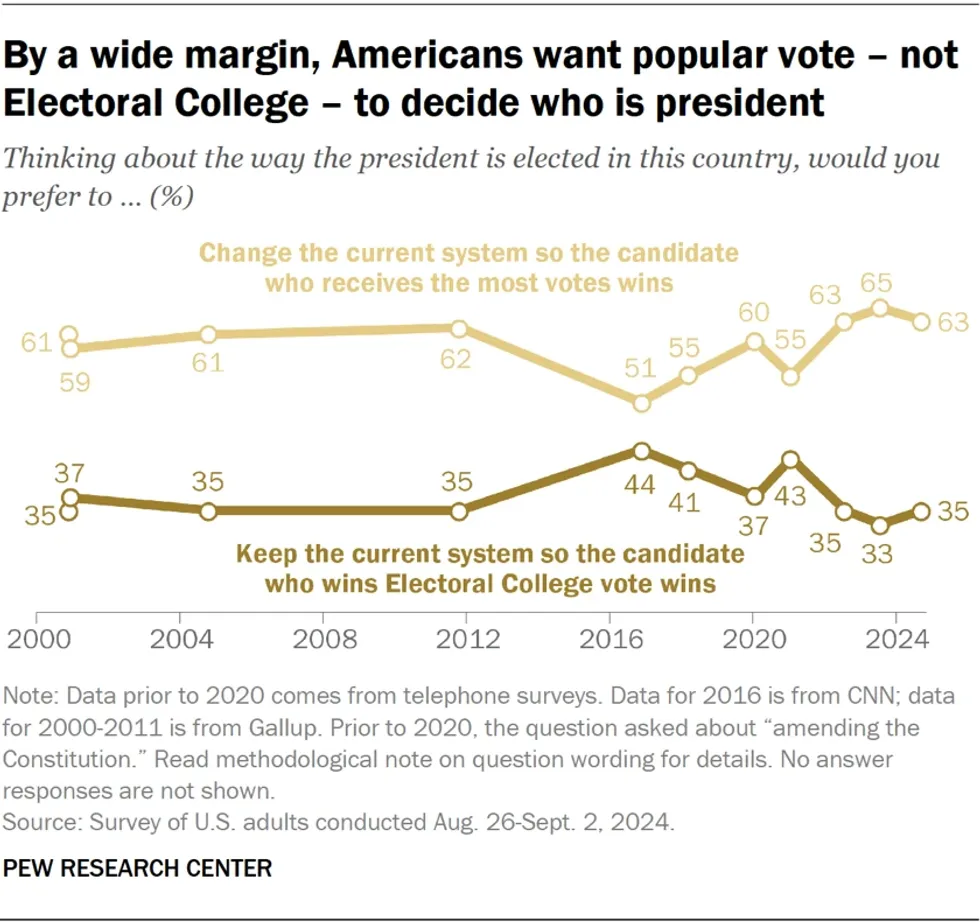
Polling results released Wednesday, less than six weeks away from November's Election Day, show that a majority of Americans want to ditch the Electoral College and "would instead prefer to see the winner of the presidential election be the person who wins the most votes nationally."
Pew Research Center surveyed 9,720 adults across the United States in late August and early September, and found that 63% want to abolish the process outlined in the U.S. Constitution and replace it with a popular vote approach, compared with just 35% who favor keeping the current system.
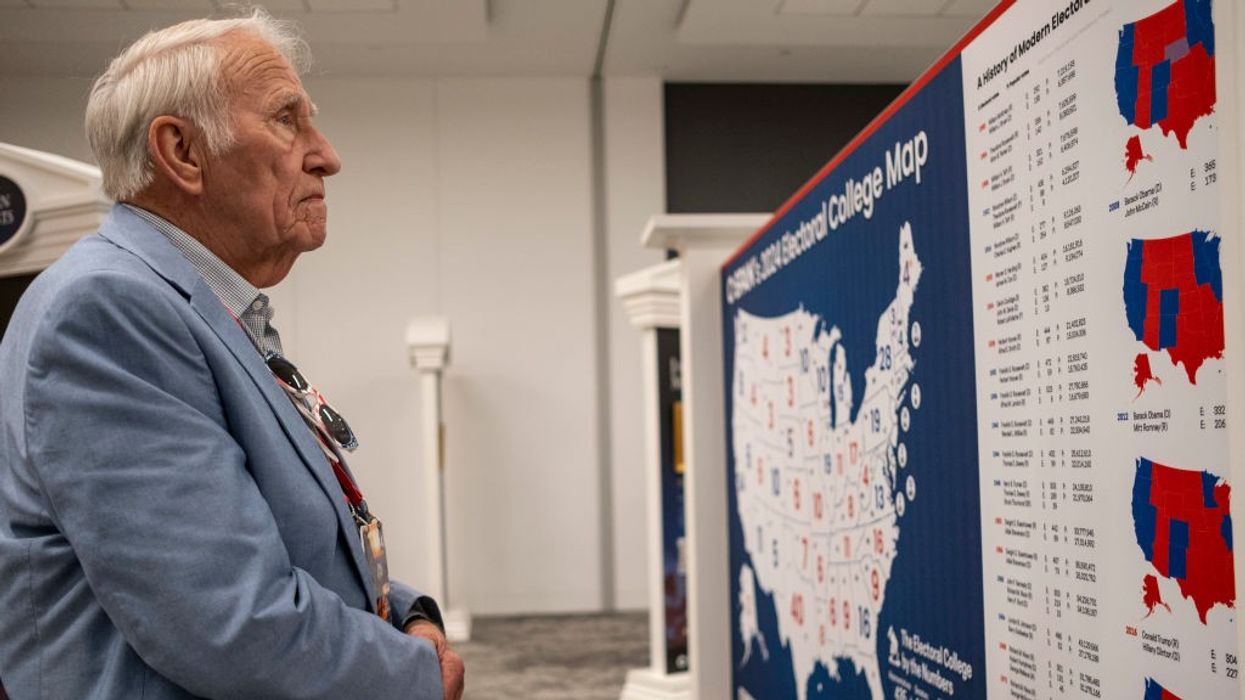
The Electoral College is made up of electors who are supposed to act on behalf of their state's voters. Each state gets the same number of electors as its members of Congress, and Washington, D.C. gets three electors, bringing the current total to 538. The candidate who secures 270 electoral votes becomes the next president.
D.C. and most states allocate all of their electoral votes to the winner of the popular vote in their state, though Maine and Nebraska give two votes to the statewide winner, and the remaining votes to the most popular candidate in each congressional district.
Pew noted Wednesday that "some Republicans have been pressing to change Nebraska's rules so that the statewide winner gets all five of its electoral votes. This would likely work to former President Donald Trump's advantage, given Nebraska's consistent support of GOP presidential candidates."
Republican Nebraska Gov. Jim Pillen confirmed Tuesday that he has no plans to call a special legislative session to restore a winner-takes-all approach before the November election, in which Trump is set to face Democratic Vice President Kamala Harris.
There have been just five presidential contests in which the Electoral College winner did not also win the nationwide popular vote—1824, 1876, 1888, 2000, and most recently in 2016, when Trump beat Democrat Hillary Clinton by securing key "swing states."
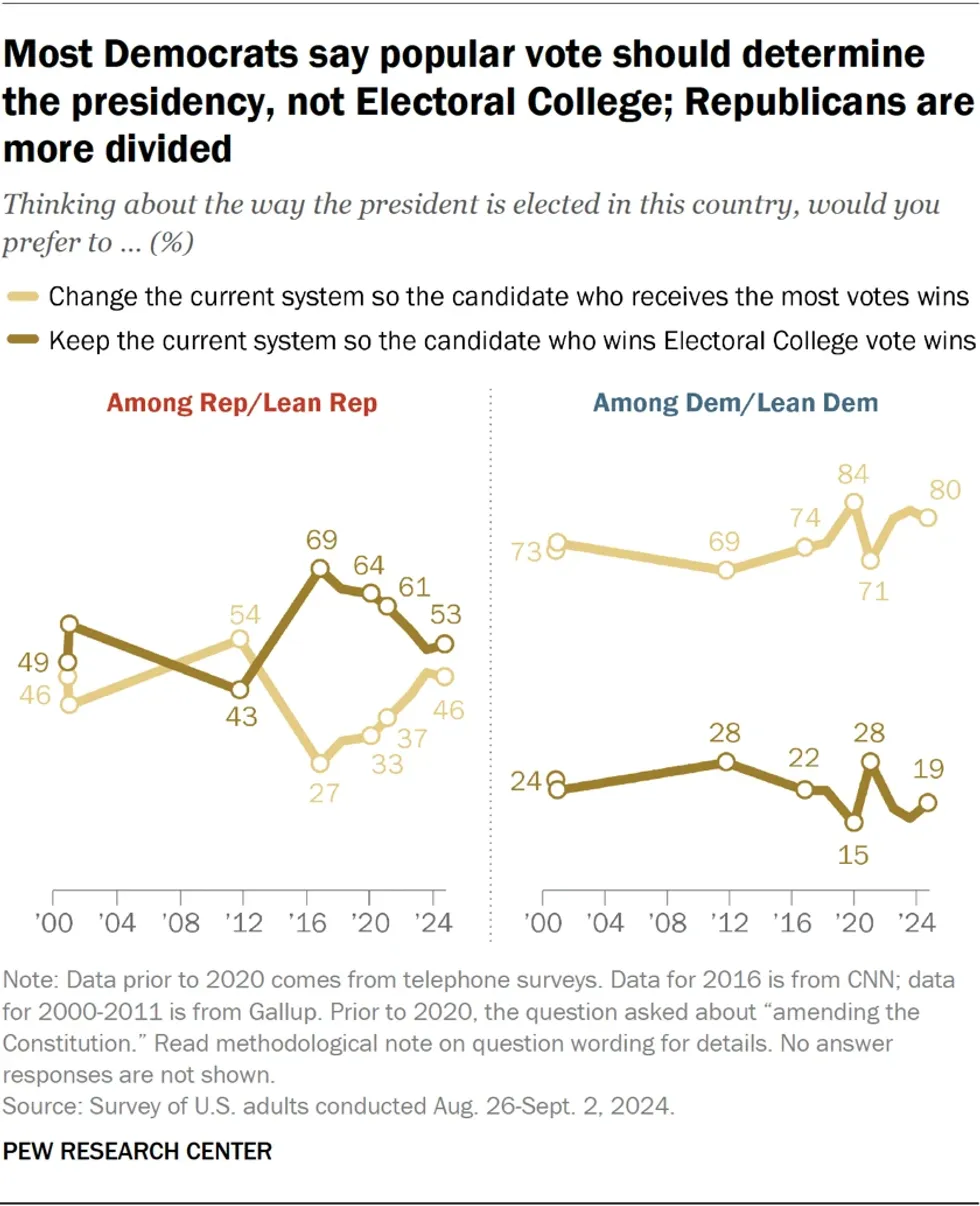
Continuing a trend that's lasted over two decades, 8 in 10 Democrats and Democratic-leaning Independents told Pew that they prefer a popular vote system for the presidential contest, while Republicans and Independents who lean toward the GOP were more divided: 53% want to retain the Electoral College and 46% would like to replace it.
"Reference sources indicate that over the past 200 years more than 700 proposals have been introduced in Congress to reform or eliminate the Electoral College," according to the National Archives. "There have been more proposals for Constitutional amendments on changing the Electoral College than on any other subject."
Among them is a joint resolution that Congressman Steve Cohen (D-Tenn.) introduced just days after Trump incited a violent mob to disrupt the certification of his 2020 loss by storming the U.S. Capitol on January 6, 2021—for which the Republican nominee faces ongoing legal trouble.
"Americans expect and deserve the winner of the popular vote for any office to win and assume that office," Cohen said at the time. "More than a century ago, we amended our Constitution to provide for the direct election of U.S. senators. It is past time to directly elect our president and vice president. The Electoral College is a vestige of the 18th Century when voters didn't know the candidates who now appear daily on their phones and television screens."
"Last week's mayhem at the Capitol shows that attempts to manipulate the Electoral College vote by politicians employing falsehoods are a real danger," he added. "The president should always be elected by the people, not by politicians. Currently, the system allows politicians to make the ultimate decision. It is well past time to do away with this anachronistic institution and guarantee a fair and accurate vote for president."
Nearly 9 in 10 respondents to the Pew Research Center survey also said the 2024 election campaign "does not make them feel proud of the country."
A majority of U.S. voters view both President Joe Biden and former President Donald Trump, the presumptive Republican nominee, as "embarrassing" choices, according to a Pew Research Center survey published Thursday.
Not only do 63% of voters see both men as embarrassing, 37% of Biden supporters and 33% of Trump backers also said the same thing about their own preferred candidates. Nearly 9 in 10 respondents said the 2024 campaign "does not make them feel proud of the country."
The survey found that 44% of respondents support or "lean toward" Trump, while 40% back or lean toward Biden. Robert F. Kennedy Jr., who switched from a Democratic to an Independent candidate, came in a distant—but significant—third with 15% of respondents supporting or leaning toward him.
The new poll comes as several of Biden's closest allies told NBC News that "they now see his chances of winning as zero."
Furthermore, these people—including three who are "directly involved" in Biden's reelection effort—believe his candidacy will harm down-ticket Democratic candidates.
"He needs to drop out," one Biden campaign staffer told the outlet. Referring to the president's disastrous debate performance last month, the official added that "he will never recover from this."
Politico reported that a Thursday meeting between top Biden advisers and Democratic senators meant to reassure nervous lawmakers "didn't work."
Speaking about Biden's campaign staff, Sen. Peter Welch (D-Vt.)—who on Wednesday became the first Democratic member of the upper chamber to call on Biden to step aside—said: "I have great respect for their team. It doesn't change my point of view."
Reps. Hillary Scholten (D-Mich.), Brad Schneider (D-Ill.), Ed Case (D-Hawaii), and Greg Stanton (D-Ariz.) on Thursday
urged Biden to stand down, bringing the total number of U.S. lawmakers who have done so to 14.
"President Biden has served his country well, but for the sake of our democracy, he must pass the torch to a new candidate for the 2024 election," Scholten said on social media.
Politico reported that other lawmakers are preparing to publicly call on Biden to drop out of the race. In a Thursday CNN interview, Rep. Gerry Connolly (D-Va.), a former Biden staffer from his Senate days, said that "hard, cold decisions" must be made about the president's candidacy, stopping just short of urging him to step down.
"I'm very concerned that Biden could lose," said Connolly. "Polling data is not encouraging right now, and I hope the White House takes that into account as well."
Rep. Gerry Connolly, a long-time Biden ally and former staffer, goes right up to the line in calling on Biden to drop out.
Says “hard, cold decisions” need to be made and that Biden needs to listen to outside voices that aren’t just his family’s.
“I’m very concerned that Biden… pic.twitter.com/S3FgSS4r3f
— Manu Raju (@mkraju) July 11, 2024
Some observers have criticized the U.S. corporate media for its heightened focus on Biden's age and mental fitness at the expense of Trump's recent felony conviction in a New York hush money case, his three pending federal and state criminal trials—two of them related to efforts to overturn the 2020 presidential election—and his apparent lies about a far-right plot to ensure the federal government is stacked with Trump loyalists.
Guardian columnist Margaret Sullivan wrote this week that the "bigger story" is Trump's "appalling unfitness for office, not only because he tried to overturn a legitimate election and is a felon, out on bail and awaiting sentencing, but because of things he has said and done in very recent weeks."
"As just one example, he claimed that he doesn't know anything about Project 2025, the radical right-wing plan hatched by some of his closest allies to begin dismantling our democracy if he wins another term," she continued.
"All of these disturbing elements—the Democrats' dilemma, the media's failures, and the cult-like, unquestioning support of Trump—could add up to one likelihood in November," Sullivan added. "A win for Trump, and a terrible loss for democracy."
On Thursday, the Los Angeles Times editorial board wrote that Biden's debate performance "raised concerns about whether he can win in November, and prompted calls from prominent Democrats, columnists, and others for him to step aside."
"It's up to the Democratic Party to sort this out," the board said. "But it's time to refocus attention on the only candidate in the race who is patently unfit for office—any office—and an imminent threat to democracy: Donald Trump."
The editors continued:
It's unbelievable that the nation is spending so much time on the question of Biden's verbal acuity, when the greatest concern ought to be that his challenger is a self-aggrandizing felon and twice-impeached election-denier. Trump fomented the January 6 insurrection, shows contempt for the rule of law, and shamelessly lies in pursuit of more power. He's an authoritarian who admires murderous despots, wants to jail his political enemies, and has publicly flirted with declaring himself a dictator on his first day back in office.
"Leaders of the Democratic Party have to stop the self-defeating discussion about Biden's fitness and decide whether to replace him or unify behind him," the editors conclude. "And Americans must start hearing more about how the records, positions, and character of Biden, Vice President Kamala Harris, and any of the prominent Democrats being floated as possible replacements make them all unquestionably superior to Trump."
I still remember the day that my family and I became American citizens. We emigrated from Iran and had wound our way through this country's arcane immigration system for 14 years. We were finally ready after filling out countless forms, enduring endless waits in INS offices, and taking the citizenship exam. We got into our brand-new Toyota and drove to a small courthouse in Danville, Illinois, where we raised our right hands and were sworn in. Just months later, I was so excited to get my navy-blue-covered passport in the mail.
I felt like we had finally made it. I felt like maybe we were free and equal. Yet more than 20 years later, all of that feels like a farce. Because of the poisonous effects of Donald Trump, our newest American demagogue, I am about to become a second-class citizen when I travel abroad. After Trump first proposed a ban on Muslims traveling to the U.S., his fellow Republican, House Speaker Paul Ryan, condemned the plan. Yet that very same day, Speaker Ryan's own US House passed a bill that would restrict my travel - as well as Syrian-, Iraqi- and Sudanese-Americans by eliminating a visa waiver program.
Congress approved that toxic measure last Friday as part of the omnibus government funding bill, which President Obama signed the same day.
Words matter. Donald Trump's words are far more than fodder for fellow politicians, late-night comedians, and people who create amusing social media memes. His Islamophobic rants in GOP debates and rallies have a real-life effect, reverberating in seemingly small but deeply important shifts in public policy and personal interactions. Our country will feel the impact of his words for years to come in many ways.
Ask the young Muslim girl in the Bronx who was physically attacked by fellow students who yelled "ISIS" at her. Talk to the Moroccan-American cab driver who was shot with a rifle by an Islamophobic customer in Pittsburgh. Or the Latino man in Boston, beaten up by two brothers who said that Trump was right about deporting immigrants after they beat the man with a pipe and urinated on him.
Ignoring and laughing at Trump haven't worked. What should we do about the clear and present danger Mr. Trump poses? First and most obviously, we must fight the onslaught of hate on the airwaves and stop its spread in our city councils, statehouses, and Congress. I know few organizers and communicators who don't regret seeing Mr. Trump's threat earlier and treating it more seriously.
Second, we must organize against him at the ballot box. As Trump is far too happy to point out, our country's demographics are changing: Every year, 800,000 Latinos turn 18 and become eligible to vote. Asian Americans and Pacific Islanders are the fastest-growing racial groups in the U.S. We should use every moment to naturalize, register, educate, and turn out these new voters.
Our third task is the most difficult: engaging, confronting, and talking with his supporters. Because Trump's moment is temporary, the issue is about his supporters. An easy go-to is to write off his base and turn up our noses in liberal arrogance: "Can you believe some bigoted dimwit thinks this way?" Rather than writing off a voter who is interested in Trump as racist or ignorant, we need to engage them. The rise of social media and narrow-casting have enveloped all of us in comfortable cocoons occupied by only the people who agree with us.
No matter what they think, Trump's supporters will continue to be a durable part of one big electorate and a part of our nation. A recent study by the Pew Research Center is just the latest to show the incredible trends in downward mobility for tens of millions of people. And as another recent study from the National Academy of Sciences shows, middle-aged white people are killing themselves off at an alarming rate. Xenophobia is an easy answer to their anxieties about skyrocketing income inequality and the extraordinary concentration of wealth. But we can't let this easy answer win.
One small but hopeful example is from Ohio on a recent day of coordinated protests against mosques. In Columbus, a lone woman showed up and held signs filled with Islamophobic slogans. A woman from the mosque nudged the protestor into conversation and then did the unthinkable: she invited the protestor into the mosque. The woman dropped her hostility and put down her signs. "I've never been in a mosque," said the woman as she entered the building to applause from the assembled members. These leaders modeled the simple courage and determination that we all must carry.
Though I didn't have to answer any questions on my US citizenship exam about American demagogues, our country is getting a full-scale lesson in one now. Demagogues have been a familiar character in democracies since the ancient Greeks created the term -- "demos agogos," meaning "the one leading the people" -- centuries ago. And in the history of demagogues in our country, from the anti-Semite Father Charles Coughlin during the 1930s to red-baiter Joe McCarthy in the 1950s, people have always defeated them. The political historian Michael Signer writes, "History shows that the American people have internalized a set of constitutional values that short-circuit demagogues...the people themselves have refused to accede to a national demagogue's seductions."
We must call to the best angels in our country's nature, which takes more than words. It takes engagement, vigilance, and refusing xenophobic policies. I look forward to helping defeat our most recent demagogue.