SUBSCRIBE TO OUR FREE NEWSLETTER
Daily news & progressive opinion—funded by the people, not the corporations—delivered straight to your inbox.
5
#000000
#FFFFFF
To donate by check, phone, or other method, see our More Ways to Give page.
Polling results released Wednesday, less than six weeks away from November's Election Day, show that a majority of Americans want to ditch the Electoral College and "would instead prefer to see the winner of the presidential election be the person who wins the most votes nationally."
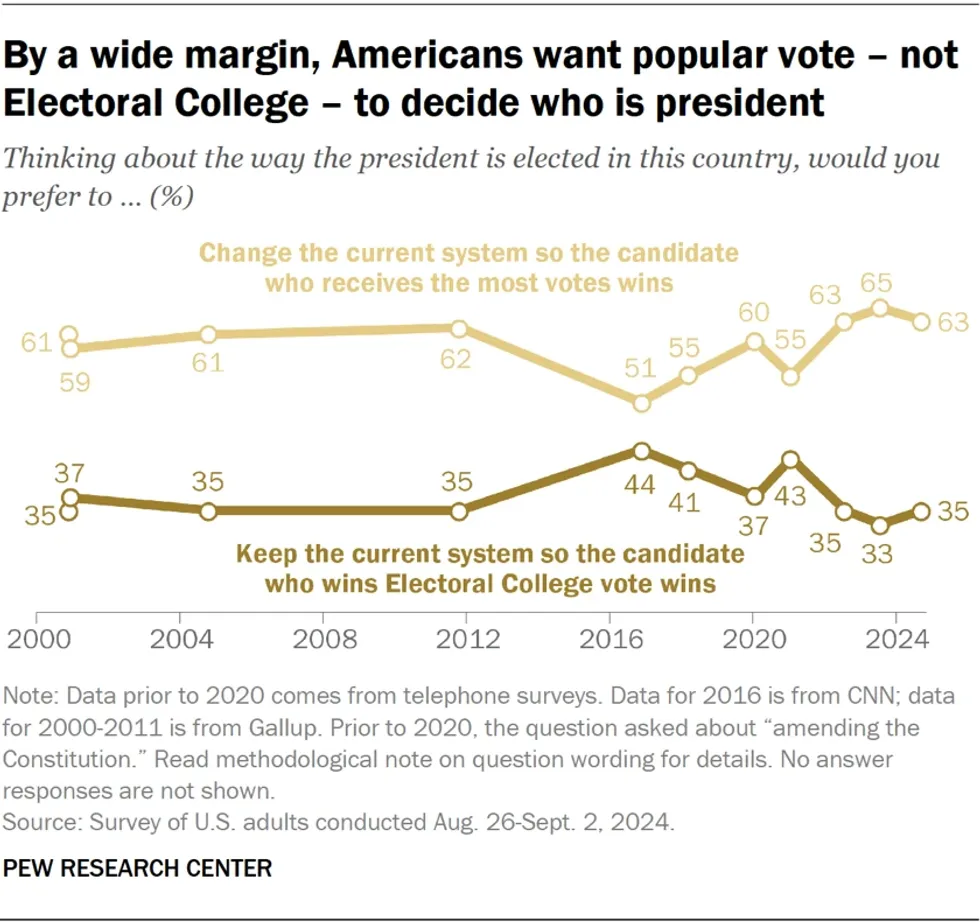
Pew Research Center surveyed 9,720 adults across the United States in late August and early September, and found that 63% want to abolish the process outlined in the U.S. Constitution and replace it with a popular vote approach, compared with just 35% who favor keeping the current system.
The Electoral College is made up of electors who are supposed to act on behalf of their state's voters. Each state gets the same number of electors as its members of Congress, and Washington, D.C. gets three electors, bringing the current total to 538. The candidate who secures 270 electoral votes becomes the next president.
D.C. and most states allocate all of their electoral votes to the winner of the popular vote in their state, though Maine and Nebraska give two votes to the statewide winner, and the remaining votes to the most popular candidate in each congressional district.
Pew noted Wednesday that "some Republicans have been pressing to change Nebraska's rules so that the statewide winner gets all five of its electoral votes. This would likely work to former President Donald Trump's advantage, given Nebraska's consistent support of GOP presidential candidates."
Republican Nebraska Gov. Jim Pillen confirmed Tuesday that he has no plans to call a special legislative session to restore a winner-takes-all approach before the November election, in which Trump is set to face Democratic Vice President Kamala Harris.
There have been just five presidential contests in which the Electoral College winner did not also win the nationwide popular vote—1824, 1876, 1888, 2000, and most recently in 2016, when Trump beat Democrat Hillary Clinton by securing key "swing states."
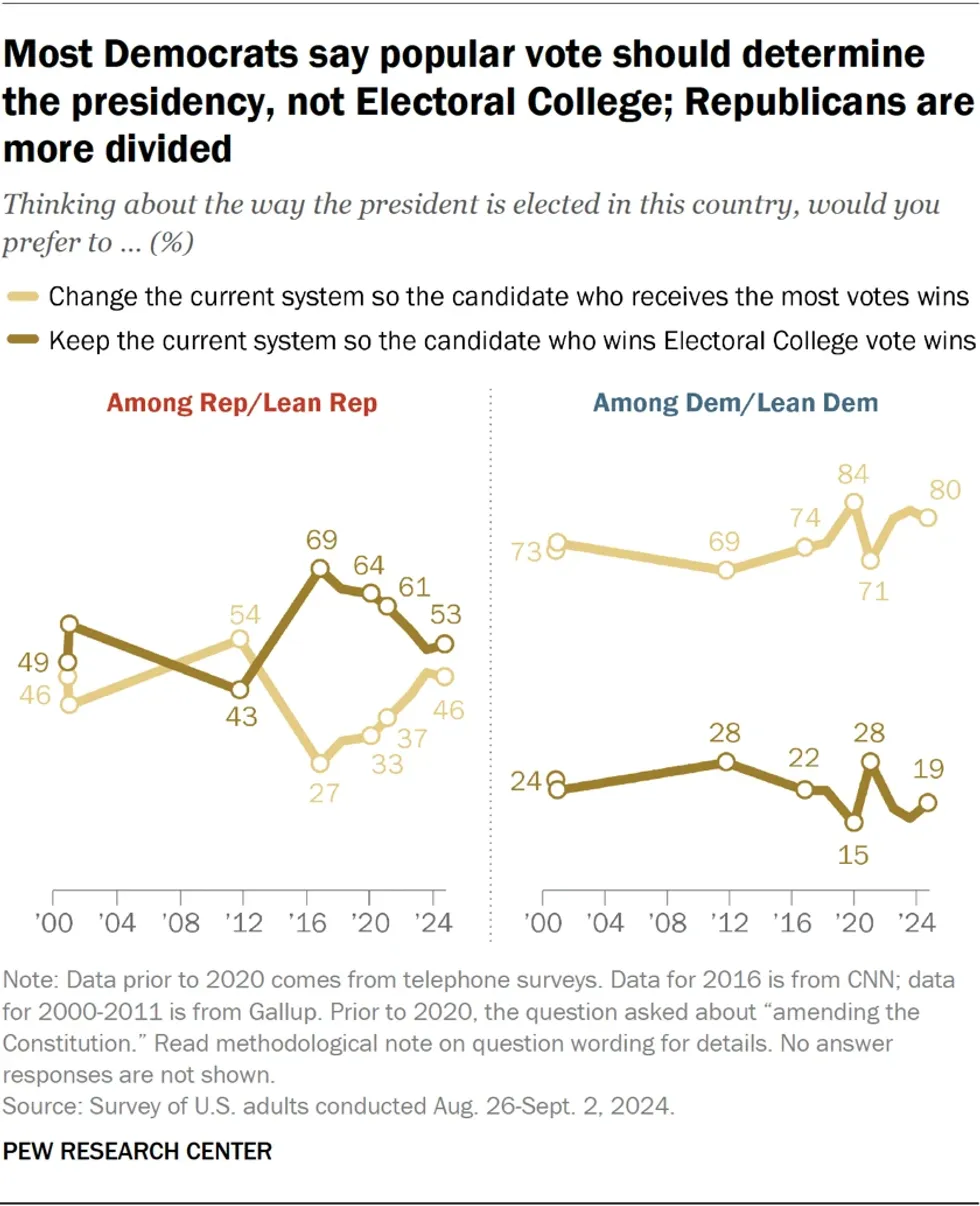
Continuing a trend that's lasted over two decades, 8 in 10 Democrats and Democratic-leaning Independents told Pew that they prefer a popular vote system for the presidential contest, while Republicans and Independents who lean toward the GOP were more divided: 53% want to retain the Electoral College and 46% would like to replace it.
"Reference sources indicate that over the past 200 years more than 700 proposals have been introduced in Congress to reform or eliminate the Electoral College," according to the National Archives. "There have been more proposals for Constitutional amendments on changing the Electoral College than on any other subject."
Among them is a joint resolution that Congressman Steve Cohen (D-Tenn.) introduced just days after Trump incited a violent mob to disrupt the certification of his 2020 loss by storming the U.S. Capitol on January 6, 2021—for which the Republican nominee faces ongoing legal trouble.
"Americans expect and deserve the winner of the popular vote for any office to win and assume that office," Cohen said at the time. "More than a century ago, we amended our Constitution to provide for the direct election of U.S. senators. It is past time to directly elect our president and vice president. The Electoral College is a vestige of the 18th Century when voters didn't know the candidates who now appear daily on their phones and television screens."
"Last week's mayhem at the Capitol shows that attempts to manipulate the Electoral College vote by politicians employing falsehoods are a real danger," he added. "The president should always be elected by the people, not by politicians. Currently, the system allows politicians to make the ultimate decision. It is well past time to do away with this anachronistic institution and guarantee a fair and accurate vote for president."
Polling results released Wednesday, less than six weeks away from November's Election Day, show that a majority of Americans want to ditch the Electoral College and "would instead prefer to see the winner of the presidential election be the person who wins the most votes nationally."
Pew Research Center surveyed 9,720 adults across the United States in late August and early September, and found that 63% want to abolish the process outlined in the U.S. Constitution and replace it with a popular vote approach, compared with just 35% who favor keeping the current system.
The Electoral College is made up of electors who are supposed to act on behalf of their state's voters. Each state gets the same number of electors as its members of Congress, and Washington, D.C. gets three electors, bringing the current total to 538. The candidate who secures 270 electoral votes becomes the next president.
D.C. and most states allocate all of their electoral votes to the winner of the popular vote in their state, though Maine and Nebraska give two votes to the statewide winner, and the remaining votes to the most popular candidate in each congressional district.
Pew noted Wednesday that "some Republicans have been pressing to change Nebraska's rules so that the statewide winner gets all five of its electoral votes. This would likely work to former President Donald Trump's advantage, given Nebraska's consistent support of GOP presidential candidates."
Republican Nebraska Gov. Jim Pillen confirmed Tuesday that he has no plans to call a special legislative session to restore a winner-takes-all approach before the November election, in which Trump is set to face Democratic Vice President Kamala Harris.
There have been just five presidential contests in which the Electoral College winner did not also win the nationwide popular vote—1824, 1876, 1888, 2000, and most recently in 2016, when Trump beat Democrat Hillary Clinton by securing key "swing states."
Continuing a trend that's lasted over two decades, 8 in 10 Democrats and Democratic-leaning Independents told Pew that they prefer a popular vote system for the presidential contest, while Republicans and Independents who lean toward the GOP were more divided: 53% want to retain the Electoral College and 46% would like to replace it.
"Reference sources indicate that over the past 200 years more than 700 proposals have been introduced in Congress to reform or eliminate the Electoral College," according to the National Archives. "There have been more proposals for Constitutional amendments on changing the Electoral College than on any other subject."
Among them is a joint resolution that Congressman Steve Cohen (D-Tenn.) introduced just days after Trump incited a violent mob to disrupt the certification of his 2020 loss by storming the U.S. Capitol on January 6, 2021—for which the Republican nominee faces ongoing legal trouble.
"Americans expect and deserve the winner of the popular vote for any office to win and assume that office," Cohen said at the time. "More than a century ago, we amended our Constitution to provide for the direct election of U.S. senators. It is past time to directly elect our president and vice president. The Electoral College is a vestige of the 18th Century when voters didn't know the candidates who now appear daily on their phones and television screens."
"Last week's mayhem at the Capitol shows that attempts to manipulate the Electoral College vote by politicians employing falsehoods are a real danger," he added. "The president should always be elected by the people, not by politicians. Currently, the system allows politicians to make the ultimate decision. It is well past time to do away with this anachronistic institution and guarantee a fair and accurate vote for president."
Polling results released Wednesday, less than six weeks away from November's Election Day, show that a majority of Americans want to ditch the Electoral College and "would instead prefer to see the winner of the presidential election be the person who wins the most votes nationally."
Pew Research Center surveyed 9,720 adults across the United States in late August and early September, and found that 63% want to abolish the process outlined in the U.S. Constitution and replace it with a popular vote approach, compared with just 35% who favor keeping the current system.
The Electoral College is made up of electors who are supposed to act on behalf of their state's voters. Each state gets the same number of electors as its members of Congress, and Washington, D.C. gets three electors, bringing the current total to 538. The candidate who secures 270 electoral votes becomes the next president.
D.C. and most states allocate all of their electoral votes to the winner of the popular vote in their state, though Maine and Nebraska give two votes to the statewide winner, and the remaining votes to the most popular candidate in each congressional district.
Pew noted Wednesday that "some Republicans have been pressing to change Nebraska's rules so that the statewide winner gets all five of its electoral votes. This would likely work to former President Donald Trump's advantage, given Nebraska's consistent support of GOP presidential candidates."
Republican Nebraska Gov. Jim Pillen confirmed Tuesday that he has no plans to call a special legislative session to restore a winner-takes-all approach before the November election, in which Trump is set to face Democratic Vice President Kamala Harris.
There have been just five presidential contests in which the Electoral College winner did not also win the nationwide popular vote—1824, 1876, 1888, 2000, and most recently in 2016, when Trump beat Democrat Hillary Clinton by securing key "swing states."
Continuing a trend that's lasted over two decades, 8 in 10 Democrats and Democratic-leaning Independents told Pew that they prefer a popular vote system for the presidential contest, while Republicans and Independents who lean toward the GOP were more divided: 53% want to retain the Electoral College and 46% would like to replace it.
"Reference sources indicate that over the past 200 years more than 700 proposals have been introduced in Congress to reform or eliminate the Electoral College," according to the National Archives. "There have been more proposals for Constitutional amendments on changing the Electoral College than on any other subject."
Among them is a joint resolution that Congressman Steve Cohen (D-Tenn.) introduced just days after Trump incited a violent mob to disrupt the certification of his 2020 loss by storming the U.S. Capitol on January 6, 2021—for which the Republican nominee faces ongoing legal trouble.
"Americans expect and deserve the winner of the popular vote for any office to win and assume that office," Cohen said at the time. "More than a century ago, we amended our Constitution to provide for the direct election of U.S. senators. It is past time to directly elect our president and vice president. The Electoral College is a vestige of the 18th Century when voters didn't know the candidates who now appear daily on their phones and television screens."
"Last week's mayhem at the Capitol shows that attempts to manipulate the Electoral College vote by politicians employing falsehoods are a real danger," he added. "The president should always be elected by the people, not by politicians. Currently, the system allows politicians to make the ultimate decision. It is well past time to do away with this anachronistic institution and guarantee a fair and accurate vote for president."