

SUBSCRIBE TO OUR FREE NEWSLETTER
Daily news & progressive opinion—funded by the people, not the corporations—delivered straight to your inbox.
5
#000000
#FFFFFF
To donate by check, phone, or other method, see our More Ways to Give page.


Daily news & progressive opinion—funded by the people, not the corporations—delivered straight to your inbox.
Though it is little noted in discussions of this year's election, Senator Bernie Sanders's campaign has brought back the essential message of then-Senator Barack Obama's "Yes We Can" campaign of 2008. The core of that message is the word "we," in contrast with former Secretary of State Hillary Clinton's frequent use of "I." However this year's election turns out, the idea that the people -- not politicians -- are the most fundamental driver of change is back in the public discussion.
The contrast between "we" and "I" has old roots in the progressive tradition. Debates about "socialism" are a diversion -- both Sanders and Clinton have legitimate claims to be progressive. But they represent different strands of the progressive tradition: the expert tradition and the populist tradition.
"Whatever the outcome of the contest between Clinton and Sanders, the key to real change is the people."
Progressivism emerged in the late 19th century and early 20th century as a movement to roll back the excesses of Gilded Age capitalism. Progressives believed in a positive role for government in taming the market. They believed in the principle of social change. They valued science. They affirmed the intrinsic worth and dignity of human beings.
But as David Thelen, past editor of the Journal of American History and a leading historian of progressivism, argued in his essay "Two Traditions of Progressive Reform" and other works, beyond these general agreements were two different tendencies. One was oriented toward bureaucracy and expert decision-making; the other was more populist, focused on grassroots democracy and participation.
Donna Shalala -- longtime Hillary Clinton confidant, secretary of health and human services during President Bill Clinton's administration and now president of the Clinton Foundation -- expressed clearly the tenets of the expert tradition back in 1989, in "Mandate for a New Century," a now-famous speech she delivered as chancellor of the University of Wisconsin-Madison. Shalala called upon higher education to engage with the problems of the world, from racism and sexism to environmental degradation, war and poverty. She also voiced the view that scientifically trained experts -- "a disinterested technocratic elite" -- should be at the center of decision-making. As Shalala put it:
The idea of society's best and brightest in service to its most needy, irrespective of any particular political philosophy ... is an idea of such great elegance... We all need to see our gifted researchers set about the work that will eliminate the cripplers we face now as thoroughly, if not as swiftly, as our research eliminated juvenile rickets in the past.
Hillary Clinton's "fighting for you" channels these expert-driven ideas. It places Clinton in the role of savior of the disadvantaged and marginalized -- Shalala's "best and brightest in service to its most needy." Clinton's calls for collective effort also suggest expert consultation. "We've got to get our heads together to come up with the best answers to solve the problems so that people can have real differences in their lives," Clinton said in her concluding remarks in a debate with Sanders on February 4, 2016.
However, the democratic tradition of progressivism has long been animated by populist movements: labor union organizing, civil rights, educational reform, the struggles of farmers to keep their farms and other such crusades. Progressive intellectuals with a grassroots democratic bent like Jane Addams, John Dewey, A. Philip Randolph and Alain Locke all had strong ties to these movements. So too did Henry Wallace, Franklin Roosevelt's secretary of agriculture and then-vice president, who in 1942 delivered a speech entitled "Century of the Common Man." Wallace's speech explicitly challenged Life publisher Henry Luce's "American Century" essay of 1941, which claimed warrant for America as global policeman. Wallace's tenure as secretary of agriculture also encompassed a little-remembered but enormous effort to democratize decision-making around how American farmland is used, from 1938 to 1941. Detailed in Jess Gilbert's 2015 book Planning Democracy, this movement showed how participatory democracy could take place with government acting as an empowering partner to its citizens -- neither savior nor enemy.
If we are to reverse the deepening mood of discouragement and powerlessness in the nation, we need wide civic involvement, amounting to a democratic awakening.
This populist, small-D democratic tradition of progressivism was revived in the civil rights movement of the 1950s and 1960s. It surfaced again in the community-organizing movement of the 1970s and 1980s, which fundamentally shaped a young Barack Obama in Chicago.
Obama took the message of grassroots democracy which he had learned from community organizing to the nation in the 2008 campaign, amplifying its themes and engaging millions of people. "I'm asking you not only to believe in my ability to make change," read the campaign website. "I'm asking you to believe in yours." The message was expressed in such memorable campaign slogans as, "We are the ones we've been waiting for," drawn from a song of the freedom movement of the 1960s. And it infused Obama's field operation. As Rolling Stone reporter Tim Dickinson noted, the goal was "not to put supporters to work but to enable them to put themselves to work, without having to depend on the campaign for constant guidance."
"We decided that we didn't want to train volunteers," Obama field director Temo Figueroa explained to Dickinson. "We want to train organizers -- folks who can fend for themselves."
After Obama took office, the democratic promise of his campaign remained largely unrealized. Indeed, after becoming president, Obama's language began to shift from "we" to "I." At the news conference marking the first 100 days of his administration, Obama was asked what he intended to do as chief shareholder of some of America's largest companies. "I've got two wars I've got to run already," he laughed. "I've got more than enough to do." This shift in pronouns paralleled the deactivation of the grassroots base of Obama for America (OFA), which had powered the campaign.
As of election night 2008, OFA included some 2.5 million activists in the My.BarackObama social network, four million donors and 13 million email supporters. After the election, the organization's name shifted to "Organizing for America," at which point a fierce argument erupted among campaign leaders. Deputy campaign manager Steve Hildebrand argued that the new OFA should become an independent nonprofit. Joe Trippi, campaign manager for 2004 Howard Dean race, observed that OFA and its supporters had many independents and some Republicans and shouldn't lose its cross-partisan qualities. Finally, David Plouffe, a key architect of the 2008 campaign was put in charge of OFA. He decided to incorporate the organization as part of the Democratic National Committee.
"The move meant that the machinery of an insurgent candidate, one who had vowed to upend the Washington establishment, would now become part of that establishment, subject to the entrenched, partisan interests of the Democratic Party," observed Rolling Stone's Dickinson. "It made about as much sense as moving Greenpeace into the headquarters of ExxonMobil."
Flash forward to 2016, and we find the Democratic campaign tapping into growing activism on many fronts -- from Occupy Wall Street and Black Lives Matter to action on climate change and local development. Bernie Sanders's core argument, that a grassroots movement will be necessary for real change, echoes the Obama 2008 message, both in its stress on participatory democracy and in its integration of a range of issues into a larger call for change -- "we" language, not "I" language. In his speech after the Iowa caucuses, Sanders said: "The powers that be... are so powerful that no president can do what has to be done alone... When millions of people come together... to stand up and say loudly and clearly, 'Enough is enough'... when that happens, we will transform this country." Should Sanders become president, he would pursue a broad activation of citizens. "Bernie Sanders has always identified with the populist side of progressivism," Huck Gutman, Sanders's chief of staff in the Senate from 2008 to 2012, told me.
It is still possible that Hillary Clinton could pick up themes from the Reinventing Citizenship project I coordinated with Bill Galston, deputy assistant for domestic policy to President Bill Clinton from 1993 to 1995, now of the Brookings Institution. Reinventing Citizenship proposed a number of measures to strengthen government as a partner of citizens in public problem-solving and the work of democracy.
Whatever the outcome of the contest between Clinton and Sanders, the key to real change is the people. The issues that the campaign has raised -- the power of Wall Street, economic inequality and stagnant wages, college debt, mass incarceration, universal health care, campaign finance reform, climate change and others -- will require citizen power on a large scale if fundamental change is to occur. There are also many other, large-scale issues, crucial to the fate of the nation, that scramble partisan lines: revitalization of the democratic purpose of education; local economic development in the face of radical technological change; the drug epidemic; and reweaving the social fabric in a time of eroding community ties, to name just a few. These are enormous challenges. If the Democratic debate continues and deepens the call for citizen activation, it could well catalyze civic efforts beyond the issues of the campaign.
It is also clear that the idea of "we" has found a resonant audience especially among young people. "Sanders gives young people a place in his campaign," wrote Elisabeth Bott, one of my students from the University of Minnesota. "For so many people, politics is tainted. Sanders's campaign restores the idea that politics can be a source of change. He understands that we live in a time of change and extreme injustice and wants to change that with the help of us all."
This idea is not Sanders's alone. Politics -- by the definition of the term dating from the Greeks until the modern era -- has long involved citizens of diverse views and interests learning to work together to solve common problems, create common good and negotiate a democratic way of life. If we are to reverse the deepening mood of discouragement and powerlessness in the nation, we need wide civic involvement, amounting to a democratic awakening.
In this election, perhaps we see its beginnings.
The protagonist of a long series of detective novels, the admirable Inspector Maigret, would see a mystery at the heart of what goes on in America. How is it that violence barely disturbs us, yet we protect ourselves against its manifestation by a massive state apparatus dedicated to searching through the lives of ordinary Americans?
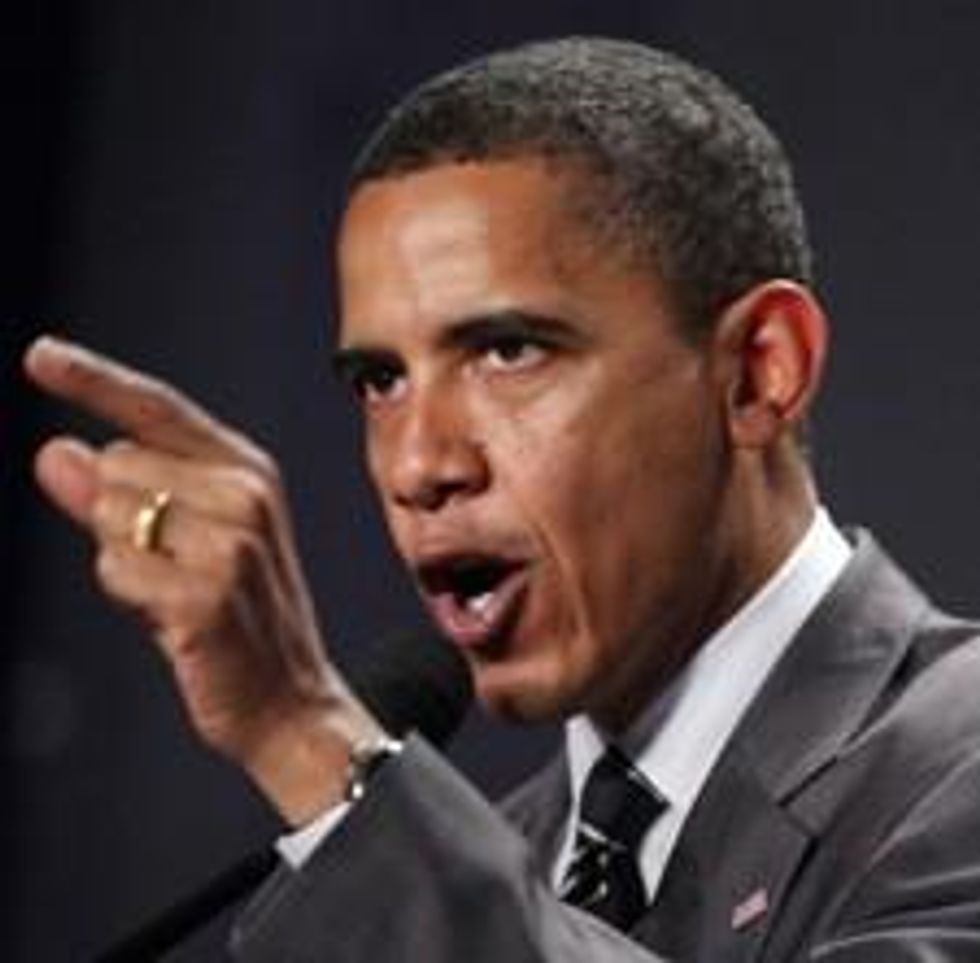
For those who follow politics, the mystery can be posed in personal terms. How is it that a senator who opposed the widespread gathering of telephone records of American citizens can, as president, approve the continuation and expansion of just such a program?

President Obama has advisors, not just military and civilian but political. All of them have a vested interest in assuring that nothing goes wrong in small ways, even as they ignore things going wrong in large ways.
That is not to say that his advisors, and the President himself, don't feel an obligation to keep Americans safe from harm and to prevent American society from sliding towards a chaos of destructive violence. We are not contemporary Iraq, nor do we want to be.
But much of the ongoing intrusion into our civil liberties arises out of narrow political fear. If we are attacked by a terrorist, there will be hundreds of thousands of fingers of blame pointing to those in command. As if a president, the FBI or the Congress, can somehow be blamed for every strangely-firing synapse in the brain of an individual living in Topeka or Charlotte.
The politics of accusation, layered into the politics of personal destruction - to his implacable opponents, the president was not born in the United States, is a socialist and is determined to take away everyone's guns - has had a calamitous result. Those close to the White House are tenaciously determined prevent any new impetus to a right wing determined to destroy our first black president. Even if they have to destroy part of America to forestall such a possibility.
Fear, not wholly unjustified, has driven those in power and those who provide counsel to power to establish and expand domestic spying. If a bomb goes off on a bus in Seattle, if someone blows himself up in a restaurant in Abilene, if a crazed man shoots the mayor of Philadelphia, the president will be blamed. 'Why didn't we know? Why didn't we prevent this tragedy?' Our generals, our representatives in Washington, will suffer collateral damage.
And so the administration, backed up by a majority of the Congress, countenances and supports widespread spying on ordinary American citizens. But what they do is shaped by a fear not just irrational, but unjustified.
Their aim is not, as they claim to themselves, to prevent violent destruction. Every year in the past decade over 30,000 Americans have died as a result of firearms. Yet there is remarkably little desire to prevent this staggering and largely avoidable destruction of human life.
More Americans die as a result of guns in a month and a half than died on September 11th. For a decade, over 58,000 Americans have been injured each year by firearms: 73,883 in 2011, 73,505 in 2010.
The tragic events of this year's Boston marathon, which kept a nation transfixed and glued to their television screens (myself included), resulted in 5 deaths and 264 injuries. It is instructive to do the math: on average, more people die of gun violence in two hours, more are injured by guns in less than a day and a half, than were casualties in Boston.
Terrorism strikes a deep nerve. And that means that anyone who 'coddles' terrorists or 'does not take terrorism seriously' can all too readily be accused of not caring about the security of Americans.
It is the fear of blame and not the need to protect American citizens that motivates those in Washington to countenance the enormous information gathering that has been taking place. Better, they think, to track every American's phone calls, to tally every key stroke and web visit and email that you or I produce on our computers, than suffer the blame for a terrorist attack. Better to jail the whistleblower who let us know the huge dimensions of surveillance than to step back and ask what the heck we are doing.
The civil liberties we proclaim as part of the great heritage of our Founding Fathers go out the window when the distant possibility of terrorism is before us. And that possibility is purely abstract, not justified by a particular action or threat. Yes, we do have enemies abroad and maybe here at home, but the fact of life is that it contains risk.
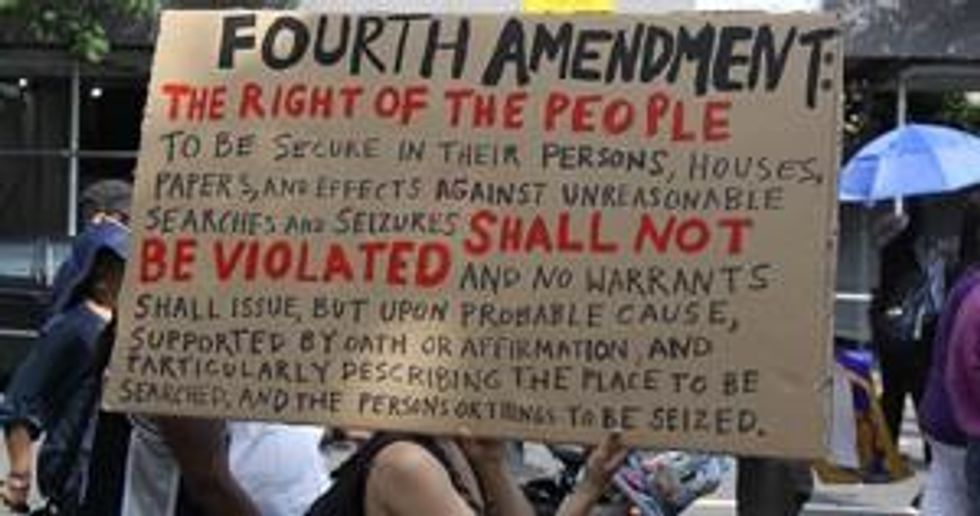
Those who wrote our Constitution knew that. They had recently been through a bloody war with England and nasty arguments between different factions in America, yet they enshrined in our Bill of Rights an amendment protecting citizens from intrusive searches by their government.
The 54 words of the Fourth Amendment are remarkably clear: "The right of the people to be secure in their persons, houses, papers, and effects, against unreasonable searches and seizures, shall not be violated, and no Warrants shall issue, but upon probable cause, supported by Oath or affirmation, and particularly describing the place to be searched, and the persons or things to be seized."
But fear, the fear of being attacked politically (and not by terrorists), has led the Obama administration to ignore the Fourth Amendment and violate our rights to be secure in our houses (and on our phones). They have chosen to have our "papers, and effects" searched and in effect seized by the government. Does it matter that these papers are often in electronic texts, as documents in our files, or that our letters are mailed electronically rather than in a paper envelope? I don't think anyone can in good conscience answer in the affirmative.
There is not really a mystery to be unlocked. Our leaders are ruled by fear, fear not of violence but of blame. Recognizing that part of their fear is the result of right-wing efforts to invalidate the government, to bring down a duly-elected administration, does not justify acting in such a craven fashion.
We as a nation, we as citizens, deserve better.

Almost unnoticed last week, a federal judge ruled that a recent Maryland statute requiring Wal-Mart to spend more on health care was invalid under federal law.
The state required, through its Fair Share Health Care Fund Act, any employer with more than 10,000 Maryland employees to spend at least 8 percent of its payroll on worker health care. An employer who spent less would be obliged to pay the difference in taxes to the state. That money would be dedicated to a state medical assistance program.
Maryland's legislation was remarkably popular. A Washington Post poll found that 77 percent of registered voters supported it.
Those voters understand the simple truth: There is no free lunch. Any employer who does not pay for health insurance just passes its workers' medical bills on to others. Either to other employers in the form of higher premiums or to the taxpayers, who fund Medicaid. As the Speaker of the Maryland House, Michael E. Busch, observed, "When large employers don't provide health benefits, the rest of us pick up those costs."
His legislative colleague, Maryland Senate President Mike Miller was more blunt. "These guys are billionaires," he said, referring to the Walton family, which owns Wal-Mart. Christy Walton ranks as the sixth wealthiest American, with a fortune of $15.7 billion, tied with Jim Walton. Altogether, five of the ten richest Americans are Waltons, with close to $80 billion between them. That's more than Bill Gates and Paul Allen combined. "We're not going to let a big Arkansas corporation, protected by their contributions to the Republican Party, avoid their basic responsibility to the citizens of Maryland."
Someone pays for health care for Wal-Mart's employees -- only it often isn't Wal-Mart
The large retailers would rather defend stockholders who reap large profits than provide health care for their employees. So Wal-Mart, (and Target, and K-Mart, and Kohl's), in the guise of the Retailers Industry Leaders Association, took the Maryland legislation to court. They feared that the legislation would hurt their bottom line and that, if the Maryland legislation worked, many other states would enact similar laws. And they won in court.
"The decision sends a clear signal," warned Sandy Kennedy, president of the trade organization, "that employer health plans are governed by federal law, not a patchwork of state and local laws."
Kennedy read the District Court decision correctly. Judge J. Frederick Motz ruled, as he wrote, "in accordance with long established Supreme Court law that state laws which impose health or welfare mandates on employers are invalid under" the Federal Retirement Income Security act of 1974.
In other words, if it's broke, and our medical insurance system certainly is, the states shouldn't fix it.
But Judge Motz's ruling need not be the end of the matter.
If a federal law is needed, legislation should be introduced in the Congress -- and passed forthwith. Any corporate entity engaged in interstate commerce that has 1000 or more employees engaged would be required to spend at least 8 percent of its total wages on employee health care. (And let's include executive compensation, so those huge executive bonuses and stock options we read about so often have a real cost to the corporation.) Any corporation not spending 8 percent would have to make up the difference in a supplemental payment to Medicaid.
In addition, the law should go beyond what Maryland required not just by changing the numbers from 10,000 employees to 1000, but also by inserting a requirement for rough equality. All employees should have to receive some of the health care benefits -- they could not be distributed only to upper-echelon management in the form of Cadillac plans for some, and no health care for everyone else. Even part-time employees should be entitled to partial benefits.
Support for federalizing the Maryland law comes from an unexpected source. Counsel for the Retailers' Association Eugene Scalia, son of arch-conservative Supreme Court Justice Antonin Scalia, told reporters after the ruling went in his favor, "Attempts to address the problem are going to require a federal response, not a patchwork of state and local mandates." Scalia acknowledged, "It's widely recognized that employers and employees need more assistance addressing problems with rising health-care costs."
How right he is. A federal response is needed. It's time to get the Wal-Marts, the K-Marts, the Hiltons, the Tyson Foods -- all those employers of clerks and chambermaids and chicken processors -- to start paying something for their workers' health care.
While Congress was in session this week debating such momentous issues as whether to prevent the courts from interfering with the Pledge of Allegiance and whether to make it illegal to use women's bodies to raise stem cells (in point of fact, all stem cells are taken from in vitro fertilization), a remarkable report came out in a minor government committee, a report on the cost of the US "global war on terrorism." What is particulary revealing in the report is its provision of very specific numbers for the cost, in dollars, of the Iraq War.
As almost everyone knows, unless they have very faulty memories, the initial estimates of the Bush administration were that the war in Iraq would not cost American taxpayers much
In a fateful September 2002 interview with the Wall Street Journal while the Bush administration was planning the Iraq war, the President's economic advisor Lawrence Lindsey proposed an "upper bound" estimate of $100 billion to $200 billion for its cost. The numbers were too high for the President's liking, so he did what all irresponsible people do: He fired the messenger. Mr. Lindsey was gone.
In damage control mode, Mitch Daniels, Director of the Office of Management and Budget, spun the Lindsay estimate by saying that it was "very, very high." Note that it was not just high, or very high -- but very, very high.
Defense Secretary Rumsfeld got into the spin circus, saying, "the Office of Management and Budget, has come up with a number that's something under $50 billion for the cost." If you don't like the numbers, you can not only fire the statistician, you can hire another one to give you the numbers you want to hear. As Mark Twain once said, "Facts are stubborn, but statistics are more pliable."
But facts are facts. The cost is far higher than "under $50 billion," far higher than even the high end of Mr. Lindsay's estimate. As Ms. Belasco has revealed, the cost of the Iraq war through fiscal 2006 is $319 billion.
In addition to this, she notes that both CRS and the General Accounting Office have found that the Defense Department, in reporting on the costs of the war, has omitted substantial amounts of war spending. So the figure is likely to be higher, and it will of course keep growing as the tragic occupation continues.
And will grow still higher as we care for our wounded veterans, and as we re-supply a military which has used up many of its material resources.
Thus, it was not only about weapons of mass destruction that the Bush administration misled the country. The enormous fiscal cost of the President's misadventure in Iraq means that there is a lot less federal money to address the crisis in health care, the lack of affordability of college for young people, and the need to find alternatives to fossil fuel.
The Bush administration knew this would happen, of course -- the war in Iraq is, among other things, a way for neoconservatives to insure that the federal government fails in its mission to "promote the general Welfare," a mission mandated by the U.S. Constitution. . We will have a government less able to serve the needs of its people not because we want that kind of government, but because so much of our financial resources will have been poured into the sands of Iraq. Between tax breaks for the wealthy and the costs of the war, President Bush is bankrupting the American treasury.
This, then, is the truth, revealed more clearly than ever before: The Bush administration, which thought up the war and then urged it upon the American people, lied to us, lied about the cost of the war. If Americans knew what the war in Iraq would cost in dead, brave, American soldiers; if Americans knew how many other brave soldiers would return gravely wounded; if Americans knew that making war on Iraq would cut the heart out of HeadStart and Medicaid and would bankrupt state and local governments as revenue sharing declined and unfunded mandates increased -- if, in other words, Americans had known the costs of the war in Iraq, they would not have been eager to support the President.
It has all been a tissue of lies, from weapons of mass destruction to the irresponsible low-ball estimates of the war's costs, to the unfulfilled claims that Iraqi oil would pay for our troops.
Even today the administration refuses to tell the truth. There is still an ongoing deception about cost. Appropriations for the war in Iraq are supplemental rather than regular, which means that our military costs in Iraq are off-budget. Over 90 percent of the costs of the "war on terror" have been provided for in supplemental appropriations bills or as "emergency" funding. The President's apologists will no doubt say that all wars start this way, with supplementals. But wars have never before continued to be funded in this off-budget manner, as Stephen. Daggett of CRS has revealed in a recent report.
In 1951, at the start of the Korean War, supplemental appropriations comprised almost three quarters of all appropriations. By the next year, supplementals were under 3 percent. By the third year of the Korean War, supplementals were down to zero.
In 1966, the first year of the escalation in Vietnam, supplemental appropriations were seven times as high as regular appropriations. The next year, they were roughly equal. In 1968 supplementals were less than a fifth of regular appropriations, and by 1970 they were down to zero.
But the Bush administration will not take responsibility for its actions. Mr. Rumsfeld will never acknowledge that his planning for the war was all wrong, and Mr. Bush will never acknowledge that the costs of the war are real, and not somehow accidental. He seems to believe that if the spending is off-budget, we will somehow never have to pay for the war.
Thus, by looking at numbers, we can see anew the breathtaking ability of the President and his administration to lie about the costs, fiscal and human, of their decision to make war with Iraq. They lied about the numbers before the war, they hide the real costs each day and each month, and they put the whole mess "off-budget" so that -- they hope -- nobody will notice how large is the bill that comes due each year.
Bush is quite likely the worst president in the 200-year history of the United States. This has enormous implications for the international community, since his country is not a small republic like the Maldives or Andorra, but a global behemoth.
His power as the most powerful man on earth derives not from a particular intelligence or set of talents, but by virtue of his position as the leader of the dominant military and economic nation on our planet.
Americans are very fond of lists, so let me do the American "thing." Here is a list of the top 10 reasons why President George W. Bush can be considered the most disastrous president in American history. This is actually a double list: the first five items concern foreign policy, while the second five address domestic policy.
Mr Bush began a war on false pretences. He lied to his people when he committed them to the war on Iraq, and on the basis of those lies he has undermined world security and committed his nation to the destruction of much of Iraq. Tens of thousands of Iraqis have died -- and over 1,700 Americans -- for no reason greater than that being a war-time president would improve his political stature. (Well, it is possible that his personal oil interests, and those of his friends, factored in. Maybe also an idiosyncratic personal grudge -- on the order of, "I-m going to show up my father and get that damn Saddam Hussein and show I'm tougher than both Saddam and my Dad" -- that raises his Oedipal complex to international dimensions.)
That he lied about Iraq's "threat" to the United States is no unsubstantiated allegation. The recently revealed "Downing Street Memo" is the report of Britain's' intelligence chief made to Prime Minister Blair about his trip to the United States eight months before the war in Iraq began, long before it was publicly considered.
The memo makes clear that deception and the fitting of facts to serve a military agenda was a high priority for the Bush administration. ("C" in the following is Sir Richard Dearlove, head of Britain's foreign intelligence service -- MI 6 -- who had just returned from meetings in Washington.) "C reported on his recent talks in Washington. There was a perceptible shift in attitude. Military action was now seen as inevitable. Bush wanted to remove Saddam, through military action, justified by the conjunction of terrorism and WMD. But the intelligence and facts were being fixed around the policy."
Let us be blunt. Basing a war on "fixed" evidence is a high crime, a betrayal of the trust of the nation's citizens. In the United States, it is grounds for impeaching the president and removing him from office. But since Mr Bush's own Republican Party controls both houses of Congress, such impeachment is, though warranted, unlikely.
Mr Bush has undermined global security by legitimizing a doctrine of 'preemptive war. "What nation cannot use Mr Bush's rationale -- "to counter a sufficient threat to our national security...to forestall or prevent such hostile acts by our adversaries, the United States will, if necessary, act pre-emptively" -- in its own interest to attack a neighboring state"? The threshold which prevents nations from legitimately making war on other nations has been dramatically lowered by the Bush administration.
Even worse, as I have argued previously on this page, the American president's "National Security Strategy" justifying preemptive war provided economic reasons as examples of a casus belli: a disrespect for private property, policies which do not "support business activity," and a refusal to commit to "tax policies -- particularly lower marginal tax rates -- that improve incentives for work and investment." If one parses that last statement, it says that if another nation that taxes the wealthy to provide services for the poor, the United States may consider it has a sufficient cause for preemptive war.
Mr Bush has waged a destructive war in and against Iraq. There is no question that Saddam Hussein was a dictator and that his regime was repressive. But by ignoring the international community and the United Nations, by starting a war to show he was tougher than his father, Mr Bush has visited destruction and death on the people and the economy of an independent nation.
Reliable reports put the civilian death count in Iraq at somewhere between 22,500 (actually reported and verifiable) to 98,000 (the number provided by the British medical journal Lancet nine months ago based on its sophisticated statistical sampling). Electric service is unreliable in 78 per cent of households in Iraq, a figure which increases to 92 per cent in Baghdad. Potable water is often non-existent. Male unemployment is over 30 per cent. Meanwhile, American companies are growing immensely profitable by supposedly providing services -- repairing infrastructure, pumping oil -- that benefit them far more than the citizens of Iraq.
Mr Bush embarked on a war with no plan to win the peace. He created a dramatic made-for-television scenario on the deck of an aircraft carrier on May 1, 2003, when, dressed in a pilot's jacket, arms outspread, he declared victory in Iraq. He insisted, "major combat operations in Iraq have ended. In the battle of Iraq, the United States and our allies have prevailed." Since that date, 1,365 Americans have died in combat, almost 10 times the number who died before Bush declared "victory," and between 15,000 and 35,000 have been wounded.
(It is telling, and chilling, that there seem to be no cumulative figures on the number of Iraqi civilians who have been wounded during the American occupation. Aren't the deaths of fathers and aunts and children and co-workers worth tallying? We know that the US administration seeks to control the news: but how can the scope of this tragedy go unreported?)
Mr Bush seems to have no sense of history: it is as if the French occupation of Algeria, the American occupation of Vietnam, the Russian occupation of Afghanistan, taught him and Vice-President Dick Cheney and Defense Secretary Donald Rumsfeld nothing at all. Perhaps they have been too busy looking at political poll numbers, and figuring out how to get new contracts for American corporations, to read any books about what happens when major powers decide to wage a war in and against developing nations.
Mr Bush is committed to unilateralism. There will be no American ratification of the Kyoto Protocol, which seeks to curb climate change. Mr Bush rejected the anti-ballistic missile treaty with Russia, the International Criminal Court, bilateral negotiations with North Korea. He invaded Iraq with only the support of what he called the "coalition of the willing," a code name for Great Britain and a number of American client states.
Tellingly for the future of humankind, he has unilaterally rejected the Geneva Conventions regarding the treatment of prisoners of war and civilians. The United States has held over 500 people of 35 different nationalities at Guantanamo Bay in Cuba, "many" according to Amnesty International, "without access to any court, legal counsel or family visits."
The American military subjected inmates at the infamous Abu Ghraib prison to humiliation amounting to torture. Amnesty International reports that the "total number of detainees held outside the USA by the US during the "war on terror" is 70,000 -- and it is unknown for how many of them their Geneva Conventions rights are secured.
To summarize: Instead of making the world a safer place, Mr. Bush has made war, wrought destruction, and undermined multilateral efforts to build and sustain a more livable world. MR Bush has not been kinder to American people, nor secured their well-being as their elected leader is supposed to do. He has redistributed wealth from the middle class upward -- to the very wealthiest families in America. Two tax cuts which give the biggest benefits to the top one per cent -- those who earn more than $337,000 annually -- have raised the tax burden on the middle class.
This past year, for instance, President and Mrs Bush earned $784,219 and Vice-President and Mrs Cheney earned $2,173,892. (Yes, they are both clearly in the top one per cent of income earners). The Bush-enacted tax cuts slashed their tax bills, 12 per cent for Mr Bush, 18 per cent for Mr Cheney so that they paid $110,182 less than they would have paid had the legislation not been enacted.
Meanwhile, in the longer run the only way to pay for these tax cuts -- which turned a federal surplus into an enormous deficit that the Bush administration projects at $521 billion in this year alone -- will be to reduce government spending on the programs which underwrite the quality of life for poor and middle class Americans: food and income support for the poor, education and health care and pensions for the middle class. Thus, the massive tax cuts to the wealthy will be paid for by hacking away at, bankrupting and terminating programs that support the working people of America.
In his administration, more than any other during the past three quarters of a century, the rich have gotten richer, the poor have gotten poorer, and the middle class has shrunk. America is currently an oligopoly run not only by, but for, the wealthy class.
Mr Bush has embraced deficits which will undermine the long term health of the American economy. The numbers are staggering. The budget deficit is $512 billion. The current accounts deficit for the first quarter of 2005 was $195.1 billion, which projects to a deficit for 2005 of $780.1 billion. That means that this year alone the United States has financed its lowered taxes, its costly war in Iraq, its hunger for cheap goods, by a total of $1.29 trillion.
Numbers can by themselves be numbing, so let us try a comparison. Pakistan's government budget expends $16.5 billion, India's 2004 $104 billion, China's $348.9 billion, all including capital expenditures. The three governments spend barely over a third of what the United States borrows through deficit spending and balance of payments debits.
Although Mr Bush would prefer to hide the fact, this money in one way or another will have to be repaid. Those repayments will hold the United States hostage, exactly as developing nations today are often held hostage by the IMF and the World Bank. Even a vibrant American economy would be strained by the enormous obligation of paying interest on and paying down the national debt, and repatriating the dollars "borrowed" by the balance of payments deficit.
But the American economy is not as vibrant as is claimed: more and more of America's productive capacity, both in manufacturing and in the intellectual work done by white collar workers, is being supplanted by the productive capacity of other nations, China and India chief among them. Consumer spending has been fueled almost entirely by low interest rates which have created a housing boom -- now at the stage of being a speculative bubble which may soon crash, bringing the economy to a halt.
Thus, the American standard of living, already in modest decline, will likely plummet fairly rapidly in coming decades. And American economic pre-eminence is likely to be challenged -- though this may well be a fine thing for other nations -- by China and the other nations of East Asia, the EEC, India and South Asia, and perhaps the nations of Southeast Asia.
Mr Bush has initiated an attack on civil liberties almost unparalleled in the history of the United States. With the passage of the Bush-initiated "Patriot Act," the federal government was given enormous powers to invade privacy and intrude on basic freedoms which had been guaranteed to Americans for over two centuries. The legislation gave federal authorities the power to obtain medical records, tax records, book buying and library borrowing records -- all without requiring a probable cause or a court adjudication that national security is imperiled. Federal police are now authorized to break into a person's home and do a search without ever informing the person the search has been conducted. Not only have civil liberties been curtailed, the chilling effect on freedom of speech and association means that more and more Americans are afraid to exercise their most basic liberties.
Mr Bush has politicized the American nation beyond permissible bounds. He has politicized the judicial system by forcing the judicial appointment of ideological conservatives who pass a "litmus test" on such issues as abortion (opposed), class action suits which allow collections of individuals to sue corporations which have injured them (opposed), and the rights of labor (opposed). The sole credential for important government positions, too, is ideological purity. Recently, Mr Bush and his cohorts tried to slash the funding for public broadcasting because he thinks it too "liberal."
He refuses to work with the opposition party, the Democrats. Just as he adheres to unilateralism in foreign policy, in domestic affairs it must always be his way, with no negotiation, no meeting half-way, not even consultation. He seems -- and this if far more frightening in fact than the mere statement of it suggests -- determined to turn America into a de facto one-party state.
And then, there is the corruption in which political cohorts get huge government subsidies and gifts. His defense department gives huge contracts to "friendly" corporations without even the semblance of open bidding or fair awarding of contracts. Halliburton, for instance, was awarded a $7 billion contract, non-competitively, to repair Iraq's oil infrastructure. (The former CEO of Halliburton is none other than the sitting vice-president, Mr Cheney.)
Mr Bush has played the religion card -- what South Asians call communalism -- often, and with a vengeance. Elected in large part with the support and money of fundamentalist Christians, Mr Bush has turned American politics into a religious battleground. His communalist "game" seldom addresses religion per se, instead using coded words and battles about social phenomena to communicate to fundamentalists that he is committed to turning America in a profoundly religious direction.
Thus, in recent years, Mr Bush has opposed abortion (while 63 per cent of Americans said, this month, that they do not want to see the federal court legalizing abortion overturned). He has opposed stem cell research (58 per cent of Americans approve such research). He has campaigned against a homosexual's right to marry (55 per cent of Americans do not want to see homosexual marriage. But an even larger 58 per cent opposed the Constitutional amendment to ban homosexual marriage that Mr Bush called for.) Increasingly, Muslims, Jews, atheists, and non-religious people in general feel social pressure from the Bush administration to be like other people -- meaning, to act like Christians or shut up.
There is much that can be said about America not living up to its ideals, but in the separation of church and state -- enshrined in the nation's Constitution -- it has been a model of religious tolerance and freedom for most other nations. No longer. No other American president has injected religion and religious doctrine as deeply into the discourse of American politics as Mr Bush. Expediency has won out over tolerance; accordingly, the religious divide between Americans seems more profound than at any moment in its history.
Whether it is world peace, religious tolerance, the American economy or social and economic justice, Mr Bush has hollowed out much that he should have been strengthening. Nor has he learned from his experience: in not one of the 10 areas highlighted has he changed his course or his thinking. In fact, his mind seems permanently made up, untouched by experience, and untouchable. He sails serenely forward, towards disaster, trying to drag America and the world along on his misguided journeys. The only good news is that, more and more, the American people are not sure they want to be his fellow sailors.
William Wordsworth tells us that it is only in retrospect that one can sort out what has been most significant, most telling, in our experience. In his epic poem The Prelude he writes,
"There are in our existence spots of time,
Which with distinct preeminence retain
A renovating virtue,"
and says that it is to these "spots of time" that we return, again and again, for emotional nourishment, for a sense of what the world is and who we ourselves are within that world.
Recently, I had business which took me to New York City for a week. I attended an academic seminar which was far livelier and more engaged than most intellectual affairs. I found the time to visit two of the world's great museums, the Metropolitan Museum of Art and the Museum of Modern Art. On the weekend I saw a Broadway show.
One of the great pleasures of modern life is walking in and through large cities. When I taught for five months at Calcutta University, for instance, I often spent an hour, or two, or three, walking through the streets of Kolkata, walking and watching. More than those who only ride in cars or taxis might expect, a city lives on its streets. A great cross-section of people pass by. One has glimpses of family life, of what is for sale and what people buy, of the great diversity of class and caste and dress and gesture that comprise the populace of a contemporary urban setting. There are continuities with the past to be seen, and as well auguries of the various futures struggling to be born.
So, in New York, with the long summer days, I had wonderful opportunities to walk through that city's streets, sometimes staying up till past midnight as I moved from one downtown district to another. I had a Wordsworthian "spot of time" in New York, and it was not in a museum or a fine restaurant. It occurred as I wandered the streets of upper Manhattan -- walking leisurely towards a museum with no particular timetable in mind.
As I walked, I passed a dry cleaner's shop. At its front, immediately behind a large plate glass window, was a man ironing a shirt. I stopped and watched. (I should mention that I like ironing my own shirts. In America, ironed shirts are an expensive luxury unless one does it oneself; and I have found that the repetitive motions of ironing, and the concentration required to assure that one irons wrinkles out and not in, is a restful activity. For me.) He ironed, and I watched. And watched. He ironed one shirt, then a second. There was a defined progression for each shirt. First, he sprayed the shirt lightly with water to dampen it. Then, as he ironed each successive portion of the shirt he sprayed on a light dose of starch to make the fabric stiffer. He proceeded to iron the collar, then carefully laid out each sleeve and ironed them, one at a time. Then he starched and ironed one half of the shirt, placed flat on his white-cotton clad ironing table. When he was done, he lightly touched the iron to the middle of the collar at the back of the neck -- just a small crease so it would fold properly. He hung the shirt on a hanger, and proceeded to the next.
I, an amateur, iron quickly. He, a professional, did not. He took care, making certain that each sweep of the iron made a flat expanse of brilliant white fabric.
As I watched him, I realized I was receiving instruction in how to iron properly. The man in the window was of early middle age, seemingly of Central American background. He was totally focused on his work. (Only when I left, and bowed my head slightly in dual acknowledgment of his excellence and my gratefulness at being allowed to watch him, did he indicate by a small smile and a brief nod of his head that he had been aware of my presence.)
So that was it, my "spot of time," my peak experience. A moment -- 15 minutes, actually -- of observing menial work in the modern city. Only the work was not menial, even though its status, and no doubt the ironer's pay, were low. The man I watched took great care with what he did, and seemed in a quiet and unobtrusive way to be proud that he ironed shirts well. Would a customer have noticed if he ironed more quickly, and the shirt were not as perfect as he strove to make it? I doubt it. But the man who ironed worked to a different standard. If his labor was worth doing, it was worth doing well.
He seemed to understand what Wallace Stevens, the American modernist poet, meant when he began his great lyric Of Modern Poetry with the fragment, "The poem of the mind in the act of finding/ What will suffice." For the man in the window, ironing, doing his work well, was the lynchpin on which the entire world depended. Ironing a shirt -- to most observers scarcely a world-shattering event -- was, nonetheless, the entire universe writ small, a synecdoche, a part standing for the whole, of the heroic stature of human existence.
Is that too strong a statement, a poeticizing of an ordinary urban sight? (I have seen men ironing in the streets of Kolkata, only without the protection of that glass window I was too self-conscious to stop and observe closely. I have seen people ironing in Paris, and in the backroom of laundries in my own hometown.) The Stevens' poem about modern poetry I cited above ends,
"It must
Be the finding of a satisfaction, and may
Be of a man skating, a woman dancing, a woman
Combing. The poem of the act of the mind."
It could as well have added "a man ironing". Stevens understood that in the gestures of modern life we create a place for ourselves in the world in which we live and thus we find ourselves.
For several months the dire situation in America -- a senseless war, an assault on civil liberties, a fraying economy, a drive towards oligarchy -- has been so depressing that I have not known how to address it in print. Nor do I want to do so, now. For the moment, even in the midst of bad times, I want to acknowledge simply that human labor continues, and that labor has its dignity.
The man ironing with such self-contained pride in his work makes a gesture that is appropriate for all of us. It is of course not enough, just by itself: we all have political roles to play, for society is ours and not the sole possession of a ruling class or small group of political professionals. But doing our work with attentiveness, doing it well, taking pride in whatever work we do in the human community, is the bedrock on which all human society and culture rests. Wallace Stevens wrote poems; my Central American acquaintance irons. Work, prideful work, in the world.
When he reached 50, the Chilean poet Pablo Neruda decided he should write not just for the literary world, but for his neighbors. The Orissan poet Jayanta Mayapatra made a similar decision a number of years ago when he decided to write in Oriya, so his neighbors could read and understand what he wrote.
In Neruda's case, he turned from writing poems of love -- he was one of the greatest love poets of the just-concluded century -- and Latin American epics, to writing odes about the simple objects that surround us in daily life: tomatoes, lemons, bicycles, socks.
The first of these new odes was The Invisible Man. In it, Neruda begins by telling us how he admires the old poets, those who write of how they love, how they feel when the walk through the streets -- but that on the streets those poets write about, no one else exists. All people other than the poet and his lover are invisible.
Neruda himself walks through streets populated by people --
"everyone passes by, and everyone
tells me something,
look at all the things they do!
They cut wood, string electric lines,
bake bread late into the night,
our daily bread,
with an iron pick
they pierce the entrails
of the earth"
-- but like each of us he is too busy to celebrate these people all around him who do their work and live their lives.
"As I walk by, things
ask me to sing them, but I haven't time," he laments.
But then he realizes -- Neruda would have no trouble, no trouble at all, understanding why I was so impressed with the man ironing in that New York City window -- that he must celebrate them.
"I want
them all to live
through my life,
to sing through my song
I am not important
I have no time
for my own affairs,
night and day
I must write down what's happening,
not forgetting anyone."
I quote Neruda because he understands so deeply, so fully, what I saw in the man ironing: each of us has work to do and a life to live, and we are fully alive when we do our work and inhabit our lives, even if our work is ironing.
Neruda's poem is a song to solidarity, "the song of the invisible man/ who sings with all men." I cannot claim as much for myself. It was not solidarity I felt on the street as I watched a man ironing, but a sense of the fullness of work, how an embrace of work can fill our lives. The man I watched was as good at what he did as the finest batsman or actor or political figure and took pride as least as great as they in doing his work well.
He exemplified for me, also, the pleasure of cities, the exciting sense of sharing, that Neruda so lyrically shapes for us.
"When I get up
the night is gone, the street has awakened before me,
the poor girls of the neighborhood
are on their way to work,
fishermen are returning
from the sea,
miners
in new shoes
are going down into the mines
everything's alive
everyone's hurrying to and fro,
and I scarcely have time
to get into my clothes,
I must run:
no one must
pass by without my knowing
where's he's going,
what he's doing."
Perhaps what I felt was not just the pride of work, but a sense of solidarity as well. For we are, each of us, joined with one another in this vast enterprise called life, and the work we do -- and do well -- is what connects us to the human collectivity.
What does it mean that Alberto Gonzales is about to be approved as Attorney General of the USA? That this particular appointee of President George W Bush will become the chief law enforcement officer of the American nation?
The President's advisors and spin doctors proclaim his elevation from the President's counsel to his current position, as a moment of historic magnitude. For the first time in American history, a Hispanic will occupy one of the four highest administrative offices in the nation. They cite his story, the rise from rags to riches, as proof that democracy and egalitarian opportunity are alive and well in the world's sole superpower. Even the often-pugnacious Democratic Senator Patrick Leahy, the ranking member of the opposition party on the Judiciary Committee which vetted and will vote on the nomination, recently said: 'The road you've traveled, from being a 12-year-old boy, just about the age of your oldest son, selling soft drinks at football games, all the way to the state house in Texas and our White House is a tribute to you and your family.'
Bush is no doubt mindful of the Latino success story that Gonzales embodies. Hispanics, according to exit polls, gave 44 per cent of their votes to Bush in the just-concluded presidential election. Gonzales' appointment is a matter of pride for many Hispanics, even among those who didn't support or vote for Bush.
But something other than identity politics and cultural pride are at stake in the Gonzales appointment.
More than any other event, this appointment, and the ease with which it will pass the Senate without significant opposition, reveals the extent to which the USA is moving expeditiously, and without significant complaint, along a road that leads to what one can only, uncomfortably, call fascism.
Gonzales stands as the apostle of torture in the administrative councils of the American policy. When it appeared that questioning of 'suspects' held as possible informants about the murderous attack on the Twin Towers in New York on 11 September 2001 might violate the Geneva Convention, international law and American law, Gonzales asked Department of Justice attorneys for a definition of what constitutes torture, and to whom the prevailing legal restrictions on torture might apply.
On 25 January 2002, a memorandum from Gonzales to Bush stated that 'the war against terrorism is a new kind of war, which renders obsolete Geneva's strict limitations on questioning of enemy prisoners and renders quaint some of its provisions.' The prohibition against torture was thus found to be 'obsolete' and 'quaint', as if it were a hand-cranked phonograph in our day of stereos and portable CD players.
Much was made of the USA's previous President, Bill Clinton, and his dalliance with a young intern, Monica Lewinsky. Again and again, conservative critics called him 'immoral'. Let there be no doubt: there is something morally wrong about breaking marriage vows and about using the perquisites of power and age to take advantage of a young woman. But the fate of a nation scarcely swung on some sexual escapade in the White House, however distasteful and upsetting the incident may have been. Such is not the case with Gonzales and his unethical work in the White House.
It is more difficult to talk about ethics than we often imagine. Philosophers do it, religious sages do it, but in daily life we are more likely to talk about other things: sports, cinema, political intrigues, celebrities. When we talk about ethics, we often fall back on morality, on the codes that have been handed down to us by our parents, our religion, our schooling or (more and more in today's world) what pundits tell us in the mass media.
But ethics goes to the very deepest concerns of human life. It inquires into how we will live together with others--sometimes those immediately around us, sometimes those of that larger world of community or town or nation or even world--in a way that is compassionate, fair, just and responsible.
What does it mean to be a 'good' man or woman? That is the central question addressed by ethics, the very core of ethical inquiry.
Whatever answer one moves toward in defining what comprises a 'good' human being, we can be certain that the answer does not include condoning the torture of other human beings.
Yet, at this moment the USA is poised to anoint as its chief law enforcement official a man who counsels and condones the use of torture.
Nor was his January 2002 memo aberrant, an accident. Six months later, in August 2002, Gonzales cleared a Justice Department memo that stated bluntly that both international treaties such as the Geneva Convention and US law do 'not apply to the President's detention and interrogation of enemy combatants.' Simple reasoning, but terrifyingly strange: If you're not an American, then it is OK for the American authorities to torture you.
That memo, which is addressed to Gonzales, opens with the words 'You have asked for our Office's views regarding the standards of conduct under the Convention Against Torture and Other Cruel, Inhuman and Degrading Treatment or Punishment.' It states that Americans acting under the President's authority can inflict 'cruel, inhuman or degrading' treatment to prisoners without violating laws and treaties against torture. Torture can properly be claimed, according to the memo prepared by Assistant Attorney General Jay Bybee, only when there is severe pain of 'an intensity akin to that which accompanies serious physical injury such as death or organ failure.' If you aren't dead or close to it, it isn't torture.
Mark Danner, the author of Torture and Truth: America, Abu Gharib and the War on Terror, recently wrote with admirable clarity of Gonzales: 'He is unfit because, while the Attorney General is charged with upholding the law, the documents show that as White House counsel, Gonzales, in the matter of torture, helped his client to concoct strategies to circumvent it.'
In his opening testimony before the US Senate, which continues to consider his nomination, Gonzales claimed he was only soliciting opinions, that this was his job as counsel.
Wrong. Wrong. Wrong.
In the first place, he passed along opinions over his signature, so that those opinions carried his implicit, and likely his explicit, consent.
In the second place, choosing to ask if torture is legal, and asking if it can be narrowly defined as only the most harrowing of conduct, are not innocent acts: they presume that extant prohibitions against torture might and probably should be weakened. His request was to cast about for legal loopholes rather than to seek to clarify fundamental principles of the rule of law. And, in fact, Gonzales' staff played a role in preparing the memo which found those loopholes: Timothy E Flanigan, his deputy counsel, talked about a draft of the memorandum with lawyers at the Office of Legal Counsel before it was finalized. (It should be noted that when the memo became public, and only then, the administration repudiated it.)
But the worst offense is one which the Senators--who, not wanting to offend Hispanic voters, will end up overwhelmingly approving Gonzales as Attorney General--refuse to address.
The purpose of legal counsel is not merely to tell one's employer what is legal. The purpose of a counsel is to "counsel": to offer sound advice, not just about narrow constructions of legality, but about the rightness of proposed courses of action. 'This might be legal,' a counsel should advise his client, 'but it is the wrong thing to do.' It may be wrong because it is impractical, or because it has negative operational consequences, or because is costly, or because it opens one to litigation by those who challenge its legality. But it may also be wrong because it is unethical.
The fact that Gonzales solicited and then passed along advice which defined prohibitions against torture as quaint and obsolete is not as egregious as the fact that he passed that advice along without saying, 'This is a legal opinion, but anyone can offer an opinion. This opinion is wrong, both because it is too narrow legally, and more importantly, because it is unethical.' He should have informed Bush that the Geneva Convention protects people everywhere from unjust and inhumane treatment, and that its abrogation would have severe consequences for the conduct of nations - and specifically, in the diminishing of protection for US troops abroad. (Secretary of state Powell submitted a memo to the President saying exactly that. But then, Powell is now on the way out, and Gonzales is now on the way in.)
He should have said torture is heinous, and when carried out systematically, it is a crime against humanity. Instead, he looked for ways to justify torture.
Later he, like everyone in the Bush administration, professed amazement that American soldiers tortured prisoners at Abu Ghraib prison in Iraq. (Well, they weren't dead and didn't have organ failure, so maybe it wasn't really torture?) (But I should not jest, not even parenthetically: We are speaking of torture, here.)
Such a man as Gonzales should not be walking the streets. He should be brought up for trial on the basis of enabling war crimes. Instead, he is the soon-to-be confirmed next Attorney General of the USA. Its chief law-enforcement officer.
Ethics seem irrelevant in the USA today, despite much talk by pollsters that ethical issues have an effect on elections. (That sort of ethics refers primarily to sex: no Presidential fooling around, no sanctioning of homosexual behavior through "gay marriage".) Meanwhile, Bush is determined to use his power to get what he wants, even if what he wants is wrong. Even if what he wants is to torture suspects and to appoint a possible war criminal to head up the legal functions of the US government.
And the American people? A lassitude has set in. There is work, there is shopping, there are television and video games and popular music. Ethics seem, for many, too difficult a burden to shoulder. Maybe in the 22nd century. But not now, in this time, in this place.
The world's largest seismic dislocation since the 1940s which occurred in the Indian Ocean on the 26th of December was catastrophic. When two tectonic plates shifted under the Andaman Sea, they created a tsunami of terrible intensity, wreaking immense destruction in Sumatra, Thailand, Sri Lanka, India, even the east coast of Africa. At first 20,000 deaths were reported; as of the moment of my writing, the death toll has climbed to more than 150,000. Five million are reported homeless. There is every reason to believe that both figures will increase as rescue workers reach areas as yet unsurveyed.
World response has been swift and generous. Offers of aid -- food, money, transport -- have led to huge rescue operations and the relatively swift provision of food and clean water. Even in the USA, where the generosity of the people far outstrips the miserly commitment to human welfare of the current business-oriented political establishment, President Bush was forced by public opinion to increase US contributions to the relief effort from $35 million to $350 million. Private donations augment public funds, and help for the two most severely hit nations, Indonesia and Sri Lanka, is well under way.
Nature, many have realized, is not to be controlled: it continually reminds us that human life is contingent. At the same time, billions have understood, watching images on television or listening to eyewitness reports on radio, that we are all united on this globe we inhabit. Tragedies which occur in one part of our planet affect us all by reminding us that those made wretched could, but for the grace of accident or fate, be ourselves.
The earthquake has also revealed to many a difference between more developed nations, which have put in place tsunami warning stations in the Pacific, and less developed nations, which do not have such easy access to funding and therefore have made such warning stations a low priority. Despite the fact that we live on one globe, disasters have more severe repercussions in impoverished nations than wealthy ones.
Still, another tsunami -- metaphorical but no less real -- has crested beyond the shores of the nations of the world, and is heading toward those shores, threatening devastation to both underdeveloped and developed nations. It will spare India and China, but should wreak havoc on Bangladesh, Cambodia, Indonesia, possibly Pakistan, and a host of other nations, not excepting the USA. The worst consequences, as we might expect, will come in the poorest places.
About this tsunami, not natural in origin but humanly created, and therefore capable of being prevented by human intervention, there is little public recognition and almost no outcry of concern. Indeed, dominant financial interests have made certain that no steps will be taken to prevent the destruction that it will occasion.
In 1973, a Multi-Fiber Agreement set international textile quotas, providing a large number of developing nations with access to new manufacturing sectors and, more importantly, enabled them to generate large numbers of new jobs. Those quotas expired on 1 January.
The ensuing new economy of textiles will transform the world. New wealth will be amassed, new jobs created. And millions of current workers, some in the most impoverished areas of the world, will be permanently thrown out of work. (Business Week reported that the end of MFA quotas could mean losses of 30 million jobs.) The nations inhabited by these newly and soon-to-be unemployed will likely plunge into a downward economic spiral unlike anything those nations have experienced in recent decades.
What is so appalling is that this tsunami, created by greed and an ideological commitment to "free trade," can be prevented. But there are few warning systems in place: the mass media and even the intellectual centers in universities serve the interests of the rich and powerful. Of course, when the tidal wave of massive unemployment occurs it may not be dramatic enough to appear on television screens.
Yet, the suffering brought about by this tidal wave of unemployment and the national economic catastrophes which ensue will quite literally dwarf the immense suffering which has been the consequence of the historic tsunami in the Indian Ocean.
Textile manufacture, and what it can do to working people, is far less photogenic than natural disaster. For almost two and a half centuries, the textile industry has been a mixed blessing, providing employment on a large scale -- but almost always at low wages and in extremely difficult working conditions.
The production of textiles and apparel can be called, with good reason, the great motor of economic development. The industrial revolution began in Britain, occasioned by the invention of the spinning jenny and the mechanical shuttle, which in the 18th century made it possible for machines to do much of the work historically performed by human hands. It is fruitless to argue whether Britain's navy or its textile manufacture or its banks made that nation into a great imperial power: the navy protected and expanded the shipping routes which were essential to textile trade, and the textile trade created the profits which enriched the London banks and underwrote the costs of the world's most potent navy.
Likewise, Germany's emergence as a world power in the 19th century was also based on the textile industry -- although not in textile manufacture directly. Germany's development of the chemical dyes which supplanted plant-based dyes in textile manufacture created not just great profits, but a strong chemical industry which served as the industrial armature for one of the world's great producers of munitions. Two World Wars were indirect results of this.
But textile industry jobs -- both the production of cloth, and the sewing of fabric into clothing -- have been, since the onset of the industrial revolution, low-paying jobs. As industrialists turned their attention to high-priced items, first cars and then electronics, they shipped low-paying textile jobs to underdeveloped areas internally and then externally. For example, immigrant communities in the north of the USA, and later low-wage agrarian areas of the American south, had an influx of such jobs; when labor costs rose, those jobs were sent to low wage nations overseas.
Under the 1973 MFA, with its set-asides to enable nations to achieve a small slice of market share of the world need for clothing, underdeveloped nation after underdeveloped nation used clothing manufacture as a means to provide jobs to its poorest citizens. Four years ago, wanting to write a report on what international clothing manufacture looks like in the daily life in a developed nation, I visited a local Wal-Mart (the world's largest chain of stores) and began reading labels in clothing. Poland, the Mauritius, Sri Lanka, Egypt, Guatemala, Nepal, Turkey, Kenya, the Philippines. The list ran on and on, to over 50 countries.
As Mark Weisbrot, an economist with Washington's Center for Economic and Policy Research said recently, "These quotas were there for a reason, so that some of the poorest developing countries would have a chance to have an apparel and textile industry and use that as a steppingstone for development."
Textile manufacture provides jobs, but the jobs are a mixed blessing. To be sure, weavers and more importantly today sewers earn wages, which enables those workers to enter into and even survive in a cash economy. But textile workers have, since the origin of textile factories in Britain in the 18th century, always and everywhere been lowly paid and badly exploited.
This is not the place to argue whether the location of exploitative shops in Bangladesh and El Salvador and Kenya are good or bad for those national economies. Certainly, the textile industry provides not just large numbers of jobs, it also provides important new sources of the foreign exchange so necessary for a nation's economic well-being and development. Yet, for every increased dollar of needed foreign currency which flows into those nations, new problems emerge: the uncontrolled growth of cities, grueling labor, the expansion of urban poverty, dramatic new inequities of wealth.
The largest benefits from textiles and apparel accrue to those who own textile and clothing factories, and in the post-modern world, to those huge multinational conglomerates which merchandise and sell clothing. In developed nations, and increasingly in developing ones, the "value added" which comes through advertising brand names is far, far higher, in many products, than the value of the raw materials, weaving, and sewing which go into those products.
The profits on the manufacture of this clothing make a small group of entrepreneurs rich. Let us look, for instance, at Nike, the world's wealthiest maker of sports shoes and sports clothing. Here is a fiscal analysis by the US-based National Labor Committee: "Nike sneakers made in China by young women paid 20 cents an hour arrive in the USA with a total customs value of $14.61. That $14.61 includes every conceivable expense -- the materials, labor, shipping, and the profit to Nike's contractor in China." That profit to the contractor is not inconsiderable: it has been the driving force behind the growth of the new wealth in China. "Nike then turns around and sells the sneakers in the USA for $135, which represents a 924 per cent mark-up." What labor earns is pitifully small, especially as compared to the profits made by the multinational conglomerates, as another example reveals: a worker in the Dominican Republic who sews a sweatshirt for Nike earns eight cents ($0.08 dollar) for a garment which retails in the USA for $22.99.
Now, with the expiration of the Multi-Fiber Agreement quotas, the world enters a new era, one of global free trade in textiles and clothing.
The world textile and apparel market is enormous, in excess of $353 billion annually. Nations with low labor costs, chemical and fiber-producing industries, strong transportation infrastructure, and access to large ports are expected to be the big winners. (India is the world's third largest cotton producer, the second largest yarn spinner. It has infrastructure in place: not just experience with textiles -- until Independence, India had the world's largest textile industry -- but an existent base, with textiles currently employing 35 million, the second largest sector in India's economy after agriculture. Already, textiles are 17 per cent of India's manufacture, 27 per cent of its export earnings, and generative of 8 per cent of GDP.)
There will be winners in the "free trade" era following the elimination of the MFA quotas. According to the World Trade Organization, China, which currently has a 16 per cent share of the US clothing market, will jump to 50 per cent of that $77 billion annual market. India will be another winner, going from 4 to 15 per cent. South America will be a big loser, dropping from 16 to 5 per cent.
Figures can be so dull, yet we ignore them at our peril. So, despite a kind of brute facticity, I hope the reader will bear with me for several paragraphs. For these figures are like a seismological reading of a major earthquake which will produce tsunamis all over the globe. We can ignore the instruments and what their statistics speak to us, but we do so at our peril.
Indonesia has 1.7 million workers in clothing: many of its factories are expected to close, and the remaining factories expect to cut 20 to 30 per cent of their workers. Business Week estimates one million jobs will be lost in Indonesia. The direct casualties of economic disaster -- jobs are there to turn to when the factories close? -- will be higher by a factor of five than the fatalities of the recent tsunami. And that is without counting any of the family members who depend on those textile paychecks for their collective livelihood.
To take a small yet surprising example: More than a third of Morocco's 200,000 textile workers face the loss of their jobs. Singapore's The Age revealed, "As many as 50,000 workers in the tiny mountain kingdom of Lesotho in southern Africa could lose their jobs after WTO textile quotas are lifted." Or to take a larger one: a sizeable proportion of Vietnam's almost 3 million textile jobs are imperiled.
Nor is the developed world immune. In the USA's largest textile-producing state, North Carolina, 160,900 jobs were lost in the last decade: 100,000 remain, and between a quarter and half of them will be gone in next four years. Overall, one-third of the 675,000 textile/apparel jobs which remain in the USA are at risk.
Among the worst casualties will be many of the nations of South Asia.
In Bangladesh, between 1.8 and 2 million people are employed in the textile trades, 80 per cent of them women. The UN Development Fund expects up to one million Bangladeshis will lose their jobs in the wake of the MFA quota expiration.
Cheap and efficient Chinese and Indian manufacture will likely lead to these huge job losses, which will come in jobs held by vulnerable people. As a trade specialist at Bangladesh's mission to the WTO said recently, "These are mostly very low qualified female workers who will find it very difficult to find employment in other sectors."
The economic catastrophe will be much larger, of course, since the direct employment of textile workers indirectly provides further employment of another 5 to 10 million workers (the latter figure is the estimate of the Bangladesh government); one responsible economist suggests the figure will be closer to 15 million. Even more difficulties loom in terms of the nation's finances. Bangladesh accounted for four per cent of clothing imports into the USA in 2002, and three per cent of the European Union's import market, for a total of $5.5 billion in export income. Three-quarters of Bangladesh's foreign exchange comes from these textile exports. Thus, the ultimate effect of the elimination of MFA quotas will be deeper fiscal penury not just for individuals, but for the nation of Bangladesh. And it is not just Bangladesh.
Nepal has 50,000 textile trade workers, 60 per cent of them women. According to broader figures supplied by the Garment Association of Nepal, another 50,000 workers are provided jobs because of linkages to the textile industry. Ten per cent of the workforce is employed in textile and apparel manufacture. When their families are included, up to 350,000 people rely on the textile industry. Three quarters of Nepal's foreign exchange comes from textile exports. Analysts predict that Nepali job losses will be massive.
This article is a continuation of Gutman's Man-Made Tsunami . . .
Pakistan is vulnerable as well, with textile products comprising two-thirds of its $12 billion in exports. Textiles account for 1.4 million jobs and over 11 per cent of its GDP. There is disagreement about whether Pakistan, which produces cotton and has ports, will be able to hold its own -- or whether it will like Bangladesh see its textile industry destroyed by more efficient production facilities in India and especially China. This past year, Pakistan imported 1.9 million bales of cotton, making Pakistan the third largest cotton importer in the world. That cotton is used in textile production -- but it could very easily go elsewhere, like China. Indeed, the South China Morning Post recently reported that "Bangladesh, Cambodia and Pakistan are the most vulnerable to the end of textile quotas, as garments account for more than 70 per cent of their exports, according to the IMF and the WTO."
In Sri Lanka, textiles are responsible for 450,000 jobs in a nation of 19 million people, over 15 per cent of all economic activity, and 65 per cent of all industrial exports. According to a recent report in the Washington Post, 93 per cent of those textile exports went to the USA and EU countries where the MFA guaranteed access. "Fifty to 60 thousand people might lose their jobs. Fifty to 100 factories will be closed," according to Sri Lanka's minister of trade, Jeyaraj Fernandopulle.
Mongolia is greatly vulnerable to textile job loss. One hundred foreign-owned textile companies operate in Mongolia, 48 of them from China. Textiles provide 12 per cent of its exports, and 30 per cent of its labor force. In Cambodia and Laos, textiles provide 90 per cent of foreign exports.
And it is not just Asia. Egypt and El Salvador, Tunisia and Mexico, Botswana and Guam are all at risk. Individual workers will be laid off, families will sink beneath subsistence, social programs will be ended because foreign exchange is no longer available.
On the other hand, China will reap the advantages of cheap labor, excellent infrastructure, efficient transportation, vast pools of capital investment -- and economies of scale which stagger the imagination. Consider the city of Datang, the apparent sock capital of the world. Last year, its 2,500 factories produced five billion pairs of socks -- about a third of socks produced in the whole world! Although a majority of the socks were sold in the domestic market, even before the expiration of the MFA, Chinese exports to the USA had increased from 11 million to 260 million in the last three years.
China is expected to increase its production dramatically, and to garner a larger share of the world market for clothing: 50 percent of the US market, for instance. There will be more jobs for Chinese workers, but the wealth will be unevenly distributed, flowing far more into the pockets of those who own the factories than those who work there.
To offset the concerns of many nations about its unfair advantages -- with great access to capital both internally and from abroad, with government subsidies which go unreported, with an artificially low yuan pegged to a sinking dollar -- China has said it will place an export tax on textile products. But though this will raise the cost of Chinese goods marginally, it will also bring new revenue into the Chinese Treasury, enabling the government to spend additional money upgrading infrastructure, providing loans, and extending subsidies.
Waves pound behind the waves that are forthcoming. One can foresee devastation in Bangladesh, for instance: a million workers losing their jobs in one of the world's most fragile economies. Fifteen million more jobs at risk. And no more foreign exchange to help develop alternate infrastructure, or pay for rice when the next typhoon destroys part of the current crop.
The loss of foreign exchange as cotton exports plummet in nations like Bangladesh, will set in motion draconian social forces. The more negative a country's current accounts balance, the less money it has available for use in the trade between nations, the less it has for internal investment, the more it is helpless before IMF mandates to cut its national budget. Without supplies of foreign exchange, all development will atrophy. Without supplies of foreign exchange, the IMF will demand ever greater reductions in social programs as the requirement for extending existing loans or guaranteeing new ones. Without such exchange, the desperately poor nations of the world will become outcasts, orphans.
But one can also foresee devastation in the nations that gain jobs. For the world's labor market, and especially in textiles, has been a race to the bottom. As soon as workers ask for more money, or a burgeoning economy develops, buyers look for cheaper sources of labor It is the MNCs which win, not laboring men and women. Ann Chen, a partner in the business consulting firm Bain & Co., said recently, "The big winners in the WTO's plans to eliminate textile quotas will be global retailers, such as Wal-Mart, who will be given even more power to squeeze textile suppliers for lower price points on goods. Global retailers will be free to offer almost any volume of commitment to a Chinese factory, which could further stifle global competition in textile manufacturing. Among the losers will be consumers as the variety of textile goods will decrease." Even bigger losers will be textile workers with jobs whose wages will likewise be squeezed by lower price points: it is estimated that US apparel prices will drop as much as 20 per cent in the wake of the end of MFA quotas. And then there are the possible 30 million workers who will lose their jobs.
In a world guided by rationality, it ought to be realized that the intent of the MFA, to give every nation a chance to develop a textile industry and provide textile jobs to its citizens, was both visionary and just. And this should have guaranteed protection of the quotas that rein in the MNCs so that human values, and not just profits, determine how and where textile products are manufactured.
But we live in a world where greed is rampant -- not among all of us, but among the powerful. And the powerful will do what they want, even if a devastating but silent tsunami is the result. The wealthy and powerful, after all, can take vacations in lovely places and live in gated compounds: they can block out every vestige of human misery. For the workers of the world, and the underdeveloped nations, the expiration of the MFA quotas will quite likely be another story.
Concluded.
As I write, the radio, television and newspapers are consumed by an incident that occurred in Detroit, a large city in the USA's Middle West. As a professional basketball game between the Detroit Pistons and the Indiana Pacers was entering its final minute, a hard foul by an Indiana player named Ron Artest led to a reprisal by the Detroit player he fouled. Ben Wallace reached out, shoved his hand to Artest's neck, and half throttled half pushed his opponent. A fight between the two teams broke out. Artest stepped back, ostentatiously trying to show he would not become involved by lying down on the long table at which scorers and reporters sit. Shouting and physical confrontation ensued; as it died down, a fan in the stands threw a cup of ice at the prone Artest.
Artest, enraged, jumped up and climbed four rows into the stands to confront the fan. He pushed the fan, and other fans pushed him, punching him from behind. Several of Artest's teammates followed him into the stands, trying to protect their teammate. Fights broke out, and as the players finally returned to the court, other fans confronted them and the fighting continued. As the players finally left the court, they were assaulted by cups of beer, soda bottles and screaming fans. A chair was thrown, and several fans were injured as the police and security seemed incapable of controlling the small-scale riot.
I go on at length not because I am a basketball fan -- which I am -- or because I think this event is a sign of the "undoing" of American civility, although the incident certainly testifies to the rage and violence which lie beneath the surface of American life. There is certainly more rage and more incipient violence than most commentators, or most Americans for that matter, acknowledge. In part, the re-election of President Bush was fueled and made possible by that rage. People angry that their jobs had been lost, their retirement pensions imperiled, their access to health insurance rendered ever more fragile; people pushed by longer working hours, by increasing amounts of personal debt, by families which statistics tell us tend to split apart as often as they stay together: these Americans carry a load of anger. And the task, successfully accomplished, of the Bush re-election campaign was to channel that anger, on one level channeling fear of all sorts into the specifiable fear of "terrorists", on a deeper level channeling those angers into a rage against the homosexual who might move in next door with his partner and unabashedly call their relationship a "marriage".
But such an analysis of the violence which erupted in a basketball game would, while apt, miss the deepest truth which underlies the event which has captured much of the American nation's attention.
In what most literary critics regard as the second "detective" story ever written, Edgar Allen Poe's The Purloined Letter (his Murders in the Rue Morgue, published four years earlier in 1841, was the first), the detective C Auguste Dupin is set the task of finding a letter, used for blackmail, which the police have been unable to locate. He discovers it in the most unlikely place -- in plain view, on the suspect's desk, but turned inside out and addressed to a different recipient, so that it is "camouflaged" to look like a different letter. What Poe teaches all who seek to solve mysteries of any variety is that, sometimes, the "answer" is right before us, if we but have the capacity to see the hidden truth that masquerades in the obvious.
Here is the truth which lies open hidden in the incident on the basketball court. The USA is a nation at war. Over 1,200 American soldiers have died in Iraq. The official count of the wounded is 8,956, though unofficial estimates almost double this, putting the total at between 15,000 and 17,000. The Iraqi casualties, of course, are far higher. A group of independent American and British researchers, Iraq Body Count, having collated published figures, puts the number of Iraqi dead between 14,454 and 16,604, but acknowledges that since they require stringent proof for every mortality, their total "is certain to be an underestimate." The renowned British medical journal The Lancet published a study estimating civilian deaths at over 1,00,000. That study was conducted by researchers at Johns Hopkins University in Maryland and the College of Medicine at Al Mustansiriya University in Baghdad, using sophisticated modern statistical sampling of overall mortality figures.
How is it, one might ask that the American media is outraged over a fight at a basketball game, while it largely ignores the violence that has leveled much of Fallujah in Iraq? Why is what seems like largely symbolic violence -- no one was seriously injured in the melee in Detroit -- treated as a catastrophe, while catastrophic violence in Iraq seems so ordinary that it passes with little notice?
It is not that Fallujah goes unreported in the American media. But the American entry into the Iraqi city, the leveling of much of it, is not seen as an instance of modern violence. Quite the contrary: it masquerades as "pacification". While I myself have seen the fight at the basketball court replayed on television close to a dozen times in the past few days, in the past several weeks I and my fellow Americans have seen very, very few pictures of wounded children in Fallujah, or the corpses which apparently lie unburied on many of that city's streets. Surprisingly, even dead or wounded American soldiers are seldom seen in the stream of images which flicker across the television screens of the USA.
The war hides in public sight, while the USA wrings its hands over "declining moral values" that seem to allow a basketball player to punch a fan at a basketball game. The events of the fracas in Detroit receive far more attention than the mourning of families in Iraq or the destroyed neighborhoods of Iraq's cities. The penalties handed out to the players involved in the melee on that basketball court are front page news, while the newspapers ignore the amputees both American and Iraqi who have been devastated by the process of a war to... to what? Abolish terrorism? (In any case, terrorism is more entrenched than ever.) Remove Saddam Hussein from power and establish democracy? (Iraq is currently in chaos, its primary "order" is that of paramilitary thugs.) Eliminate weapons of mass destruction? (There were none in Iraq.) Democratize West Asia? (A non-negotiable polarization seems regnant, not democracy.)
While in the week before the war in Iraq began, a majority of Americans believed force was justified in removing Saddam, a majority at that time also believed that the USA should not invade until the United Nations sanctioned military action. At that time, almost a third of Americans opposed military action. A year later, a majority disapproved of the invasion: only 47 per cent of Americans thought "the USA had done the right thing in taking military action against Iraq."
Yet, the strong undertow of resistance to the war receives almost no public acknowledgement. Nor does the media report on the reality of warfare in Iraq for fear that such reports might further erode what public support there is for the war, and thus subject the media to the disapproval of the Bush administration. The television networks show few casualties, the newspapers print few photographs of the dead. Meanwhile, in the USA flags are everywhere, de rigeur as a backdrop for televised newscasts, hoisted in every corner of every community: Patriotism is in, dissent is out. As James Boswell reported Samuel Johnson observing on 7 April 1775, over two centuries ago (it was true then, and it is true today), "Patriotism is the last refuge of a scoundrel."
So while the eruption of violence on a basketball court obsesses journalists and dominates the American nation's attention, the ongoing violence in Iraq is portrayed as a side-product of war, not worth paying attention to (unless one of the dead lives in the local community, in which case the death is a item of local interest). War is a matter of notching up victories -- which have been, to acknowledge the truth, rather few in the past eight months for the US forces -- and lamenting the "lawlessness" that enables localized resistance to spring up in city after city in Iraq.
For a period of 40 years, television made the casualties of war more and more visible. The American presence in Vietnam, the Russian presence in Afghanistan, were shaped by video broadcasts of the wounded -- both those of the invading nation, and those of the resisting Viet Cong and Taliban. But with the American incursion into Iraq, a new way of "packaging" violence has emerged, one which sanitizes the images which show the brutality of war, and in many cases banishes them from public view.
In today's American media, violence erupts on basketball courts, while corpses and hospital wards slip quickly and quietly into a haze of unseeing. We in the USA do not see what is happening right in front of us. We see what television wants us to see, the stylized violence in movies, the pretend violence of commentators shouting at one another in spurious political debates, the small-scale violence of a couple of basketball players accosting some basketball fans.
The dead are mourned only by their families. The wounded forgotten. That is how war is packaged in the post-modern era.