
SUBSCRIBE TO OUR FREE NEWSLETTER
Daily news & progressive opinion—funded by the people, not the corporations—delivered straight to your inbox.
5
#000000
#FFFFFF
To donate by check, phone, or other method, see our More Ways to Give page.


Daily news & progressive opinion—funded by the people, not the corporations—delivered straight to your inbox.
"The students leading today's walkouts are showing the entire nation what it means to resist authoritarianism with strength and solidarity," said Rep. Pramila Jayapal.
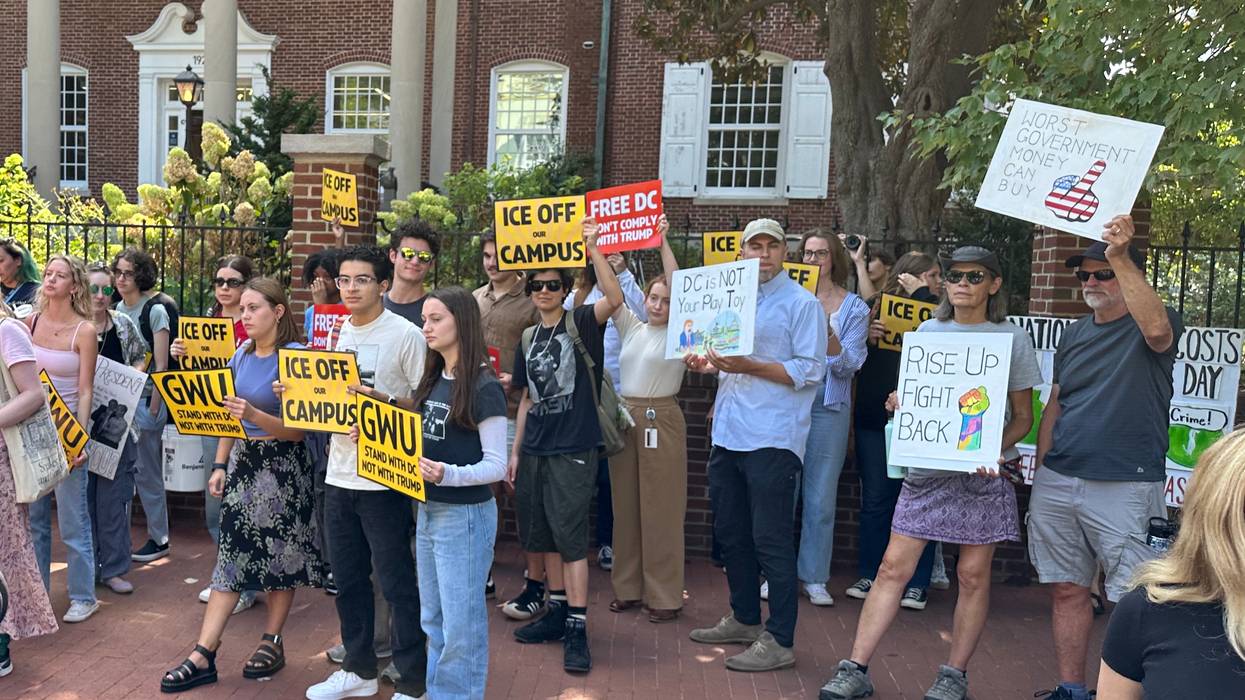
As US President Donald Trump expands his authoritarian takeovers of Democrat-led cities, more than 1,000 students from four universities in Washington, DC walked out to protest the Republican's recent actions in the nation's capital.
Students from American University, Georgetown University, George Washington University, and Howard University are protesting Trump's deployment of National Guard troops and federalization of the Metropolitan Police Department (MPD), which have also provoked a lawsuit from DC Attorney General Brian Schwalb and a congressional resolution that aims to stop his takeover.
"Students are showing the country that we won't be silent while Trump tries to strip DC residents of our rights," American University student organizer Asher Heisten said in a statement circulated Tuesday by the youth-led Sunrise Movement.
"When Trump sends federal forces into DC, he is trying to intimidate and silence us," Heisten continued. "But students are proving that we will fight back to reject Trump's dangerous authoritarianism."
The students were joined by a pair of progressive lawmakers, US Sen. Ed Markey (D-Mass.) and Rep. Pramila Jayapal (D-Wash.).
"Trump's federal takeover is a direct attack on democracy and the people of Washington, DC," Jayapal said in a statement. "The students leading today's walkouts are showing the entire nation what it means to resist authoritarianism with strength and solidarity."
The congresswoman told a crowd at Georgetown, her alma mater, that "this is an unprecedented moment in our country, where we have an authoritarian leader who is deploying federal troops to Washington, DC—to cities across the country, militarizing our streets, kidnapping people on the streets."
"The only bulwark that we have is the people, and so what you are doing here today is so important, because, at the end of the day, the checks and balances that were supposed to be built into our Constitution so that we could protect our constitutional rights are not working right now," she stressed, calling out Republicans in Congress and US Supreme Court justices for refusing to hold Trump accountable.
Acknowledging the thousands of protesters who marched to the White House on Saturday, Jayapal declared that "we are not powerless," a line that drew loud cheers from the crowd.
Markey, in his remarks at Georgetown, noted that when the president's supporters stormed the US Capitol on January 6, 2021 in hopes of stopping the certification of his 2020 electoral loss, "Trump refused to send in troops."
"He allowed for that assault," Markey said of the attempted insurrection. "But now, here in DC, the president is attempting to create an impression that the crime rate is going up rather than down, that there is in fact a crisis here in the District of Columbia."
"And what he is doing, not just here in DC, but in Chicago, in LA, in Boston, is to try to characterize communities that are majority minority, that are majority Black and brown, as being unsafe to live," Markey noted. "And it's not a coincidence... It is to scare America. You cannot make America great again by making America hate again."
Markey argued that "this is not about policing, this is about political theater," and denounced Trump's DC takeover as a "charade."
Like the lawmakers, Georgetown student Scout Cardillo suggested that the DC takeover isn't just about the district. Cardillo told The Washington Post that "the effects of the occupation of DC and federalization of MPD is going to be felt throughout the country imminently, and it is on us to take a stand and fight back."
We are most powerful when we dismantle the systems designed to isolate, disconnect, and distract us from uniting against the genocide in Gaza.
Being in Washington, D.C., the heart of the beast, meant that establishing and maintaining our encampment was a formidable task. Situated just a 15-minute walk from the State Department and the White House, we were perpetually under surveillance. Yet, it was precisely for this reason that we needed to be there—to confront the institutions that uphold the empire. No bomb falls in Gaza without the State Department's consent; no child is maimed by airstrikes without the White House's approval. Just around the corner, the architects of genocide convened to plan further carnage against my people in Gaza.
The camaraderie forged at the encampment was unforgettable. Time seemed to stretch and warp—two weeks felt like months, even years. In our modern world, uniting in large numbers for a powerful cause such as Palestinian liberation is rare. At the George Washington University encampment, friendships and solidarity blossomed quickly. Everyone understood that daily routines were distractions from what truly mattered: standing up for Gaza, for Palestine, against the relentless and systematic violence of a depraved Zionist state intent on massacring an innocent population, punishing them for their mere existence.
I am from Gaza. Dozens of my relatives have been murdered by the Israeli regime. I could never have imagined the scenes we experienced at Shohada' Square (Martyr's Square), our name for the "University Yard" where our encampment stood.
Gaza, and by extension our encampment, taught us that true liberation is achieved by consistently prioritizing the group's welfare over individual gain.
After enduring the struggle for a free Palestine alone for most of my life, the encampment finally gave me a family of individuals who understood that Gaza's plight is an existential issue that we must all attend to. For the first time in almost a decade of living in North America, I felt at home. We did not have to feign a sense of normalcy, nor did we shy away from challenging the state responsible for the most live-streamed genocide in human history. So the tents were put up, adorned with Palestinian flags and banners. Every day, the air was thick with the scent of shared meals and the hum of voices engaged in discussion. The encampment was not just a group of individuals; it represented a collective force bound by a shared struggle and an unbreakable commitment to Palestinian liberation.
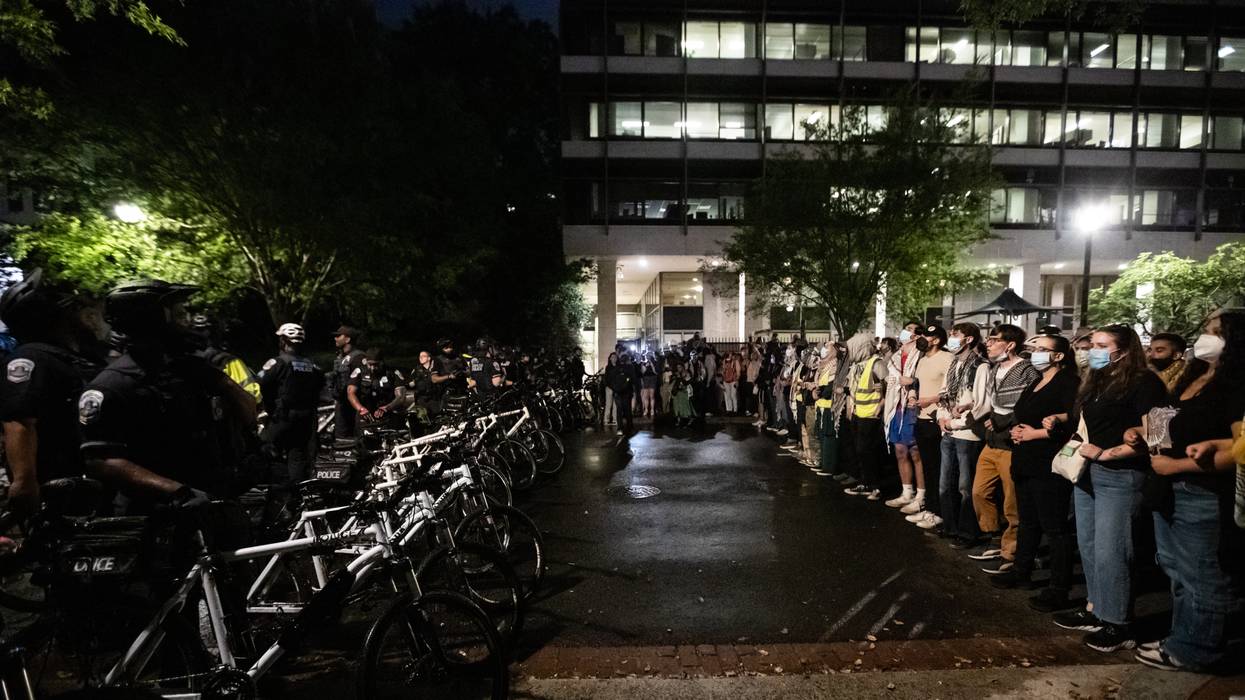
For this, university president Ellen Granberg and Mayor Muriel Bowser of D.C. ordered the local police department to raid our encampment, to brutalize and vigorously pepper spray the students and supportive community. All because they dared to be unwavering in their demand for the liberation of Palestine.
The support from our local D.C. and extended DMV (DC, Maryland, and Virginia area) community, especially in the early days of the encampment, revealed the unbreakable interconnectedness of our fight. This principle must guide every action and decision, especially in moments of opportunity and peril. Our time at the encampment revealed a profound truth: We are most powerful when we dismantle the systems designed to isolate, disconnect, and distract us from uniting against the genocide in Gaza. During our two weeks together, we forged bonds that transcended the constraints of a system fixated on capital over humanity. We discovered a deeper, radical connection that challenges these structures.
Contrary to the "outside agitator" narrative propagated by mainstream media, the encampment unveiled the geographic and psychological divisions meant to keep us apart. These divisions prevent us from fully embracing and fighting for each other's freedom and true liberation. The encampment stands for Gaza, for Palestine, and for the liberation of Palestinians from settler-colonial hegemony. It is the heart of our struggle. It symbolizes a broader fight for collective liberation and the realization that a better future is attainable for everyone. Each day at the encampment was dedicated to thought, learning, exchanging ideas, and sustaining one another.
This movement was never confined to students alone. At George Washington University, our supportive D.C. and extended DMV community had the opportunity to bolster our cause for Palestinian liberation. Whether or not everyone fully grasped this cause as part of our larger struggle, they profoundly understood it when they united to bring it to life. The encampment taught us the imperative of challenging the systems facilitating the ongoing genocide against Palestinians in Gaza.
As committed citizens and active participants in the fight for collective liberation, we must balance the line between reasonable risk and self-preservation. Prioritizing individual safety and comfort over collective sacrifice is the path most tread because it is what we are taught. This mindset allowed the university to call in a brutal Metropolitan Police force to terrorize, beat, and pepper spray students and community members. President Granbeg, the complicit university administration, and Mayor Bowser demonstrated their priority of maintaining genocidal policies over divesting from them.
Simply put, the encampment showed that our strength as a collective lies in our numbers, and our power is magnified when we act in unison. We must continually reflect on and challenge how often we prioritize personal comfort over the collective good. This is how we honor the sacrifices made by my people and family in Gaza. Gaza, and by extension our encampment, taught us that true liberation is achieved by consistently prioritizing the group's welfare over individual gain.
Within the encampment, people understood that they are united in this struggle. As a Palestinian from Gaza, I have come to understand the rationale behind prioritizing sacrifice for Palestine. This is not a symbolic point or an abstract act of courage but a settled understanding developed over the last nine months that my life is no more valuable than any life lost or enduring in Gaza. As a Palestinian in the diaspora, the student encampments represented the forefront of our opposition to imperialism and colonialism in the U.S., embodying the spirit of our fight. We must look past a rudimentary view of our student movement as a focal point but rather understand what the students did was intertwined with the local community that understood the importance of opposing imperialism from within its place of origin.
Our struggle is one, our liberation is intertwined, and with our combined fights and sacrifices we will soon see a free Palestine, inshAllah.
As the presidential nominating contests enter their final stretch, a troubling new trend has developed for Democratic voters. Recent polling indicates that Hillary Clinton may be losing her lead over Republican frontrunner Donald Trump.
According to the new Rasmussen Reports national telephone survey, released on Monday, the New York billionaire would defeat the former secretary of state 41 to 39 percent in a hypothetical matchup.
According to the survey, which was conducted from April 27 to 28 among 1,000 likely voters:
Trump now has the support of 73% of Republicans, while 77% of Democrats back Clinton. But Trump picks up 15% of Democrats, while just eight percent (8%) of GOP voters prefer Clinton, given this matchup. Republicans are twice as likely to prefer another candidate.
Among voters not affiliated with either major party, Trump leads 37% to 31%, but 23% like another candidate. Nine percent (9%) are undecided.
The results mark the first time since October that Trump has led Clinton in the Rasmussen poll while the latest RealClearPolitics average shows Clinton ahead of Trump by 7.3 percent.
These findings follow the George Washington University Battleground Poll last week, which found Clinton leading Trump by just 3 percentage points. Both surveys had a margin of error of roughly 3 points.
Underscoring both candidates' consistently low favorability ratings, Rasmussen also reported that nearly a quarter of voters said they would "opt-out" of a Clinton-Trump race, either by voting for another candidate (16 percent) or staying home (6 percent).
Rasmussen states that Clinton's narrow lead among under-40 voters (38 to Trump's 32 percent) "suggests that younger voters will be a big target in the upcoming campaigning."
This "traditionally...reliable Democratic group," as the pollster put it, has heretofore resoundingly backed Sen. Bernie Sanders in this race, and wooing youth voters is a challenge currently facing the Clinton campaign.
The Rasmussen poll comes one day ahead of the Indiana primary, which could prove to be a tight race for both parties. An NBC News/Wall Street, Journal/Marist poll, released Sunday found that Trump currently holds a seven-point lead over Clinton among Hoosier State voters.