

SUBSCRIBE TO OUR FREE NEWSLETTER
Daily news & progressive opinion—funded by the people, not the corporations—delivered straight to your inbox.
5
#000000
#FFFFFF
To donate by check, phone, or other method, see our More Ways to Give page.
Daily news & progressive opinion—funded by the people, not the corporations—delivered straight to your inbox.
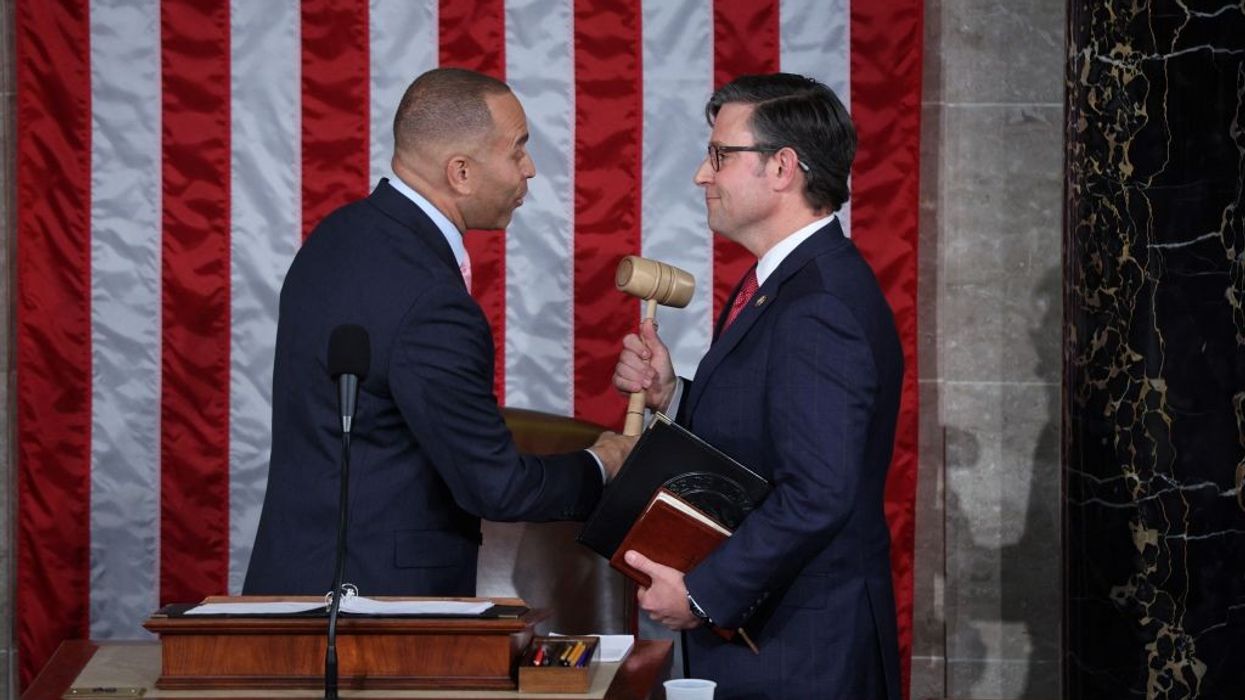
"How much damage is done at the federal level to the progress we have made will... depend on the election outcomes in the House of Representatives and the role it will play," said one climate expert.
While Republicans have won the White House and U.S. Senate as of early Wednesday afternoon, control of the House of Representatives remains too close to call—and may be the only governmental firewall against the GOP's fascist federal agenda.
Democrats went into the Tuesday election hoping to flip the House, which is now narrowly controlled by Republicans. There are 435 seats in the lower chamber, so the party to secure 218 of them will have the majority.
Various decision desks have called 179 to 193 House seats for Democrats and 200 to 210 for Republicans. The Associated Press noted that "vote-counting can take weeks in California, where most voters use mail-in ballots."
Congressman Gerry Connolly (D-Va.), who won his ninth term on Tuesday, told The Hill early Wednesday that "in terms of the power trifecta, the House is the only hope for Democrats to maintain a check on our out-of-control Donald Trump," now the president-elect.
"The House is the only hope for Democrats to maintain a check on our out-of-control Donald Trump."
"The results tonight are grim... for the country, and Democrats offer those who believe in constitutional democracy the only hope of presence in the White House and an enabling Republican Senate," Connolly said. "So a lot is hinging on district-by-district results tonight."
The AP has called flips in New York's 19th and 22nd Congressional Districts, with Democrats Josh Riley and John Mannion ousting Republican Congressmen Marc Molinaro and Brandon Williams, respectively. Democrat Laura Gillen is also on track to beat GOP Rep. Anthony D'Esposito in the state's 4th District; she has declared victory.
"Our livable future was on the ballot this year, and New York's climate movement delivered," declared Food & Water Action New York state director Laura Shindell, whose group endorsed Gillen and Riley. "New Yorkers voted like our lives depended on it, rebuking the dangerous pro-corporate Project 2025 interests seeking to boost climate-killing fossil fuels, dismantle clean air and water safeguards, and spread misinformation and distrust about the reality of the crisis we face."
"New York's newest congressional representatives have the backing of the state's grassroots climate movement—now, it's time to get to work fighting for our livable future against all odds, and delivering the climate wins that won them their seats," Shindell said.
House Minority Leader Hakeem Jeffries (D-N.Y.) similarly welcomed the "critically important" wins in his state on social media. Redistricting also helped Democrats pick up seats in Alabama, where Shomari Figures won the state's 2nd Congressional District, and Lousiaina, where former Congressman Cleo Fields claimed victory in the newly drawn 6th District.
However, the GOP has picked up two seats in Pennsylvania—with Republicans Ryan Mackenzie and Rob Bresnahan beating Democratic Reps. Susan Wild and Matt Cartwright, respectively—plus three in North Carolina, thanks to redistricting. Republican Tom Barrett also flipped an open seat in Michigan's 7th Congressional District.
As Bloomberg reported Wednesday:
Democratic House control would force Republicans to negotiate on trillions of dollars worth of provisions in the 2017 tax law that expire at the end of next year. It also would provide a check on Trump's "America First" foreign policy agenda, providing perhaps some hope to Ukraine and other allies of continued support.
The House under Democratic control also impeached Trump twice during his first term in office. He was never convicted by the Senate.
Key issues on the minds of progressive lawmakers and advocates across the country on Wednesday included reproductive freedom and the climate emergency.
"How much damage is done at the federal level to the progress we have made will... depend on the election outcomes in the House of Representatives and the role it will play," Chitra Kumar, managing director of the Climate & Energy Program at the Union of Concerned Scientists, wrote Wednesday.
Food & Water Action executive director Wenonah Hauter said in a statement that "control of the House is still undetermined, and it's critical that every vote be counted."
"If Democrats retake the House, it will be essential that they stand strong against Trump's reactionary agenda," Hauter stressed. "We've seen Trump's playbook before and we're prepared to confront him head-on—through the courts, in Congress, and through determined grassroots organizing that has been responsible for great progress in the face of adversity for generations."
Even if Democrats don't win a House majority, progressive organizers remain determined to combat the far-right agenda.
"Our story does not end with this election result; we have a lot of work ahead of us. The future we are dreaming of is worth fighting for."
"Despite the deeply disappointing results of the election yesterday, our work to build a better future for our families and our nation does not end here," said MoveOn Political Action executive director Rahna Epting in a statement. "Donald Trump and MAGA Republicans will continue to try and divide us in hopes we give up and clear the path for them to dismantle our democracy and take away our freedoms."
"As exhausted and defeated as we all may feel right now, giving up is not an option. The organizers, change-makers, and heroes before us have sacrificed far too much for us to drop the baton and surrender now," she continued. "Our story does not end with this election result; we have a lot of work ahead of us. The future we are dreaming of is worth fighting for."
Acknowledging the tens of millions of people who voted for Vice President Kamala Harris and a Democratic Congress, Epting added that "together, we can defeat the far right by staying engaged, mobilizing our communities, and remaining defiant guardrails against their fascist vision for our country."
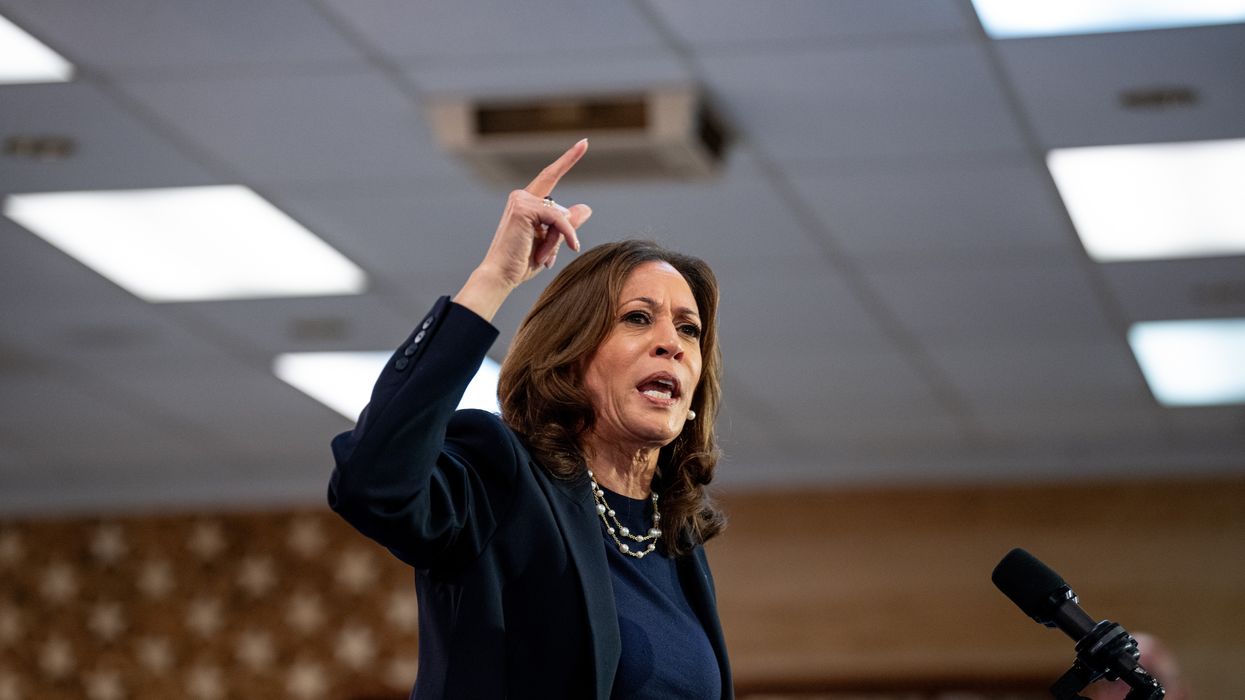
"It's wonderful to see the vice president unleash a suite of policy proposals to crack down on these cheaters and protect Americans' pocketbooks," said one advocate.
Economic justice advocates on Thursday applauded the Harris campaign's announcement the Vice President Kamala Harris is planning to unveil a historic ban on food and grocery price gouging amid widespread discontent about costs that have ballooned by 26% in the last five years.
The Democratic presidential candidate is expected to unveil the proposal for the first-ever federal price gouging ban at a rally in Raleigh, North Carolina on Friday, detailing plans to direct the Federal Trade Commission (FTC) to impose "harsh penalties" on companies that hike food prices to pad their profits.
As president, the campaign said late Wednesday, Harris would set "clear rules of the road to make clear that big corporations can't unfairly exploit consumers to run up excessive corporate profits on food and groceries," building on actions President Joe Biden has taken, such as the creation of a Strike Force on Unfair and Illegal Pricing and his guidelines aimed at reining in corporate mergers.
The rules would be introduced in Harris' first 100 days in office, should she win the presidential election in November.
Wenonah Hauter, executive director of Food & Water Action, said Biden and Harris have set out to correct "decades of failure by federal leaders to tackle food monopolies [that] have sent grocery prices skyrocketing."
"President Biden finally turned the corner with real action against ill-advised corporate mergers, and the Harris campaign's signals of intent to work even harder against food profiteering are encouraging," said Hauter. "We look forward to seeing robust antitrust policy that will make a difference in our wallets, and send the food monopolies packing."
Food & Water Action pointed out that the proposal came a day after it was announced that the multinational food company Mars would acquire its competitor, Kellanova, for $36 billion "in a bid to dominate snack market sales at consumers' expense."
Such acquisitions have continued, said Food & Water Action, even as the monthly food cost for a family of four sticking to inexpensive groceries to save money increased 50% over the past four years, while the top four grocery companies in the U.S. saw their revenues go up as much as 36%.
"The cost of a whole chicken rose 41%, while poultry giants Tysons Foods and Perdue saw revenue increases of 22.5% and 54.9%, respectively," said the group.
While grocery prices have gone up by just 1% in the past year, costs have not eased since they shot up due to supply chain and labor issues during the coronavirus pandemic.
A Gallup poll in May found that 41% of Americans viewed the high cost of living as the most pressing financial issue for their families, and a survey by public opinion research group Blueprint found in June that penalties for companies that price gouge had the support of 81% of respondents, including 86% of Independent voters.
"It's hard to get down an aisle in the grocery store without finding an example of price gouging or price fixing, and it's costing us dearly," Lindsay Owens, executive director of the think tank Groundwork Collaborative, told The Washington Post. "It's wonderful to see the vice president unleash a suite of policy proposals to crack down on these cheaters and protect Americans' pocketbooks."
On social media on Thursday, Owens exposed "some of the worst offenders" who raise prices with the goal of boosting profits—a major driver of inflation, according to an analysis by Groundwork earlier this year.
"Practices like shrinkflation (that half empty bag of chips) and it's evil twin skimpflation (like when Wishbone salad dressing swaps the oil for water), or Walmart rigging the produce scales to charge a little more on a pound of oranges, are everywhere," said Owens. "It's wonderful to see that Harris will address her plans to take on price gouging in the food and grocery sector tomorrow. She has a strong track record of going after cheaters from her time as California's top lawyer, and through her great work this past four years."
As Americans express strong support for price gouging penalties, said David Sirota, founder of The Lever, Harris' proposal will "inevitably" push Republican presidential nominee Donald Trump into defending corporations that willfully force families to pay more for essentials.
The proposal will "bait the entire American right into screaming, 'Let them eat cake' as they go on record in support of food conglomerates fleecing the working class," said Sirota.
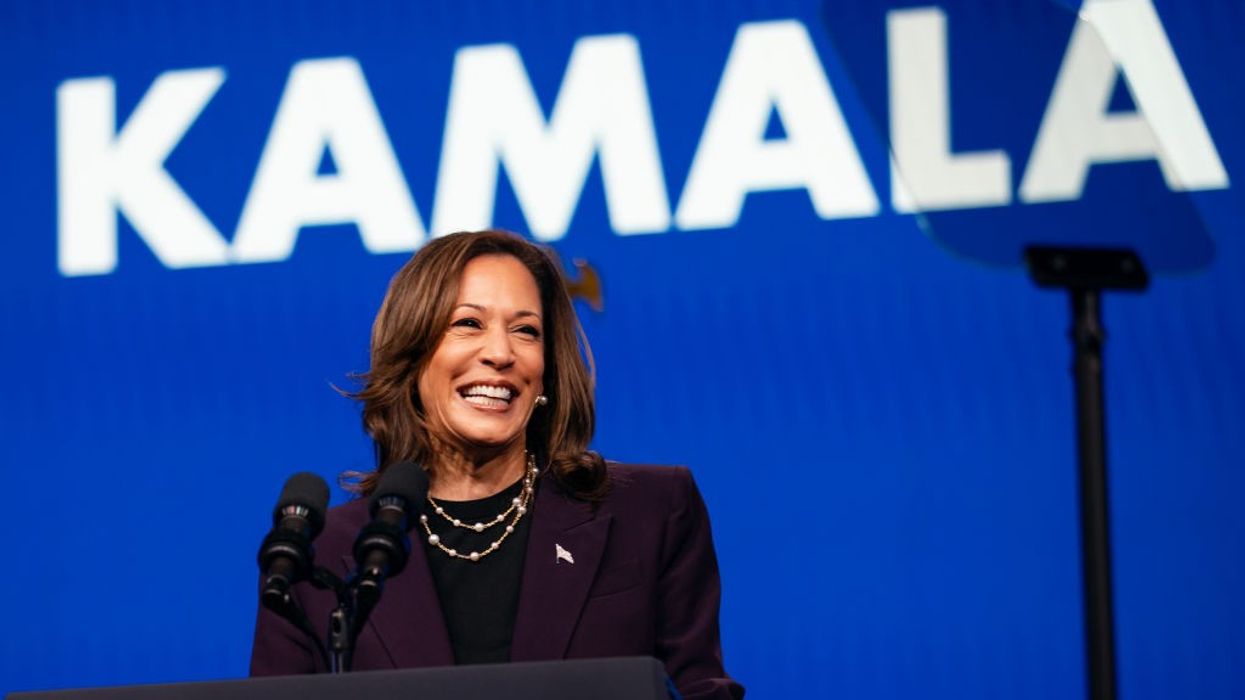
"With a President Harris, we will have a chance to build the political power to move the bold climate initiatives we need."
Progressive climate and environmental advocacy groups on Wednesday stressed the threat posed by the Republican presidential ticket and endorsed Vice President Kamala Harris, the presumptive Democratic nominee for the November election.
One coalition of six groups—350 Action, Center for Biological Diversity Action Fund, Clean Water Action, Climate Hawks Vote, Food and Water Action, and Friends of the Earth Action—cited Harris' record as vice president and a U.S. senator from California.
Despite his months as the presumptive Democratic nominee, none of the organizations had endorsed President Joe Biden before he dropped out of the race and backed Harris earlier this month.
"Vice President Harris is a visible leader in the Biden-Harris administration's successful work to address environmental injustice, tackle the climate crisis, hold polluters accountable, reduce water pollution, and ensure clean drinking water for all," said Clean Water Action president and CEO Jeff Carter, emphasizing that her actions "have made a real difference in people's lives."
Jeff Ordower of 350 Action highlighted that in addition to being "part of the administration that invested in renewable energy through the historic Inflation Reduction Act," Harris "has a history of taking on Big Oil and advocating for environmental justice."
"As a global climate movement, we know Harris represents not just the ability to make progress in the U.S., but globally as well," he added. "For those... who care about democracy, climate, and decreased corporate capture of our government, Kamala Harris is our only choice."
"For those... who care about democracy, climate, and decreased corporate capture of our government, Kamala Harris is our only choice."
Kierán Suckling, president of the Center for Biological Diversity Action Fund, similarly urged "everyone who cares about our planet, environmental justice, women's rights, civil rights, and our democracy to get out and vote for Kamala Harris to be our next president."
Suckling also took aim at former President Donald Trump, the Republican nominee, declaring that "Harris will lead us toward a brighter future for our children and grandchildren, and put the nightmare of Trump behind us."
Trump—who earlier this month announced Big Oil-backed Sen. JD Vance (R-Ohio) as his running mate—has vowed to "drill, baby, drill" and roll back the Biden-Harris administration climate policies if fossil fuel executives pour money into his campaign.
Although the U.S. is among five wealthy countries that have led a global surge in oil and gas development this year, Harris' campaign has warned that "oil barons are salivating" over Trump's potential return to the White House.
A March study found that Trump's plans for a second term would lead to 4 billion more tons of carbon dioxide being released into the atmosphere by 2030 when compared with the policies of Biden—who has passed the torch to Harris, whose online nomination process is set to start on Thursday.
"Kamala Harris' record provides a stark contrast with Donald Trump and the far-right, pro-polluter Project 2025," said Wenonah Hauter, founder and executive director of Food and Water Action. "Of course, much more needs to be done, and Harris' positions do not yet go far enough to tackle the existential threats to our food, water, and climate."
"But with a President Harris, we will have a chance to build the political power to move the bold climate initiatives we need," Hauter emphasized. "Four more years of Trump and Project 2025 will further accelerate an already escalating climate crisis and eviscerate important protections for our food and water."
The six groups that backed Harris but not Biden were among the campaigners and scientists angered by the president supporting the Willow project and Mountain Valley Pipeline, continuing fossil fuel lease sales, skipping last year's United Nations summit, and declining to declare a national climate emergency.
As HEATED, which scooped the endorsement news, reported late Tuesday:
Harris has already received endorsements from the so-called "Big Green" groups—the political arms of the League of Conservation Voters, the Natural Resources Defense Council, the Sierra Club, and Clean Energy for America. But those weren't much of a surprise, as each group had already backed Biden's reelection bid, and are traditionally loyal to Democratic Party politicians.
The groups endorsing Harris on Wednesday, however, had so far held off on throwing their support behind Biden while he was running for reelection—in part because of the sitting president's mixed record on climate policy.
"It was very much a debate" on whether to endorse Biden, said one of the group's staffers, who spoke on background because the Harris announcement is not yet public. But with Harris, the calculus has changed.
"Because of her work in California and when she was a senator—a lot of us worked with her on creating the Environmental Justice for All Act—it gives us hope," the staffer said. "She's just a different person [than Biden], and has a stronger track record."
"Friends of the Earth Action is excited to endorse Kamala Harris for president of the United States," the group's president, Erich Pica said Wednesday. "We are not going back to an era dominated by fossil fuel interests, corporate greed, and disenfranchisement. Instead, we're looking forward to building a healthy and just future with Vice President Harris."
For Climate Hawks Vote, this is the organization's first presidential endorsement since its founding over a decade ago.
"We're breaking our usual rule of not endorsing in presidential elections, given our strong history with Kamala Harris (we endorsed her in her 2016 Senate race), her track record in taking on Big Oil and holding polluters accountable, and the extraordinary moment of this election," explained RL Miller, the group's president. "We are climate hawks who vote, and we'll be flocking together for Kamala Harris."
The Green New Deal Network—which also never endorsed Biden—separately threw its support behind Harris on Wednesday.
"What the Green New Deal really is, is understanding that everything's connected," the network's national director, Kaniela Ing, told Inside Climate News. "Making sure our tax dollars aren't just going to kill children abroad, but to build schools and hospitals here at home… Local control of resources, self-determination of our communities. That's the vision Kamala Harris, given her background—being bused to schools, really being a product of a lot of our social programs—really understands."
One group that has not yet endorsed Harris but has certainly been attentive to both major party tickets is the youth-led Sunrise Movement. The organization warned earlier this month that the Republicans would cause "catastrophic and irreversible damage" to the climate if elected, and some members were arrested for a Monday protest Vance's Senate office on Capitol Hill.
That same day, Sunrise rallied outside of the Democratic National Committee headquarters in Washington, D.C. to urge Harris "to put forward a comprehensive plan on the economy and climate."
Sunrise is also part of a youth-led coalition—which includes Gen-Z for Change, March for Our Lives, and United We Dream Action—that wrote to Harris last week, "This is your chance to energize young people and our communities to vote, mount one of the greatest political comebacks in decades, and deliver a resounding defeat to the far-right agenda of Trump and Vance."

"Young people are here because Kevin McCarthy and other Republicans are playing political games with our lives. We're over this bullshit."
A group of youth climate activists occupied House Speaker Kevin McCarthy's office in Washington, D.C. on Thursday to condemn the Republican leader and his caucus for pushing the U.S. government to the brink of a destructive shutdown as they demand draconian cuts to food aid, housing assistance, and environmental programs.
"We are fed up and we won't take it anymore," said Adah Crandall a 17-year-old Sunrise Movement organizer who joined a number of other climate activists inside McCarthy's (R-Calif.) office. "As storms rage stronger, fires grow hotter, and heatwaves grow more deadly, Kevin McCarthy is playing political games with our futures. We're facing a climate emergency and McCarthy can't even do his job."
The Sunrise Movement said around 150 students from across the nation traveled to Capitol Hill Thursday to take part in the protest, which comes just two days before the federal government is set to shut down.
Eighteen youth activists were arrested outside of McCarthy's office during the demonstration, according to the climate group.
Earlier Thursday, the Biden administrationbegan notifying government employees that they could soon be temporarily furloughed after McCarthy rejected a bipartisan short-term funding proposal put forth in the U.S. Senate this week.
"Speaker McCarthy is a coward," Shiva Rajbhandari, a 19-year-old Sunrise Movement organizer. "McCarthy and Republicans can either do their jobs, act on the climate crisis, and fund our schools, or they can risk our economy to appease a few extremists. Our generation is watching and we will hold them accountable for their actions."
The impacts of a shutdown on critical government functions and programs—and the overall U.S. economy—could be massive.
"With each passing day, Washington would further deplete federal safety net programs that carry over their unused money from past years," The Washington Post's Tony Romm reported earlier this week. "Eventually, the government might not be able to provide some poor families with childcare, nutrition assistance, housing vouchers, or college financial aid. The longer a shutdown persists, the greater the blow it could ultimately deliver to an economy that has teetered for more than a year on the precipice of recession."
Food & Water Action warned Thursday that "in the event of a shutdown, serious and specific threats to food and water safety could immediately arise," noting that Environmental Protection Agency (EPA) regulators "could be forced to suspend critical safety inspections at drinking water sources, hazardous Superfund waste sites, and chemical facilities."
Additionally, the group noted, the EPA "would be forced to shut down the $15 billion project to replace dangerous lead water pipes throughout the country, putting impacted families at continued risk."
"By driving this country to the brink of a shutdown, congressional Republicans are proving once again, in stark relief, that they simply don't care about the health and well-being of the American people," said Mitch Jones, deputy director of Food & Water Action. "Nowhere is this more obvious than in their willingness to shut down critical food and water safety inspections that occur every day across the country."
"Rather than working with Democrats to responsibly fund the government, Speaker McCarthy and his slim majority are catering to the most extreme right-wing members in an already extreme caucus," Jones added. "House Republicans should be thoroughly ashamed of themselves, and they must be shown the door in 2024."

This is a developing story... Please check back for possible updates...
While Democratic leaders on Wednesday celebrated a surprise budget reconciliation deal with Sen. Joe Manchin on new climate and tax policies, progressive campaigners had a range of responses, from cautious optimism, to skepticism, to outright concern.
"Until Sens. Manchin and Sinema give us proof that their tag-team two-face act is over, we're not going to get our hopes up."
Manchin (D-W.Va.) and Senate Majority Leader Chuck Schumer (D-N.Y.) unveiled what Politico called "Washington's best-kept secret" less than two weeks before the August recess and less than two weeks after Manchin signaled he wasn't open to climate and tax reforms right now.
The new agreement--the Inflation Reduction Act of 2022--follows months of tense negotiations after Manchin last year killed the House-approved Build Back Better Act, which was backed by most of his Democratic colleagues, President Joe Biden, American voters, and progressive advocates.
"With more than 85 million Americans currently under a heat advisory, we are facing a climate emergency, and we must address it in ways that advance justice and create jobs. I commend Sen. Schumer, President Biden, and the entire Senate Democratic Caucus for reaching a deal on legislation that invests in climate and aims to help lower energy costs for Americans," said Margie Alt, director of the Climate Action Campaign, in a statement.
"While I look forward to studying the details closely, this is welcome news that the Senate appears to be moving forward on these investments," Alt added. "We need both Congress to pass meaningful investments in climate, justice, clean energy, and jobs AND President Biden to use every tool in his toolbox to implement strong solutions for pollution. There is no time to waste."
While echoing the message that American policymakers must immediately and ambitiously take on the climate emergency, Food & Water Action Executive director Wenonah Hauter expressed concern that, as Manchin highlighted, "it is truly all of the above, which means this bill does not arbitrarily shut off our abundant fossil fuels."
Hauter said that "after dragging his feet for more than a year, Sen. Manchin announced an agreement that won't solve the crisis, and may make it worse. The few details released this evening suggest this deal will prop up fossil fuels and promote the various false climate solutions beloved by industry."
Noting that as part of the deal, Biden, Schumer, and House Speaker Nancy Pelosi (D-Calif.) have also agreed to reform the permit process for energy infrastructure before the end of the fiscal year, Hauter warned that "streamlining permitting for natural gas pipelines and exports is not climate action, it is the opposite. More subsidies for dirty hydrogen, carbon capture, and nuclear energy are not climate action, they are the opposite."
Using the budget reconciliation process allows Senate Democrats to bypass a GOP filibuster, but due to the Democratic Party's narrow control of the upper chamber, the bill must be supported by the full caucus, including Manchin and fellow obstructionist Sen. Kyrsten Sinema (D-Ariz.), to pass.
"This so-called deal forced by Sen. Manchin is what we would expect when Congress is so closely divided and friends and beneficiaries of the fossil fuel industry have effective control over 'climate' policy," said Hauter. "It proves we need to elect more climate champions so that we can pass the policies actually needed to confront the crisis we all face. Until then, we should not accept deals that strengthen the oil and gas industry to the detriment of us all."
Morris Pearl, chair of the Patriotic Millionaires, wondered on Wednesday whether the bill will even make it to Biden's desk, given the right-wing Senate Democrats' track record.
"We'll believe it when we see it pass on the floor of the Senate," Pearl said. "We've been down this road before--until Sens. Manchin and Sinema give us proof that their tag-team two-face act is over, we're not going to get our hopes up."
"Manchin and Sinema have spent the last year leading Democrats on a wild goose chase in search of the perfect bill that would get both of their support," he noted. "Manchin's decision to come back to the bargaining table solves one half of that puzzle, but it does nothing to ensure that Sinema will cooperate. In fact, some of the tax changes that he's included in his bill, like fixing the carried interest loophole, are ones that Sinema has previously said she will not support."
Pearl stressed that "I hope the Inflation Reduction Act becomes law. Multinational corporations, fund managers, and criminal tax evaders should all be paying more. But it hasn't passed yet, and without more pressure on both Manchin and Sinema, it might never."
According to Politico, "Sinema learned of the deal on Wednesday afternoon and had no immediate comment."
HuffPost pointed out that the proposal could also run into trouble in the closely divided lower chamber:
House Democrats from New York and New Jersey have said they'll refuse to support any deal that doesn't restore the federal tax deduction for paying state and local income taxes.
Manchin explicitly rules out restoring the deduction in his statement: "Our tax code should not favor red state or blue state elites with loopholes like SALT," he said, referring to it by the acronym for "state and local tax."
Business-friendly Rep. Josh Gottheimer (D-N.J.), who is leading the group demanding the restoration of SALT, was noncommittal Wednesday night.
Meanwhile, Congressional Progressive Caucus Chair Pramila Jayapal (D-Wash.) was among those celebrating the deal.
"If it's all true... it's a huge victory for the American people," she told NBC News' Kyle Stewart. "It's a really important set of investments in people's healthcare, keeping costs down, extending the subsidies, and climate change."
"Today, I'm allowing myself to feel a little bit of hope," Jayapal added. "And let's see if we can get this done because it would be life-changing for so many people across our country and across the world."
Pelosi struck a similar tone, saying that "it is welcome news for House Democrats, who have fought relentlessly to lower the cost of healthcare, combat the climate crisis, and ensure that the biggest corporations and the wealthiest few pay their fair share."
While vowing to "continue to fight for priorities not contained in this legislation," Pelosi said that the deal "is a victory for America's families and for protecting our planet," and "in light of the discussions of the past year, this agreement is a remarkable achievement."
In addition to a joint statement with Manchin announcing the broad strokes of the deal, Schumer separately said that "I expect that the remaining work with the parliamentarian will be completed in the coming days and the Senate will vote on this transformative legislation next week."
Along with the full legislative text and a one-pager on the deal, Schumer released summaries of the tax, prescription drug, and climate provisions.
The senators expect the proposal to raise $739 billion in revenue: $313 billion from a 15% minimum corporate tax rate, $288 billion from prescription drug pricing reform, $123 billion from enhanced enforcement by the Internal Revenue Service, and $14 billion by closing the carried interest loophole.
The deal would invest $369 billion in energy security and climate change, $64 billion in extending Affordable Care Act subsidies, and approximately $300 billion in deficit reduction, a key priority for Manchin. It would allow Medicare to negotiate drug prices and cap out-of-pocket costs at $2,000 as well as cut planet-heating emissions roughly 40% by 2030.
Schumer--who was confronted in his Capitol Hill office earlier this week by congressional staffers who staged a sit-in for climate action--thanked Manchin "for his willingness to engage and his commitment to reaching an agreement that can earn the support of all 50 Senate Democrats."
Manchin, in his own lengthy statement, hailed the Inflation Reduction Act for providing "a responsible path forward that is laser-focused on solving our nation's major economic, energy and climate problems," while reiterating his opposition to the much broader package he blocked.
"For too long, the reconciliation debate in Washington has been defined by how it can help advance Democrats' political agenda called Build Back Better," he said. "Build Back Better is dead, and instead we have the opportunity to make our country stronger by bringing Americans together."
Data for Progress polling conducted in late December--just after Manchin publicly made clear that he would thwart passage of the Build Back Better Act--showed that 61% of voters across party lines somewhat or strongly supported the plan to invest $1.75 trillion over the next 10 years in various social programs. Support for the package rose to 63% after they were told it would be paid for with new tax policies.
Though much smaller than the Build Back Better package, Biden on Wednesday expressed his support for the Inflation Reduction Act, declaring that "this is the action the American people have been waiting for."
The president, who's faced mounting pressure to push harder for a legislative win, thanked Schumer and Manchin "for the extraordinary effort that it took to reach this result," and urged Congress to "move on this bill as soon as possible."
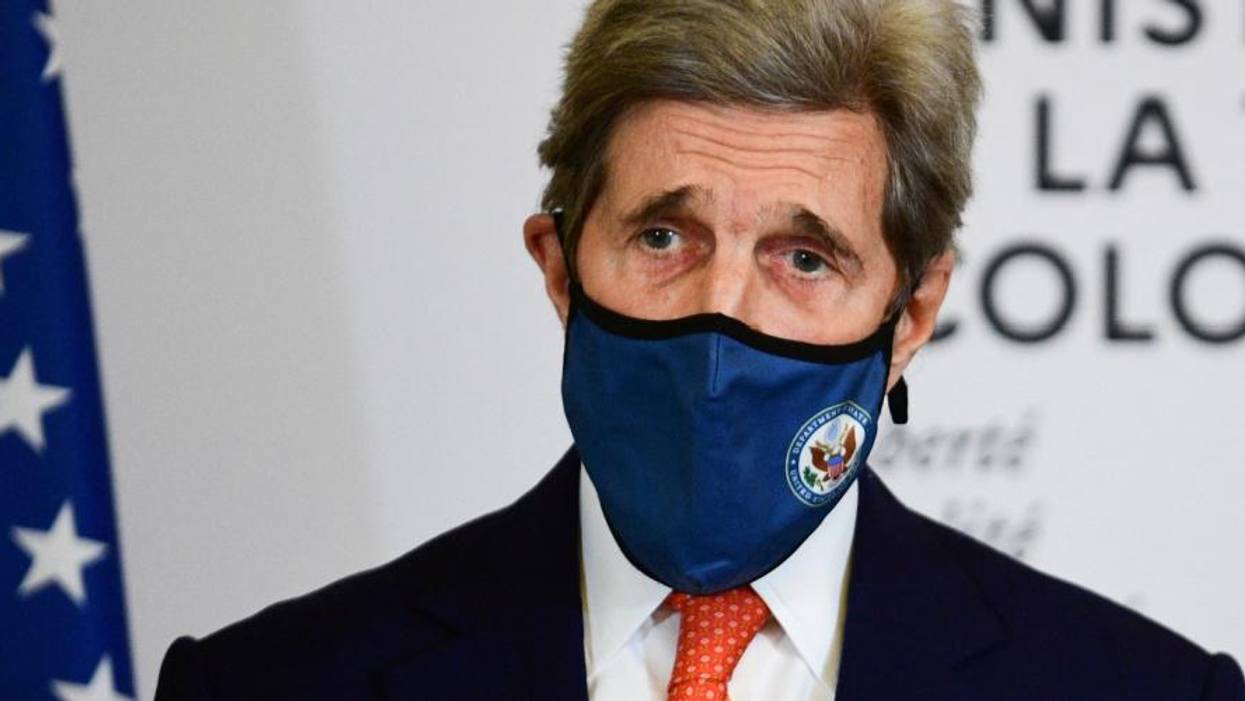
Just days after he suggested the private sector, not government, will lead the fight against the climate crisis, 145 organizations sent a letter Tuesday urging U.S. Special Presidential Envoy for Climate John Kerry to use his position to help end "the flow of private finance from Wall Street to the industries driving climate change around the world--fossil fuels and forest-risk commodities."
"It's time that the U.S. government take the reins back from Wall Street so we can assure the rapid, justice-centered decarbonization necessary for a livable planet."
--Moira Birss, Amazon Watch
President Joe Biden's selection of the former secretary of state as the first-ever White House climate envoy was met with mixed reactions from advocates, with critics such as Food & Water Action executive director Wenonah Hauter calling Kerry "a long-time apologist for fossil fuel fracking and a reliable promoter of false climate solutions like market-based carbon-trading schemes."
The sister organization Food & Water Watch signed on to the new letter. Other signatories included Amazon Watch, Center for Biological Diversity, Earthworks, Friends of the Earth U.S., Future Coalition, Greenpeace USA, Oil Change International, Public Citizen, Rainforest Action Network (RAN), SumOfUs, and several chapters of 350.org.
"Climate policy has so far been left to markets, and now we're in a climate crisis," said Moira Birss, climate and finance director at Amazon Watch and steering committee member of the Stop The Money Pipeline coalition. "It's time that the U.S. government take the reins back from Wall Street so we can assure the rapid, justice-centered decarbonization necessary for a livable planet."
The letter (pdf)--sent just before the release of new data on deforestation that one expert warned "represents a crisis for climate stability and biodiversity conservation, as well as a humanitarian disaster and lost economic opportunity"--argues that demonstrating climate leadership on a global scale requires ending "financing of fossil fuels and deforestation around the world by U.S. firms and entities."
"That is why we applauded President Biden's executive order directing you and Treasury Secretary [Janet] Yellen to develop a U.S. climate finance plan, and why [we] were encouraged when you said this plan will include 'ending international financing of fossil fuel projects with public money,'" the letter says. "However, in order to credibly take on this challenge, we must recognize that Wall Street is not yet an ally--as long as U.S. firms continue to pour more money into the drivers of climate change, they are actively undermining President Biden's climate goals."
The groups expressed disappointment that Mark Gallogly--a major Democratic donor who spent 16 years at Blackstone, the world's biggest private equity firm and a notable investor in fossil fuels--joined Kerry's international climate team, adding that "a climate action approach that seeks to partner with Wall Street without also holding it accountable is no longer credible in 2021."
The letter encourages the Biden administration to embrace four key commitments that would address Wall Street's financing of industries driving the climate emergency:
"Wall Street amassed its riches by pouring money into fossil fuels, and they don't want that gravy train to end," said Doug Norlen, director of the Economic Policy Program at Friends of the Earth U.S. "It's dangerous to suggest that the very institutions that financed and fueled the climate crisis should dictate our response to it. Climate Envoy Kerry must support the use of the levers of government to end U.S. and international institution support for fossil fuel and forest-destroying financing."
The letter says that "until we can hold Wall Street firms to account, no amount of new green finance commitments can credibly undo the damage that their fossil fuel financing is doing to the climate, to U.S. climate leadership, and to our chances of meeting the goals of the Paris agreement." The groups have requested a meeting with Kerry, who was involved with the crafting the 2015 climate deal.
David Arkush, director of Public Citizen's Climate Program, said that "Kerry's recent statement that the government can't do much more than help Wall Street fix the climate crisis is deeply troubling" because "Wall Street is almost completely on the wrong track, and we need financial regulators to help right the course."
Public Citizen and Americans for Financial Reform Education Fund on Wednesday released the Climate Roadmap for U.S. Financial Regulation (pdf), which includes recommendations for personnel, staffing, and agency organization; supervision and prudential regulation; and capital markets regulation.
"Wall Street is gambling against our future and putting the health of our communities and economy at grave risk. Given the urgency of the climate crisis, we can't afford continued inaction," said Arkush. "Financial regulators already have an obligation to protect us from Wall Street's risky bets and this roadmap is designed to help them act immediately, using all the tools currently at their disposal."
"Financial regulation is a key piece of the whole-of-government approach necessary to tackling the climate crisis and realizing the level of economic transformation needed to avert disaster for people and for the planet," said Alex Martin, senior policy analyst at Americans for Financial Reform Education Fund.
The new letter and roadmap follow a report released last week by RAN and other advocacy groups detailing how the world's 60 largest banks have dumped more than $3.8 trillion into the fossil fuel industry since the Paris agreement was adopted in 2015--despite recent "splashy" net-zero commitments from major U.S. institutions.
Last year, Sen. Jeff Merkley (D-Ore.) introduced a pioneering pair of bills that would prevent banks and global financial institutions from pouring money into fossil fuels. As he said in October: "It's time to prioritize the interests of the American people and the planet above the wishes of fossil fuel CEOs who want to hold our economy hostage."

Last week, IATP joined Food & Water Action and nearly 550 other national and regional organizations including Action Center on Race & The Economy, Center for Biological Diversity and Corporate Accountability in support of the Water Affordability, Transparency, Equity and Reliability (WATER) Act. This legislation was introduced in the House and the Senate last week by Reps. Brenda Lawrence and Ro Khanna and Sen. Bernie Sanders and is backed by 71 other Democratic lawmakers.
Four years ago, this month, we wrote that clean water was one of the first casualties of Trump administration's partisan attacks to roll back regulations. The use of the Congressional Review Act to repeal the Stream Protection Rule, which was established to protect 6,000 miles of streams and 52,000 acres of forests and was passed after extensive public consultation, was indicative of the administration's callous approach to protecting the nation's communities and its environment.
As it is, decades of underinvestment in water infrastructure have been plaguing America's drinking water systems. The Guardian reported last week that federal funding for water systems has fallen by 77% in real terms since its peak in 1977. This has left local utilities scrambling to raise funds to pay for infrastructure upgrades, comply with safety standards for toxic contaminants such as Per-and Polyfluorinated Substances (PFAS), lead and algae blooms, and adapt to extreme weather conditions like drought and floods linked to global heating.
So, it is indeed urgent and necessary that building America's public water infrastructure becomes a priority for the Biden administration. The WATER Act of 2021, as Sen. Sanders puts it, "is the most comprehensive approach to improving our water systems and helping ensure that every person has access to safe and clean water in the United States."
The WATER Act of 2021 "establishes increased yearly mandatory spending", up to $34.85 billion per year for drinking water and clean water infrastructure, creating up to one million jobs throughout the economy. It not only responds to water accessibility and affordability, but also details a path for upgrading public water systems to remove highly toxic and hazardous chemicals like lead and PFAS from drinking water while also maintaining public control over these systems.
The WATER Act is introduced against the background of COVID-19-related crises in the U.S. that has further worsened the inequities in water access, drawing sharper attention to environmental justice concerns.
Most importantly, these programs include a specific focus on providing support for rural and small municipalities, Indigenous communities, and low-income Black and brown communities who face disproportionate water issues. The WATER Act of 2021 will help the United States move towards making the internationally recognized right to water a reality in this country and simultaneously help meet targets linked to several United Nations Sustainable Development Goals (and indicators) especially those on water and sanitation.

Calling Tom Vilsack "Mr. Monsanto," a coalition of progressive groups launched a new campaign Monday to urge senators to vote against President Joe Biden's nominee to lead the U.S. Department of Agriculture.
The effort from Food & Water Watch, Progressive Democrats of America, RootsAction.org, and The Zero Hour points to Vilsack's time both as Agriculture Secretary under the Obama administration--and his record since then--as evidence Vilsack would elevate corporate interests over those of everyday people, climate-friendly policies, and a more just agricultural system.
"Tom Vilsack has made a career of catering to the whims of corporate agriculture giants--some of whom he has gone to work for--while failing to fight for struggling family farmers at every turn," Wenonah Hauter, executive director of Food & Water Watch, said in a statement.
Two broad problems underscore why Vilsack should not be allowed to reprise the role of Agriculture chief, according to the campaign:
Tom Vilsack is in the pocket of "Big Ag." As Agriculture Secretary he repeatedly capitulated to corporate interests over the needs of workers and small farmers. Vilsack ushered through a spineless GMO labeling standard rubber stamped by Big Ag, and sped-up the approval process for genetically modified crops. He allowed the meat industry to further monopolize--squeezing out small farmers--and scaled back oversight of poultry processing plants, permitting them to effectively self-regulate and thereby endangering food and worker safety. Immediately after leaving his post at the USDA in 2016, Vilsack became CEO of one the largest U.S. dairy lobbies.
Tom Vilsack also has an egregious record on matters of civil rights. At the end of his tenure as USDA secretary, Vilsack proudly claimed to have presided over a "New Era for Civil Rights at the USDA," but--according to the numerous civil rights groups and associations of Black farmers angered by his recent nomination--the truth was quite the opposite. An extensive two-year investigation by The Counter revealed that Vilsack's USDA misrepresented data to minimize persisting disparities and discrimination against Black farmers to deceptively portray its civil rights record in a positive light.
"America needs an Agriculture Secretary that will finally prioritize sustainable family farming and national food security over corporate profits," said Hauter. "Tom Vilsack has proven not to be the leader we need."
The campaign is calling on people to email their senators and flood their offices with calls on Thursday, January 28.
Other progressive groups and sustainable farming advocates voiced concerns last month when news emerged that Biden would be nominating Vilsack.
The chorus of criticism included People's Action director George Goehl, who wrote in an op-ed at the Guardian that Biden could have charted "a bold, new course for rural communities and farmers in America. Instead, Vilsack's nomination signaled more of the same from Democratic leadership."
Alan Minsky, executive director of Progressive Democrats of America, said Monday that the nation needs "an advocate for small farmers, a champion for civil rights, and a protector of the environment to lead the Department of Agriculture," but "Vilsack was none of these things during his eight years as Agriculture Secretary."
"We encourage U.S. senators to vote No on his nomination," he said.

President-elect Joe Biden said Monday that former Secretary of State John Kerry would serve as his Special Presidential Envoy for Climate, an announcement that provoked a range of responses from climate campaigners--many who broadly saw the pick as encouraging and others who warned the politically moderate statesman is a troubling choice to address the planetary emergency facing humanity.
The post, which will not require Senate confirmation, is within the National Security Council and is being referred to as "climate czar."
"This marks the first time that the NSC will include an official dedicated to climate change, reflecting the president-elect's commitment to addressing climate change as an urgent national security issue," the transition team said in statement.
The statement pointed to Kerry's background as "a key architect of the Paris Climate Accord," from which President Donald Trump withdrew and Biden has pledged to rejoin.
Green New Deal co-sponsor Sen. Ed Markey (D-Mass.), who in 2013 won Kerry's Senate seat, praised the nomination, saying that Kerry "understands that the climate crisis is the greatest national security threat of our time. I know that he will lead with courage and be a tremendous partner to the climate movement in the Biden administration."
Washington Gov. Jay Inslee, who earned plaudits for making the climate crisis centerpiece of his 2020 democratic presidential bid, called Kerry "an excellent choice" in light of "his deep commitment to follow science to save our planet and create millions of jobs."
Plenty of skepticism about the announcement emerged as well.
Food & Water Action called the choice an "alarming red flag" and the group's executive director Wenonah Hauter accused Kerry of being "a long-time apologist for fossil fuel fracking and a reliable promoter of false climate solutions like market-based carbon-trading schemes."
"Kerry's proposals are tired ideas from years past that will do little or nothing to address our climate crisis, and will actually continue to place a disproportionate, unjust burden on vulnerable communities that have borne the brunt of fossil fuel pollution and climate impacts for decades now," she said. As such, "We have our work cut out for us," added Hauter.
Still, Grenpeace USA and the Sunrise Movement said there was reason to be encouraged and pointed to additional climate steps the Biden White House must take.
"The appointment is a positive sign for Biden's intention to integrate climate leadership into every facet of the administration," declared Janet Redman, Greenpeace Climate Campaign Director.
But merely rejoining the Paris accord "should be the baseline for Biden's climate ambition, not the ceiling," she said, and urged to the next administration to make "a commitment to a Green New Deal-style economic recovery plan that includes a just transition for workers and their families, not just golden parachutes for CEOs."
A futher step for Biden, said Redman, is to "empower a climate council to act on the substantive changes we need to survive."
"We deserve a world beyond fossil fuels--a world in which workers' rights, community health, and our shared climate come before corporate profits. Right now," she added, "John Kerry has an unprecedented chance to lay the groundwork."
Sunrise Movement co-founder and executive director, Varshini Prakash called it "an encouraging sign of President-elect Biden's commitment to addressing the climate crisis that one of his very first staffing decisions is the creation of a high-level office to manage international climate negotiations and appointing a former secretary of state to lead it."
"I worked alongside Secretary Kerry on the Biden-Sanders Climate Task Force, and know that he is committed to engaging and listening to young voices--even when we might not always agree--and ensuring we have a seat at the table," Prakash said in a statement.
"This is an encouraging commitment, but it is not enough," she continued.
"What good is it to engage in diplomacy abroad if we're not doing everything we can at home? The next White House must also include a domestic counterpart reporting directly to the president to lead an Office of Climate Mobilization, who can marshal, convene, and push federal agencies, departments, states, local governments, industry, and civil society to use every tool at their disposal to address the climate crisis," said Prakash.
Given likely Republican obstruction on climate legislation, Prakash said that "we need a White House that does absolutely everything in its power to act and pushes every federal department to do the same, and a creative leader with a proven track record of grasping the urgency of the crisis with a strong team to work alongside the resident to make it happen."
In addition to Kerry, the Biden transition team announced other cabinet appointees including Antony Blinken for Secretary of State; Alejandro Mayorkas for Secretary of Homeland Security; Avril Haines for Director of National Intelligence; Linda Thomas-Greenfield for U.S. Ambassador to the United Nations; and Jake Sullivan for National Security Advisor.

Amid speculation that President-elect Joe Biden may select former Sen. Heidi Heitkamp to lead the U.S. Department of Agriculture despite her ties to agribusiness and fossil fuels, more than 50 progressive advocacy groups on Wednesday urged Biden to instead choose Democratic Congresswoman Marcia Fudge of Ohio.
"Now more than ever, we need a champion like Rep. Fudge to restore common-sense food safety standards in America," Food & Water Action executive director Wenonah Hauter said in a statement. "She has been an unsung hero of our food system workers, who are forced to deal with some of the most dangerous working conditions of any industry in the country."
Food & Water Action and Family Farm Action led the coalition of animal welfare, environment, farm, and food safety organizations that sent a letter (pdf) to Biden detailing why they want Fudge to run the USDA.
"Congresswoman Fudge is a skilled and compassionate leader of unparalleled reputation and integrity," the letter says. "She has long been an ally to farmers, food-chain workers, consumers, and rural communities. She is best positioned to help the department navigate today's unprecedented challenges--from the ongoing rural crisis, to climate change, to the pandemic's rupturing of our food system."
The letter highlights promising pieces of her political history, from urging federal agencies including the USDA "to strengthen workplace protections for slaughterhouse workers at the onset of the Covid-19 pandemic" and fighting against industry-led attempts to speed up lines at processing plants to introducing bills "to increase local procurement for the National School Lunch Program and to increase scrutiny of foreign investment in U.S. farmland."
The groups praise Fudge as not only a supporter of working people, family-scale farms, and regional food systems, but also someone who "understands the central role farmers play in fighting climate change and protecting natural resources." Additionally, the letter notes, she is "an advocate for farmers and communities historically underserved by USDA."
While celebrating her "unparalleled track record of protecting and strengthening nutrition programs," the letter also says that "as the first Black woman to serve as agriculture secretary, Congresswoman Fudge would address the department's legacy of discrimination against Black and other historically-underserved farmers, and ensure these groups have full access to USDA programs and resources."
"Congresswoman Fudge has a vision for our food and agriculture system that is inclusive of America's farmers, food-chain workers, and local and regional businesses."
--Joe Maxwell, Family Farm Action
Family Farm Action president Joe Maxwell--whose group recently released a roadmap outlining how the incoming Biden administration can revitalize rural America--emphasized that "Congresswoman Fudge has a vision for our food and agriculture system that is inclusive of America's farmers, food-chain workers, and local and regional businesses."
"What we need in a USDA secretary is a leader who will root out the historical discrimination within the department's farm programs, who will lift up all farmers not with government handouts but with markets that work, who will work to restore food security for all families, and who will restore Abraham Lincoln's vision for the department as 'The People's Department,'" he added.
Other signatories include national groups such as the Center for Biological Diversity, the Center for Food Safety, Mercy For Animals, Oil Change U.S., Open Markets Institute, People's Action, and 350.org, along with state and local organizations like Iowa Citizens for Community Improvement.
"Independent family farmers in Iowa are calling for Rep. Fudge as the next secretary of agriculture," said Adam Mason, state policy organizing director at Iowa Citizens for Community Improvement. "Family farmers know we need a different direction, one in which USDA takes on seed and chemical mega-mergers and the lack of competition in livestock markets. Industrial agribusinesses have been writing the rules for too long, and we believe we can work with Rep. Fudge at USDA to change that."
Open Markets Institute executive director Barry Lynn concurred that "it is high time for a secretary of Agriculture who is not beholden to Big Ag."
"Rep. Fudge has a strong track record of fighting for those on the front lines of our monopolized food systems; including workers, independent farmers and ranchers, and Black, Latinx, indigenous, and other communities of color," Lynn said. "Fudge can help reverse years of Wall Street-backed exploitation and consolidation, address the systemic racism that has long warped American farm policy, and create a more equitable, competitive, and safe food system for all."
Lynn's group was among the more than 160 organizations--led by Friends of the Earth--that came together Tuesday for a letter to Biden's team opposing Heitkamp. They warned that the former senator from North Dakota "is the wrong choice for the USDA because she has aligned herself with corporate agribusiness at the expense of family farmers, supports fossil fuel interests, and holds views that are out of step with the Democratic Party and the majority of Americans."