SUBSCRIBE TO OUR FREE NEWSLETTER
Daily news & progressive opinion—funded by the people, not the corporations—delivered straight to your inbox.
5
#000000
#FFFFFF
To donate by check, phone, or other method, see our More Ways to Give page.

Daily news & progressive opinion—funded by the people, not the corporations—delivered straight to your inbox.
"Nuclear warfare is not on trial here, you are!" said Judge Samuel Salus, in exasperation.
Before him were eight activists, including two priests and a nun. As Judge Salus tried to preside over the government's prosecution of them for their trespass onto -- and destruction of -- private property, the eight were trying to put nuclear warfare, nuclear weapons, nuclear policy and U.S. exceptionalism on trial.
That was 40 years ago this week -- ancient history by some measures. And no one reading this will be surprised to find that the eight were found guilty and the human family is still threatened by almost 15,000 nuclear warheads. So, four decades later, why isn't nuclear warfare on trial?
They are the crime responsible for the deaths of hundreds of thousands of Japanese civilians 75 years ago. They have littered the landscape with radioactive waste. They have cost the United States more than $5 trillion from the public coffers. They are the apocalyptic nightmare on hair-trigger alert that haunt our children's dreams.
On September 9, 1980, my father, Philip Berrigan, along with his brother Daniel, John Schuchardt, Dean Hammer, Elmer Maas, Molly Rush, Sister Anne Montgomery, and Father Carl Kabat, gained entry into the General Electric plant in King of Prussia, Pennsylvania. Once inside the complex, they poured blood over two nuclear weapons' nose cones, and used household hammers to dent the metal. They came to be known as The Plowshares Eight. They were motivated by the prophets of the Hebrew scriptures who enjoined that "they shall beat their swords into plowshares, and their spears into pruning hooks; nation shall not lift up sword against nation, neither shall they learn war any more."
As we mark this 40th anniversary in a strange and fearful time of pandemic, white violence, political instability and economic insecurity, it is heartening and instructive to reflect back on the origins of the Plowshares movement. It was largely white, largely Catholic and relatively small. Their purpose was to take personal responsibility for nuclear weapons -- these implements of mass destruction shrouded in almost mystical secrecy and reverence -- and label them improper property, converting, transforming, exposing and ultimately abolishing them. Plowshares activists don't just hold these views or espouse these beliefs. They conspire. They pray. They act through nonviolent means.
As we mark this 40th anniversary in a strange and fearful time of pandemic, white violence, political instability and economic insecurity, it is heartening and instructive to reflect back on the origins of the Plowshares movement. Over and over in the last 40 years, small groups of activists have gained entry to military installations, warships, submarines, missile silos, weapons manufacturer's office parks and warehouses, air shows, communication hubs and other sites. They have carried bibles and banners, densely researched indictments, blood, hammers and other household tools. More than a hundred of these actions have happened since the Plowshares Eight, and the activists involved have cumulatively spent lifetimes in jails and prisons.
As a priest, my dad has resisted the Vietnam War, trespassed and destroyed property -- at that earlier time, it was the draft records that were calling young men to the killing fields of Indochina. While inviting his older brother Daniel into this new nuclear age conspiracy, Dad called it "a second Catonsville," referring to their May 1968 draft board raid. In a letter included in Daniel Cosacchi and Eric Martin's "The Berrigan Letters," Dad wrote to Dan that; "Quite nearby and we hope, accessible, lies a noxious toy assembly line to which stalwarts may gain entry for an admiring view and perhaps something more."
It is a testament to their well-honed connection and commitment that Uncle Dan did not need a decoder ring to parse out the meaning here. That letter was written on March 4, 1980, and after just six months of planning, the eight acted. In their action statement they declared: "We come to GE to beat swords into plowshares and to expose the criminality of nuclear weapons and corporate piracy. We want to expose the lethal lie spun by GE through its motto 'we bring good things to life.' At GE, darkness shuts out light, death reigns over life. GE is helping the Pentagon prepare for atomic holocaust."
Arrested and jailed, tried and found guilty, my father and his friends faced 25 years in jail. My brother Jerry and I were 5 and 6 years old at the time, and our sister Kathleen was conceived in the midst of the trial. The dire consequences did not temper the activists' spirits or dull their courage. In fact, they were so adamant that they carried their resistance into the courtroom, turning their backs on Judge Salus when he refused to admit some of their expert witnesses and walking out of the court house and heading back to General Electric for a demonstration. When they refused to return to court the next day, vigiling again at the gates of GE instead, they were arrested there and brought back to court in cuffs. In the end, four of the eight received sentences of 3-10 years, three were sentenced to 1.5 -5 years, and Molly Rush, a first-time offender, got 2-5 years.
That first Plowshares action set off a chain reaction. Over the last 40 years, there have been more than 100 similar actions. People are attracted to, and inspired by, the alchemic mixture of symbolic disarmament and real transformation that carries through the action, jail witness, courtroom saga and time in prison. It is a long haul commitment that measures effectiveness in the ineffable stirrings of conscience, the trim-tab turnings toward nonviolence, new strands of conversation and musings -- rather than in Senate bills passed, dollars raised or ground gained.
Arthur Laffin, who compiled "Swords Into Plowshares: Nonviolent Direct Action for Disarmament, Peace, Social Justice," writes of the process of community building and prayer that is a key component of the Plowshares witness, sharing that "People who have been involved in Plowshares actions have undertaken a process of intense spiritual preparation, nonviolence training and community formation, and have given careful consideration to the risks involved. Plowshares activists, accepting full responsibility for their actions, remain at the site of their action so that they can publicly explain their witness."
Indeed, many see the prayer and preparation as the piece of the work that "makes the magic happen." My Uncle Dan recalled the furor around the action as they were first arrested. How did they gain entry? How did they know about the weapons? Was there a leak? Was there inside information? In "Swords Into Plowshares" Dan wrote "Of course we had inside information; of course there was a leak -- our informant is otherwise known in the New Testament as Advocate, Friend, Spirit. We had been at prayer for days."
From King of Prussia to Kings Bay, Georgia
My mother, Elizabeth McAlister, is a veteran of two Plowshares actions herself. Jonah House -- the community she, my father and their friends founded in the early 1970s -- was the incubator of countless others. Mom's most recent Plowshares action took place in April 2018, at the Kings Bay Naval Base in Georgia. She and six others gained entry to the 16,000-acre base on the 60th anniversary of Martin Luther King Jr.'s assassination. They trekked through the night to reach sites on the base where nuclear weapons are celebrated and memorialized. Four of the group dismantled the memorials and marked office buildings with blood and messages. Mom and two others were apprehended as they tried to reach bunkers where Trident submarines are stored. Their banners read: "Nuclear Weapons: Illegal - Immoral" and "'The Ultimate Logic of Racism is Genocide' Dr. Martin Luther King" and "The Ultimate Logic of Trident is Omnicide."
"Nuclear weapons forfeit our future."
--Elizabeth McAlisterSix Trident submarines operate out of Kings Bay, and they are the likely launchers of a first-strike nuclear attack. They are armed with D5 missiles capable of traveling over 1,370 miles in less than 13 minutes, allowing for a U.S. nuclear strike anywhere on planet Earth within 15 minutes. The Navy plans to replace its aging fleet of Tridents with the Columbia-class submarine. These new submarines are estimated to cost $122.3 billion. In the indictment they carried on to the base, the Kings Bay Plowshares activists highlighted that "each day this program steals from all in our nation and world by its theft of much-needed resources."
In October 2019, they were tried and found guilty in relatively short order. The judge was willing to engage with the activists about their conscience and formation, but would not allow expert testimony about nuclear weapons, foreign policy or international law. In the end, it took her longer to instruct the jury than it took for the jury members to find the defendants guilty.
In January 2020, the Bulletin of the Atomic Scientists moved the hands of the Doomsday Clock 20 seconds closer to midnight. We stand at 100 seconds to midnight, closer than ever before, because they say "Civilization-ending nuclear war -- whether started by design, blunder, or simple miscommunication -- is a genuine possibility. Climate change that could devastate the planet is undeniably happening. And for a variety of reasons that include a corrupted and manipulated media environment, democratic governments and other institutions that should be working to address these threats have failed to rise to the challenge."
Most of the Kings Bay Plowshares still await sentencing. Mom was sentenced to time served by video conference in June -- a surreal and dislocating experience that is now more and more common in our criminal justice system. Her co-defendants opted to postpone sentencing in hopes that it could be in person, but it is unclear if that will happen.
Waging Nonviolence depends on your support. Become a sustaining member today and receive this gift.
Reaping the peace dividends
Last week, my mom and I sat at the edge of a playground watching my 6 and 8 year olds climb and jump. I asked her what she remembered of September 1980. "I remember the feeling of utter relief when I heard that your dad and the rest of the eight were still alive. I felt such gratitude that they were able to do the action without being hurt or damaged. Your dad, when I finally talked to him from jail, was tired but satisfied. He was prayerfully grateful."
My mom, who has spent years in prison after following her conscience, mused, "No one in their right mind wants to take these weapons on. No one wants to take on the consequences. Jail is dehumanizing and removes you from the people you love. Going up against that which defines the United States of America as 'number one' is terrifying. But, I think, that we can address these weapons of mass destruction and help people understand how wrong they are, how destructive they are. We can show people that these weapons take away from every good effort people engage in. They undercut everything we try to do. Nuclear weapons forfeit our future. But our 'no' is heard and inspires others."
Just as there is a direct line between King of Prussia and Kings Bay, we can also draw a line of inspiration and mutual respect between the actions of religiously-motivated nuclear disarmers and the (perhaps more secular) racial justice activists who are toppling, dismantling and replacing racist statues and monuments.
We hope that by the time we mark 50 years since the Plowshares Eight, we are erecting windmills for energy, planting sunflowers to detox the soil, practicing mutual aid, building community and finally prosecuting nuclear warfare and reaping the peace dividends that flower from global nuclear abolition.
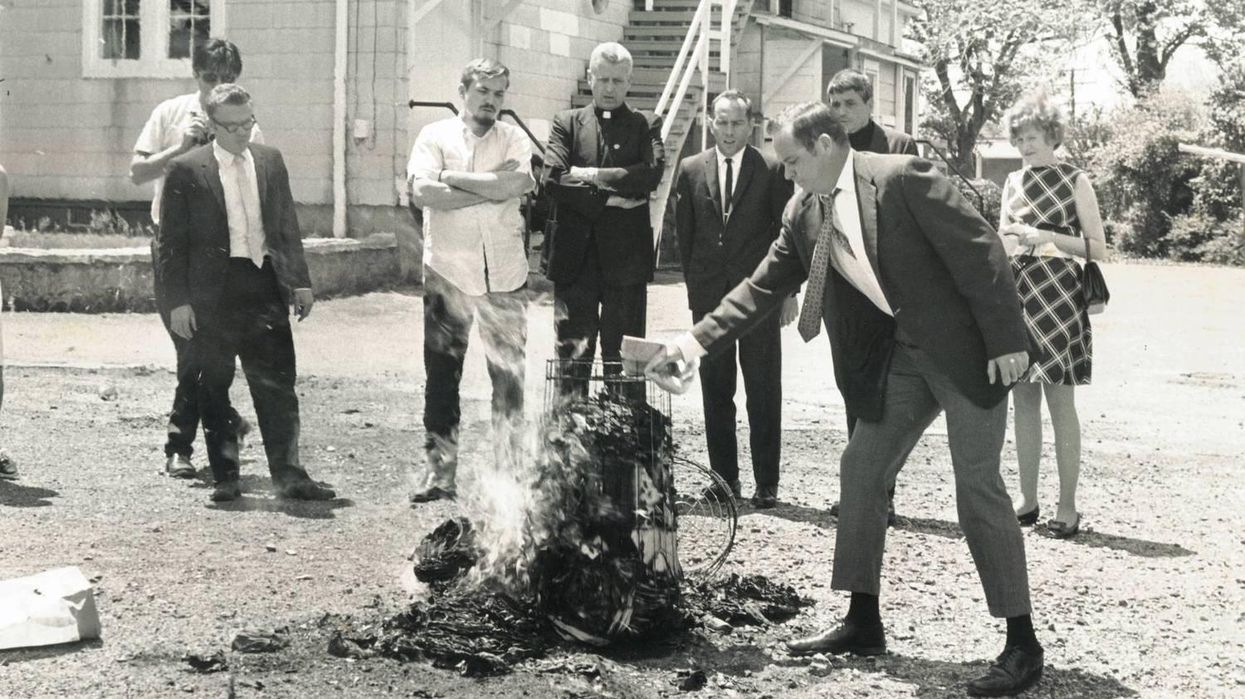
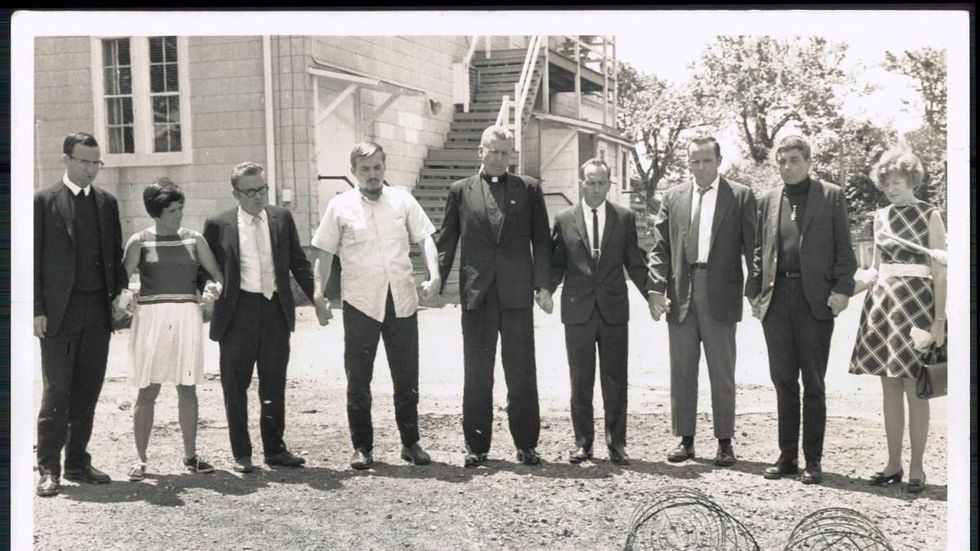
Fifty years ago today--on May 17, 1968 in the small town of Catonsville, Maryland--nine Catholic Worker and anti-war activists made history, and inspired a wave of popular resistance, for their stance against the Vietnam War as they used homemade napalm to torch a pile of draft notices they had seized from the local federal office.
"Our apologies, good friends, for the fracture of good order, the burning of paper instead of children, the angering of the orderlies in the front parlor of the charnel house," declared Father Daniel Berrigan in 1968 as he explained the group's action. "We could not, so help us God, do otherwise."
Despite knowing full well they would be arrested and likely imprisoned, the group did not flee the scene, but stayed as they prayed over the burning notices and waited for the police to arrive.
Along with Daniel, and his brother his brother Philip Berrigan, the other seven who made up the group included: David Darst, John Hogan, Tom Lewis, Marjorie Bradford Melville, Thomas Melville, George Mische, and Mary Moylan.
In their column this week, Democracy Now's Amy Goodman and Denis Moynihan recount the original protest and how it's been commemorated this year:
The 50th anniversary of the Catonsville Nine action was recently held, just blocks from the site where these committed activists burned the draft records. In 1968, the local draft board rented an office on the second floor of the local Knights of Columbus building. The Knights is a conservative Catholic organization and wanted nothing to do with the commemoration, so the official Maryland state historical roadside marker sits about 100 yards away, in front of the public library.
At the marker's dedication ceremony, one of the only two surviving members of the Catonsville Nine, Marjory Melville, walked with us to the scene of the "crime." When asked if, in retrospect, she would have done anything differently, she surveyed the empty parking lot, smiling, and said, "I would do it all over again." Her commitment was reminiscent of Dan Berrigan's, when he was finally arrested after being underground. A reporter asked, "What are your future plans?" Smiling, in handcuffs, Berrigan flashed a peace sign and shouted, "Resistance!"
Fifty years later, the action of the so-called "Catsonville 9" continues to inspire those opposed to the violence and suffering produced by U.S. empire and militarism. As the Baltimore Sun recently reported:
Frida Berrigan [daughter of Phil Berrigan] said the fearlessness and teamwork of the Catonsville Nine have informed her own activism. In 2005 and 2015, she and others traveled to Cuba in defiance of U.S. law, to protest the detention of terror suspects at the U.S. Naval base at Guantanamo Bay.
"We certainly felt like we were going in the spirit of Catonsville," she said.
Last month, a group of Catholic Workers infiltrated the Kings Bay Naval Submarine Base in St. Mary's, Georgia in order to protest the nuclear submarines stationed there and the U.S. imperialism and wars abroad they represent. Calling themselves the "Kings Bay 7," the group specifically cited the Cantonsville 9, as well as the example set by Martin Luther King Jr., as a source of strength and a model for their direct action.
"The Trident and all nuclear weapons are the cocked gun held to the head of the planet," wrote Clare Grady, one of the Kings Bay 7, in a recent letter from jail. "These omnicidal weapons embody all three of the triplets [of racism, extreme consumerism, and militarism] Dr. King spoke of, seeking global dominance for resources. This always has a racial dimension effecting people of color. Black, Brown, Indigenous Peoples are always on the receiving end of deadly force as empire seeks to maintain its global dominance."
And Mary Anne, another member of the group, added, "We must encourage each other to be the resistance needed to end empire. The U.S. government is gearing up to spend over a trillions of dollars on more nuclear weapons. And the U.S. government's ongoing airwars, like lethal and illegal use of MQ9 Reaper drones over Afghanistan and elsewhere is another continual killing many are blind to."
Fifty years after they set hundreds of draft files ablaze to protest the Vietnam War, the "Catonsville Nine" were honored with a historical marker in the Maryland community.
The state sign, unveiled Saturday, recognizes the pivotal role of their action. Indeed, Joby Taylor, director of the Shriver Peaceworker Program at the University of Maryland, Baltimore County, called it "one of the most significant acts of war resistance in our nation's history." The sign reads:
On May 17, 1968, nine Catholic activists raided the Selective Service Office in Catonsville and burned several hundred draft files to protest the Vietnam War. In a highly-publicized trail, the "nine," who included priests Daniel and Philip Berrigan, were convicted and sentenced to prison. The Catonsville action played an important role in the antiwar movement, inspiring similar acts of civil disobedience across the country.
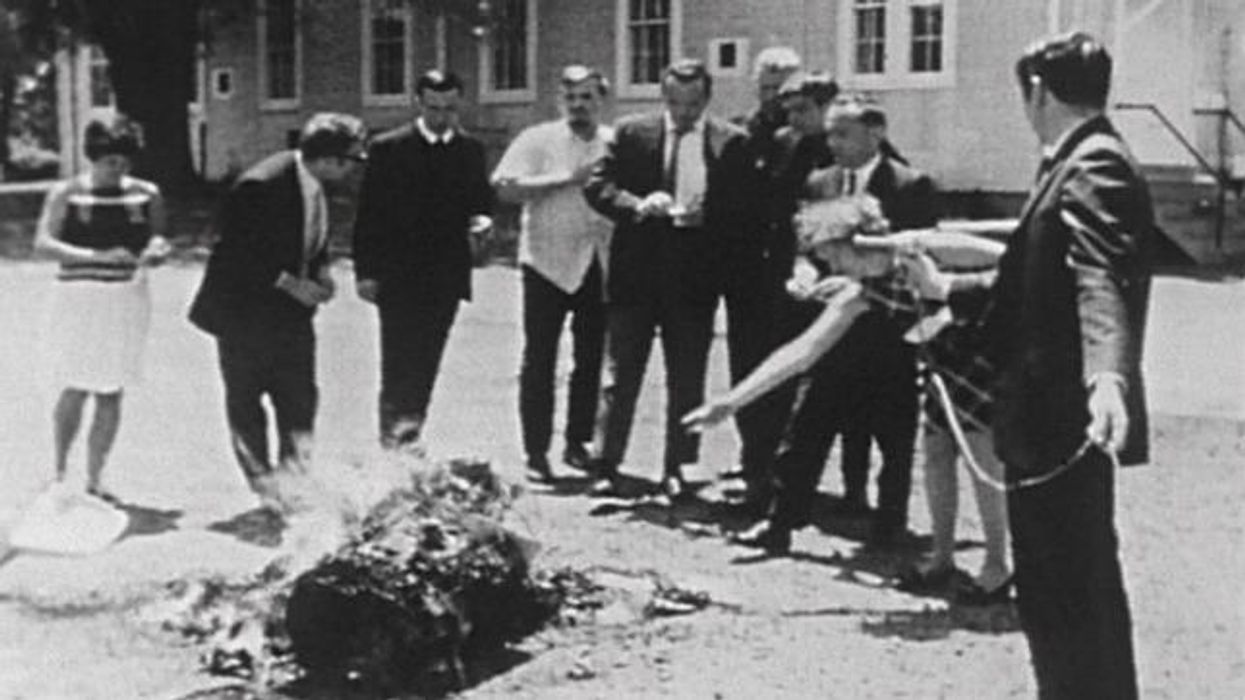
The marker sits just across the street from the site where the Berrigans, along with Brother David Darst, John Hogan, Tom Lewis, Marjorie Melville, Thomas Melville, George Mische, and Mary Moylan took the 378 draft files, put them into wire trash bins, and carried them outside where they set them ablaze with homemade napalm.
"Our apologies, good friends, for the fracture of good order, the burning of paper instead of children, the angering of the orderlies in the front parlor of the charnel house. We could not, so help us God, do otherwise," Father Dan Berrigan, who died in 2016, said at the time.
As the draft documents turned to ashes, "we prayed for peace and waited for the police," Mische would later write.
Marjorie Melville was at the commemoration event on Saturday, and recalled to the Baltimore Sun, "I personally put a match on [the draft files]." She and Mische are the only remaining survivors of the nine.
The new sign was erected on the grounds of the Catonsville Public Library. That's because, according to organizers, the Knights of Columbus, where the Selective Service files were housed, did not want the marker there, the Sun reported.
Other events commemorating the 50th anniversary are continuing this month.
To watch the historic event, click below on the footage obtained by Waging Nonviolence:
Reaction to the death of Muhammad Ali this weekend was reverential, and why not? As obituaries explained at great length, Ali was more than just a great boxer. He was a "civil rights activist," a "champion of free speech," a "humanitarian," a "tireless human rights ambassador and philanthropist" known for "gentle generosity."
Reading this, one might imagine that Ali lived the kind of life that made everyone admire him. The truth is quite opposite. During the prime of his life, Ali was widely hated. Politicians and news commentators denounced him as a cowardly, anti-American traitor. The legislature of his home state, Kentucky, passed a resolution declaring that he had brought discredit to the state and to "thousands who gave their lives for this country." Even other African-American athletes, including Joe Louis and Jackie Robinson, criticized him.
This is a wonderful lesson in the way we whitewash figures who harshly criticize America's conduct in the world. While they live and speak, we abhor them. Years later, when they are conveniently gone, we forget the ferocity of their words and pretend they were part of America's happy family.
If Ali was a gentle giant beloved by all, he symbolizes our goodness and the unity of our society. Yet he was much more than that. Ali sacrificed years at the peak of his career because he hated what his country was doing to nonwhite people far away. As he was about to enter prison for refusing induction into the Army, he explained his motive: "My conscience won't let me go shoot my brother, or some darker people, some poor, hungry people in the mud, for big powerful America."
Ali believed it was wrong and even sinful for the United States to bomb faraway lands because their people or leaders do not behave as we wish. His message is every bit as urgent today as it was when he first began preaching it. Yet in the fawning coverage that has followed his death, Ali comes across as a friendly grandpa rather than a passionate critic of American foreign policy.
His case is hardly unique. Not long before Ali died, much publicity was given to the death of another relentless advocate of peace, the Rev. Daniel Berrigan. Like Ali, Berrigan was jailed for actions that stemmed from his antimilitarist convictions. At one protest, he denounced "the Catholic Church, other Christian bodies, and the synagogues of America, with their silence and cowardice in the face of our country's crimes." Obituaries did not ignore his activism -- they could not, since it was the center of his life -- but many portrayed him as an eccentric oddball and suggested that he would be remembered for his poetry and "wry wit."
Martin Luther King Jr. has suffered the same fate. Today he is an icon, universally revered, and even honored with a statue on the Washington Mall. Most of us have come to share his belief that African-Americans deserve civil rights. We congratulate ourselves for having heeded his antiracist message.
That was not, however, King's only message. He detested what he called "smooth patriotism," and was horrified by the American compulsion to bomb, invade, and occupy countries on other continents. "We increased our troop commitments in support of governments which were singularly corrupt, inept, and without popular support," he said in one speech. "People read our leaflets and received the regular promises of peace and democracy and land reform. Now they languish under our bombs." Statements like that led the director of the FBI to call King "the most dangerous man in America," all but begging some misguided patriot to kill him. We forget this essential part of King's message because it applies too directly to the foreign policy we follow today.
Activists of earlier generations have suffered the same fate. Radicals from Thoreau to Paul Robeson to Malcolm X now appear on US postage stamps. Mark Twain is remembered as a folksy humorist partly because his vivid denunciations of American intervention are absent from most anthologies. Few today realize that Twain opposed sending "our clean young men to shoulder a discredited musket and do bandit's work," that he believed foreign wars had "debauched America's honor," or that he proposed a new American flag "with the white stripes painted black and the stars replaced by the skull and cross-bones."
Americans who want our country to change the way it acts in the world often feel that we are blazing a new trail. We are not. The idea that the US harms itself and others, by considering itself "indispensable," and by trying to "shape" the politics and culture of faraway countries, was not recently invented. It is as American as apple pie. Yet those who have preached this gospel are either forgotten or -- even worse -- portrayed after death as friendly folks who may have spoken an intemperate word or two but in their hearts loved everything America is and does. Muhammad Ali is the latest to suffer this indignity. We do him, and others who share his antiwar passion, a disservice when we forget crucial aspects of their political identities.
Father Dan Berrigan's life, legacy and gifts were celebrated at Saint Francis Xavier Church in New York City on Friday, May 6. The church is supposed to fit only 700 people, but more than a thousand crammed in, packing the aisles and sides, sitting and standing through the more-than-two-hour-long service.
Communion took half an hour, and they ran out of wine about two-thirds of the way through. Liz McAlister, my mother and Dan's sister-in-law, offered a powerful eulogy, bringing his familiar words from Catonsville ("Our apologies good friends, for the fracture of good order") into the sanctuary, as well as the assembled to their feet for an extended ovation. My siblings, Kate and Jerry Berrigan, and our cousin Carla Berrigan Pittarelli, joked that this is what Dan must have felt like all these years preaching and teaching. Standing ovations for days!
The four of us "young" Berrigans (in our 30s, 40s and 50s) conspired on a single eulogy to share different facets of our "Unka" that didn't make it into the obituaries in the New York Times, Washington Post and other media outlets. Now that the planning, organizing and interacting with so many people is over, I offer you my portion of that eulogy. At the same time -- as I sift through precious memories, a lot of great lessons, sadness and longing -- I try to remind myself of my own wisdom: It is enough.
--
I moved to New York City in 1998, with an internship, a notion of being a writer, and a way station of sanity and welcome at 98th Street (where Dan and a dozen other Jesuit priests lived). I didn't need a New York City dream -- I had Uncle Dan.
For more than 10 years, we had such great times -- long lunches, long leisurely walks through Riverside Park and long prayer walks across 42nd street for Pax Christi's Stations of the Cross on Good Friday. Actions, Bible studies, dinners at 98th street, road trips to Syracuse or Kirkridge [a retreat center in Pennsylvania]. I was always welcome. He always had time. He answered my phone calls at odd hours, asked me questions and listened for the real answers. He loved cappuccinos, cold white wine in the afternoon, and for the toll operators on the George Washington Bridge to be really energetic and colorful. He hated the radio, but always had music running through his head. He loved to share his food and would always offer me half of whatever he had, not eating until I ate. My Uncle Dan -- Unka -- told me my history. He shared his favorite books. He lifted his eyebrows in a particular way when he was ready to be rescued from a conversation.
And then -- all of sudden -- this spry and stalwart man, this slight man of swagger and soul and scripture (alliteration is my only poetry) beings to falter, grow slow, grow quiet. And now, the one I leaned on for advice, clung to for courage and counted on for the word that made it all make sense -- now, he needs. Not much, not all the time, but more and more. And what does he need? An arm, a hand, easy company, love without condition. He needs me. Imagine... Me. And I find -- improbably and providentially -- that I have something and someone to offer. Myself, but more, a love that changes with time and a son -- Seamus Philip -- who is (or was, he is four now) pure love.
And so my wordless son and my quiet uncle find one another, and they congregate on a new plane and conspire in a new language at once so simple and infinitely more complicated than what is available to me -- to us. Eyes lock, hearts lift and souls connect. And what do I do? Be present, mark it down, appreciate it.
My Madeline Vida comes later and understands the heart of the matter. When words emerge for her, "Uncle Dan" becomes a declaration, an assertion, a key to open up reality. "Uncle Dan!" she announces at the threshold of a new place. The words and the person connected to them are -- for a time -- a kind of talisman for her. We go to the White House for a demonstration in January and she chants "Uncle Dan, Uncle Dan, Uncle Dan" sometimes under her breath, sometimes loud and clear. My dear uncle, her magic spell. I don't understand it, but I like it.
The children -- Seamus, Madeline and their big sister Rosena -- love him, and we -- Patrick and I, and all of us up here -- love him. And it is enough. It is all. No more words. Just being together.
And then that too is gone. He has left us. Of course, we believe Dan is in heaven, cheering us on and loving us deeply. But he is gone.
We have one another. It is enough. It has to be.
NEW YORK--I arrived early Friday morning, after walking through the rain, at the St. Francis Xavier Church in Greenwich Village for the funeral of the Rev. Daniel Berrigan. I stood, the church nearly empty, at the front of the sanctuary with my hand on the top of Dan's rosewood casket. It was adorned with a single red carnation and a small plaque that read: "Rev. Daniel J. Berrigan. Born May 9, 1921. Entered S.J. August 14, 1939. Ordained June 21, 1952. Died April 30, 2016."
The walls of the Romanesque basilica had large murals, by German artist William Lamprecht, of the stations of the cross--Pilate's condemnation of Jesus, Jesus collapsing under the weight of the cross, Jesus nailed to the cross and crucified. Lamprecht had muted the colors so each successive scene was darker and more ominous than the previous one. A Tiffany stained-glass window, with its glints of light, portrayed the Madonna and child. Over the large sanctuary, with its rows of wooden pews, hung soft, milky-white, bulbous lamps. The blue-veined marble altar, the graceful arches, the Carrera marble floor and the towering organ with its 3,323 pipes gave the moment solemnity and grandeur, although Dan relentlessly challenged the pomp and power of all institutions, including the church.
Dan, like his brother, Philip Berrigan, and his close friends Dorothy Day from the Catholic Worker Movement and Trappist monk Thomas Merton, led a life defined by the Christian call to bear the cross. This is the central call of the Christian life. It is one few Christians achieve. The bearing of the cross, in Christian theology, is counterintuitive. It says that the "the last shall be first, and the first last." It demands nonviolence. It holds fast to justice. It stands with the oppressed, those who Dan's friend, the Jesuit priest Ignacio Ellacuria, who was murdered by the death squads in El Salvador, called "the crucified people of history." It binds adherents to moral law. It calls on them to defy through acts of civil disobedience and noncompliance with state laws, when these laws, as they often do, conflict with God's law.
If you bear the cross, you often go to jail or, in Dan's case, federal prison for 18 months, after he, his brother and seven other religious activists in 1968 burned 378 draft files of young men--most of them African-American--about to be sent to Vietnam. The activists had manufactured homemade napalm to set the documents on fire in garbage cans in the parking lot outside the building from which they took the files.
In her eulogy, Elizabeth McAllister, Dan's sister-in-law, read the statement Dan wrote for the group, known as the Catonsville Nine:
Our apologies good friends
for the fracture of good order the burning of paper
instead of children the angering of the orderlies
in the front parlor of the charnel house
We could not so help us God do otherwise
For we are sick at heart
Our hearts give us no rest for thinking of the Land of Burning Children ...
We say: Killing is disorder
life and gentleness and community and unselfishness
is the only order we recognize ...
How long must the world's resources
be raped in the service of legalized murder?
When at what point will you say no to this war?
We have chosen to say
with the gift of our liberty
if necessary our lives:
the violence stops here
the death stops here
the suppression of the truth stops here
this war stops here ...
The 2,000 mourners erupted in a prolonged standing ovation.
Dan--whose 50 books of poetry, essays and Scripture commentaries, as well as his play, "The Trial of the Catonsville Nine," are as important a contribution as his activism--was the bete noire of senior church officials, including the archbishop of New York, Cardinal Francis Spellman. FBI Director J. Edgar Hoover, who loathed the peace activists, fabricated a case accusing the Berrigan brothers of conspiring to blow up tunnels under federal buildings in Washington, D.C., and kidnap Richard Nixon's national security adviser, Henry Kissinger.
Dan, who took part in the Freedom Rides and civil rights marches in the South, was in and out of jail all his life. With seven other activists, he illegally entered a General Electric nuclear missile plant in King of Prussia, Pa., in 1980. They poured blood and hammered the fragile cones of Mark-12A warheads. He had been, by the time he died a few days short of his 95th birthday, arrested hundreds of times. This, he said, was the cost of discipleship.
"But what of the price of peace?" he asked in his book "No Bars to Manhood."
I think of the good, decent, peace-loving people I have known by the thousands, and I wonder. How many of them are so afflicted with the wasting disease of normalcy that, even as they declare for the peace, their hands reach out with an instinctive spasm ... in the direction of their comforts, their home, their security, their income, their future, their plans--that five-year plan of studies, that ten-year plan of professional status, that twenty-year plan of family growth and unity, that fifty-year plan of decent life and honorable natural demise. "Of course, let us have the peace," we cry, "but at the same time let us have normalcy, let us lose nothing, let our lives stand intact, let us know neither prison nor ill repute nor disruption of ties." And because we must encompass this and protect that, and because at all costs--at all costs--our hopes must march on schedule, and because it is unheard of that in the name of peace a sword should fall, disjoining that fine and cunning web that our lives have woven, because it is unheard of that good men should suffer injustice or families be sundered or good repute be lost--because of this we cry peace and cry peace, and there is no peace. There is no peace because there are no peacemakers. There are no makers of peace because the making of peace is at least as costly as the making of war--at least as exigent, at least as disruptive, at least as liable to bring disgrace and prison and death in its wake.
Bearing the cross is not about the pursuit of happiness. It does not embrace the illusion of inevitable human progress. It is not about achieving wealth, celebrity or power. It entails sacrifice. It is about our neighbor. The organs of state security--in Dan's case, the FBI--monitor and harass you. They amass huge files on your activities. They disrupt your life. And in Friday's homily, the Rev. Stephen Kelly, evoking laughter, welcomed the FBI agents who had been "assigned here today to validate that it is Daniel Berrigan's funeral mass so they can complete and perhaps close their files."
"Daniel and Phil exposed the historical alliance of religious leaders who colluded with structures of domination," said Kelly, who has spent more than a decade in prison for acts of nonviolent protest.
"The imperial power of Pax Romana ran aground on the shoals of Christian steadfastness," he went on. "But through the centuries the circle of outcasts and martyrs dissembled. They gained ascendancy to the power they were meant to resist. Daniel and Phil untied, illegally, those held in power's captivity. They risked retaliation. They touched the idol of the state."
Dan, who went underground for four months after burning the draft files, was on the FBI's most-wanted list--the first Catholic priest in the country to hold that distinction. But he and his small circle of activists pushed the clergy--including my father--out of their pulpits and into the streets to denounce the Vietnam War, especially after Dan founded Clergy and Laity Concerned about Vietnam in 1965 with Rabbi Abraham Heschel. He traveled to North Vietnam with Howard Zinn in 1968 on a peace mission and returned home with three U.S. Air Force personnel who had been held prisoner. He and Zinn made the men promise they would no longer take part in the war. Dan spent time with church communities working with the poor in Latin America. He visited, unnoticed, the activists at Manhattan's Zuccotti Park during the Occupy Wall Street movement and walked through the crowd, giving his silent blessing.
"This is the worst time of my long life," he said when I interviewed him for The Nation magazine a few years ago. "I have never had such meager expectations of the system. I find those expectations verified in the paucity and shallowness every day I live."
Yet he refused to despair. The cross, he knew, is carried even in the face of inevitable failure. This is the absurdity of faith. Martin Luther King Jr. repeatedly made reference to this reality of Christian life, saying, "When I took up the cross I recognized it's meaning ... The cross is something that you bear, and ultimately you die on."
Dan's worldly possessions, including his small collection of threadbare clothes, could barely fill two suitcases. He was as opposed to abortion as he was to the death penalty, a stance that did not always endear him to many left-wing activists. He denounced the violence employed by the left during the Vietnam War, especially the Weather Underground, writing, "No principle is worth the sacrificing of a single human being." He knew the poison of violence. He saw no hope in the farce of managed electoral politics, quoting Emma Goldman, who said, "If voting was that effective it would be illegal." He feared dark and disastrous times, especially as we savaged the environment, and he told me that all we may have left is the "Eucharist and each other."
Reinhold Niebuhr, a theologian whose words are misinterpreted and misused by conservatives and the powerful, including Barack Obama, wrote about the importance of being a "Christian realist." No one defined this concept more than Dan. He saw the world for what it was. He had no illusions about it. He understood the power of evil. He knew how seductive it was. As a solitary individual, he could accomplish nothing without community. His duty was to bear the cross, even if it did not make sense, even if it did not seem to make a difference. He was sustained by others and majestically sustained those around him.
Dan provided, for me, the most cogent definition of religious faith.
"The good is to be done because it is good, not because it goes somewhere," he told me. "I believe if it is done in that spirit it will go somewhere, but I don't know where. I don't think the Bible grants us to know where goodness goes, what direction, what force. I have never been seriously interested in the outcome. I was interested in trying to do it humanely and carefully and nonviolently and let it go."
A bagpiper played as Dan's casket was loaded into the back of a silver and black hearse outside the basilica. Hundreds of mourners, their cheeks streaked by rain and tears, filled the street. I stood on the steps.
It was a few blocks from here, at the shrine of the Church of St. Anthony of Padua, that Dan baptized my youngest daughter five years ago. He cradled her in his arms and spoke of faith as resistance. He reminisced about marching in Selma with Dr. King. He asked us to each say out loud what qualities we hoped my daughter would possess. Dan said he wished for "a sense of humor."
The hearse moved slowly down the vacant street. A man held his fist in the air. Some in the crowd sang a hymn. When the hearse reached the end of the street, its luminous red tail light began to blink on and off in the drizzle, signaling a right turn. Then it was gone.
A change is coming. I can feel it.
Fr. Daniel Berrigan's funeral was being live-streamed Friday, as I started to write this, which seems only fitting. Dan's witness and writing have been a constantly re-chargeable battery for my moral compass.
Live-streaming (arranged by America magazine) was the next-best thing to being at the funeral in person. And it brought back memories of getting shoe-horned into West Baltimore's St. Peter Claver church in early December 2002 for an equally moving celebration of the life of Dan's younger brother, Fr. Phil Berrigan.
Homilist Fr. Steve Kelly, S.J., who has spent more than a decade in this or that prison for non-violent resistance to war began with some Berrigan-style Irish humor: "Let members of the FBI assigned here today validate that it is Daniel Berrigan's funeral Mass of the Resurrection, so they can complete and perhaps close their files. 'Death has no dominion!' to quote Daniel's friend William Stringfellow."
Kelly then minced no words in calling out "appointed pastors who collude with structures of domination, blessing the bombs."
Tears welled as I watched Catholic Worker friends drop a large banner with the words from Isaiah, "They shall beat their swords into plowshares. Nations shall make war no more," a charge lived into by all three brothers Berrigan - Jerry, Dan, and Phil.
And I thought back on what I learned decades ago at retreats led by Dan on the prophets Isaiah and Amos.
During the eulogy, Liz McAlister, Phil's widow, quoted from the "apology" Dan wrote for burning draft cards with home-made napalm in Catonsville, Maryland, in May 1968 at the height of the Vietnam War:
"Our apologies, good friends, for the fracture of good order, the burning of paper instead of children, the angering of the orderlies in the front parlor of the charnel house."
Liz continued to read from the Statement of the Catonsville 9: "The suppression of truth stops here; this war stops here!" (emphasis added by Liz's own prophetic voice.) Not stopping was the loud, un-church-like cheering that rattled the rafters.
So Liz added a vintage Berrigan admonition for those who "seek ways to exempt themselves from responsibility." I had the feeling that the affirming crowd would still be making a din, had not Phil's daughter Frida gently gestured: Please, let my mom finish.
Thanks to the live-streaming, I could discern many of my friends at the still functioning Dorothy Day Catholic Worker houses for men and women in the Bowery. The only folks missing were those doing the daily Martha-work of preparing food for the lunch line. Ringing in my ears was another charge, heard hundreds of times from my Irish grandmother: "Show me your company, and I'll tell you who you are!"
As the daughter of the late Jerry Berrigan, eldest of the three brothers, added her words to the eulogy, I felt proud to be out on bail, awaiting trial with 11 others of the "Jerry Berrigan Memorial Anti-Drone Brigade" for shutting down the main entrance and exit to Hancock Air Force Base Brigade near Syracuse, New York, on the morning of Jan. 28, 2016. Jerry, who lived in Syracuse, was frequently arrested there for similar protests against drone killings.
'Whatever His Views, He's Harmless'
Following people like Dan, Phil, and Jerry can get you beaten up and thrown in jail, but the benefits are out of this world, so to speak. Watching Dan's funeral, I found myself musing over the words chosen by Secretary of State Hillary Clinton's confidant Sidney Blumenthal, reassuring Clinton that she had nothing to fear from the likes of me.
On Feb. 15, 2011, at George Washington University, Clinton had, with callous aplomb, completely ignored my getting assaulted by two security personnel as I silently stood directly in front of her with my back turned.
In a Feb. 18, 2011 email, Blumenthal explained: "Ray McGovern, a former CIA officer who gave the daily brief for President George H.W. Bush, is pretty well known in the intelligence community. He's become a Christian antiwar leftist who goes around bearing witness. Whatever his views, he's harmless."
Harmless or not, I can see my grandmother smiling down at the company I now keep, and whispering in her thick Irish brogue, "If you were really harmless, Raymond, they would not be writing them email things about you."
It was not so long ago that I moved in circles where the label "activist" was dismissed as misguided but, well, harmless. How fortunate, then, to learn of the definition given to activism by my co-passenger on the U.S. Boat to Gaza, poet Alice Walker: "Activism is the rent I pay for living on this planet."
I could not be more grateful at having fallen in, better late than never, with such companions. Dan's funeral served as a reminder of how much my journey has changed - having witnessed power from the inside, and the consequences of challenging it from the outside.
On the Inside
During the first Ronald Reagan administration, it was my job to conduct early morning one-on-one briefings of the Secretary of Defense (Caspar Weinberger), Secretary of State (George Shultz), and Chairman of the Joint Chiefs of Staff (Gen. Jack Vessey) and also, depending on their schedules, Vice President George H. W. Bush, as well as a movable feast of Assistants to the President for National Security Affairs.
Another senior CIA officer and I took turns, each of us briefing every other day six days a week. As professional intelligence analysts, we conducted ourselves in a completely non-partisan way, and our services were appreciated. We relied largely on The President's Daily Brief that we had helped prepare the day before, and we updated and supplemented the material in it, as needed.
Ronald Reagan was given these one-on-one briefings as soon as he became president-elect and put considerable value on them. Once in the White House, however, he ordered that, as a general rule, the early morning briefings be given to his most senior national security advisers whom he would normally ask to brief him directly several hours later.
When I took early retirement at age 50, I was fully aware that few others on "the outside" had the privilege of acquiring a first-hand feel for how intelligence could be used, and power abused.
At the time, however, I had no inkling that the creeping politicization and careerism fostered by senior CIA official Robert Gates on behalf of Reagan's CIA Director William Casey would corrupt managers and analysts alike to the point they would let themselves be suborned into conjuring up the kind of faux intelligence that President George W. Bush and Vice President Dick Cheney ordered up to "justify" war on Iraq.
'Quid Est Veritas?'
What brought this to mind earlier this week was the tenth anniversary of an impromptu, four-minute debate that I had with Defense Secretary Donald Rumsfeld in Atlanta on May 4, 2006.
It was not hard to prove him an inveterate liar about important matters like the weapons of mass destruction (WMD) he said were in Iraq - but weren't; and the ties that existed between Al Qaeda and Saddam Hussein - but didn't. But my Rumsfeld anniversary brought a painful reminder that things have hardly improved - and that no one has challenged former Secretary Clinton openly about her lies - about Syria and Libya, for example. [See Consortiumnews.com's "A Need to Clear Up Clinton Questions."]
The opportunities for such challenge have become fewer; the penalties harsher; the Fawning Corporate Media dumber and dumber.
The mini-debate with Rumsfeld in Atlanta depended largely on luck. Not only had I truth as my breastplate, so to speak, but the stars were nicely aligned. People like Rumsfeld, an accomplished Princeton debater (and, for that matter, Wellesley valedictorian Hillary Clinton), are required to keep careful track of their lies. Those not normally burdened with that extra chore - professional intelligence analysts, for example - enjoy a distinct advantage, even in times like these, when all too many Caesars keep asking "Quid est Veritas?" - "what is truth?" - a phrase attributed to Pontius Pilate during the trial of Jesus.
As it turned out, I had some success - momentarily, at least - exposing Rumsfeld, who had played fast and loose with the truth, while enjoying the "matinee-idol" label pinned on him by President George W. Bush during the initial weeks of "shock and awe."
The abundance of evidence notwithstanding, my attempts to expose the lies of Hillary Clinton proved much more difficult (as I was wrestled away by security guards for turning my back on the Secretary of State), and I had zero success exposing Teflon-coated General (and former CIA Director) David Petraeus for the fraud he is (as I was arrested by New York City police at the entrance of a Petraeus speech). Worse still, the violence I encountered escalated with each nonviolent attempt.
With Rumsfeld, none of the media stenographers at Pentagon briefings ever looked up from their pads long enough to ask the Defense Secretary a direct question about his prevarications, so the Pentagon prima donna seemed a bit shocked by a factual question he could not spin.
So, Rumsfeld was not used to fielding "impertinent," un-self-censored questions. Indeed, it may have seemed to some as though I were unfairly blindsiding the poor Secretary of Defense.
An Exchange with Power
The setting for Rumsfeld's talk was a little-known, defense-secretary-friendly-Southern-white-male-upper-crust "think tank." There was no advance notice of Rumsfeld's talk on its website, but some women friends from the World Can't Wait figured out a way to get me a ticket (for $70!).
The impromptu debate went as follows:
RAY McGOVERN: And so, I would like to ask you to be up front with the American people. Why did you lie to get us into a war that was not necessary and that has caused these kinds of casualties? Why?
DONALD RUMSFELD: Well, first of all, I haven't lied. I did not lie then. Colin Powell didn't lie. He spent weeks and weeks with the Central Intelligence Agency people and prepared a presentation that I know he believed was accurate, and he presented that to the United Nations. The President spent weeks and weeks with the Central Intelligence people, and he went to the American people and made a presentation. I'm not in the intelligence business. They gave the world their honest opinion. It appears that there were not weapons of mass destruction there.
RAY McGOVERN: You said you knew where they were?
DONALD RUMSFELD: I did not. I said I knew where suspect sites were, and we were --
RAY McGOVERN: You said you knew where they were, "near Tikrit, near Baghdad, and northeast, south and west of there." Those were your words.
DONALD RUMSFELD: My words -- my words were -- no, no, no, wait a minute! Let him stay one second. Just a second.
RAY McGOVERN: This is America, huh? Go ahead.
DONALD RUMSFELD: You're getting plenty of play, sir.
RAY McGOVERN: I'd just like an honest answer.
DONALD RUMSFELD: I'm giving it to you.
RAY McGOVERN: We're talking about lies and your allegation that there was bulletproof evidence of ties between al-Qaeda and Iraq. Was that a lie or were you misled?
DONALD RUMSFELD: Zarqawi was in Baghdad during the prewar period. That is a fact.
RAY McGOVERN: Zarqawi, he was in the north of Iraq, in a place where Saddam Hussein had no rule. That's where he was.
DONALD RUMSFELD: He was also in Baghdad.
RAY McGOVERN: Yeah, when he needed to go to the hospital. Come on, these people aren't idiots. They know the story.
DONALD RUMSFELD: You are -- let me give you an example. It's easy for you to make a charge, but why do you think that the men and women in uniform every day, when they came out of Kuwait and went into Iraq, put on chemical weapon protective suits? Because they liked the style? They honestly believed that there were chemical weapons. Saddam Hussein had used chemical weapons on his own people previously. He had used them on his neighbor, the Iranians. And they believed he had those weapons. We believed he had those weapons.
RAY McGOVERN: That's what we call a non-sequitur. It doesn't matter what the troops believe. It matters what you believe.
MODERATOR: I think, Mr. Secretary, the debate is over. We have other questions, courtesy to the audience.
'Let Him Stay'
Early in the exchange, the black-hatted point man from Rumsfeld's SWAT Team (clearly seen in the video) put his elbow in my solar plexus as I was speaking and started to pry me from the microphone to which I was adhering like permanent glue.
However, after a glance in the direction of the TV cameras, Rumsfeld waved him off, with a "no, no, no, wait a minute! Let him stay one second. Just a second." It was a snap decision to continue the debate, with Rumsfeld convinced he could put me in my place. After all, I had identified myself as a former CIA analyst, and Rumsfeld had had an easy time intimidating CIA directors George Tenet and Porter Goss, as well as those of my former colleagues badgered into dancing the Cheney/Rumsfeld fraudulent tango on Iraq.
The event also took place early enough that afternoon to make the evening news. Better still, the event was aired live on C-Span and CNN. All this together made it very difficult for TV producers, anchors and pundits to brush off my challenges to Rumsfeld as inconsequential. Besides, there was very little happening that was newsworthy on May 4, 2006, which put icing on the cake.
In any case, the tense scene of a citizen challenging the great and powerful Rumsfeld with real questions was so unusual that even the corporate media recognized it as "news" and gave it at least fleeting attention on the evening news shows.
But my unmasking of Rumsfeld's Iraq War lies also created a highly unwelcome precedent that I would be made to pay for by soon being pigeonholed as a disgruntled stalker.
CNN anchor Paula Zahn's first questions that evening were (1) "How long have you harbored this animus against Donald Rumsfeld?" and (2) why was I "following the Secretary of Defense all the way down to Atlanta?"
I explained that, in fact, I had gotten to Atlanta first - to receive, that same evening, the ACLU's National Civil Liberties Award (won the previous year by Coretta Scott King).
I could not remember how long I had had "this animus" toward Rumsfeld. Were I quicker on my feet, I would have said something like -- since his lies got thousands of human beings killed in an unnecessary war. But you don't get a do-over.
After the Zahn interview, CNN's Anderson Cooper's first question, asked of me haltingly as I was exiting the auditorium, was much less hostile but, in its own way, far more revealing: "Weren't you afraid?" he asked. Think about that for a while.
No Such Luck With Hillary
Five years later, with some slight hope for an encore during a possible Q & A - this time with then-Secretary of State Hillary Clinton - I wangled a ticket to hear her speak at George Washington University on Feb. 15, 2011. After several minutes of fulsome praise from the university president and prolonged, standing, adulatory applause from the carefully chosen audience, before Clinton even uttered a word, I decided to remain standing in silence with my back to her.
Unlike Rumsfeld in 2006, Secretary of State Clinton was taking no chances. True, her speech focused on the need to respect dissent, but she was talking about the authorities in Iran, not in Washington. She missed not a syllable as she watched me brutalized directly in front of her and then dragged down the main aisle (with Clinton seeing-no-evil and nary a peep from the Hillary-friendly audience of by-standers/by-sitters).
Once outside the auditorium, a Clinton security-woman interrogated me at some length, after two sets of steel handcuffs were put on my wrists. I was then arrested and dumped into jail.
Perhaps Clinton thought her tacit condoning of this pre-emptive strike by her security folks would provide a useful deterrent to others who might choose nonviolent but highly visible ways to express dissent - or, God forbid, ask an impertinent question of the kind asked of Rumsfeld in Atlanta.
Unlike my encounter with Rumsfeld and even though multiple TV cameras caught the brutal way I was seized and thrown out directly in front of Hillary Clinton ("escorted out" is the gentle way Fox News put it), there was almost no further mention in mainstream media.
The Clinton incident happened at the same time of day as my mini-debate with Rumsfeld, so its absence from the evening news had nothing to do with the news cycle. Still, one would have thought the Kafkaesque nature of my brutalization at the very moment Clinton waxed eloquent about respecting dissent - in Iran - might have provided irresistible grist for a news story or commentary.
But in the five years that had passed since the Rumsfeld event in Atlanta, the media had grown five years-worth tamer. And, in contrast to Rumsfeld's quick calculation as he looked at the cameras in the back, Clinton apparently believed she could count on the TV outlets and pundits NOT to give much coverage to the assault. In any case, she calculated correctly.
A number of Washington media stenographers were there, of course, as well as the cameras, but the evening TV producers and anchors chose the safer path. After all, no "sensible" commentator or outlet will gratuitously put out of joint the nose of a probable heiress to the presidency.
Less Tolerance of Dissent
If my understandable chagrin at the way Hillary Clinton ignored the assault right in front of her leaves me open to charges of having an "animus" toward Hillary Clinton, so be it. That is very small potatoes in the grand scheme of things.
My "animus" was substantive - her share of responsibility for all manner of death and destruction because of her vote for the Iraq War and the benighted escalation/surge in Afghanistan, for example. It would be only another couple of months after her GWU speech before she helped create equal tragedies in Libya and Syria.
I suppose I should thank my blessings in having avoided the far more brutal, fatal treatment accorded Libyan leader Muammar Gaddafi.
Although I had a ticket to hear David Petraeus speak at the 92nd Y in New York City on Oct. 30, 2014, I was barred from even entering, roughly treated, whisked away by NYPD cops already on the scene and jailed overnight in the infamous "The Tombs" beneath the Criminal Court in lower Manhattan.
Although my arrest occurred in the so-called "media capital of the world," the incident was almost completely ignored at least in the mainstream media. [See Consortiumnnews.com's, "When Silencing Dissent Isn't News."]
The trend seems to be more violence from the "organs of state security," as they were known in Soviet parlance, and more silence in the mainstream media.
All the more need to follow the example of the Berrigans.
May is historically a month for protests, and first, I'd like to protest the fact that Rev. Daniel Berrigan died last weekend, just a few days shy of what would have been his 95th birthday on May 9.
May, too, was the month in which this outspoken Jesuit poet and peace activist, with his fellow priest and brother Philip, and seven others, staged one of the most significant and symbolic protests against the horrors of Vietnam. On May 17, 1968, they walked into the office of a draft board in Catonsville, Maryland, removed the files of young men eligible for military duty, took them to a parking lot next door, doused them with homemade napalm and set the files ablaze.
"Our apologies, good friends," Dan Berrigan said, "for the fracture of good order, the burning of paper instead of children, the angering of the orderlies in the front parlor of the charnel house. We could not, so help us God, do otherwise."
The Catonsville Nine were tried and convicted for destroying government property. Rather than go to prison, three of them, including Dan and Phil Berrigan, went on the lam, but the brothers soon were caught (while underground, Dan had a habit -- greatly vexing to J. Edgar Hoover and the FBI -- of popping up in public to deliver sermons, then disappearing again). In August 1970, Dan began his three-year sentence at the Federal Correctional Institution in Danbury, Connecticut.
So he wasn't around to offer guidance the following year, in 1971, as many of the more militant in the anti-Vietnam war movement decided that in light of events like Catonsville the time had come to up the ante and move from largely peaceful mass demonstrations to more direct and sometimes even violent acts of civil disobedience.
This, too, was in May, 45 years ago this week, in fact, when thousands came from around the country and gathered in Washington under the slogan, "If the government is not going to stop the war, we will stop the government."
The week before, perhaps as many as half a million had shown up for a Vietnam protest so mellow that many took advantage of a closed-off Pennsylvania Avenue to skateboard and sunbathe along the boulevard on a warm spring Saturday. But now, thousands gathered with the express purpose of physically blocking bridges, main arteries and traffic circles leading into the capital. According to The New York Times, the Nixon White House responded with 12,000 federal troops, 5,100 local police and 1,500 National Guardsmen.
Police broke up an encampment at West Potomac Park, near the Lincoln and Jefferson memorials, and protesters scattered, many of them to the Georgetown University campus, where I was a student. I still remember the helicopters buzzing overhead.
On Monday, May 3, the protesters regrouped and put into action their plan to shut the city down during the morning rush hour, using hit-and-run tactics and any large or small object that came to hand. The police and military pushed back hard.
I was a student reporter and my photographer John and I headed toward Key Bridge near the Georgetown campus. Forever in my memory is the sight of Rhode Island US Senator Claiborne Pell, standing on the steps of his townhouse in robe and pajamas, retrieving his daily copy of The Washington Post and looking completely befuddled by the flying debris and overturned cars around him.
Soon John and I were fleeing through streets and alleys with the demonstrators. We rounded the intersection of Prospect and 36th Streets and ran smack into a wall of tear gas, the worst I had ever experienced. We fell to the pavement, blinded, but soon were taken in hand by volunteer medics and led to a makeshift infirmary in the basement of a university building. Once our eyes had been thoroughly flushed with water and we had a chance to rest a bit and catch our breath, we headed back to the streets and raced to the main campus where police on motor scooters, in total violation of an agreement with the university, fired grenade after grenade of tear gas at protesters and students alike.
Over the course of three days, some 12,000 protesters were taken into custody, the largest mass arrest in American history. There were so many the city's jails couldn't hold them all and most were taken to RFK Stadium. People from the neighborhood threw food and blankets over the security fence.
I wanted to report on what was happening at the stadium but figured the only way to do it was to get arrested myself. I went to a sit-in on the Capitol steps where police were dragging protesters into buses. Get close enough, I thought, and I was certain to be sucked into the vortex. Sure enough, an officer soon had his hand on my arm but just as he tightened his grip, a photographer I knew from the Post pulled my other arm in the opposite direction. "He's with me," the photographer shouted and the cop actually let go. Thanks, I said to my friend, but inside I was screaming, "Stop helping me!"
I never did get into the stadium; ultimately, fewer than a hundred of the arrested were charged, everyone else was quickly released. The debate would continue over whether the violent confrontations were justified -- on the face of it, the attempted shutdown was a failure -- but in retrospect the government's overreaction to the Mayday protests was a misstep, one more proof of a failed policy that was simply delaying the inevitable in Vietnam at the cost of thousands and thousands more lives. Like the Berrigan brothers and their comrades at Catonsville, the attempt to obstruct the streets and bridges of Washington was an act of disobedience designed to throw a wrench in the works of the war machine.
The next year, Dan Berrigan was freed from Danbury after serving half his sentence. I interviewed a number of Jesuits for an article on Dan and Phil in Georgetown University's alumni magazine, modeled on an extraordinary all-Berrigan issue of the Holy Cross Quarterly, then joined the staff of Democrat George McGovern's quixotic, anti-war presidential campaign.
A few weeks after we had gone down to exhausted but noble defeat, I went to a lecture Dan Berrigan was giving at a downtown Washington church. I was nursing what I thought was just a very bad, long-lasting cold. We met afterwards and his greeting, characteristically to the point, was, "You look terrible. Go see a doctor." Sound advice. When I took off my shirt for the ER physician, revealing my fading McGovern tee shirt underneath, he said, "You're the seventh McGovern guy I've had in here since the election." Diagnosis: pneumonia.
Several years later, I had moved to New York. One Friday night, some friends showed up at my tiny apartment for a late dinner and with them was Dan Berrigan. He was in good form. Sufficient alcohol was consumed during the evening that unfortunately I recall little of what actually was said but I do remember Dan's post-midnight recitation of another great Jesuit poet, Gerard Manley Hopkins:
I say more: the just man justices;
Keeps grace: that keeps all his goings graces;
Acts in God's eye what in God's eye he is --
Christ. For Christ plays in ten thousand places,
Lovely in limbs, and lovely in eyes not his
To the Father through the features of men's faces.
In the following years, I lost touch with him and apparently that was not uncommon. He took the advice of the great Catholic philosopher and author Thomas Merton and, in the words of Georgetown senior fellow Paul Elie, became "a figure of radical purity and apartness." The man once so visible, once so potent and public a symbol of dissidence, quietly continued to write and protest (and get arrested), as he kept his vows, studied and taught scripture and humbly ministered to those who needed his faith. The just man justiced and kept grace.
May is historically a month for protests. It's the month of Chicago's Haymarket bombing in 1886; of Paris in 1968, when students and workers almost brought down the government of Charles de Gaulle; of May 1970 and deaths at Kent State and Jackson State, the resulting student strike that closed colleges and universities across the country.
And now in yet another May of turmoil we protest the death of Dan Berrigan, mourn his passing but celebrate all that he did and said and wrote, while celebrating, too, all those like him who speak out and strive to make this country a land of peace and justice that's honest and wise and decent and compassionate. You know, the things that truly make America great.
Like countless others, including all those whose stories follow, Dan Berrigan had a profound impact on my life. I grew up in a conservative Catholic family and community, and was on the fast track to a very different life as a defender of the status quo. During a college class on nonviolence that I took while interning in the world of private intelligence, I read Dan's beautiful letter to Ernesto Cardenal -- a priest who supported the Sandinista's armed resistance in Nicaragua.
Like countless others, including all those whose stories follow, Dan Berrigan had a profound impact on my life. I grew up in a conservative Catholic family and community, and was on the fast track to a very different life as a defender of the status quo. During a college class on nonviolence that I took while interning in the world of private intelligence, I read Dan's beautiful letter to Ernesto Cardenal -- a priest who supported the Sandinista's armed resistance in Nicaragua. I didn't yet know who the author was or the bold way that he had lived out his beliefs, but I couldn't deny the power of his words, or how faithful they were to the Gospels. It was one of the first arguments for nonviolence, grounded in faith, that broke through my shell and challenged my support for war to the core. By the end of that fateful course, I decided to give my life to working for peace, not knowing what shape or form it would take.
Years later, by some lucky chance of fate, I found myself living with Dan and the Jesuit community that he was a part of in New York. While I was thrilled by the opportunity, I was at first intimidated and in awe of the man sitting across the dinner table from me. But those feelings quickly melted from his warmth and wonderful sense of humor. He suggested we get a bite to eat and take a walk through Central Park the following weekend, which became a cherished weekly routine. The conversations we had -- about the sorry state of the world, life, faith and our families -- had no bounds, and were some of the most meaningful moments of my life.
What impressed me most about Dan was his kindness, his support for the journey I was on, his unwavering reliance on God, and how even at that late stage in life he continued his lifelong mission for peace, never losing his sharp edge. This often came out in memorable one-liners. When I broke the hard news, for instance, that the bishop in my hometown would not let Dan speak with me at a church event, he lightheartedly quipped, "If that wouldn't have happened, I would have worried that I had sold out."
While the media have published many thorough obituaries on Dan since he died last weekend, most stuck to a straightforward recounting of the well-documented highlights of his remarkable life. In the interest of giving at least a small glimpse of this inspiring human being -- when the cameras weren't on -- we have collected memories and anecdotes that speak to Dan's character, conviction and wit, from some of the family and friends who knew him best.
--
"The world is full of evil geniuses. But there are some good ones too. When I used to see my dear friend Dan, I would kiss his check and ask him how he was doing. He'd laugh like my existence was a joy worth a reaction. His most common response to asking how he was doing was one of my favorite gems: 'Better for the sight of you,' he'd say. In one brief phrase he offered such a precise and precious idea - I make the world around me better. In just his greeting, I was already healing, I was already more powerful. Genius. Good genius.
- Luke Nephew is a co-founder of The Peace Poets, a trainer with The Wildfire Project and an artist for Liberation.
--
"I met Dan Berrigan in 1995 at a Pentagon protest. He asked me to walk him to the bathroom. We went into the Pentagon and used the facilities. As we stood there, Dan said "In the 1940s, some suggested they should turn this place into a hospital after the war." A few seconds later, he added, "In a way they did. It is the largest insane asylum in the world."
- Jeremy Scahill, a founding editor of The Intercept. He is an investigative reporter, war correspondent, and author of "Dirty Wars" and "Blackwater."
--
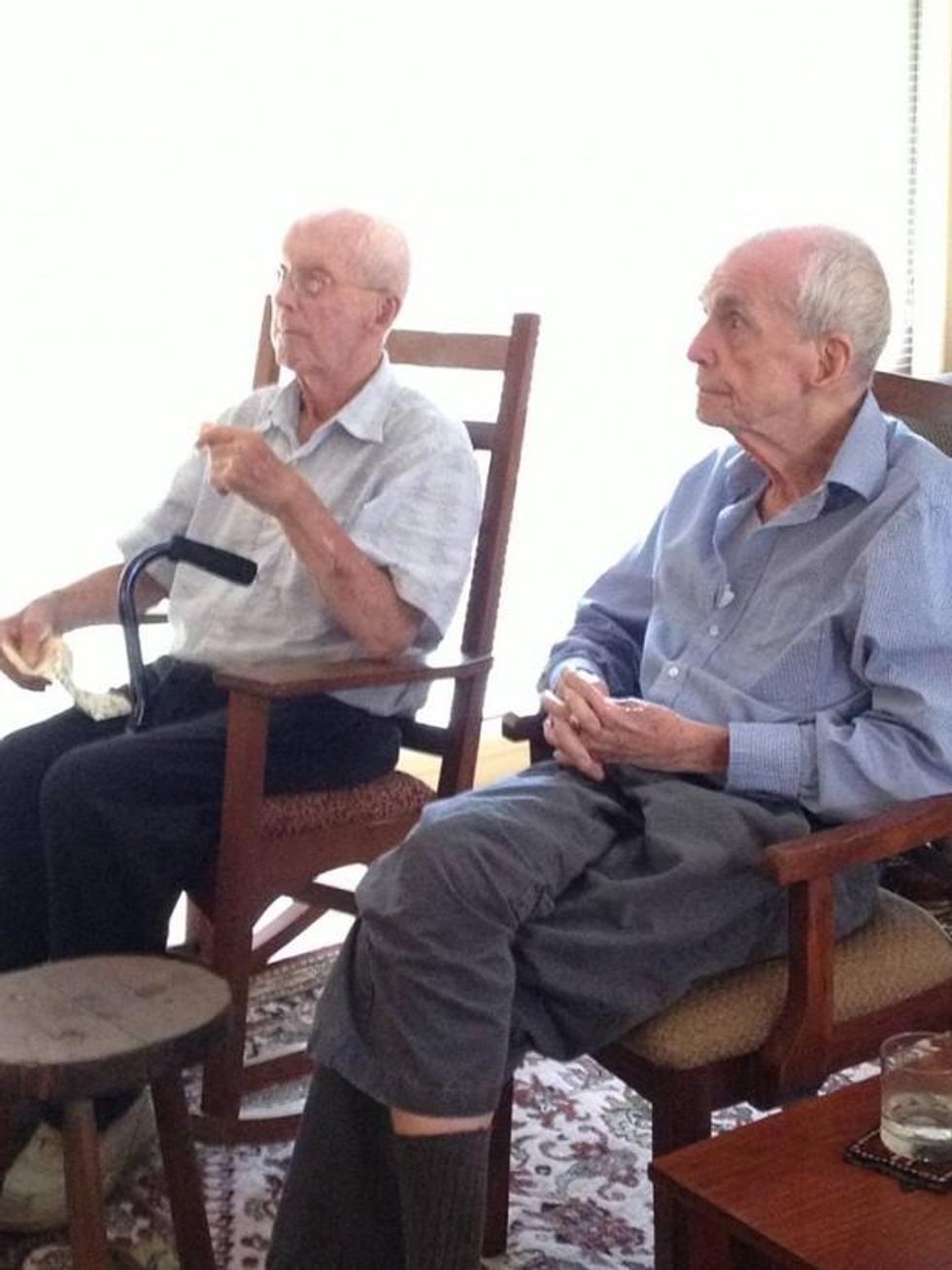
Growing up, it was always a lot of anticipation and excitement when my uncles would come to visit Syracuse. It's hard to grasp the depth and intensity of the brother's lives, because growing up it was the norm. It was normal for me to spend weekends visiting my uncle in jail, having many people in and out of the house, to have reporters and police calling the house and sitting outside the house trying to get information. My fondest memories of my uncle include sitting around the living room with a couple of drinks, joking and telling the stories of their childhood days. He and his brothers would sit around for hours. He was an uncle who always showed up and was around for many big moments in my life.
- Philip Daniel Berrigan, nephew
--
"I first met Father Berrigan in the hall of Lincoln Center at Fordham. He was teaching a class called 'Poems by Poets in Torment' that semester and I was determined to get a seat. Fordham did not allow freshmen to take classes at different campuses, so I was unable to register for the class. A senior who was registered for the class suggested I get a physical add/drop slip, see if Dan would sign it, and then turn it into the dean. The school might enter it into the system and once it was in they'd be unable to change it from their end.
So after the first day of class, I approached Dan in the hall and explained the situation. I wanted to be upfront, so I explained everything to him as clearly as I could. He stared at the slip for a few moments and then looked at me and said, 'So, we'll be breaking the rules?' I replied, 'Yes...' He took out a pen, and while scribbling his initials on the slip, said, 'Good! I hope it will be the first of many times.' He loved to make mischief, and I will forever love him for it.
- Patrick Stanley lives in Athens, Georgia with his wife and 3-year-old daughter. He spends his time repairing books and bicycles.
--
"A few months after I had been with Witness For Peace in northern Nicaragua, I mentioned the experience to Dan and he responded, 'Why don't we go down there again?' He made the connection with our mutual friend, Gene Palumbo, a Catholic Worker living and working as a journalist in El Salvador, and in June of 1983 we were off. The trip prompted Dan's book 'The Steadfastness of the Saints.' For me it sealed my decision to spend some time in Central America.
Dan's intellect, humor and groundedness were always inspirations for me. But where our spiritual paths had a special affinity was in the value he placed on art. He voiced his concerns movingly in poetry; I was more interested in the formal issues of order and chaos in painting and sculpture. Dan's apartment in New York was filled with pictures and sculptures. Most were figurative and peace-related; a few of mine found a place there, but I doubted that Dan would have much to say about my major interest in metal sculpture with no narrative content.
In the mid-90s, while back from Guatemala for a few weeks, I was visiting Dan, and he suddenly suggested that we tape a conversation about my sculpture. I had some images from a calendar printed that year by the Jesuit university in Guatemala. A sculpture for each month was the focus, but like any good conversation, the focus was a catalyst for musings about poetry, art and social change. Dan's comments were as clear and impassioned as any I had heard from artists.
He entered my world, as he did so many others, with interest, curiosity, wit and intelligence. At the close of our conversation Dan commented, 'I don't know, I can't give thanks loud enough.' That mirrors perfectly my own feelings, and makes his parting a bit more bearable.
- Dennis Leder, S.J. is a Jesuit priest and artist, who lives in Guatemala.
--
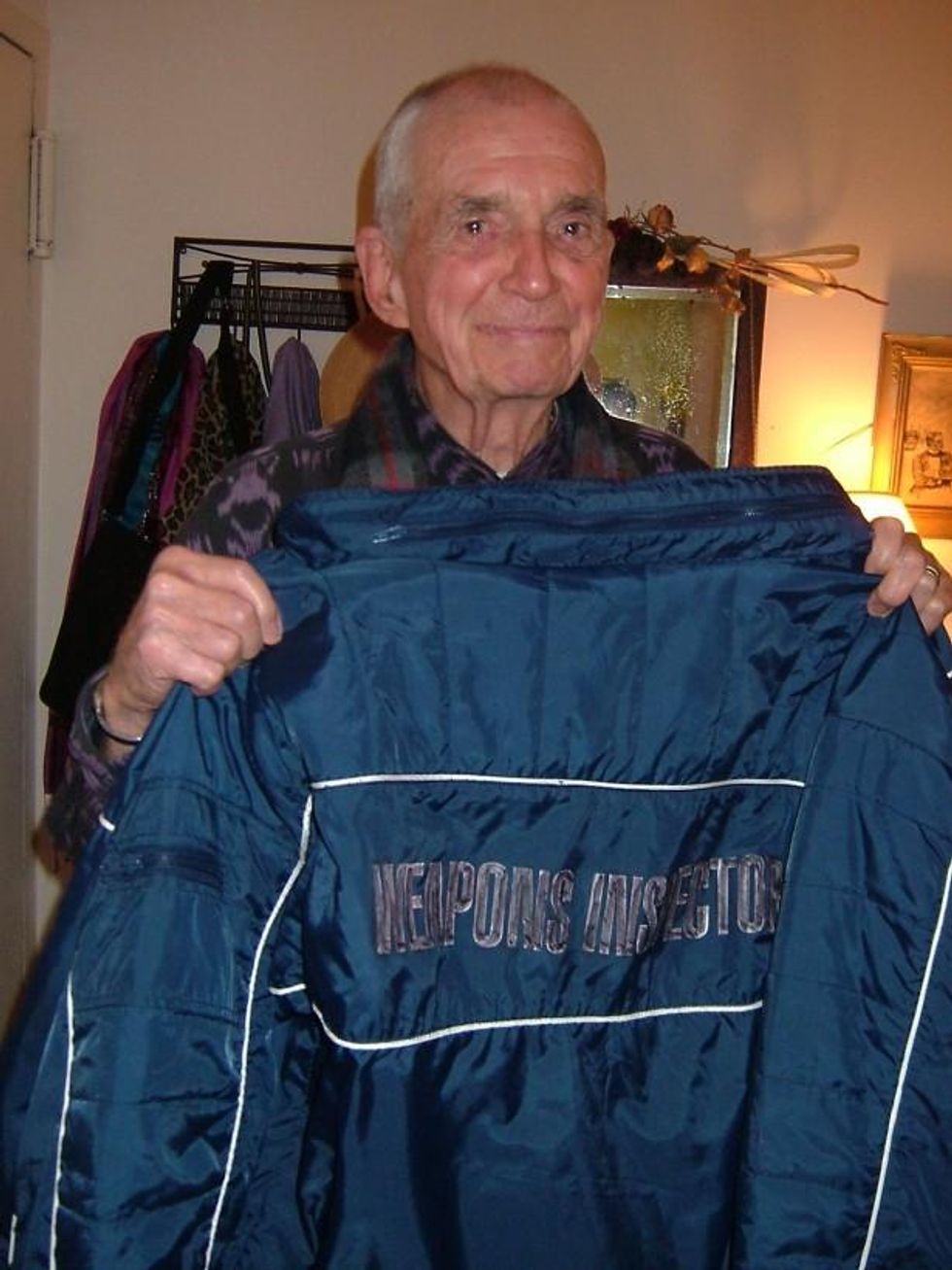
- Mark E. Lang and Alison J. Murphy are a New York-based actor couple. Their current project is a biographical play about the actor couple Lunt and Fontanne.
--
It was in 1999 that I first met Dan, and began a friendship that will remain one of the most important of my life. Dan had led a retreat that I attended, and when he needed a ride to the train station after the retreat ended, I jumped at the opportunity to spend an hour in the car with this person who had become a mythic figure, a hero in my life. I'm fairly certain that I spoke at breakneck speed for the first 45 minutes of the ride -- me going through my list of questions and Dan patiently listening. Then finally and mercifully, he stopped me. With that mischievous smile and twinkle in his eye that I would be fortunate to see so many times over the coming years, Dan said that he had one answer to every question I had asked.
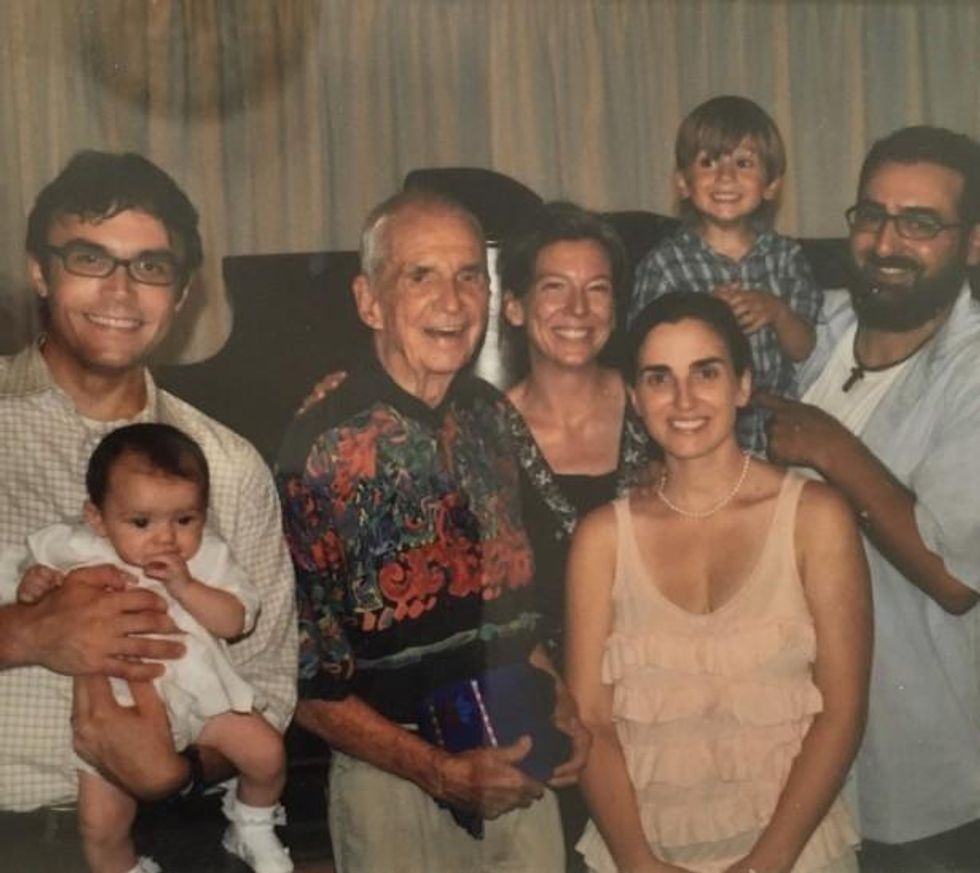
Dan was known to occasionally make up words sometimes. With the gift of his words, his wit, his friendship, and his example of living the answers, I wish I had the ability to create a word to encompass what this priest, and poet, and prophet meant and continues to mean to me. I feel like an anchor, a touchstone, is now gone. And yet, what an incredible thing to have shared some time on this earth with Dan Berrigan. Of all the times to live, and people to live with -- I can't think of any better. And now. What an incredible responsibility we all have. A gift really. To carry Dan's spirit, and his work forth in community. Dan Berrigan. Rest in the peace you fought so hard for."
- Matt Daloisio is a member of Witness Against Torture and the New York Catholic Worker. He is also on the board of the War Resisters League.
--
"In 2007, while I was on a 3,300-mile walk across the United States for genocide awareness (the Journey for Humanity), I recall talking on the phone with friends from Kairos, the peace community Dan helped found. Having discussed the media outreach work we were doing with mixed results, Bud Courtney reminded me that Dan taught us to 'do good for the sake of good itself,' so it's sometimes important not to fixate our minds on 'results' or 'success' per se. That's what I needed then, and I've never forgotten it.
Years later, at a Kairos meeting with Dan, I learned about a certain medical doctor who treated him for a small cyst in a New York hospital. It turned out that this doctor wanted to thank Dan because his was one of the draft cards burned in Catonsville, Maryland. 'That action spared my life,' he said, 'and I used it to get a medical degree. Now I'm here to take care of you, Fr. Dan.' Had Dan and the rest of the Catonsville Nine been seeking proof of results, they may not have simply acted in protest of that war and its draft. And yet, by the witness of Dan's long and beautiful life, the truth is affirmed that results can come in the most unpredictable of ways -- if only we do good for the sake of good itself in the present moment."
- Ed Majian, president and founder of Sartonk, a student of Zen and philosophy, and a magician with an emphasis on the spirit of social justice.
--
Dan Berrigan will always be associated with his daring and courageous public resistance to war: Catonsville, going underground and eluding the FBI, appearing on the cover of Time magazine and hammering on nuclear weapons. But I remember him most as a brother Jesuit who patiently listened to my questions, fears and hopes. For the quality of his presence. For his generosity in responding to letters. For his deference to the experience and wisdom of other people in the room. And for his often small and subtle but always poetic and prophetic challenges to our common ways of thinking and acting.
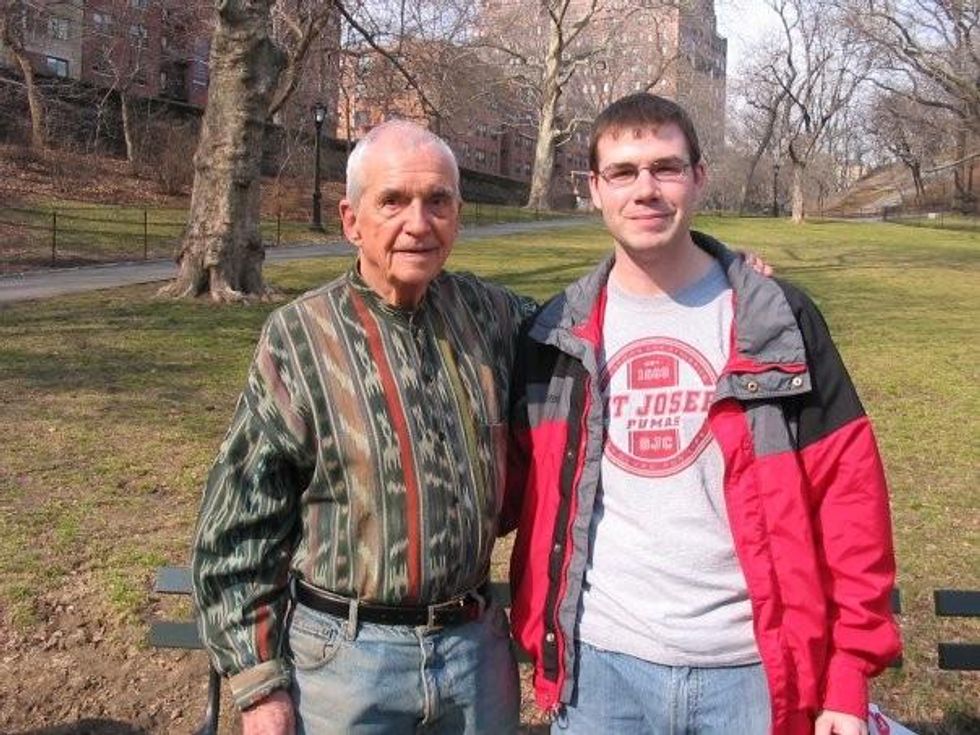
Dan didn't want people to follow him. He wanted people to follow the Gospel. He repeatedly encouraged me, 'Stay focused on the Gospel and let the rest take care of itself.' He wrote to our young resistance community in Chicago: 'The formula has been deceptively simple; open the Bible together as a discipline of holy literacy, be attentive to the spirit of the words, see where they lead.'
Dan has challenged and inspired so many young Jesuits who are involved in the peace and ecological movements, anti-racism work, and the accompaniment of migrants. The work continues. Dan paved the way for us and helped us to imagine that protest and resistance and even civil disobedience are not only possible for Jesuits but essential to our vocation as human beings and as followers of the crucified and risen Christ.
- Luke Hansen, S.J., a former associate editor of the Jesuit journal America, is a student at the Jesuit School of Theology, a graduate school of Santa Clara University, in Berkeley, California.
--
I believe it was 1968 that Philadelphia Quakers' largest gathering, the Yearly Meeting, invited Daniel Berrigan to be the keynote speaker. The weighty Friend Lyle Tatum was chosen to introduce him. In Lyle's introduction he said that, several centuries ago, Quakers Ann Austin and Mary Fisher had walked from Northwest England to Rome to try, as Lyle said, "to convert the Pope to Christianity." At that, Dan laughed as heartily as the rest of us. When he stepped to the microphone to speak, his first words were, "I hope you'll keep trying." For me, Daniel Berrigan was a model of how to focus on a point of passionate conviction and at the same time keep the broad perspective that supports a sense of humor.
- George Lakey is a columnist with Waging Nonviolence and co-founder of the Earth Quaker Action Group.
--
"It was the first day of a class called 'Revelation: The Nightmare of God.' Father Dan explained the mark of the beast. The Roman empire used to tattoo DC on people, which stood for Divine Caesar. It meant that you were recognizing Caesar as holy and you were declaring that you would worship the empire. At the end of class, he said 'Alright, for our next class, don't show up here.' The class murmurs a general huh? 'We'll meet at Bryant Park and 42nd Street. From there we will march to the U.S. Military Recruiting Station because that is where they put the mark of Caesar on people today.' My classmates and I looked at each other with eyebrows raised.
Two days later, our class marched through the busy chaos of 42nd Street. We walked slowly and in silence, carrying cardboard coffins. The pictures some of the people carried showed people shredded by bombs and women wailing at the sky. When we arrived, our teacher and about 12 others locked arms and stood in front of the door of the recruiting station. Inside, the military men looked confused and tried to open the door, but the group refused to move. Class had turned into a march, and it was now turning into direct action. Our teacher was teaching by example. Within 10 minutes the little triangle in the middle of Times Square was covered with NYPD, who were ordering the protesters to leave. Instead of obeying the police orders, they were singing.
My classmates and I watched in awe as they made a final order for them to leave and their only response was a beautiful rebellious version of 'We Shall Overcome.' Somewhere deep in my heart I wanted so bad to believe. Minutes later, our teacher and his fellow peacemakers were being tossed in the back of the paddy wagon. The salty water of profound sadness in his eyes, our teacher gave us a solemn nod as if to say, 'This is the bare minimum of what is necessary.' The truth appeared stark and brutal. Our family is murdering our family and the rest of this city is rushing off to work -- too exhausted to notice or too complicit to dare acknowledge these wars.
This is a funeral procession. It is not just symbolic when there were people being murdered by war yesterday and today. These people getting arrested are refusing to let that happen without an act of resistance. The paddy wagon shut its doors. The police ordered the crowd to disperse. The blue and red lights flashed across the scene and our teacher was driven deeper into the belly of the beast. Class dismissed. Education commenced."
- Luke Nephew is a co-founder of The Peace Poets, a trainer with The Wildfire Project and an artist for Liberation.
--
"In 2004, I asked Dan if I could interview him for the New York Catholic Worker paper and he declined. But we struck up a correspondence anyway. My son had entered the military in May of that year and I was despondent. My son was at Fort Benning, Georgia where my brother had trained nearly 40 years prior, and Granny had visited him there. My brother was sent to Vietnam.
Dan helped bring me back into my Catholic faith through his gentle love and support. He was still grieving his brother Phil's death two years prior and so we shared our grief through letters, not really knowing each other personally. I met him in person (other than seeing him when I was a child) in 2006, at his 85th birthday celebration. The moment he saw my face he turned away. He loved [my grandmother] Dorothy so much. We will miss him sorely just as we miss Dorothy. But we still have each other and the Eucharist, as Dan has said. Beloved community."
- Martha Hennessy, granddaughter of Dorothy Day, divides her time between family in Vermont and volunteering at Maryhouse Catholic Worker.
--
"I was fortunate enough to have made a visit to Dan on April 22, Earth Day, and only a couple days before he became gravely ill. I arrived just as Dan was coming from chapel and midday mass. I joined him in the dining room for lunch. He was especially expressive that day, asking questions and commenting on various things. He pointed out the beauty of the planters in the solarium and made sure I saw them. When I offered him his coffee cup, he raised it to me and so we toasted. After a bit more back and forth, Margaret wheeled him to his room where he admired the bright, pink daisy I had put in his room. We chatted a bit longer and then I began to sense he was running out of steam. I asked if I could do anything for him before I left. He asked that I lower his blinds. I did that, then kissed him goodbye. I took his hand and he gave me a little reassuring squeeze. I said 'peace' to him and he replied 'peace.'"
- Mary Berrigan, niece
--
"In 1981 I traveled from California to the East Coast to visit a number of foreign policy think tanks as part of my research for a book project on the consequences of the nuclear arms race. No one I spoke with could envision a world free of atomic weapons. At most, they thought we might be able to cut back on nuclear weapons by dramatically increasing conventional ones. Each appointment left me more and more depressed, and finally, when I arrived in New York, I suddenly thought to call Dan. I was in need of some pastoral counseling on the matter of nuclear weapons, and who better to see? We had never met, but he graciously welcomed me to his quarters.
For several hours, he shared with me his vision, which essentially boiled down to this: 'We live in a culture of death -- and it is up to us to resist it.' There was a lifetime of experience behind these words and I felt the weight of them. Then, as we were coming to the end of our time, I said, 'Dan, I'm going back to the West Coast. What can I do for you?' He then delivered a point-blank missive: 'Don't do anything for me. Find some people you can pray with and march with.' This handful of syllables hit their mark all those years ago, and I have done my best to practice them. Following his plain and provocative order, I did as he asked -- and my life took an unexpected detour onto a road of nonviolent transformation that I am still, in fits and starts, traveling. Dan, I am grateful for your mighty journey -- and the one it inspired in me and countless others."
- Ken Butigan is director of Pace e Bene, a nonprofit organization fostering nonviolent change through education, community and action.
--
"Early on in his priesthood, Dan would say mass for a nunnery in Brooklyn that my aunt, Sr. Rene Donovan, belonged to. When I was a young man protesting the war (in 1970-71) my aunt shared a story about Fr. Berrigan. She said she liked him but many of the nuns did not. Why? Because most of them had to shove off to jobs, and needed to grab a quick breakfast, get up and out. She said Dan would say each mass, each word, with such feeling and pause after many lines in contemplation. He was feeling the words, and reliving the experience of the cross when he said each mass. She said many of the sisters would be looking at their watches, sighing, and relieved if they got a priest who would just zip through mass without any pausing."
- Anthony Donovan, hospice nurse and filmmaker. His latest documentary is "Good Thinking," about those who tried to halt nuclear weapons.
--
My uncle Dan stood up against injustices in the world because it was the right thing to do. He saw changes that needed to be made and took action to make said changes. He became the voice for people whose voices couldn't be heard. To me, he will always be my uncle Dan with the sparkly blue eyes, bright smile and an affinity for sweets. A man who loved a good laugh and reminiscing on the past. His impact on others has been profound and he continues to inspire me to be determined, passionate in my beliefs, teach others and continue to make a difference every day.
- Jenn Berrigan, grandniece
Daniel Berrian was many things - Jesuit priest, poet, teacher, fine cook, good listener, radical thinker, antiwar activist, pacifist. And, for his opposition to the Vietnam war, he was considered an enemy of both state and church.
Of everything he wrote, including more than forty books, these words stand out as the most memorable and most emblematic of his life: "Our apologies, good friends, for the fracture of good order, the burning of paper instead of children, the angering of the orderlies in the front of the charnel house. We could not, so help us God, do otherwise . . . How many must die before our voices are heard, how many must be tortured, dislocated, starved, maddened . . . When, at what point, will you say no to this war?"
That is what Berrigan said in May, 1968 as he and his brother, the late Philip Berrigan, and seven other activists, most of them nuns and priests, burned draft files they had just removed from the draft board in Catonsville, Maryland, and waited for police to arrive to arrest them. These words appear in Berrigan's most famous writing, The Trial of the Catonsville Nine, a play based on the transcript of the trial. It has been staged throughout the world.
When Berrigan's sister-in-law, Elizabeth McAllister, read those words at his funeral mass today, the more than 1,000 people in attendance at St. Francis Xavier Catholic Church in Greenwich Village responded with a thunderous and sustained standing ovation. They had come from near and far to say farewell. For many of them, these words he spoke at Catonsville had moved them into civil disobedience and resistance many years ago.
Read the full article at The Intercept.