SUBSCRIBE TO OUR FREE NEWSLETTER
Daily news & progressive opinion—funded by the people, not the corporations—delivered straight to your inbox.
5
#000000
#FFFFFF
To donate by check, phone, or other method, see our More Ways to Give page.


Daily news & progressive opinion—funded by the people, not the corporations—delivered straight to your inbox.
"You cannot buy this administration's favor. For the right price, you can only borrow it. And the price always goes up."
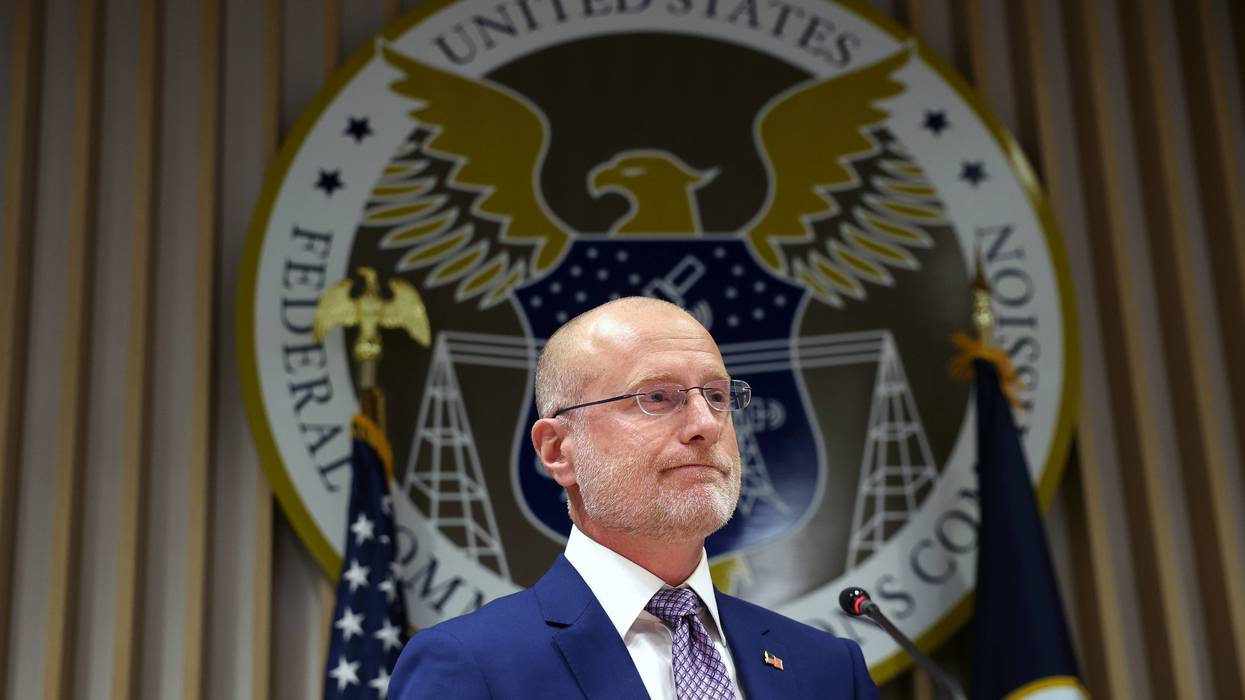
Anna Gomez, the lone Democrat on the Federal Communications Commission, delivered a scathing attack on her own agency in a letter sent on Monday to Walt Disney Company CEO Josh D'Amaro.
At the start of her letter, Gomez told D'Amaro that his company "has once again been made a target by this FCC," as part of "a sustained, coordinated campaign of censorship and control, carried out through the weaponization of the FCC’s authority as a federal regulator."
Gomez said that while Disney, the parent company of television network ABC, is not the first media firm targeted by the administration's censorship campaign, its case is "the most documented," and thus "worth laying... out plainly."
The FCC commissioner said that the campaign against Disney started shortly after it agreed to pay $15 million to settle a lawsuit brought by President Donald Trump, which signaled to the president and allies that "pressure works," while also telling other major media companies that "capitulation was an option."
And instead of getting the Trump administration to back off, Gomez explained, Disney's decision to cave only emboldened it to crack down further.
"You cannot buy this administration's favor," she wrote. "For the right price, you can only borrow it. And the price always goes up."
Since the settlement, Gomez continued, the administration has opened up investigations into Disney's diversity, equity, and inclusion (DEI) policies, pressured the company to pull late-night talk show host Jimmy Kimmel off the air, and opened up an investigation into the daytime talk show "The View" after it hosted Democratic US Senate candidate James Talarico of Texas.
On top of all that, Gomez said, the FCC has demanded that eight ABC-owned local TV stations file early for renewal of their broadcast licenses, which she described as "the most egregious assault on the First Amendment" the agency has taken so far.
Gomez concluded her "blistering" letter by urging Disney to fight against administration efforts to censor it, and she said that both the law and the American public would be behind the company if it decides to take a stand.
"Your journalists do work that matters to millions of Americans across the country, and the viewers who rose up to defend Jimmy Kimmel are the same viewers who will stand up again if this FCC follows through with its threat," she wrote. "I am encouraged to see that Disney is choosing courage over capitulation. The fight ahead may not be easy, but the law, the facts, and the public are on your side. This is a fight worth having, and one that I am confident you will win."
Disney last week came out swinging against the Trump FCC over the agency's investigation into "The View," accusing the administration of trying to "upend decades of settled law and practice and chill critical protected speech, both with respect to ‘The View’ and more broadly.”
"ABC has finally learned that bullies don’t stop when companies cower in a corner," said one free press advocate.
ABC News earned plaudits on Friday after it came out swinging against the Trump administration's investigation into its daytime talk show "The View."
In a filing with the Federal Communications Commission (FCC), first reported by The New York Times, ABC said the Trump administration's actions "threaten to upend decades of settled law and practice and chill critical protected speech, both with respect to 'The View' and more broadly."
The FCC launched an investigation into "The View" over its interview with Democratic US Senate candidate James Talarico of Texas earlier this year, as the agency questioned whether the program should be exempt from Section 315 of the Communications Act, which requires networks to provide equal access to candidates' political opponents.
Disney-owned ABC noted that "'The View' has been broadcasting under a bona fide news exemption granted to it more than 20 years ago," and argued that forcing the show to abide by equal-time rules "would risk restricting political discourse exactly when it is needed most."
The network's aggressive posture against the FCC inquiry earned it praise from press freedom watchdogs who have long criticized mainstream media outlets for timidity in the face of the Trump administration's authoritarianism.
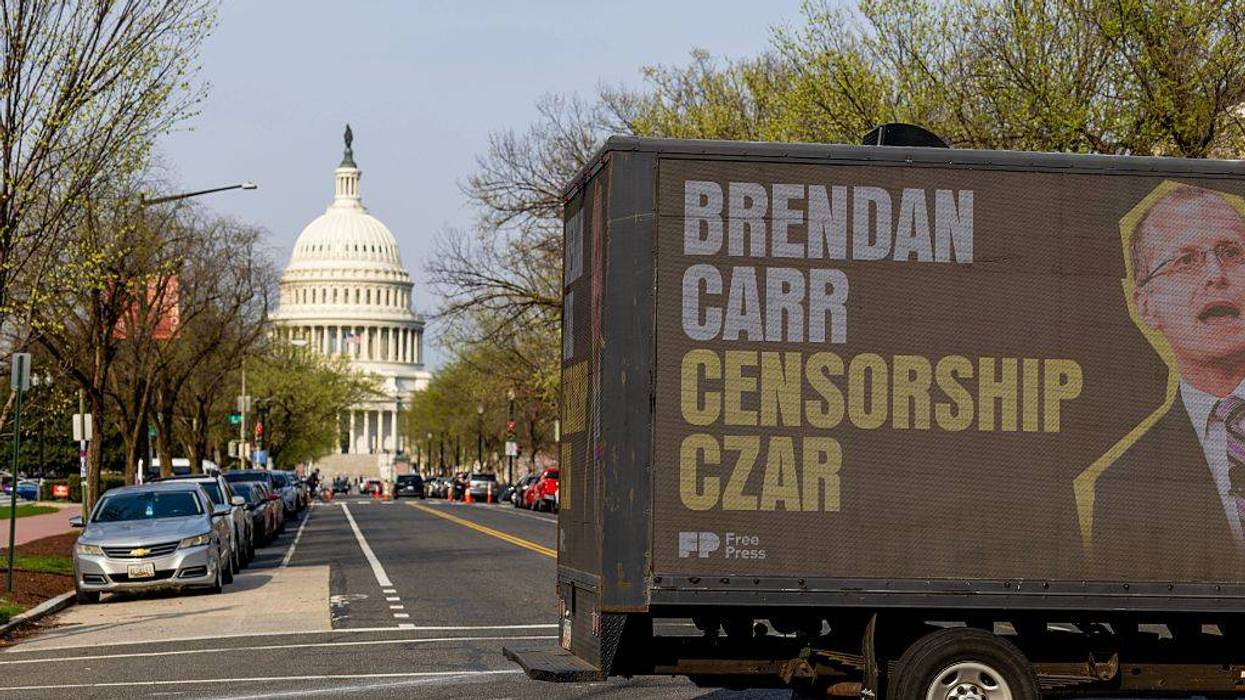
Seth Stern, chief of advocacy for the Freedom of the Press Foundation, said ABC deserved kudos for "for standing up for itself and the First Amendment" amid attacks from President Donald Trump and FCC Chairman Brendan Carr, who has repeatedly threatened to pull broadcasters' licenses over unfavorable news coverage.
"It’s about time news outlets start telling Carr and his Donald Trump lapel pin to kick rocks," said Stern. "Otherwise, he’ll continue manufacturing bogus pretexts to harass and jawbone licensees that air content his boss doesn’t like."
Jessica J. González, co-CEO of Free Press, said she was "pleased that ABC has finally learned that bullies don’t stop when companies cower in a corner," referring to past settlements ABC and other networks made with Trump after his 2024 election victory.
"The FCC chairman has blatantly and repeatedly abused his power to silence speech that displeases Trump," said González. "This doesn’t just violate the First Amendment rights of broadcasters on the receiving end of Brendan Carr's tactics; it also harms the broadcasters’ audiences."
Mark Jacobs, former editor at the Chicago Tribune and the Chicago Sun-Times, similarly pointed to ABC's past capitulations to Trump, while expressing hope that the network had learned its lesson.
"Remember when ABC folded to Trump's shakedown scheme with a $15 million settlement?" he wrote in a social media post. "Maybe they thought it would buy peace with the dictator. It didn't. The regime demanded Jimmy Kimmel's firing and harassed 'The View.' Now ABC is fighting back after learning that fascists always come back for more."
"Although the FCC has the authority to ensure broadcasters operate in the public interest, it cannot serve as President Trump’s roving censor."
A group of Senate Democrats on Thursday told Federal Communications Chairman Brendan Carr to back off his threats to strip Disney-owned TV network ABC of its broadcast licenses.
In a letter addressed to Carr, the Democrats took Carr to task for ordering Disney to file early license renewals for eight ABC stations shortly after President Donald Trump demanded that the network fire late-night host Jimmy Kimmel.
Kimmel earned Trump's ire when he jokingly likened first lady Melania Trump to an "expectant widow" days before a gunman stormed into the White House Correspondents' Dinner in an alleged attempt to assassinate the president.
The senators called Carr's order an "extraordinary abuse of power" and "the latest and most extreme step in your use of the FCC’s licensing authority as a cudgel against broadcasters whose editorial choices displease the president."
The Democrats charged that the order "appears to penalize Disney for refusing to capitulate to Trump’s demands to fire Kimmel and to send a message to other broadcasters: Modify your speech to favor Trump or face the FCC’s wrath," while noting that the order was the first time in over 50 years that the commission had called on a broadcaster to apply for early renewal.
The day before the order to Disney, the FCC sent a similar order to a small station license holder called Bridge News.
Carr's order to Disney was also part of a broad pattern of Trump administration assaults on the free press, including calls to fire Kimmel last year after the comedian said Trump and his political allies were trying “to score political points" after the assassination of right-wing activist Charlie Kirk.
"Although the FCC has the authority to ensure broadcasters operate in the public interest," they wrote, "it cannot serve as President Trump’s roving censor, threatening to revoke licenses against broadcasters whose editorial content—including a comedian’s jokes—displeases the president."
The Democrats concluded their letter by asking Carr to provide information about the timing and process by which the FCC decided to send Disney its early renewal order, including whether any FCC staff had communicated with the White House about the order before it was issued.
The letter was signed by Sens. Ed Markey (D-Mass.), Chuck Schumer (D-NY), Maria Cantwell (D-NM), Ben Ray Lujan (D-NM), John Hickenlooper (D-Colo.), Mazie Hirono (D-Hawaii), Jacky Rosen (D-Nev.), Bernie Sanders (I-Vt.), Brian Schatz (D-Hawaii), Adam Schiff (D-Calif.), Chris Van Hollen (D-Md.), and Elizabethe Warren (D-Mass.).
Trump also contradicted a US intelligence assessment that Saudi Crown Prince Mohammed bin Salman had ordered the murder of journalist Jamal Khashoggi.
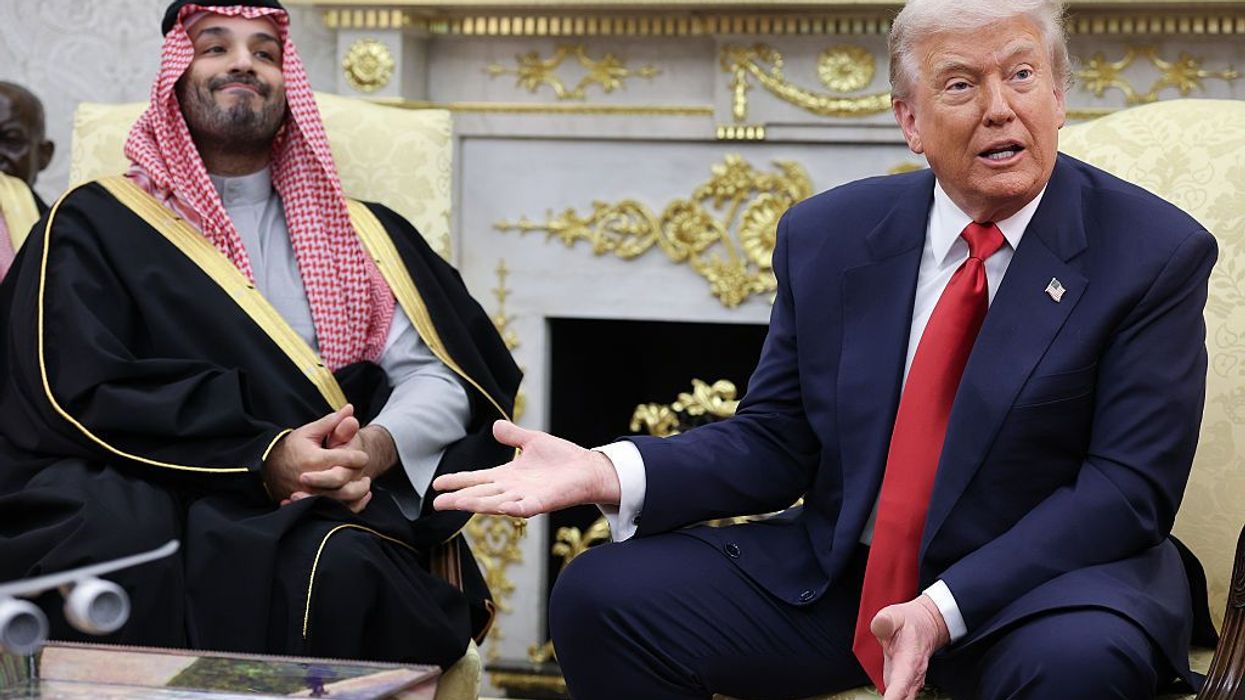
President Donald Trump angrily snapped at ABC News reporter Mary Bruce while taking questions alongside Saudi Crown Prince Mohammed bin Salman in the White House on Tuesday.
The testy exchange began when Bruce tried to ask the crown prince about a US intelligence assessment concluding that he was responsible for the murder of journalist Jamal Khashoggi.
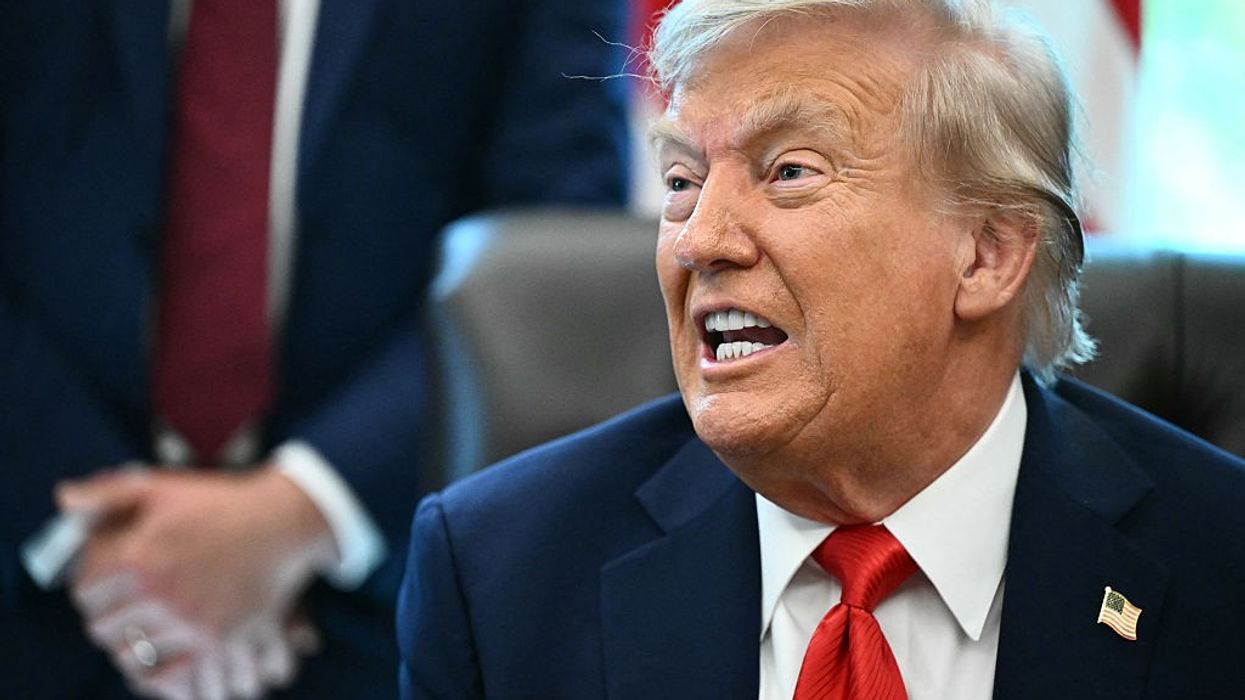
"Who are you with?" Trump demanded to know as Bruce attempted to ask her questions.
"I'm with ABC News, sir," she replied.
"Fake news," Trump said. "ABC, fake news, one of the worst in the business."
Shortly after this, Trump described the slain Khashoggi as "somebody that was extremely controversial."
"A lot of people didn't like that gentleman that you're talking about," Trump said, referring to Khashoggi. "Whether you like him or didn't like him, things happen. But [the crown prince] knew nothing about it. You don't have to embarrass our guest."
In fact, a US intelligence report that was declassified in 2021 concluded that the crown prince personally approved of a plan carried out by Saudi forces to murder Khashoggi after he entered a Saudi consulate in Istanbul, Turkey in 2018.
Shortly after this, Bruce tried to ask the president a question about FBI files related to the late sex offender and longtime Trump friend Jeffrey Epstein, and he again hit her with personal insults.
"It's not the question I mind, it's your attitude," he said. "You're a terrible person and a terrible reporter."
He then threatened to take ABC News completely off the air.
"I think the [broadcast] license should be taken away from ABC because your news is so fake, and it's so wrong," he said. "And we have a great commissioner... who should look at that."
Trump's mention of the "commissioner" was presumably a reference to Federal Communications Commission Chairman Brendan Carr, who earlier this year threatened to pull ABC's broadcast license unless it fired late-night host Jimmy Kimmel, a frequent critic of the president.
Kimmel's show was suspended shortly after Carr made this statement, although he was reinstated days later amid public outcry about government censorship.
"The commercial news media, which helped elevate Trump to power, have proven repeatedly that they are ill-equipped to withstand such pressures," warned one scholar.
As US President Donald Trump late on Sunday lashed out against the American media and threatened to pull broadcasting licenses from networks for their alleged "biased" coverage of him, media experts said the danger to the news media lies partially in corporate outlets' potential capitulation to the Trump administration.
In a post on his Truth Social platform, the president railed against NBC and ABC, which he called "two of the absolute worst and most biased networks anywhere in the world."
He then said the networks should "lose their licenses for their unfair coverage of Republicans and/or conservatives, but at a minimum, they should pay up BIG for having the privilege of using the most valuable airwaves anywhere at anytime!!!"
The president concluded his angry rant by declaring that "crooked 'journalism' should not be rewarded, it should be terminated!!!"
Trump did not point to any specifics regarding his claim that the networks' coverage of him is unfair, but asserted that they "give [him] 97% bad stories."
This is not the first time that Trump has called on the Federal Communications Commission to strip broadcasters' licenses for producing news he doesn't like, although so far no network has had its license revoked by the Federal Communications Commission (FCC).
Even so, some experts were alarmed at Trump's latest attacks, which they feared could lead to more capitulation from major media corporations similar to the $16 million settlement that CBS parent company Paramount agreed to earlier this summer, which stemmed from what experts called a meritless lawsuits over a "60 Minutes" interview with 2024 Democratic presidential candidate Kamala Harris.
Victor Pickard, professor of media policy and political economy at the University of Pennsylvania's Annenberg School for Communication, described the president's angry rants as "yet more worrying signs that Trump knows no limits in exerting dictatorial power over our news media."
"The commercial news media, which helped elevate Trump to power, have proven repeatedly that they are ill-equipped to withstand such pressures since they typically privilege their profit motives over democratic needs," he said. "Some individual journalists have shown much courage despite Trump's attacks, but the corporate media institutions themselves too often capitulate."
Tim Karr, senior director of strategy and communications at Free Press, echoed Pickard's point about the media being responsible for the president's political rise, and he singled out NBC's decision to air Trump's reality TV show, "The Apprentice," which he said gave Americans the false impression that he was a "successful and decisive businessman."
He also expressed concerns that broadcasters would offer the president more concessions in an attempt to avoid retaliation.
"What should be more worrying to anyone who appreciates a free press is the degrees to which these massive media conglomerates are capitulating before the president," he said. "If we've learned anything about the media from the past eight months, it's that massive media companies are far too beholden to the political elite to speak truth to power."
He then accused the major networks of cowering before Trump despite having the First Amendment clearly on their side.
"NBC and ABC are protected under the First Amendment from the sort of government meddling proposed here by Trump—and enacted by his obsequious FCC chairman, Brendan Carr," he said. "The problem is that big media conglomerates like these two would rather cave to the president than stand up for their constitutional rights."
Too many of the president’s alleged adversaries are keeping their head down and trying to stay out of the line of fire. That has to change, and change soon, or they—and we—will all hang separately.
The appalling spectacle of some of the nation’s most prestigious law firms, media companies, and universities surrendering to bully pulpiteer Donald Trump’s extortion brings to mind that quip Benjamin Franklin made at the signing of the Declaration of Independence: “We must all hang together, or assuredly we shall all hang separately.”
Trump’s revenge campaign is just one aspect of his all-out war on democracy—and it’s easy to get distracted by his latest daily outrage—so there’s no blame for not following it closely. The gist of it is, since taking office, Trump has relentlessly attacked his perceived enemies and has brought a significant number of them to heel.
Trump’s crusade should not come as a total surprise. After all, he told his supporters at a March 2023 rally: “For those who have been wronged and betrayed… I am your retribution.” What is shocking is the capitulation rate. One by one, Trump has been picking off his alleged adversaries. To be sure, some are fighting back, but too many are keeping their head down and trying to stay out of the line of fire. That has to change, and change soon, or they—and we—will all hang separately.

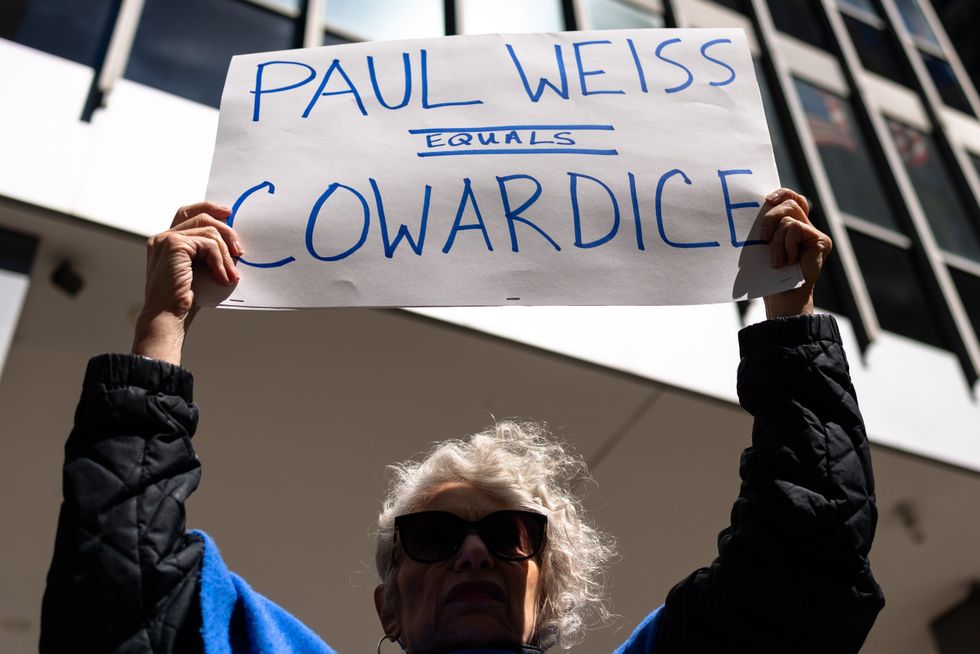
Nine prominent law firms, including Paul Weiss, Skadden Arps, and Latham & Watkins, have struck deals to avoid punitive executive orders Trump issued because they represented clients or took legal positions at odds with his administration. The orders would have revoked the firms’ security clearances, blocked their access to government buildings, and canceled their federal contracts. To get Trump to back down, they agreed to provide a total of $940 million in pro bono legal services to support Trump’s pet causes and eliminate diversity, equity, and inclusion (DEI) considerations in hiring and promotion.
At least four other major law firms, including Perkins Cole and WilmerHale, are resisting. They filed lawsuits arguing that Trump’s executive orders are unconstitutional retaliations that threaten the rule of law and violate First Amendment protections. Judges have issued temporary injunctions to block the executive orders.
Trump has not issued any executive orders against law firms since April, but the threat has had a chilling effect. “Some of the country’s largest law firms have declined to represent clients challenging the Trump administration…,” a recent ProPublica investigation found, “while others have sought to avoid any clients that Trump might perceive as his enemies.”

Both ABC News and Paramount, owner of CBS News, crumpled in the face of a meritless Trump lawsuit.
Trump’s case against Disney’s ABC News, which settled last December for $15 million for Trump’s presidential library, largely turned on semantics. Anchor George Stephanopoulos incorrectly stated on air that Trump was found civilly liable for raping writer E. Jean Carroll. In fact, he was found guilty of sexually assaulting (and defaming) Carroll. That said, the judge handling the case said the claim that Trump raped Carroll was “substantially true,” but the term “rape” is narrowly defined by New York state law. At any rate, to win the case, Trump would have had to clearly prove that Stephanopoulos’ comment was false and that he said it with “actual malice”—that he knew it was false or acted with reckless disregard of the truth. Trump would have lost.
Will news organizations now think twice before criticizing Trump? Most likely, yes.
Paramount’s July 2 settlement of $16 million for Trump’s library was tantamount to bribery. Trump sued Paramount for $10 billion last October, alleging that “60 Minutes” deceptively edited an interview with presidential candidate Kamala Harris to make her look good. No matter that editing interviews for time and clarity is what broadcast news organizations do.
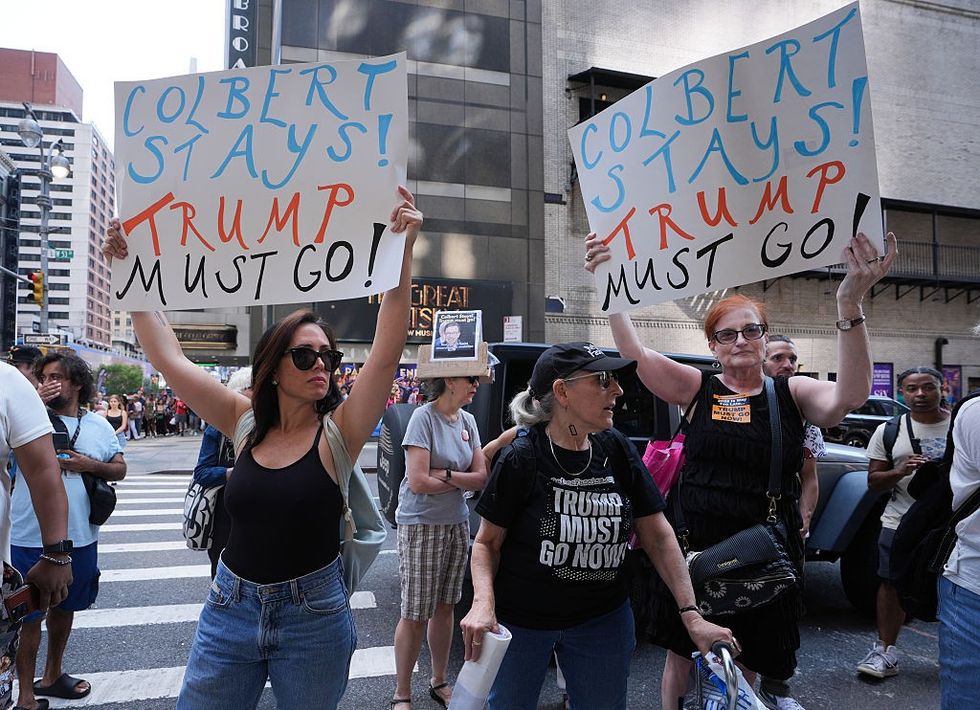
Trump did not have a case, but Paramount had a $8.4 billion merger with Skydance, a Hollywood studio, pending before the Federal Communications Commission (FCC)—now chaired by Project 2025 coauthor Brendan Carr—and it didn’t want to antagonize Trump. On July 14, CBS “Late Show” host Stephen Colbert called Paramount’s settlement a “big fat bribe.” The network cancelled his show three days later. On July 24, the FCC approved the merger.
Critics characterized the two settlements as acts of cowardice that threaten press freedom by emboldening frivolous lawsuits. Will news organizations now think twice before criticizing Trump? Most likely, yes.

At least a handful of news organizations, including the Associated Press and NPR, have pushed back against Trump’s bullying, but the results were hardly a victory for the First Amendment.
The Associated Press (AP) sued the White House in February for blocking its reporters from Oval Office briefings and Air Force One press pools because the news service didn’t adopt Trump’s new name for the Gulf of Mexico. AP argued banning its reporters violates its First Amendment rights. The case is still tied up in court.
In late April, the Corporation for Public Broadcasting (CPB) sued Trump for firing three of its five board members. In late May, NPR and PBS sued the Trump administration over the executive order to revoke federal funding for public broadcasting. Late last month, Trump signed a bill canceling $1.1 billion in public broadcast funding—which Congress had originally approved—in a “rescission” package, and on August 1, CPB announced it was shutting down.
More recently, Trump filed a $10 billion defamation lawsuit after the Wall Street Journal published a story on a sexually suggestive letter Trump sent to Jeffery Epstein for his 50th birthday. Denying that he had written the letter, Trump sued Rupert Murdoch; News Corp and its CEO, Robert Thomson; Dow Jones & Company; and the reporters who wrote the piece, calling the article “false, malicious, defamatory, FAKE NEWS” on Truth Social. The Journal stands by the story and is prepared to defend it in court.
“There’s nothing inherently wrong with a president bringing a libel suit,” the renowned constitutional lawyer Floyd Abrams told the AP. “But this claim [against the Wall Street Journal] certainly seems like nothing more or less than an effort to suppress speech that our president finds discomforting. That’s not why we have libel law. It’s why we have a First Amendment.”

Under the pretext of rooting out antisemitism and DEI programs on campus, Trump has been bludgeoning the most prominent American universities, threatening to cancel their federal research funding unless they change their policies.
On July 23, my alma mater Columbia University and the University of Pennsylvania were the first to capitulate. Columbia did not admit to any wrongdoing, but agreed to pay a $200 million fine; stop considering race in admissions and hiring; share with the federal government applicants’ standardized test scores, grade point averages, and race; and pay an additional $21 million to settle US Equal Employment Opportunity Commission investigations. In return, the school regains access to nearly $1.3 billion in annual federal funding that was placed on hold. Penn settled the same day but did not agree to pay anything. Among other things, it promised to align its athletic department’s policies with the Trump administration’s position banning transgender athletes.
Less than a week later, my other alma mater, Brown University, settled with the administration, agreeing to dismantle DEI programs and spend $50 million over 10 years on Rhode Island workforce development organizations. In return, the administration will reinstate $510 million in federal contracts and grants it threatened to block. Like Columbia, Brown also agreed to share details about its applicants with the federal government. Trump celebrated the agreement with a post on Truth Social proclaiming: “Woke is officially DEAD at Brown.”
In a March interview with the AP, former Trump White House lawyer Ty Cobb said giving in to a bully makes things worse by creating a snowball effect. “
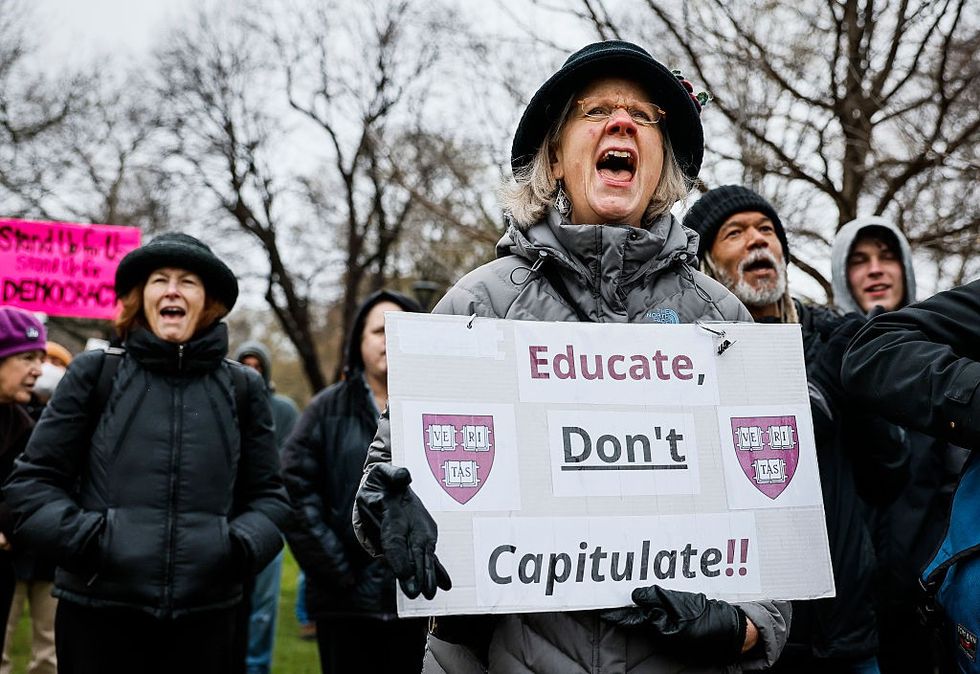
Harvard University, which initially stood up for academic freedom and sued the administration, is reportedly moving toward a settlement requiring the university to pay $500 million to vocational or work force training programs instead of directly to the federal government or Trump’s presidential library. If finalized, the Trump administration would then restore billions of withheld federal dollars to the school for research and other programs.
The administration’s professed rationale for punishing universities because of antisemitism on campus doesn’t pass the smell test. It’s a ruse. It’s all about trying to stamp out perceived leftist ideology and snuff out speech it opposes, according to Trump’s education secretary, Linda McMahon.
In a July 24 interview with Fox Business, McMahon applauded the Columbia settlement as “a monumental victory for conservatives who wanted to do things on these elite campuses for a long time because we had such far left-leaning professors…” “We’re really hopeful,” she added, “this particular settlement agreement is going be a template for other universities to follow.”
Likewise, Vice President JD Vance has made it clear that, in his opinion, “professors are the enemy.” In November 2021, he delivered the keynote address at the National Conservatism Conference in Orlando. He spent 30 minutes railing about corrupt American universities and then closed by quoting Richard Nixon, who he called a “great prophet and statesman.”
“I think in this movement of national conservatism what we need more than inspiration is we need wisdom,” Vance said, “and there is a wisdom in what Richard Nixon said approximately 40 or 50 years ago. He said, and I quote: ‘The professors are the enemy.’” (During that same taped conversation, ironically with former professor Henry Kissinger, Nixon also said “the press is the enemy.”)

In a March interview with the AP, former Trump White House lawyer Ty Cobb said giving in to a bully makes things worse by creating a snowball effect. “The more of them that cave, the more extortion that that invites,” he said. “You’ll see other universities and other law firms and other ‘enemies’ of Trump assaulted and attacked into submission because of that.”
So, what is to be done?
New York Times columnist David Brooks addressed this question on the “PBS News Hour” during his weekly discussion with MSNBC’s Jonathan Capehart on July 25.
“Well, there are two possible responses,” he said. “One, the one that’s being chosen by most organizational leaders right now, is lay low. It’s so, well, maybe they won’t pick on me, or maybe we will make a concession and they won’t pick on me...”
“The other option, which I thought we were going to have, is a broad coalition, not only of all universities, but all law firms, businesses, nonprofits, foundations, anybody in any sector that could be part of the extortion attempt,” he continued. “And they would say, we will band together. There’s strength of numbers. If they come for one of us, they come for all of us, sort of a domestic NATO Article 5.”
I would take Franklin’s proposition a bit further: It is the first responsibility of every citizen to defy authority when that authority is illegitimate.
I made the exact same argument in my graduation speech at Brown in 1976. I wasn’t talking about how to buck an authoritarian government, I was talking about how to challenge a top-down, undemocratic workplace, but it’s analogous.
The nation’s bicentennial year wasn’t a great time for a recent grad to be looking for a job. Industrial output had rebounded from a slump and corporate profits were up, but the recovery was jobless, and states and municipalities—and colleges—were facing major deficits. Given the scarcity of jobs in academia and the difficulty of earning a living as a solo practitioner, I warned my classmates: “More often than not we will find ourselves in basically undemocratic, hierarchical institutions that are resistant to change. These institutions are characterized by authoritarian control from above, and those who are not in the upper reaches of the hierarchy are excluded from the decision-making process.”
How did Brown prepare us for that future? By providing a taste of it. I cited examples of how, during my time there, Brown acted like any other corporation to protect its interests at the expense of its students, faculty, and workers. And then, like David Brooks, I spelled out the two ways to respond to authoritarians.
The first, I explained that June morning, is the “individual survival” response. One person alone has little chance against an institution, so it makes sense to keep your head down and accept the status quo. (By the same token, one university, one law firm, or one news organization alone has little chance against an authoritarian government.)
The second, more effective way is with a collective, community response. The civil rights, women’s, anti-war, gay, and environmental movements my generation grew up with demonstrated firsthand that united action can lead to positive change. It’s clear that strength comes in numbers, be it in school, the workplace, the voting booth, or the streets.
As mentioned above, 200 years before I gave that speech, Benjamin Franklin said: “We must all hang together, or assuredly we shall all hang separately.” He also pointed out: “It is the first responsibility of every citizen to question authority.”
I would take Franklin’s proposition a bit further: It is the first responsibility of every citizen to defy authority when that authority is illegitimate.
Certainly, there are significant risks to sticking your neck out, but the risks of doing nothing are even greater. If I learned anything during my four years at Brown—and my 40 years in Washington, DC—it’s that democracy is not a spectator sport, and we are all being tested by the worst political crisis of our lifetime.
This article first appeared at the Money Trail blog and is reposted here at Common Dreams with permission."This is spectacularly corrupt, a level of greed and depravity that is breathtaking, even for Trump."
U.S. President Donald Trump—no stranger to allegations of blatant corruption—faced an onslaught of criticism on Sunday in response to ABC News reporting that his administration is preparing to accept "what may be the most valuable gift ever extended to the United States from a foreign government."
Ahead of Trump's trip to Saudi Arabia, Qatar, and the United Arab Emirates, sources told ABC that the administration "is preparing to accept a super luxury Boeing 747-8 jumbo jet from the royal family of Qatar—a gift that is to be available for use by... Trump as the new Air Force One until shortly before he leaves office, at which time ownership of the plane will be transferred to the Trump presidential library foundation."
The unnamed sources also explained that "lawyers for the White House counsel's office and the Department of Justice drafted an analysis for Defense Secretary Pete Hegseth concluding that is legal for the Department of Defense to accept the aircraft as a gift and later turn it over to the Trump library, and that it does not violate laws against bribery or the Constitution's prohibition (the emoluments clause) of any U.S. government official accepting gifts 'from any king, prince, or foreign state.'"
"Even in a presidency defined by grift, this move is shocking. It makes clear that U.S. foreign policy under Donald Trump is up for sale."
ABC's revelations about the $400 million "flying palace" follow The Wall Street Journal reporting earlier this month that "the U.S. government has commissioned L3Harris to overhaul a Boeing 747 formerly used by the Qatari government... into a presidential jet."
The White House, Boeing, and L3Harris declined to comment on the Journal's report. Similarly, on Sunday, the White House, Justice Department, and a spokesperson for the Qatari Embassy did not respond to ABC's inquiries.
However, as The Associated Press reported Sunday:
Hours after the news, Ali Al-Ansari, Qatar's media attaché, in a statement said, "Reports that a jet is being gifted by Qatar to the United States government during the upcoming visit of President Trump are inaccurate."
"The possible transfer of an aircraft for temporary use as Air Force One is currently under consideration between Qatar's Ministry of Defense and the U.S. Department of Defense," the statement said. "But the matter remains under review by the respective legal departments, and no decision has been made."
Amid the uncertainty, a range of people across the internet blasted the supposed plan, slamming it as "indefensible," "incredibly illegal," and "comically corrupt." Some critics pointed out that the reporting comes after the Trump Organization, the Saudi partner DarGlobal, and a company owned by the Qatari government last month reached a deal to build a luxury golf resort in Qatar.
Journalist Mike Rothschild said that "this is spectacularly corrupt, a level of greed and depravity that is breathtaking, even for Trump. Air Force One—the people's plane—is going to be a flying palace donated by Qatar. No American should accept this."
Some critics highlighted security concerns. One legal expert declared, "An emolument and security risk all wrapped up in one!"
Robert Weissman, co-president of the watchdog group Public Citizen, said in a statement that "Trump's plan to accept a luxury plane from Qatar is blatantly unconstitutional, a textbook violation of the emoluments clause. The concern with foreign gifts is that they can sway a president's policy and predilections—and there's little doubt that Qatar wants to gift Trump a 'palace in the sky' for exactly that reason."
Weissman continued:
"The legal counsel who advised that this gift is OK because Trump will take personal control of it (through his library) only after leaving office should resign immediately, in shame and disgrace. The situation is no different than if the Qataris gave $400 million in cash to Trump and told him to keep it under his bed until 2029, when he could spend it freely. Except possibly it's worse, because he will use the plane in the interim, at great cost to the U.S. taxpayer, who will have to upgrade it.
Even in a presidency defined by grift, this move is shocking. It makes clear that U.S. foreign policy under Donald Trump is up for sale. The juxtaposition with cancelled foreign aid grants and programs for poor and vulnerable people—cancellations that will cost millions of lives unless reversed—could not be starker or more morally grotesque.
"Is taking a gift from a foreign government this big a bribe or bad judgment? Or just Trump?" Congressman Mark Pocan (D-Wis.) asked on social media. "Wish the MAGA movement cared about ethics in their president."
Congressman Brendan Boyle (D-Pa.) said: "The level of corruption from President Trump and his White House is unlike anything we have ever seen in American history. It is appalling and criminal. Openly taking bribes."
Congressional Progressive Caucus Chair Greg Casar (D-Texas) noted that the reporting comes amid issues at the Federal Aviation Administration (FAA).
"While ordinary Americans' flights are grounded because of problems at the FAA, Trump is taking a $400 million bribe in the form of a 'palace in the sky' from a foreign government," Casar said. "Over and over: He gets paid. Everyone else gets screwed."
This article has been updated with comment from Ali Al-Ansari, Qatar's media attaché.
"If major media outlets succumb to intimidation from the Trump administration, the First Amendment is in serious danger."
Independent U.S. Sen. Bernie Sanders of Vermont on Monday took aim at both President Donald Trump's attempts at "suing the media into submission" and news outlets' willingness to settle such cases and self-censor as "incredibly dangerous" precedents.
In a video posted on social media, Sanders highlighted that CBS News parent company Paramount is in talks with Trump's lawyers to possibly settle a $10 billion lawsuit filed by the president just days before the 2024 election accusing "60 Minutes" of deceptively editing an interview with Vice President Kamala Harris, the Democratic nominee.
Sanders also noted how ABC News agreed last year to pay a $15 million settlement that included a letter of regret after veteran anchor and political commentator George Stephanopoulos said Trump had been found "liable for rape" of writer E. Jean Carroll. A federal jury in Manhattan found Trump civilly liable for sexual abuse and defamation of Carroll, but not rape—even though Caroll testified in graphic detail that Trump raped her in a department store dressing room in the 1990s.
"I regard that as an incredibly dangerous precedent, both of those, ABC and CBS," Sanders said in the video, denouncing "major media outlets succumbing to pressure from the Trump administration."
"People have a right to express their own point of view," Sanders asserted. "Yeah, networks are wrong all of the time. They're wrong about me, wrong about Trump. But if you use the power of government to intimidate networks, they're not going to do the big stories. They're not going to do the investigations. Why should they go out on a limb and tell you something if they're afraid about being sued by the Trump administration?"
The video also notes Trump's lawsuit against pollster J. Ann Selzer, her polling firm Selzer & Company, The Des Moines Register, and the Iowa newspaper's parent company, Gannett, alleging fraud and "brazen election interference" over a November 2 poll showing Harris beating Trump by 3 points in the 2024 election. Trump won Iowa by 13 points.
"If major media outlets succumb to intimidation from the Trump administration, the First Amendment is in serious danger," Sanders stressed. "We need an independent press that reports the truth without fear of retribution."
Major media outlets have also been accused of self-censorship. Jeff Bezos and Patrick Soon-Shiong, the billionaire owners of The Washington Post and Los Angeles Times, respectively, have come under fire for prohibiting or restricting opinion pieces critical of Trump or supportive of his adversaries.
"If you believe The Washington Post's slogan that 'Democracy Dies in Darkness,' their owner was the first to switch off the light," journalist David Helvarg wrote last month for Common Dreams.
The Nation justice correspondent and columnist Elie Mystal wrote last month that "recent events have shown that Trump does not have to impose a new regime of censorship if the press censors itself first."
"And that, I believe, is what we are witnessing now: a press that gives away its First Amendment rights before Trump takes them away," he continued. "A press that will not speak truth to power if power threatens to kick their owners off a cocktail party list or gum up their operations."
"The debasement of the press will continue until readers and viewers reject the media that would rather lie to them than tell the truth to Trump," Mystal added. "The people who run these publications and news organizations are betting that we won't."
"Alito claims it was to help a former clerk get a job," wrote one legal commentator. "Doesn't matter. Federal law requires Alito now be DISQUALIFIED from the Trump stay petition."
Following the revelation that Supreme Court Justice Samuel Alito had a private phone call with Trump the day before Trump's legal team petitioned the Supreme Court to halt his sentencing in his New York "hush money" case, Congressman Jamie Raskin was among those Thursday who called for Alito's recusal from the high profile case.
ABC News first reported the call between Trump and Alito, which took place Tuesday, and that Alito subsequently claimed concerned one of Alito's former law clerks, who is seeking a job in the new administration. "William Levi, one of my former law clerks, asked me to take a call from President-elect Trump regarding his qualifications to serve in a government position," Alito explained to ABC News in a statement.
On Wednesday morning, Trump's legal team filed an emergency request with the Supreme Court to pause his sentencing in New York court on on 34 felony counts of falsifying business records in connection to hush-money payment to porn actress Stormy Daniels.
Alito said that he and Trump did not discuss Trump's emergency request.
Raskin, ranking member of the House Judiciary Committee, denounced the call as a "breach of judicial ethics" in a statement Thursday, adding "especially when paired with his troubling past partisan ideological activity in favor of Trump, Justice Alito's decision to have a personal phone call with President Trump—who obviously has an active and deeply personal matter before the court—makes clear that he fundamentally misunderstands the basic requirements of judicial ethics or, more likely, believes himself to be above judicial ethics altogether."
Trump's legal team also appealed to the New York Court of Appeals to postpone the sentencing, which was rejected Thursday, a day after a state appeals court in New York also rejected the request. The sentencing is slated to take place on Friday.
Other court watchers also blasted Alito for the phone call.
President of the watchdog Accountable.US Caroline Ciccone urged Alito to recuse himself from all upcoming cases in which Trump is a named party. "In addition, Congress should investigate Alito's—and other justices'—lapses in judicial ethics in order to strengthen the Court's lax code of conduct. Anything less would confirm what so many already fear: that the Court has become overtly political and a playground for the powerful," she wrote.
"Alito claims it was to help a former clerk get a job. Doesn't matter. Federal law requires Alito now be DISQUALIFIED from the Trump stay petition," wrote Tristan Snell, a lawyer and legal commentator, on Wednesday.
This is not the first time that Alito has engendered this type of scrutiny. Last year, following revelations that flags carried by Trump supporters who took part in the January 6 insurrection at the Capitol were seen flying outside Alito's homes, Alito faced calls to recuse himself from a case two cases: one dealing with Trump's claims of presidential immunity and another on the question of whether defendants who participated in the January 6, 2021 attempted insurrection should be charged with obstructing an official proceeding. Alito rejected the calls to step aside.
"Every federal judge and justice knows he or she must avoid situations such as this. Yet Justice Alito did not," said Raskin.
We are beginning to see this all over the U.S. political-economic system — giant corporations and hugely wealthy people going out of their way to appease King Trump even in advance of his coronation.
ABC shouldn’t have agreed to settle the defamation case Trump brought against it — handing him $15 million for his presidential “library” (whatever monument that turns out to be) and another million for his legal fees, along with an apology.
It shouldn’t have, first, because the standard for defamation of a public figure requires that a plaintiff prove that the defendant acted with “actual malice” — that is, knew their statement was false or acted with reckless disregard for the truth.
But when on March 10, ABC News anchor George Stephanopoulos asserted that Trump had been found civilly liable for raping writer E. Jean Carroll, there’s zero evidence that Stephanopoulos knew it to be false or was acting with reckless disregard for the truth.
At Trump’s civil trial for defaming Carroll, she testified that he pushed her against a dressing room wall, forced his mouth onto hers, yanked down her tights, and shoved his hand and then his penis inside her while she struggled against him. She said she finally kneed him off her and fled.
A very big corporation that worries about all the ways the upcoming Trump administration might hurt its bottom line.
In upholding the civil judgment for Carroll and against Trump, U.S. District Judge Lewis Kaplan wrote that the unanimous jury verdict was almost entirely in favor of Carroll, except that the jury concluded she had failed to prove that Trump raped her “within the narrow, technical meaning of a particular section of the New York Penal Law,” which requires vaginal penetration by a penis.
The judge said that jury verdict did not mean that Carroll “failed to prove that Mr. Trump ‘raped’ her as many people commonly understand the word ‘rape.’ Indeed ... the jury found that Mr. Trump in fact did exactly that.”
After a federal judge says that the jury under his purview found that Trump “exactly” raped her, as rape is commonly understood, isn’t it understandable that Stephanopoulos concluded that Trump had been found civilly liable for raping her?
By caving into Trump with this $15 million settlement, ABC didn’t just signal that Trump was correct and Stephanopoulos wrong about whether Trump had in fact raped Carroll.
ABC also signaled that Trump might be correct about a lot of other things he has accused ABC and the rest of the mainstream media of reporting falsely about him — that he lied when he said the 2020 election was stolen from him, for example, or that he lied when he claimed he did not provoke the rioters on January 6, 2021, or when he characterized it as a “peaceful” protest, or said President Biden was behind his prosecutions for trying to reverse the outcome of the 2020 election and making off with classified documents.
ABC’s cave to Trump has even larger implications.
Trump has already used legal threats to intimidate the media and anyone brazen enough to criticize or question him — saying he’ll prosecute journalists and their sources, eliminate funding for public radio and television, subpoena news organizations, revoke networks’ broadcast licenses, and use libel lawsuits.
In the wake of ABC’s surrender, Trump is already expanding his threats of legal action against the news media, stating he wants to “straighten out the press.”
On Monday, Trump said that “today or tomorrow” he would sue the Des-Moines Register newspaper over its final poll of Iowa voters that showed him losing the November election to Vice President Kamala Harris, because he believed the poll “was fraud and it was election interference.”
The Register’s final poll before Election Day, conducted by legendary pollster J. Ann Selzer, showed Harris leading Trump 47-44 percent among likely voters in the state. The poll was a bombshell that suggested Harris might pull an upset in a state Trump won in 2016 and 2020.
Trump went on to win the state by a 13-point margin.
“She’s a very good pollster,” Trump said of Selzer. “She knows what she was doing.”
Selzer said she was “mystified” by allegations she was politically motivated or had engaged in election interference. “To suggest without a single shred of evidence that I was in cahoots with somebody, that I was being paid by somebody, it’s hard to pay too much attention to it except that they are accusing me of a crime.”
Trump’s comments about the Register were in response to a reporter’s question about whether Trump planned to file more lawsuits following the settlement with ABC, including against social media influencers and other independent figures. Trump responded, “I think you have to do it because they’re very dishonest. We need a great media. We need a fair media.”
Some news organizations are already warning their reporters to prepare: Axios recently told its staff to expect an increased number of lawsuits from the Trump administration, Semafor reported.
At one point, Trump suggested that the U.S. government should be taking up these lawsuits against the news media. “I feel I have to do this. I shouldn’t really be the one to do it. It should have been the Justice Department or somebody else. But I have to do it. It costs a lot of money to do it, but we have to straighten out the press.”
So, why didn’t ABC stand by Stephanopoulos and stand up to Trump?
Media lawyers say it’s rare to see a settlement at this stage of a legal dispute.
After Trump filed the lawsuit accusing Stephanopoulos of “actual malice,” ABC filed a motion to dismiss the case, claiming Trump could not prove actual malice. In July, the judge assigned to the case rejected ABC’s motion and allowed the case to move forward. This subjected the network to the pretrial discovery process, meaning that Stephanopoulos would have his emails and other work materials scrutinized.
The curious thing here is that when media defendants are unsuccessful at the dismissal stage of a trial, they typically move on to preparing for summary judgment and challenge the legal sufficiency of a plaintiff’s claim. Four media lawyers I checked with told me they didn’t understand why ABC would settle before trying for summary judgment, especially when it had such a strong case.
Conservative radio host Erick Erickson, who used to practice law, says ABC and Stephanopoulos wanted to avoid discovery. The “$15 million settlement is not the cost of doing business. It is avoiding discovery.”
I don’t think it’s a cover-up. I know George Stephanopoulos well (we worked together in the Clinton administration), and I have utter confidence in his integrity.
But I don’t have nearly as much confidence in the Walt Disney Company — which, along with its ownership of ABC, owns the Disney Channel, ESPN Wide World of Sports, Freeform, FX, Hulu, Hotstar, and National Geographic. It also owns the properties Disneyland Resort, Walt Disney World Resort, and Disneyland Paris. It owns the studios Pixar Animation, Marvel Studios, Lucasfilm, and 20th Century Studios. It owns the brands Star Wars, The Muppets, Disney Princesses, Pirates of the Caribbean, and Winnie the Pooh. It owns a publishing company, a cruise line, a venture capital firm, and a host of international media networks.
In other words: A very big corporation with its hands in all sorts of places. A very big corporation that worries about all the ways the upcoming Trump administration might hurt its bottom line.
No large American corporation wants to be actively litigating against a sitting president, especially one as vindictive as Trump. A $15 million settlement is chickenfeed compared to the myriad ways Trump could penalize Disney, a $205.25 billion corporation.
We are beginning to see this all over the American political-economic system — giant corporations and hugely wealthy people going out of their way to appease King Trump even in advance of his coronation. They are paying him off to maintain or enlarge their profits.
Which is why Disney’s control over ABC — like Jeff Bezos’s control over The Washington Post, Elon Musk’s control over what we used to call Twitter, and Patrick Soon-Shiong’s control over the Los Angeles Times — and every other wealthy individual’s or big corporation’s control over the news we get, poses such a challenge to American democracy in the age of Trump.