
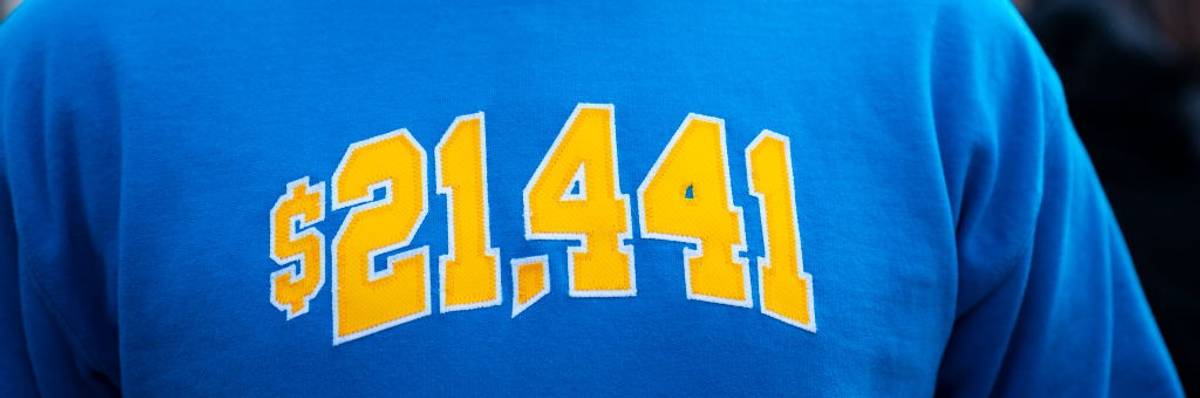
Cody Hounanian, executive director at the Student Debt Crisis Center, poses for a photo in a sweatshirt with the amount he owed in student loans to his college during a protest in support of student debt cancellation as the Supreme Court begins oral arguments outside of the Supreme Court of the United States in Washington, D.C., on Tuesday February 28, 2023.
The Win-Win-Win of Student Debt Cancellation
Everyone benefits from public health, job opportunities, and the economic growth that comes with having a well-educated population.
The Supreme Court is gearing up to weigh in on the ongoing student loan debt debate prompted by President Joe Biden’s sweeping debt cancellation plan that would help over 35 million Americans.
I spent over two decades paying off my federal student loans — and like a lot of people with educational debt, I paid $20,000 more than what I borrowed. Thankfully, because I work in public service, an earlier Biden initiative canceled over half of my debt, allowing me to reach the light at the end of the tunnel.
Everyone deserves this opportunity. But unfortunately, Republican-backed lawsuits have held back Biden’s broader loan forgiveness proposal and left it at the mercy of a conservative Supreme Court.
The whole episode is an example of the perverse economic reality America currently faces when it comes to educational debt.
Lobbyists for billionaire bankers who benefit from student loans have fueled the opposition to Biden’s plan. In effect, they’re working to keep Americans from achieving a better life for themselves and their families — all to help the already wealthy.
That’s bad enough. But they’ve also used their massive wealth to flood the airwaves with false, misleading claims that make it harder for folks to find common ground.
As a child of working-class immigrants in America, no one expected me to go to college.
While daunting, my experience as a first-generation college student opened doors for me that my parents could never have imagined when they moved here in search of better lives for their daughters. The power of education has been a catalyst for generations of people of all backgrounds and will continue to be for millions more.
But more than ever, it comes at a cost. Not just to borrowers, but to society.
The average student leaves school with about $37,500 in educational debt. Data shows student loan debt has a detrimental effect on the economy, since people with lots of debt have less to spend on consumer goods, to invest in opening or expanding a business, or to buy a house.
That debunks the notion that Biden’s student loan forgiveness plan is too costly. In reality, the long-term consequences of having so much of the population so deeply in debt could ultimately be more expensive.
The argument that student loan cancellation will inflate the national deficit is another misleading double standard. The wealthy evade $160 billion yearly in taxes and continuously benefit from tax loopholes. Billionaires pay a lower effective tax rate than most ordinary working people. Why allow all that, only to crack down on indebted young people?
Canceling educational debt has many benefits for our society. While some argue against it on the grounds of personal responsibility, they fail to recognize the advantages of a larger, more diverse group of Americans having the opportunity to pursue higher education. Everyone benefits from public health, job opportunities, and the economic growth that comes with having a well-educated population.
That’s why the majority of Americans support Biden’s student loan forgiveness proposal.
Every American should have access to higher education, which our current system simply prevents. Having a system where some people can afford college and others can’t perpetuates inequality and undermines the principle of equal opportunity that forms the bedrock of the American dream.
We are at a crossroads
This country and this world are at a monumental crossroads. In a few short weeks, US voters will have an opportunity to beat back the forces of fascism and confront the billionaires who are rigging the economy, our media system, and our democracy, making it increasingly impossible for ordinary people to get by. We’re not just talking about the election. We’re talking about what must be done once these fascist elements are vanquished from power. We need a bolder set of solutions than what either major party has so far been willing to offer and a working-class movement ready to fight like hell for it. Trump didn't emerge from nowhere. The conditions that fueled MAGA authoritarianism were created by decades of radical neoliberal economic policies and a corrupt political system dominated by corporate interests. They slashed taxes on the super-rich, promising that the benefits would trickle down. They said giveaways to the corporate titans would make life more affordable for the rest of us. It was all bullshit. And when a bitter, betrayed populace searches for someone to blame, right-wing demagogues have little trouble finding scapegoats. People know when they're being lied to, but you won't hear any of this from the corporate media. Only independent journalism—powered and funded by people who believe in building a better world—can deliver truly trustworthy daily news. Our Fall Campaign is underway, and we need your help. To power our newsroom through the rest of the year, we need to raise $125,000 by midnight on October 31. So if you share our vision, please contribute whatever you can to sustain our work. |
The Supreme Court is gearing up to weigh in on the ongoing student loan debt debate prompted by President Joe Biden’s sweeping debt cancellation plan that would help over 35 million Americans.
I spent over two decades paying off my federal student loans — and like a lot of people with educational debt, I paid $20,000 more than what I borrowed. Thankfully, because I work in public service, an earlier Biden initiative canceled over half of my debt, allowing me to reach the light at the end of the tunnel.
Everyone deserves this opportunity. But unfortunately, Republican-backed lawsuits have held back Biden’s broader loan forgiveness proposal and left it at the mercy of a conservative Supreme Court.
The whole episode is an example of the perverse economic reality America currently faces when it comes to educational debt.
Lobbyists for billionaire bankers who benefit from student loans have fueled the opposition to Biden’s plan. In effect, they’re working to keep Americans from achieving a better life for themselves and their families — all to help the already wealthy.
That’s bad enough. But they’ve also used their massive wealth to flood the airwaves with false, misleading claims that make it harder for folks to find common ground.
As a child of working-class immigrants in America, no one expected me to go to college.
While daunting, my experience as a first-generation college student opened doors for me that my parents could never have imagined when they moved here in search of better lives for their daughters. The power of education has been a catalyst for generations of people of all backgrounds and will continue to be for millions more.
But more than ever, it comes at a cost. Not just to borrowers, but to society.
The average student leaves school with about $37,500 in educational debt. Data shows student loan debt has a detrimental effect on the economy, since people with lots of debt have less to spend on consumer goods, to invest in opening or expanding a business, or to buy a house.
That debunks the notion that Biden’s student loan forgiveness plan is too costly. In reality, the long-term consequences of having so much of the population so deeply in debt could ultimately be more expensive.
The argument that student loan cancellation will inflate the national deficit is another misleading double standard. The wealthy evade $160 billion yearly in taxes and continuously benefit from tax loopholes. Billionaires pay a lower effective tax rate than most ordinary working people. Why allow all that, only to crack down on indebted young people?
Canceling educational debt has many benefits for our society. While some argue against it on the grounds of personal responsibility, they fail to recognize the advantages of a larger, more diverse group of Americans having the opportunity to pursue higher education. Everyone benefits from public health, job opportunities, and the economic growth that comes with having a well-educated population.
That’s why the majority of Americans support Biden’s student loan forgiveness proposal.
Every American should have access to higher education, which our current system simply prevents. Having a system where some people can afford college and others can’t perpetuates inequality and undermines the principle of equal opportunity that forms the bedrock of the American dream.
- 'Cancel It All,' Say Progressives as Biden Favors $10,000 in Means-Tested Student Debt Relief ›
- Benefits of Biden's Student Debt Plan Don't Stop at $10K Cancellation ›