SUBSCRIBE TO OUR FREE NEWSLETTER
Daily news & progressive opinion—funded by the people, not the corporations—delivered straight to your inbox.
5
#000000
#FFFFFF
To donate by check, phone, or other method, see our More Ways to Give page.
Daily news & progressive opinion—funded by the people, not the corporations—delivered straight to your inbox.
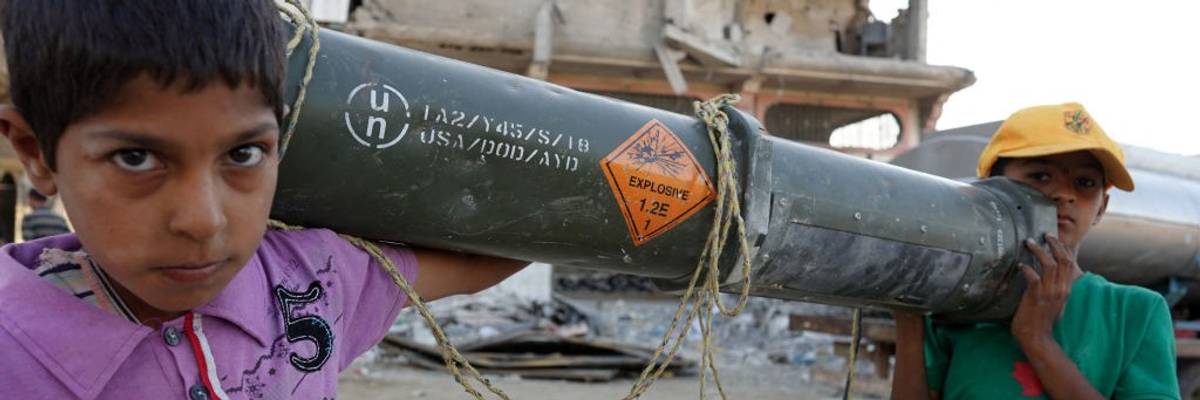
Palestinian children carry an empty US ammunition container in Khan Yunis in the southern Gaza Strip on May 16, 2024, amid the ongoing conflict between Israel and the militant group Hamas.
The more companies and countries become dependent on the profits of war, the harder it will be to shift funding towards other urgent priorities.
Revenues at the world’s top 100 global arms and military services producing companies totaled $632 billion in 2023, a 4.2% increase over the prior year, according to new data released by the Stockholm International Peace Research Institute (SIPRI).
The largest increases were tied to ongoing conflicts, including a 40% increase in revenues for Russian companies involved in supplying Moscow’s war on Ukraine and record sales for Israeli firms producing weapons used in that nation’s brutal war on Gaza. Revenues for Turkey’s top arms producing companies also rose sharply — by 24% — on the strength of increased domestic defense spending plus exports tied to the war in Ukraine.
The United States remains the world’s dominant arms producing nation, with $318 billion in revenues flowing to American firms in the world’s top 100 for 2023, more than half of the global total. And the five highest revenue earners globally were all based in the United States — Lockheed Martin, Raytheon (now RTX), Northrop Grumman, Boeing, and General Dynamics.
The United States remains the world’s dominant arms producing nation, with $318 billion in revenues flowing to American firms in the world’s top 100 for 2023, more than half of the global total.
China ranked second to the United States in arms industry revenues, with nine firms accounting for 16% of the revenue received by companies in the global top 100. Two of the fastest growing countries in terms of revenue growth for top companies were also in Asia, South Korea (plus 39%) and Japan (plus 35%). South Korea’s increase was tied to major export deals with Poland and Australia, while Japan’s was driven by its largest military buildup since World War II.
SIPRI’s analysis takes a “just the facts” approach, tracking sales numbers and correlating them with increases in domestic and export spending tied to specific events. It does not address the dire humanitarian circumstances that underlie the growing revenues of top arms companies, most notably Israel’s unconscionable attacks on Gaza, which have killed over 44,000 people directly and many more through indirect causes, including over 62,000 who have died from starvation. The companies and countries fueling this mass slaughter — including U.S. firms that have supplied a substantial share of the bombs, missiles, and aircraft used in Gaza — should be held to account for their actions, even as they halt the supply of weapons and services that the Israeli government is using to commit ongoing war crimes.
Another major impact of the revenue surge for top arms makers is the diversion of funding and talent from addressing urgent global problems, from climate change to poverty to outbreaks of disease. And the more companies and countries become dependent on the profits of war, the harder it will be to shift funding towards other urgent priorities. The continuing militarization of the global economy has a double cost — lives lost in conflict and devastating problems left unsolved. The situation needs to be treated as far more than a grim parade of statistics about who benefits from a world at war. It should be treated as an urgent call to action for a change in global priorities.
Dear Common Dreams reader, It’s been nearly 30 years since I co-founded Common Dreams with my late wife, Lina Newhouser. We had the radical notion that journalism should serve the public good, not corporate profits. It was clear to us from the outset what it would take to build such a project. No paid advertisements. No corporate sponsors. No millionaire publisher telling us what to think or do. Many people said we wouldn't last a year, but we proved those doubters wrong. Together with a tremendous team of journalists and dedicated staff, we built an independent media outlet free from the constraints of profits and corporate control. Our mission has always been simple: To inform. To inspire. To ignite change for the common good. Building Common Dreams was not easy. Our survival was never guaranteed. When you take on the most powerful forces—Wall Street greed, fossil fuel industry destruction, Big Tech lobbyists, and uber-rich oligarchs who have spent billions upon billions rigging the economy and democracy in their favor—the only bulwark you have is supporters who believe in your work. But here’s the urgent message from me today. It's never been this bad out there. And it's never been this hard to keep us going. At the very moment Common Dreams is most needed, the threats we face are intensifying. We need your support now more than ever. We don't accept corporate advertising and never will. We don't have a paywall because we don't think people should be blocked from critical news based on their ability to pay. Everything we do is funded by the donations of readers like you. When everyone does the little they can afford, we are strong. But if that support retreats or dries up, so do we. Will you donate now to make sure Common Dreams not only survives but thrives? —Craig Brown, Co-founder |
Revenues at the world’s top 100 global arms and military services producing companies totaled $632 billion in 2023, a 4.2% increase over the prior year, according to new data released by the Stockholm International Peace Research Institute (SIPRI).
The largest increases were tied to ongoing conflicts, including a 40% increase in revenues for Russian companies involved in supplying Moscow’s war on Ukraine and record sales for Israeli firms producing weapons used in that nation’s brutal war on Gaza. Revenues for Turkey’s top arms producing companies also rose sharply — by 24% — on the strength of increased domestic defense spending plus exports tied to the war in Ukraine.
The United States remains the world’s dominant arms producing nation, with $318 billion in revenues flowing to American firms in the world’s top 100 for 2023, more than half of the global total. And the five highest revenue earners globally were all based in the United States — Lockheed Martin, Raytheon (now RTX), Northrop Grumman, Boeing, and General Dynamics.
The United States remains the world’s dominant arms producing nation, with $318 billion in revenues flowing to American firms in the world’s top 100 for 2023, more than half of the global total.
China ranked second to the United States in arms industry revenues, with nine firms accounting for 16% of the revenue received by companies in the global top 100. Two of the fastest growing countries in terms of revenue growth for top companies were also in Asia, South Korea (plus 39%) and Japan (plus 35%). South Korea’s increase was tied to major export deals with Poland and Australia, while Japan’s was driven by its largest military buildup since World War II.
SIPRI’s analysis takes a “just the facts” approach, tracking sales numbers and correlating them with increases in domestic and export spending tied to specific events. It does not address the dire humanitarian circumstances that underlie the growing revenues of top arms companies, most notably Israel’s unconscionable attacks on Gaza, which have killed over 44,000 people directly and many more through indirect causes, including over 62,000 who have died from starvation. The companies and countries fueling this mass slaughter — including U.S. firms that have supplied a substantial share of the bombs, missiles, and aircraft used in Gaza — should be held to account for their actions, even as they halt the supply of weapons and services that the Israeli government is using to commit ongoing war crimes.
Another major impact of the revenue surge for top arms makers is the diversion of funding and talent from addressing urgent global problems, from climate change to poverty to outbreaks of disease. And the more companies and countries become dependent on the profits of war, the harder it will be to shift funding towards other urgent priorities. The continuing militarization of the global economy has a double cost — lives lost in conflict and devastating problems left unsolved. The situation needs to be treated as far more than a grim parade of statistics about who benefits from a world at war. It should be treated as an urgent call to action for a change in global priorities.
Revenues at the world’s top 100 global arms and military services producing companies totaled $632 billion in 2023, a 4.2% increase over the prior year, according to new data released by the Stockholm International Peace Research Institute (SIPRI).
The largest increases were tied to ongoing conflicts, including a 40% increase in revenues for Russian companies involved in supplying Moscow’s war on Ukraine and record sales for Israeli firms producing weapons used in that nation’s brutal war on Gaza. Revenues for Turkey’s top arms producing companies also rose sharply — by 24% — on the strength of increased domestic defense spending plus exports tied to the war in Ukraine.
The United States remains the world’s dominant arms producing nation, with $318 billion in revenues flowing to American firms in the world’s top 100 for 2023, more than half of the global total. And the five highest revenue earners globally were all based in the United States — Lockheed Martin, Raytheon (now RTX), Northrop Grumman, Boeing, and General Dynamics.
The United States remains the world’s dominant arms producing nation, with $318 billion in revenues flowing to American firms in the world’s top 100 for 2023, more than half of the global total.
China ranked second to the United States in arms industry revenues, with nine firms accounting for 16% of the revenue received by companies in the global top 100. Two of the fastest growing countries in terms of revenue growth for top companies were also in Asia, South Korea (plus 39%) and Japan (plus 35%). South Korea’s increase was tied to major export deals with Poland and Australia, while Japan’s was driven by its largest military buildup since World War II.
SIPRI’s analysis takes a “just the facts” approach, tracking sales numbers and correlating them with increases in domestic and export spending tied to specific events. It does not address the dire humanitarian circumstances that underlie the growing revenues of top arms companies, most notably Israel’s unconscionable attacks on Gaza, which have killed over 44,000 people directly and many more through indirect causes, including over 62,000 who have died from starvation. The companies and countries fueling this mass slaughter — including U.S. firms that have supplied a substantial share of the bombs, missiles, and aircraft used in Gaza — should be held to account for their actions, even as they halt the supply of weapons and services that the Israeli government is using to commit ongoing war crimes.
Another major impact of the revenue surge for top arms makers is the diversion of funding and talent from addressing urgent global problems, from climate change to poverty to outbreaks of disease. And the more companies and countries become dependent on the profits of war, the harder it will be to shift funding towards other urgent priorities. The continuing militarization of the global economy has a double cost — lives lost in conflict and devastating problems left unsolved. The situation needs to be treated as far more than a grim parade of statistics about who benefits from a world at war. It should be treated as an urgent call to action for a change in global priorities.