
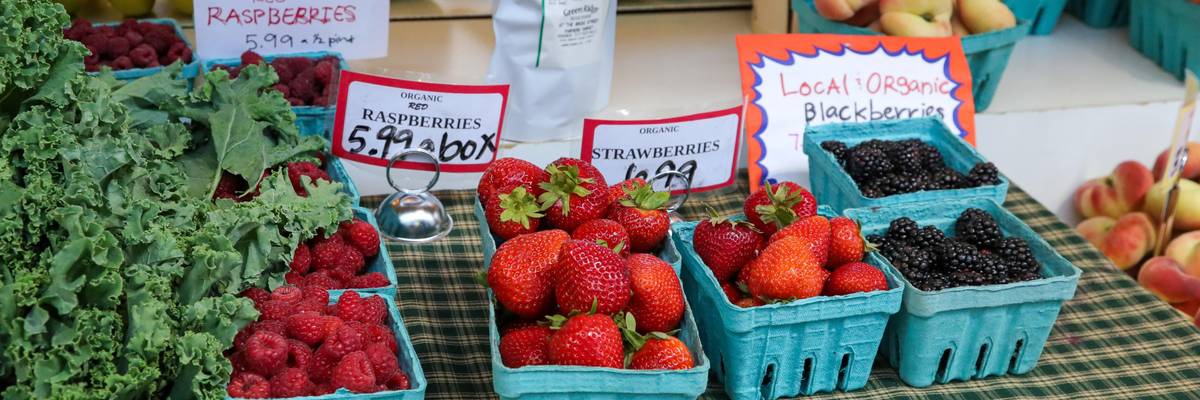
Organic berries are displayed for sale at the Broad Street Market in Harrisburg, Pennsylvania on August 5, 2022. (Photo by Paul Weaver/SOPA Images/LightRocket via Getty Images)
'Huge Win for Organic Farmers' as USDA Files Long-Sought Rule to Prevent Fraud
One advocate said the rule change "will help tighten the national organic system to ensure organic integrity and better protect American organic farmers and confidence in the organic seal."
Organic farming advocates on Wednesday cheered the United States Department of Agriculture's publication of new regulations aimed at stamping out "organic fraud" in supply chains.
The Strengthening Organic Enforcement (SOE) amendments to the USDA's National Organic Program (NOP)—a federal regulatory program that enforces national standards for organically produced agricultural products—is meant to "strengthen oversight and enforcement of the production, handling, and sale of organic agricultural products" in the United States, according to a federal memo published Wednesday.
"Organic farmers have consistently ranked National Organic Program enforcement and stopping import fraud as a top priority," Kate Mendenhall, executive director of the Organic Farmers Association and an Iowa organic farmer, said in a statement. "U.S. organic farmers and consumers will both benefit from a quick and strong implementation of the SOE rule. We are glad to see it published before the beginning of writing the next farm bill. This is a huge win for organic farmers."
USDA says the new regulations—which will take effect on March 20 and be fully implemented within a year—"protect integrity in the organic supply chain and build consumer and industry trust in the USDA organic label by strengthening organic control systems, improving farm-to-market traceability, and providing robust enforcement of the USDA organic regulations."
The agency continued:
Topics addressed in this rulemaking include: applicability of the regulations and exemptions from organic certification; National Organic Program Import Certificates; recordkeeping and product traceability; certifying agent personnel qualifications and training; standardized certificates of organic operation; unannounced on-site inspections of certified operations; oversight of certification activities; foreign conformity assessment systems; certification of producer group operations; labeling of nonretail containers; annual update requirements for certified operations; compliance and appeals processes; and calculating organic content of multi-ingredient products.
"Protecting and growing the organic sector and the trusted USDA organic seal is a key part of the USDA Food Systems Transformation initiative," USDA Undersecretary for Marketing and Regulatory Programs Jenny Lester Moffitt said in a statement.
"The Strengthening Organic Enforcement rule is the biggest update to the organic regulations since the original act in 1990, providing a significant increase in oversight and enforcement authority to reinforce the trust of consumers, farmers, and those transitioning to organic production," she added. "This success is another demonstration that USDA fully stands behind the organic brand."
Oren Holle, president of Organic Farmers' Agency for Relationship Marketing, Inc. (OFARM), said that "U.S. organic farmers have desperately needed stronger NOP enforcement on fraud."
"It is encouraging to see that a number of elements that organic grain producer members of OFARM wanted to see included have become a part of the final rule," the Kansas farmer added. "The SOE rule will help tighten the national organic system to ensure organic integrity and better protect American organic farmers and confidence in the organic seal."
We are at a crossroads
This country and this world are at a monumental crossroads. In a few short weeks, US voters will have an opportunity to beat back the forces of fascism and confront the billionaires who are rigging the economy, our media system, and our democracy, making it increasingly impossible for ordinary people to get by. We’re not just talking about the election. We’re talking about what must be done once these fascist elements are vanquished from power. We need a bolder set of solutions than what either major party has so far been willing to offer and a working-class movement ready to fight like hell for it. Trump didn't emerge from nowhere. The conditions that fueled MAGA authoritarianism were created by decades of radical neoliberal economic policies and a corrupt political system dominated by corporate interests. They slashed taxes on the super-rich, promising that the benefits would trickle down. They said giveaways to the corporate titans would make life more affordable for the rest of us. It was all bullshit. And when a bitter, betrayed populace searches for someone to blame, right-wing demagogues have little trouble finding scapegoats. People know when they're being lied to, but you won't hear any of this from the corporate media. Only independent journalism—powered and funded by people who believe in building a better world—can deliver truly trustworthy daily news. Our Fall Campaign is underway, and we need your help. To power our newsroom through the rest of the year, we need to raise $125,000 by midnight on October 31. So if you share our vision, please contribute whatever you can to sustain our work. |
Organic farming advocates on Wednesday cheered the United States Department of Agriculture's publication of new regulations aimed at stamping out "organic fraud" in supply chains.
The Strengthening Organic Enforcement (SOE) amendments to the USDA's National Organic Program (NOP)—a federal regulatory program that enforces national standards for organically produced agricultural products—is meant to "strengthen oversight and enforcement of the production, handling, and sale of organic agricultural products" in the United States, according to a federal memo published Wednesday.
"Organic farmers have consistently ranked National Organic Program enforcement and stopping import fraud as a top priority," Kate Mendenhall, executive director of the Organic Farmers Association and an Iowa organic farmer, said in a statement. "U.S. organic farmers and consumers will both benefit from a quick and strong implementation of the SOE rule. We are glad to see it published before the beginning of writing the next farm bill. This is a huge win for organic farmers."
USDA says the new regulations—which will take effect on March 20 and be fully implemented within a year—"protect integrity in the organic supply chain and build consumer and industry trust in the USDA organic label by strengthening organic control systems, improving farm-to-market traceability, and providing robust enforcement of the USDA organic regulations."
The agency continued:
Topics addressed in this rulemaking include: applicability of the regulations and exemptions from organic certification; National Organic Program Import Certificates; recordkeeping and product traceability; certifying agent personnel qualifications and training; standardized certificates of organic operation; unannounced on-site inspections of certified operations; oversight of certification activities; foreign conformity assessment systems; certification of producer group operations; labeling of nonretail containers; annual update requirements for certified operations; compliance and appeals processes; and calculating organic content of multi-ingredient products.
"Protecting and growing the organic sector and the trusted USDA organic seal is a key part of the USDA Food Systems Transformation initiative," USDA Undersecretary for Marketing and Regulatory Programs Jenny Lester Moffitt said in a statement.
"The Strengthening Organic Enforcement rule is the biggest update to the organic regulations since the original act in 1990, providing a significant increase in oversight and enforcement authority to reinforce the trust of consumers, farmers, and those transitioning to organic production," she added. "This success is another demonstration that USDA fully stands behind the organic brand."
Oren Holle, president of Organic Farmers' Agency for Relationship Marketing, Inc. (OFARM), said that "U.S. organic farmers have desperately needed stronger NOP enforcement on fraud."
"It is encouraging to see that a number of elements that organic grain producer members of OFARM wanted to see included have become a part of the final rule," the Kansas farmer added. "The SOE rule will help tighten the national organic system to ensure organic integrity and better protect American organic farmers and confidence in the organic seal."
Organic farming advocates on Wednesday cheered the United States Department of Agriculture's publication of new regulations aimed at stamping out "organic fraud" in supply chains.
The Strengthening Organic Enforcement (SOE) amendments to the USDA's National Organic Program (NOP)—a federal regulatory program that enforces national standards for organically produced agricultural products—is meant to "strengthen oversight and enforcement of the production, handling, and sale of organic agricultural products" in the United States, according to a federal memo published Wednesday.
"Organic farmers have consistently ranked National Organic Program enforcement and stopping import fraud as a top priority," Kate Mendenhall, executive director of the Organic Farmers Association and an Iowa organic farmer, said in a statement. "U.S. organic farmers and consumers will both benefit from a quick and strong implementation of the SOE rule. We are glad to see it published before the beginning of writing the next farm bill. This is a huge win for organic farmers."
USDA says the new regulations—which will take effect on March 20 and be fully implemented within a year—"protect integrity in the organic supply chain and build consumer and industry trust in the USDA organic label by strengthening organic control systems, improving farm-to-market traceability, and providing robust enforcement of the USDA organic regulations."
The agency continued:
Topics addressed in this rulemaking include: applicability of the regulations and exemptions from organic certification; National Organic Program Import Certificates; recordkeeping and product traceability; certifying agent personnel qualifications and training; standardized certificates of organic operation; unannounced on-site inspections of certified operations; oversight of certification activities; foreign conformity assessment systems; certification of producer group operations; labeling of nonretail containers; annual update requirements for certified operations; compliance and appeals processes; and calculating organic content of multi-ingredient products.
"Protecting and growing the organic sector and the trusted USDA organic seal is a key part of the USDA Food Systems Transformation initiative," USDA Undersecretary for Marketing and Regulatory Programs Jenny Lester Moffitt said in a statement.
"The Strengthening Organic Enforcement rule is the biggest update to the organic regulations since the original act in 1990, providing a significant increase in oversight and enforcement authority to reinforce the trust of consumers, farmers, and those transitioning to organic production," she added. "This success is another demonstration that USDA fully stands behind the organic brand."
Oren Holle, president of Organic Farmers' Agency for Relationship Marketing, Inc. (OFARM), said that "U.S. organic farmers have desperately needed stronger NOP enforcement on fraud."
"It is encouraging to see that a number of elements that organic grain producer members of OFARM wanted to see included have become a part of the final rule," the Kansas farmer added. "The SOE rule will help tighten the national organic system to ensure organic integrity and better protect American organic farmers and confidence in the organic seal."