SUBSCRIBE TO OUR FREE NEWSLETTER
Daily news & progressive opinion—funded by the people, not the corporations—delivered straight to your inbox.
5
#000000
#FFFFFF
To donate by check, phone, or other method, see our More Ways to Give page.
Daily news & progressive opinion—funded by the people, not the corporations—delivered straight to your inbox.
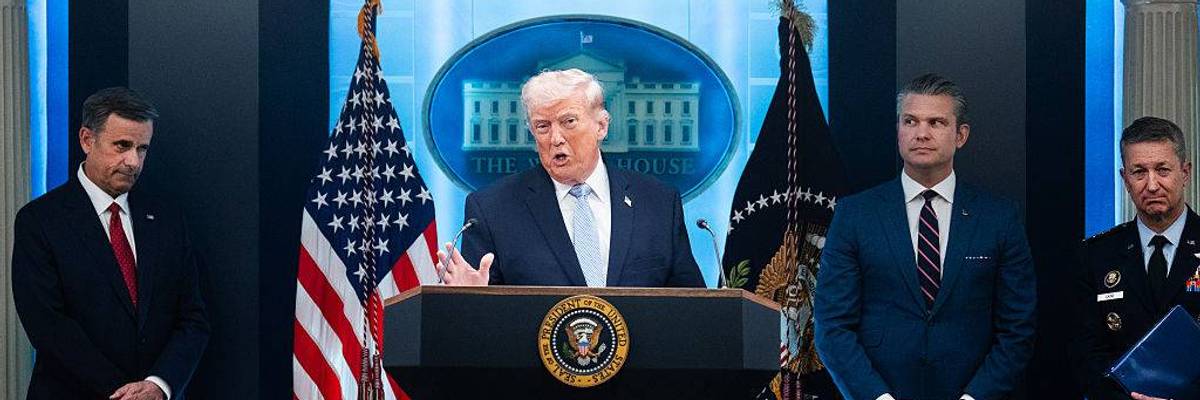
President Donald Trump conducts a news conference in Washington, DC on Monday, April 6, 2026.
Trump has shown he "is utterly helpless to fix the disaster he personally caused," and is now "trying to blame others for his own incompetence," said one critic.
Hours after President Donald Trump pitched an angry tantrum at US allies, he reportedly demanded that they draw up plans to help fix the geopolitical and economic disaster he caused by launching his illegal war with Iran.
In a Wednesday night social media post, Trump posted an all-caps tirade against members of the North Atlantic Treaty Organization (NATO) who refused to commit forces to fight in a war he started without their approval or even consultation.
"NATO WASN’T THERE WHEN WE NEEDED THEM, AND THEY WON’T BE THERE IF WE NEED THEM AGAIN," Trump wrote. "REMEMBER GREENLAND, THAT BIG, POORLY RUN, PIECE OF ICE!!!"
As Trump was attacking longtime allies, he was simultaneously demanding their help.
According to a Thursday report from Bloomberg, the US has been seeking "specific commitments from European allies on their pledge to help secure the Strait of Hormuz after the fighting in Iran stops," going so far as to request that they "present concrete plans to ensure navigation through the waterway within days."
Trump last month tried strong-arming allies into sending their navies into the strait to help secure safe passage of commercial vessels, but all of them refused.
Even as Trump is berating allies, he still hasn't achieved the primary goal of the ceasefire he announced on Tuesday: The reopening of the Strait of Hormuz, which Iran has kept shut down since the start of the war more than a month ago.
As Bloomberg reported on Thursday, ship traffic through the strait has "remained blocked," being "limited to a handful of Iran-linked ships, another sign that a fragile ceasefire between the US and Iran has yet to improve flows through the world’s key energy chokepoint."
As the strait has remained shut, the price of Brent crude petroleum futures, which initially crashed upon news of the ceasefire deal, have been slowly climbing back up to the $100 mark.
Given Trump's failure to achieve even the most basic tenet of his own ceasefire deal, many critics questioned why US allies should commit to helping him clean up his own disaster.
Dominic Waghorn, international affairs editor at Sky News, noted that "neither a military escort nor military force can reopen the Strait short of a full scale occupation of southern Iran and even then insurgents could keep it closed with the threat of action."
Journalist Marcy Wheeler observed that Trump's demands show he "is utterly helpless to fix the disaster he personally caused," and is now "trying to blame others for his own incompetence."
Economist Dean Baker encouraged US allies to remain completely defiant of the president.
"The European countries should specifically commit to pay the toll Iran is requesting," Baker wrote.
HuffPost White House correspondent SV Dáte summarized Trump's geopolitical strategy as follows: "I broke it, someone else can fix it."
Dear Common Dreams reader, It’s been nearly 30 years since I co-founded Common Dreams with my late wife, Lina Newhouser. We had the radical notion that journalism should serve the public good, not corporate profits. It was clear to us from the outset what it would take to build such a project. No paid advertisements. No corporate sponsors. No millionaire publisher telling us what to think or do. Many people said we wouldn't last a year, but we proved those doubters wrong. Together with a tremendous team of journalists and dedicated staff, we built an independent media outlet free from the constraints of profits and corporate control. Our mission has always been simple: To inform. To inspire. To ignite change for the common good. Building Common Dreams was not easy. Our survival was never guaranteed. When you take on the most powerful forces—Wall Street greed, fossil fuel industry destruction, Big Tech lobbyists, and uber-rich oligarchs who have spent billions upon billions rigging the economy and democracy in their favor—the only bulwark you have is supporters who believe in your work. But here’s the urgent message from me today. It's never been this bad out there. And it's never been this hard to keep us going. At the very moment Common Dreams is most needed, the threats we face are intensifying. We need your support now more than ever. We don't accept corporate advertising and never will. We don't have a paywall because we don't think people should be blocked from critical news based on their ability to pay. Everything we do is funded by the donations of readers like you. When everyone does the little they can afford, we are strong. But if that support retreats or dries up, so do we. Will you donate now to make sure Common Dreams not only survives but thrives? —Craig Brown, Co-founder |
Hours after President Donald Trump pitched an angry tantrum at US allies, he reportedly demanded that they draw up plans to help fix the geopolitical and economic disaster he caused by launching his illegal war with Iran.
In a Wednesday night social media post, Trump posted an all-caps tirade against members of the North Atlantic Treaty Organization (NATO) who refused to commit forces to fight in a war he started without their approval or even consultation.
"NATO WASN’T THERE WHEN WE NEEDED THEM, AND THEY WON’T BE THERE IF WE NEED THEM AGAIN," Trump wrote. "REMEMBER GREENLAND, THAT BIG, POORLY RUN, PIECE OF ICE!!!"
As Trump was attacking longtime allies, he was simultaneously demanding their help.
According to a Thursday report from Bloomberg, the US has been seeking "specific commitments from European allies on their pledge to help secure the Strait of Hormuz after the fighting in Iran stops," going so far as to request that they "present concrete plans to ensure navigation through the waterway within days."
Trump last month tried strong-arming allies into sending their navies into the strait to help secure safe passage of commercial vessels, but all of them refused.
Even as Trump is berating allies, he still hasn't achieved the primary goal of the ceasefire he announced on Tuesday: The reopening of the Strait of Hormuz, which Iran has kept shut down since the start of the war more than a month ago.
As Bloomberg reported on Thursday, ship traffic through the strait has "remained blocked," being "limited to a handful of Iran-linked ships, another sign that a fragile ceasefire between the US and Iran has yet to improve flows through the world’s key energy chokepoint."
As the strait has remained shut, the price of Brent crude petroleum futures, which initially crashed upon news of the ceasefire deal, have been slowly climbing back up to the $100 mark.
Given Trump's failure to achieve even the most basic tenet of his own ceasefire deal, many critics questioned why US allies should commit to helping him clean up his own disaster.
Dominic Waghorn, international affairs editor at Sky News, noted that "neither a military escort nor military force can reopen the Strait short of a full scale occupation of southern Iran and even then insurgents could keep it closed with the threat of action."
Journalist Marcy Wheeler observed that Trump's demands show he "is utterly helpless to fix the disaster he personally caused," and is now "trying to blame others for his own incompetence."
Economist Dean Baker encouraged US allies to remain completely defiant of the president.
"The European countries should specifically commit to pay the toll Iran is requesting," Baker wrote.
HuffPost White House correspondent SV Dáte summarized Trump's geopolitical strategy as follows: "I broke it, someone else can fix it."
Hours after President Donald Trump pitched an angry tantrum at US allies, he reportedly demanded that they draw up plans to help fix the geopolitical and economic disaster he caused by launching his illegal war with Iran.
In a Wednesday night social media post, Trump posted an all-caps tirade against members of the North Atlantic Treaty Organization (NATO) who refused to commit forces to fight in a war he started without their approval or even consultation.
"NATO WASN’T THERE WHEN WE NEEDED THEM, AND THEY WON’T BE THERE IF WE NEED THEM AGAIN," Trump wrote. "REMEMBER GREENLAND, THAT BIG, POORLY RUN, PIECE OF ICE!!!"
As Trump was attacking longtime allies, he was simultaneously demanding their help.
According to a Thursday report from Bloomberg, the US has been seeking "specific commitments from European allies on their pledge to help secure the Strait of Hormuz after the fighting in Iran stops," going so far as to request that they "present concrete plans to ensure navigation through the waterway within days."
Trump last month tried strong-arming allies into sending their navies into the strait to help secure safe passage of commercial vessels, but all of them refused.
Even as Trump is berating allies, he still hasn't achieved the primary goal of the ceasefire he announced on Tuesday: The reopening of the Strait of Hormuz, which Iran has kept shut down since the start of the war more than a month ago.
As Bloomberg reported on Thursday, ship traffic through the strait has "remained blocked," being "limited to a handful of Iran-linked ships, another sign that a fragile ceasefire between the US and Iran has yet to improve flows through the world’s key energy chokepoint."
As the strait has remained shut, the price of Brent crude petroleum futures, which initially crashed upon news of the ceasefire deal, have been slowly climbing back up to the $100 mark.
Given Trump's failure to achieve even the most basic tenet of his own ceasefire deal, many critics questioned why US allies should commit to helping him clean up his own disaster.
Dominic Waghorn, international affairs editor at Sky News, noted that "neither a military escort nor military force can reopen the Strait short of a full scale occupation of southern Iran and even then insurgents could keep it closed with the threat of action."
Journalist Marcy Wheeler observed that Trump's demands show he "is utterly helpless to fix the disaster he personally caused," and is now "trying to blame others for his own incompetence."
Economist Dean Baker encouraged US allies to remain completely defiant of the president.
"The European countries should specifically commit to pay the toll Iran is requesting," Baker wrote.
HuffPost White House correspondent SV Dáte summarized Trump's geopolitical strategy as follows: "I broke it, someone else can fix it."