SUBSCRIBE TO OUR FREE NEWSLETTER
Daily news & progressive opinion—funded by the people, not the corporations—delivered straight to your inbox.
5
#000000
#FFFFFF
To donate by check, phone, or other method, see our More Ways to Give page.
Daily news & progressive opinion—funded by the people, not the corporations—delivered straight to your inbox.
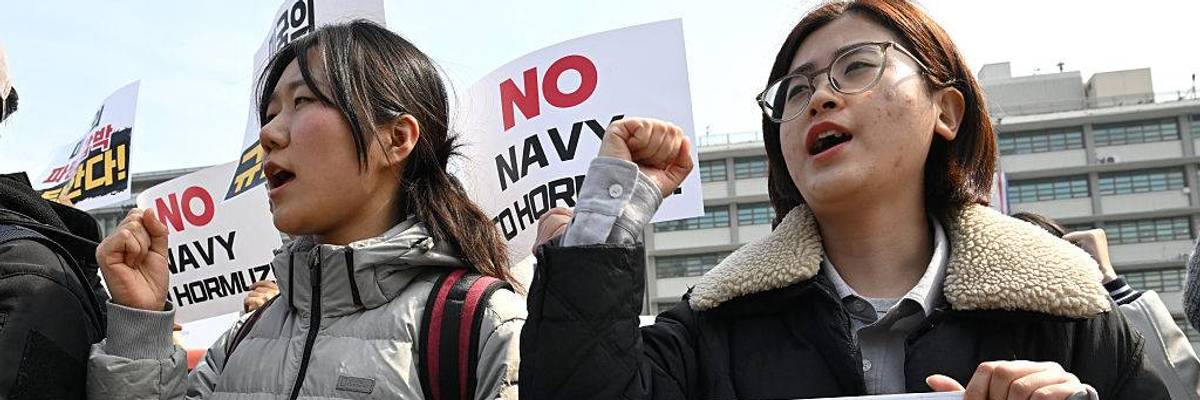
South Korean protesters hold placards during a protest against Trump's request to dispatch warships to the Strait of Hormuz in front of the US embassy in Seoul on March 16, 2026.
"What does Trump expect from a handful of European frigates that the powerful US Navy cannot do?" said one German official.
US allies are giving President Donald Trump the cold shoulder after he demanded that they send their militaries to help him reopen and secure the Strait of Hormuz, which has been shut down by the Iranian government in response to US and Israeli attacks.
Reuters chief national security correspondent Phil Stewart collected reactions from several US allies to Trump's demands in a Monday social media post, and they show little appetite for helping the president out of the jam he created when he launched an unprovoked and unconstitutional war with Iran more than two weeks ago.
German Defense Minister Boris Pistorius spoke bluntly about his country's unwillingness to get involved in what has become a regional conflict in the Middle East that has sent global energy prices soaring and is threatening to upend the global economy.
"What does Trump expect from a handful of European frigates that the powerful US Navy cannot do?" Pistorius asked. "This is not our war, we have not started it."
UK Prime Minister Keir Starmer stated flatly that his nation would not be "drawn into the wider Iran war," and insisted that only a diplomatic solution could ease the crisis.
"We are working with others to come up with a credible plan for the Strait of Hormuz to ensure that we can reopen shipping and passage through the Strait," he said. "Let me be clear, that won't be and it's never been envisioned to be a NATO mission."
Catherine King, a member of Australian Prime Minister Anthony Albanese's cabinet, said there were no plans to have the Australian military participate in Trump's efforts to reopen the strait.
"We won't be sending a ship to the Strait of Hormuz," King said. "We know how incredibly important that is, but that's not something that we've been asked or that we're contributing to."
Japanese Prime Minister Sanae Takaichi didn't completely rule out sending escort ships to help oil tankers navigate the strait, but she emphasized there are no plans to do so at the moment.
"We have not made any decisions whatsoever about dispatching escort ships," said Takaichi. "We are continuing to examine what Japan can do independently and what can be done within the legal framework."
Trump started publicly calling on US allies to assist in reopening the strait in a Saturday Truth Social post, in which he said "hopefully China, France, Japan, South Korea, the UK, and others, that are affected by this artificial constraint, will send Ships to the area so that the Hormuz Strait will no longer be a threat by a Nation that has been totally decapitated."
Trump repeated his demands to US allies while talking with reporters on Air Force One on Sunday, arguing that getting the strait reopened was in the interest of all nations.
"Really, I'm demanding that these countries come in and protect their own territory, because it is their territory," Trump said. "You could make the case that maybe we shouldn't be there at all, because we don't need it. We have a lot of oil."
Dear Common Dreams reader, It’s been nearly 30 years since I co-founded Common Dreams with my late wife, Lina Newhouser. We had the radical notion that journalism should serve the public good, not corporate profits. It was clear to us from the outset what it would take to build such a project. No paid advertisements. No corporate sponsors. No millionaire publisher telling us what to think or do. Many people said we wouldn't last a year, but we proved those doubters wrong. Together with a tremendous team of journalists and dedicated staff, we built an independent media outlet free from the constraints of profits and corporate control. Our mission has always been simple: To inform. To inspire. To ignite change for the common good. Building Common Dreams was not easy. Our survival was never guaranteed. When you take on the most powerful forces—Wall Street greed, fossil fuel industry destruction, Big Tech lobbyists, and uber-rich oligarchs who have spent billions upon billions rigging the economy and democracy in their favor—the only bulwark you have is supporters who believe in your work. But here’s the urgent message from me today. It's never been this bad out there. And it's never been this hard to keep us going. At the very moment Common Dreams is most needed, the threats we face are intensifying. We need your support now more than ever. We don't accept corporate advertising and never will. We don't have a paywall because we don't think people should be blocked from critical news based on their ability to pay. Everything we do is funded by the donations of readers like you. When everyone does the little they can afford, we are strong. But if that support retreats or dries up, so do we. Will you donate now to make sure Common Dreams not only survives but thrives? —Craig Brown, Co-founder |
US allies are giving President Donald Trump the cold shoulder after he demanded that they send their militaries to help him reopen and secure the Strait of Hormuz, which has been shut down by the Iranian government in response to US and Israeli attacks.
Reuters chief national security correspondent Phil Stewart collected reactions from several US allies to Trump's demands in a Monday social media post, and they show little appetite for helping the president out of the jam he created when he launched an unprovoked and unconstitutional war with Iran more than two weeks ago.
German Defense Minister Boris Pistorius spoke bluntly about his country's unwillingness to get involved in what has become a regional conflict in the Middle East that has sent global energy prices soaring and is threatening to upend the global economy.
"What does Trump expect from a handful of European frigates that the powerful US Navy cannot do?" Pistorius asked. "This is not our war, we have not started it."
UK Prime Minister Keir Starmer stated flatly that his nation would not be "drawn into the wider Iran war," and insisted that only a diplomatic solution could ease the crisis.
"We are working with others to come up with a credible plan for the Strait of Hormuz to ensure that we can reopen shipping and passage through the Strait," he said. "Let me be clear, that won't be and it's never been envisioned to be a NATO mission."
Catherine King, a member of Australian Prime Minister Anthony Albanese's cabinet, said there were no plans to have the Australian military participate in Trump's efforts to reopen the strait.
"We won't be sending a ship to the Strait of Hormuz," King said. "We know how incredibly important that is, but that's not something that we've been asked or that we're contributing to."
Japanese Prime Minister Sanae Takaichi didn't completely rule out sending escort ships to help oil tankers navigate the strait, but she emphasized there are no plans to do so at the moment.
"We have not made any decisions whatsoever about dispatching escort ships," said Takaichi. "We are continuing to examine what Japan can do independently and what can be done within the legal framework."
Trump started publicly calling on US allies to assist in reopening the strait in a Saturday Truth Social post, in which he said "hopefully China, France, Japan, South Korea, the UK, and others, that are affected by this artificial constraint, will send Ships to the area so that the Hormuz Strait will no longer be a threat by a Nation that has been totally decapitated."
Trump repeated his demands to US allies while talking with reporters on Air Force One on Sunday, arguing that getting the strait reopened was in the interest of all nations.
"Really, I'm demanding that these countries come in and protect their own territory, because it is their territory," Trump said. "You could make the case that maybe we shouldn't be there at all, because we don't need it. We have a lot of oil."
US allies are giving President Donald Trump the cold shoulder after he demanded that they send their militaries to help him reopen and secure the Strait of Hormuz, which has been shut down by the Iranian government in response to US and Israeli attacks.
Reuters chief national security correspondent Phil Stewart collected reactions from several US allies to Trump's demands in a Monday social media post, and they show little appetite for helping the president out of the jam he created when he launched an unprovoked and unconstitutional war with Iran more than two weeks ago.
German Defense Minister Boris Pistorius spoke bluntly about his country's unwillingness to get involved in what has become a regional conflict in the Middle East that has sent global energy prices soaring and is threatening to upend the global economy.
"What does Trump expect from a handful of European frigates that the powerful US Navy cannot do?" Pistorius asked. "This is not our war, we have not started it."
UK Prime Minister Keir Starmer stated flatly that his nation would not be "drawn into the wider Iran war," and insisted that only a diplomatic solution could ease the crisis.
"We are working with others to come up with a credible plan for the Strait of Hormuz to ensure that we can reopen shipping and passage through the Strait," he said. "Let me be clear, that won't be and it's never been envisioned to be a NATO mission."
Catherine King, a member of Australian Prime Minister Anthony Albanese's cabinet, said there were no plans to have the Australian military participate in Trump's efforts to reopen the strait.
"We won't be sending a ship to the Strait of Hormuz," King said. "We know how incredibly important that is, but that's not something that we've been asked or that we're contributing to."
Japanese Prime Minister Sanae Takaichi didn't completely rule out sending escort ships to help oil tankers navigate the strait, but she emphasized there are no plans to do so at the moment.
"We have not made any decisions whatsoever about dispatching escort ships," said Takaichi. "We are continuing to examine what Japan can do independently and what can be done within the legal framework."
Trump started publicly calling on US allies to assist in reopening the strait in a Saturday Truth Social post, in which he said "hopefully China, France, Japan, South Korea, the UK, and others, that are affected by this artificial constraint, will send Ships to the area so that the Hormuz Strait will no longer be a threat by a Nation that has been totally decapitated."
Trump repeated his demands to US allies while talking with reporters on Air Force One on Sunday, arguing that getting the strait reopened was in the interest of all nations.
"Really, I'm demanding that these countries come in and protect their own territory, because it is their territory," Trump said. "You could make the case that maybe we shouldn't be there at all, because we don't need it. We have a lot of oil."