5
#000000
#FFFFFF
To donate by check, phone, or other method, see our More Ways to Give page.
Daily news & progressive opinion—funded by the people, not the corporations—delivered straight to your inbox.
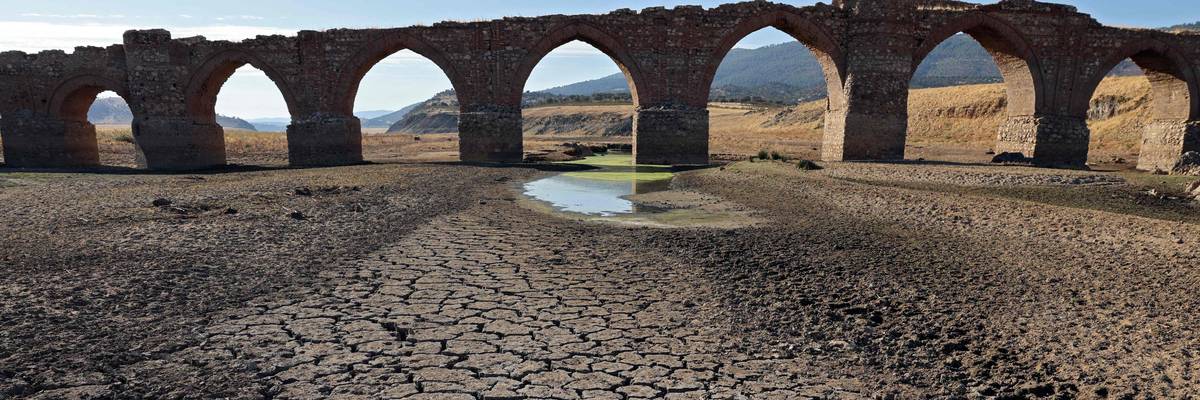
Part of the Guadiana river has dried up and gives way to dry land under the Puente de la Mesta medieval bridge in Villarta de los Montes, in the central-western Spanish region of Extremadura, on August 16, 2022.
Surviving these times requires more than just consuming information or reacting to every crisis. It requires building the discipline to focus.
There’s a question that has become almost unavoidable in movement spaces over the last several years: “What is giving you hope right now?
Usually, the question is asked with good intentions—a way to remind people of their why in the middle of authoritarianism rising, civil rights rolling back, endless surveillance, and the noise of it all.
I often asked myself, “What is giving me hope?” because people I deeply respect pushed many of us to think seriously about hope, radical imagination, and our responsibility to believe that another world is possible. And I still deeply believe in the importance of those things.
My father once told me that the thing that kept him focused while incarcerated for 24 years was the hope and vision that one day he would be reconnected to me. I’ve watched my mother make miracles happen and find ways to provide because of the hope and vision she had for me to have a better life than she did.
I’ve realized that long-term discipline requires a certain level of alignment through rest, quiet, and reassessing our personal intersections of passion, curiosity, capacity, skill, and impact.
But I’ve also found myself becoming a little irritated by the question, even wondering whether the way many of us talk about hope in the first world can become disconnected from the actual conditions so much of humanity has endured throughout history. The more I learn, the more I realize that so many people continue struggling under conditions far worse than what many of us can imagine, and yet they still endure and fight.
Just this week, I was reading I’ve Got the Light of Freedom, which focuses on the organizing traditions of the Mississippi Freedom Struggle. In one section, a young organizer from the 1960s explains that every single time he got up to organize Black people in the South, he had to seriously consider the possibility that he could be stabbed, beaten by white mobs, or lynched.
And yet, they organized anyway.
I think about Palestinians enduring genocide and starvation and still fighting. I think about political prisoners who have effectively been abandoned by much of the public and are still fighting.
At some point, I started realizing that hope alone isn’t what’s carrying people through history. Or at least not entirely. Sometimes people continue struggling because they believe they can win. Sometimes they continue because they feel a responsibility to the people around them. Sometimes they fight simply because their independence and ability to live self-determined lives are worth dying for. I still struggle with these things, and my thinking is constantly adapting. Still, I now spend a lot of my time thinking about discipline, focus, and endurance, especially in this political moment.
I have dealt with actual motion sickness since childhood. But I think many of us are dealing with social and political motion sickness right now. We are trying to simultaneously process global crises, local crises, personal crises, historical crises—you name it. Eventually, your nervous system starts collapsing under the weight of it all
What keeps me grounded is not trying to respond to everything, but instead trying my best to stay focused. Paying attention to what is actually within my control. Committing deeply to a set of responsibilities instead of scattering my energy across a thousand directions and not doing anything well.
And for me, that focus has required that I ask difficult questions about where I actually have the capacity to contribute in meaningful ways, and also if my contribution is actually building toward something constructive. I’ve realized that long-term discipline requires a certain level of alignment through rest, quiet, and reassessing our personal intersections of passion, curiosity, capacity, skill, and impact. Otherwise, over time, it becomes much harder to remain grounded, focused, and useful to the people around you.
Without moments of stillness, it becomes difficult to hear yourself clearly enough to know what you actually think, feel, or believe beneath all the noise. Enough space to actually feel what is happening in your body. And creating a little space to process those questions you have been avoiding.
I’m finding that those moments of quiet are helping me see the world, and myself, more clearly.
Part of what prompted me to write this is that I often get asked some version of the same question: “How do you hold all of this?” The work. The reading. The organizing. Being an executive director, being present for family and my daughter, and trying to stay informed about everything happening in the world. And honestly, I’ve been trying to struggle through that question myself. The truth is, there is no perfect answer, and I get it wrong all the damn time.
Building the capacity to endure is a process, like anything else. Part of the reason I’m able to hold the level of responsibility that I currently do is because of conditioning. That foundation was built years ago as a collegiate athlete, structured around 5:00 am workouts, study sessions, classes, two-a-day practices, late nights, and early mornings. It was an environment that forced me to learn how to push through discomfort, organize my time, and function while exhausted.
Today, that same discipline and structure have simply been redirected toward movement work, political education, writing, relationships, and community. But the capacity itself wasn’t built in a year; it required nearly two decades of routine, failure, and adjustment.
I don’t have all the answers, but I do think I’m slowly learning that surviving these times requires more than just consuming information or reacting to every crisis. It requires building the discipline to focus, the patience to grow over time, and the willingness to create enough silence in your life so you can hear yourself think again.
Dear Common Dreams reader, It’s been nearly 30 years since I co-founded Common Dreams with my late wife, Lina Newhouser. We had the radical notion that journalism should serve the public good, not corporate profits. It was clear to us from the outset what it would take to build such a project. No paid advertisements. No corporate sponsors. No millionaire publisher telling us what to think or do. Many people said we wouldn't last a year, but we proved those doubters wrong. Together with a tremendous team of journalists and dedicated staff, we built an independent media outlet free from the constraints of profits and corporate control. Our mission has always been simple: To inform. To inspire. To ignite change for the common good. Building Common Dreams was not easy. Our survival was never guaranteed. When you take on the most powerful forces—Wall Street greed, fossil fuel industry destruction, Big Tech lobbyists, and uber-rich oligarchs who have spent billions upon billions rigging the economy and democracy in their favor—the only bulwark you have is supporters who believe in your work. But here’s the urgent message from me today. It's never been this bad out there. And it's never been this hard to keep us going. At the very moment Common Dreams is most needed, the threats we face are intensifying. We need your support now more than ever. We don't accept corporate advertising and never will. We don't have a paywall because we don't think people should be blocked from critical news based on their ability to pay. Everything we do is funded by the donations of readers like you. When everyone does the little they can afford, we are strong. But if that support retreats or dries up, so do we. Will you donate now to make sure Common Dreams not only survives but thrives? —Craig Brown, Co-founder |
There’s a question that has become almost unavoidable in movement spaces over the last several years: “What is giving you hope right now?
Usually, the question is asked with good intentions—a way to remind people of their why in the middle of authoritarianism rising, civil rights rolling back, endless surveillance, and the noise of it all.
I often asked myself, “What is giving me hope?” because people I deeply respect pushed many of us to think seriously about hope, radical imagination, and our responsibility to believe that another world is possible. And I still deeply believe in the importance of those things.
My father once told me that the thing that kept him focused while incarcerated for 24 years was the hope and vision that one day he would be reconnected to me. I’ve watched my mother make miracles happen and find ways to provide because of the hope and vision she had for me to have a better life than she did.
I’ve realized that long-term discipline requires a certain level of alignment through rest, quiet, and reassessing our personal intersections of passion, curiosity, capacity, skill, and impact.
But I’ve also found myself becoming a little irritated by the question, even wondering whether the way many of us talk about hope in the first world can become disconnected from the actual conditions so much of humanity has endured throughout history. The more I learn, the more I realize that so many people continue struggling under conditions far worse than what many of us can imagine, and yet they still endure and fight.
Just this week, I was reading I’ve Got the Light of Freedom, which focuses on the organizing traditions of the Mississippi Freedom Struggle. In one section, a young organizer from the 1960s explains that every single time he got up to organize Black people in the South, he had to seriously consider the possibility that he could be stabbed, beaten by white mobs, or lynched.
And yet, they organized anyway.
I think about Palestinians enduring genocide and starvation and still fighting. I think about political prisoners who have effectively been abandoned by much of the public and are still fighting.
At some point, I started realizing that hope alone isn’t what’s carrying people through history. Or at least not entirely. Sometimes people continue struggling because they believe they can win. Sometimes they continue because they feel a responsibility to the people around them. Sometimes they fight simply because their independence and ability to live self-determined lives are worth dying for. I still struggle with these things, and my thinking is constantly adapting. Still, I now spend a lot of my time thinking about discipline, focus, and endurance, especially in this political moment.
I have dealt with actual motion sickness since childhood. But I think many of us are dealing with social and political motion sickness right now. We are trying to simultaneously process global crises, local crises, personal crises, historical crises—you name it. Eventually, your nervous system starts collapsing under the weight of it all
What keeps me grounded is not trying to respond to everything, but instead trying my best to stay focused. Paying attention to what is actually within my control. Committing deeply to a set of responsibilities instead of scattering my energy across a thousand directions and not doing anything well.
And for me, that focus has required that I ask difficult questions about where I actually have the capacity to contribute in meaningful ways, and also if my contribution is actually building toward something constructive. I’ve realized that long-term discipline requires a certain level of alignment through rest, quiet, and reassessing our personal intersections of passion, curiosity, capacity, skill, and impact. Otherwise, over time, it becomes much harder to remain grounded, focused, and useful to the people around you.
Without moments of stillness, it becomes difficult to hear yourself clearly enough to know what you actually think, feel, or believe beneath all the noise. Enough space to actually feel what is happening in your body. And creating a little space to process those questions you have been avoiding.
I’m finding that those moments of quiet are helping me see the world, and myself, more clearly.
Part of what prompted me to write this is that I often get asked some version of the same question: “How do you hold all of this?” The work. The reading. The organizing. Being an executive director, being present for family and my daughter, and trying to stay informed about everything happening in the world. And honestly, I’ve been trying to struggle through that question myself. The truth is, there is no perfect answer, and I get it wrong all the damn time.
Building the capacity to endure is a process, like anything else. Part of the reason I’m able to hold the level of responsibility that I currently do is because of conditioning. That foundation was built years ago as a collegiate athlete, structured around 5:00 am workouts, study sessions, classes, two-a-day practices, late nights, and early mornings. It was an environment that forced me to learn how to push through discomfort, organize my time, and function while exhausted.
Today, that same discipline and structure have simply been redirected toward movement work, political education, writing, relationships, and community. But the capacity itself wasn’t built in a year; it required nearly two decades of routine, failure, and adjustment.
I don’t have all the answers, but I do think I’m slowly learning that surviving these times requires more than just consuming information or reacting to every crisis. It requires building the discipline to focus, the patience to grow over time, and the willingness to create enough silence in your life so you can hear yourself think again.
There’s a question that has become almost unavoidable in movement spaces over the last several years: “What is giving you hope right now?
Usually, the question is asked with good intentions—a way to remind people of their why in the middle of authoritarianism rising, civil rights rolling back, endless surveillance, and the noise of it all.
I often asked myself, “What is giving me hope?” because people I deeply respect pushed many of us to think seriously about hope, radical imagination, and our responsibility to believe that another world is possible. And I still deeply believe in the importance of those things.
My father once told me that the thing that kept him focused while incarcerated for 24 years was the hope and vision that one day he would be reconnected to me. I’ve watched my mother make miracles happen and find ways to provide because of the hope and vision she had for me to have a better life than she did.
I’ve realized that long-term discipline requires a certain level of alignment through rest, quiet, and reassessing our personal intersections of passion, curiosity, capacity, skill, and impact.
But I’ve also found myself becoming a little irritated by the question, even wondering whether the way many of us talk about hope in the first world can become disconnected from the actual conditions so much of humanity has endured throughout history. The more I learn, the more I realize that so many people continue struggling under conditions far worse than what many of us can imagine, and yet they still endure and fight.
Just this week, I was reading I’ve Got the Light of Freedom, which focuses on the organizing traditions of the Mississippi Freedom Struggle. In one section, a young organizer from the 1960s explains that every single time he got up to organize Black people in the South, he had to seriously consider the possibility that he could be stabbed, beaten by white mobs, or lynched.
And yet, they organized anyway.
I think about Palestinians enduring genocide and starvation and still fighting. I think about political prisoners who have effectively been abandoned by much of the public and are still fighting.
At some point, I started realizing that hope alone isn’t what’s carrying people through history. Or at least not entirely. Sometimes people continue struggling because they believe they can win. Sometimes they continue because they feel a responsibility to the people around them. Sometimes they fight simply because their independence and ability to live self-determined lives are worth dying for. I still struggle with these things, and my thinking is constantly adapting. Still, I now spend a lot of my time thinking about discipline, focus, and endurance, especially in this political moment.
I have dealt with actual motion sickness since childhood. But I think many of us are dealing with social and political motion sickness right now. We are trying to simultaneously process global crises, local crises, personal crises, historical crises—you name it. Eventually, your nervous system starts collapsing under the weight of it all
What keeps me grounded is not trying to respond to everything, but instead trying my best to stay focused. Paying attention to what is actually within my control. Committing deeply to a set of responsibilities instead of scattering my energy across a thousand directions and not doing anything well.
And for me, that focus has required that I ask difficult questions about where I actually have the capacity to contribute in meaningful ways, and also if my contribution is actually building toward something constructive. I’ve realized that long-term discipline requires a certain level of alignment through rest, quiet, and reassessing our personal intersections of passion, curiosity, capacity, skill, and impact. Otherwise, over time, it becomes much harder to remain grounded, focused, and useful to the people around you.
Without moments of stillness, it becomes difficult to hear yourself clearly enough to know what you actually think, feel, or believe beneath all the noise. Enough space to actually feel what is happening in your body. And creating a little space to process those questions you have been avoiding.
I’m finding that those moments of quiet are helping me see the world, and myself, more clearly.
Part of what prompted me to write this is that I often get asked some version of the same question: “How do you hold all of this?” The work. The reading. The organizing. Being an executive director, being present for family and my daughter, and trying to stay informed about everything happening in the world. And honestly, I’ve been trying to struggle through that question myself. The truth is, there is no perfect answer, and I get it wrong all the damn time.
Building the capacity to endure is a process, like anything else. Part of the reason I’m able to hold the level of responsibility that I currently do is because of conditioning. That foundation was built years ago as a collegiate athlete, structured around 5:00 am workouts, study sessions, classes, two-a-day practices, late nights, and early mornings. It was an environment that forced me to learn how to push through discomfort, organize my time, and function while exhausted.
Today, that same discipline and structure have simply been redirected toward movement work, political education, writing, relationships, and community. But the capacity itself wasn’t built in a year; it required nearly two decades of routine, failure, and adjustment.
I don’t have all the answers, but I do think I’m slowly learning that surviving these times requires more than just consuming information or reacting to every crisis. It requires building the discipline to focus, the patience to grow over time, and the willingness to create enough silence in your life so you can hear yourself think again.