SUBSCRIBE TO OUR FREE NEWSLETTER
Daily news & progressive opinion—funded by the people, not the corporations—delivered straight to your inbox.
5
#000000
#FFFFFF
To donate by check, phone, or other method, see our More Ways to Give page.
Daily news & progressive opinion—funded by the people, not the corporations—delivered straight to your inbox.
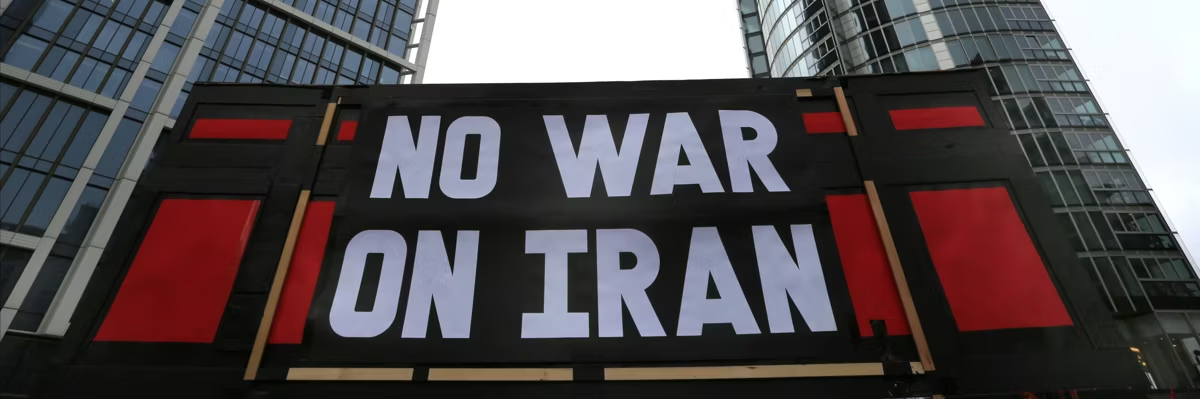
A protester holds a sign saying, "No War On Iran" during the "Stop The War" rally against the strikes on Iran on March 7, 2026 in London, England.
The US left needs a foreign policy platform that projects a positive global role for the US and can gain enough popular support to catalyze a deeper resistance to Trump 2.0 and then shape the policy of a post-MAGA government.
The US-Israeli attack on Iran put an exclamation point on the Gaza genocide. It sent a message to the world from the regimes in Washington and Tel Aviv: We will do anything that our military strength allows us to do. There are no rules or international laws we are bound to respect.
Most European governments, many regimes elsewhere, and major sections of the Democratic Party leadership offer only a few “process objections” to this level of ruthlessness but go with the flow.
This is a road to global catastrophe. Despite the fragile (and welcome) ceasefire, It is accelerating a process that was already underway where every government in the world is deciding that their overriding priority must be increasing their military strength. And that security requires cracking down on opposition movements within their own countries as well.
To halt and reverse this course, it is essential but not sufficient to build mass opposition to the war on Iran and all the other evils perpetrated by Washington, The US left also needs a foreign policy platform that projects a positive global role for the US and can gain enough popular support to catalyze a deeper resistance to Trump 2.0 and then shape the policy of a post-MAGA government.
In today’s world, there will be security for no one unless there is security for all.
That vision starts with the reality of an interconnected world where humanity’s very survival is in doubt. Viruses and the fallout from nuclear explosions know no borders. An interruption of supply chains in the Middle East threatens food security across the globe. Destruction in the Amazon Basin wreaks havoc on the climate worldwide.
In today’s world, there will be security for no one unless there is security for all. Weaving the fight for human survival together with peoples’ struggles for self-determination and against all forms of oppression, and with the fight for working class power, workers fighting for their rights, is a complex task. Yet in a world where diplomacy and inter-state cooperation predominate, movements for democracy and social justice have more favorable conditions to achieve their goals.
Without softening our critique of the US-dominated world order that is passing away, developing a forward-looking platform entails assessing the heightened dangers faced under Trump 2.0. It means breaking down the largely artificial division between domestic and foreign policies. When militarism, racism, and misogyny is practiced abroad, these pathologies inevitably come home.
Today this quote from Antonio Gramsci is popular throughout the Left: “The old order is dying, and the new one is struggling to be born.” The different factions of the oligarchy are rushing into this “interregnum” to shape what comes next.
MAGA-Trump 2.0 argues that considering values like democracy or human rights when formulating policy is naïve if not treasonous, and that multilateral institutions are simply shackles on US power. It sees staying No. 1 in global “lethality” as the road to safety and prosperity for the “heritage Americans” who will dominate the country after removing or subordinating the various “others” who now live here.
The anti-MAGA wing of the US elite insists that the “rules-based” world order of the last 80 years produced a great American way of life. A few “mistakes” (Vietnam, Iraq) just need to be corrected to get back on the right track. Their program is to preserve NATO and other Cold War-era alliances; keep China at bay; and use “soft power,” sanctions, and “smart wars” to remain the world’s dominant power.
The left has trenchant critiques of the racism and exploitation inherent in both variants of Washington’s imperial project. But we won’t win popular support if we don’t go beyond critique to offer a positive vision of what the world can look like if we are shaping US policy.
That vision has to address the hopes, fears, and pressing needs of the majority of US people. It has to be compelling enough to counter the American exceptionalist ideology that permeates US culture. Resting on the longstanding position of the US as the hegemonic global power and promoted unceasingly by the political class and mainstream media, the idea that the US is an inherently virtuous nation which always acts as the world’s “good guy” has long defined US “common sense.”
Anti-war and solidarity movements targeting Washington’s role in Vietnam, South Africa, Central America, Iraq, and Palestine have spotlighted the destructive role the US has played in each case. At times, energetic social movements have built mass support for arms control agreements and aggressive steps to fight climate change. But we have yet to win a durable majority to a structural critique of imperial behavior and support for an alternative world order where all countries are on equal footing, conflicts are resolved via diplomacy, and a transition away from fossil fuels is a worldwide priority.
The left has always stressed the common interest of the global majority in fighting imperial exploitation. But in a period when the most dangerous threats to human life—climate change, nuclear war, global pandemics, obscene degrees of inequality—can only be addressed by joint action by all countries, the arguments against American exceptionalism and the way it makes US national sovereignty absolute become stronger and more urgent.
This is a framework that draws on the insight of Albert Einstein at the beginning of the nuclear age (“Everything has changed except our thinking”). It embraces the outlook of the United Nations Charter and Universal Declaration of Human Rights, which expressed the most advanced thinking in the coalition that defeated fascism in World War II.
Amid a continuing genocide in Gaza and seeing the disaster of the war on Iran, the numbers of people saying “stop” to the guardians of empire is growing by the day. Fanning those flames of opposition and offering these millions a vision to fight for is the combination needed to accumulate the political power to transform the US role in the world.
Dear Common Dreams reader, It’s been nearly 30 years since I co-founded Common Dreams with my late wife, Lina Newhouser. We had the radical notion that journalism should serve the public good, not corporate profits. It was clear to us from the outset what it would take to build such a project. No paid advertisements. No corporate sponsors. No millionaire publisher telling us what to think or do. Many people said we wouldn't last a year, but we proved those doubters wrong. Together with a tremendous team of journalists and dedicated staff, we built an independent media outlet free from the constraints of profits and corporate control. Our mission has always been simple: To inform. To inspire. To ignite change for the common good. Building Common Dreams was not easy. Our survival was never guaranteed. When you take on the most powerful forces—Wall Street greed, fossil fuel industry destruction, Big Tech lobbyists, and uber-rich oligarchs who have spent billions upon billions rigging the economy and democracy in their favor—the only bulwark you have is supporters who believe in your work. But here’s the urgent message from me today. It's never been this bad out there. And it's never been this hard to keep us going. At the very moment Common Dreams is most needed, the threats we face are intensifying. We need your support now more than ever. We don't accept corporate advertising and never will. We don't have a paywall because we don't think people should be blocked from critical news based on their ability to pay. Everything we do is funded by the donations of readers like you. When everyone does the little they can afford, we are strong. But if that support retreats or dries up, so do we. Will you donate now to make sure Common Dreams not only survives but thrives? —Craig Brown, Co-founder |
The US-Israeli attack on Iran put an exclamation point on the Gaza genocide. It sent a message to the world from the regimes in Washington and Tel Aviv: We will do anything that our military strength allows us to do. There are no rules or international laws we are bound to respect.
Most European governments, many regimes elsewhere, and major sections of the Democratic Party leadership offer only a few “process objections” to this level of ruthlessness but go with the flow.
This is a road to global catastrophe. Despite the fragile (and welcome) ceasefire, It is accelerating a process that was already underway where every government in the world is deciding that their overriding priority must be increasing their military strength. And that security requires cracking down on opposition movements within their own countries as well.
To halt and reverse this course, it is essential but not sufficient to build mass opposition to the war on Iran and all the other evils perpetrated by Washington, The US left also needs a foreign policy platform that projects a positive global role for the US and can gain enough popular support to catalyze a deeper resistance to Trump 2.0 and then shape the policy of a post-MAGA government.
In today’s world, there will be security for no one unless there is security for all.
That vision starts with the reality of an interconnected world where humanity’s very survival is in doubt. Viruses and the fallout from nuclear explosions know no borders. An interruption of supply chains in the Middle East threatens food security across the globe. Destruction in the Amazon Basin wreaks havoc on the climate worldwide.
In today’s world, there will be security for no one unless there is security for all. Weaving the fight for human survival together with peoples’ struggles for self-determination and against all forms of oppression, and with the fight for working class power, workers fighting for their rights, is a complex task. Yet in a world where diplomacy and inter-state cooperation predominate, movements for democracy and social justice have more favorable conditions to achieve their goals.
Without softening our critique of the US-dominated world order that is passing away, developing a forward-looking platform entails assessing the heightened dangers faced under Trump 2.0. It means breaking down the largely artificial division between domestic and foreign policies. When militarism, racism, and misogyny is practiced abroad, these pathologies inevitably come home.
Today this quote from Antonio Gramsci is popular throughout the Left: “The old order is dying, and the new one is struggling to be born.” The different factions of the oligarchy are rushing into this “interregnum” to shape what comes next.
MAGA-Trump 2.0 argues that considering values like democracy or human rights when formulating policy is naïve if not treasonous, and that multilateral institutions are simply shackles on US power. It sees staying No. 1 in global “lethality” as the road to safety and prosperity for the “heritage Americans” who will dominate the country after removing or subordinating the various “others” who now live here.
The anti-MAGA wing of the US elite insists that the “rules-based” world order of the last 80 years produced a great American way of life. A few “mistakes” (Vietnam, Iraq) just need to be corrected to get back on the right track. Their program is to preserve NATO and other Cold War-era alliances; keep China at bay; and use “soft power,” sanctions, and “smart wars” to remain the world’s dominant power.
The left has trenchant critiques of the racism and exploitation inherent in both variants of Washington’s imperial project. But we won’t win popular support if we don’t go beyond critique to offer a positive vision of what the world can look like if we are shaping US policy.
That vision has to address the hopes, fears, and pressing needs of the majority of US people. It has to be compelling enough to counter the American exceptionalist ideology that permeates US culture. Resting on the longstanding position of the US as the hegemonic global power and promoted unceasingly by the political class and mainstream media, the idea that the US is an inherently virtuous nation which always acts as the world’s “good guy” has long defined US “common sense.”
Anti-war and solidarity movements targeting Washington’s role in Vietnam, South Africa, Central America, Iraq, and Palestine have spotlighted the destructive role the US has played in each case. At times, energetic social movements have built mass support for arms control agreements and aggressive steps to fight climate change. But we have yet to win a durable majority to a structural critique of imperial behavior and support for an alternative world order where all countries are on equal footing, conflicts are resolved via diplomacy, and a transition away from fossil fuels is a worldwide priority.
The left has always stressed the common interest of the global majority in fighting imperial exploitation. But in a period when the most dangerous threats to human life—climate change, nuclear war, global pandemics, obscene degrees of inequality—can only be addressed by joint action by all countries, the arguments against American exceptionalism and the way it makes US national sovereignty absolute become stronger and more urgent.
This is a framework that draws on the insight of Albert Einstein at the beginning of the nuclear age (“Everything has changed except our thinking”). It embraces the outlook of the United Nations Charter and Universal Declaration of Human Rights, which expressed the most advanced thinking in the coalition that defeated fascism in World War II.
Amid a continuing genocide in Gaza and seeing the disaster of the war on Iran, the numbers of people saying “stop” to the guardians of empire is growing by the day. Fanning those flames of opposition and offering these millions a vision to fight for is the combination needed to accumulate the political power to transform the US role in the world.
The US-Israeli attack on Iran put an exclamation point on the Gaza genocide. It sent a message to the world from the regimes in Washington and Tel Aviv: We will do anything that our military strength allows us to do. There are no rules or international laws we are bound to respect.
Most European governments, many regimes elsewhere, and major sections of the Democratic Party leadership offer only a few “process objections” to this level of ruthlessness but go with the flow.
This is a road to global catastrophe. Despite the fragile (and welcome) ceasefire, It is accelerating a process that was already underway where every government in the world is deciding that their overriding priority must be increasing their military strength. And that security requires cracking down on opposition movements within their own countries as well.
To halt and reverse this course, it is essential but not sufficient to build mass opposition to the war on Iran and all the other evils perpetrated by Washington, The US left also needs a foreign policy platform that projects a positive global role for the US and can gain enough popular support to catalyze a deeper resistance to Trump 2.0 and then shape the policy of a post-MAGA government.
In today’s world, there will be security for no one unless there is security for all.
That vision starts with the reality of an interconnected world where humanity’s very survival is in doubt. Viruses and the fallout from nuclear explosions know no borders. An interruption of supply chains in the Middle East threatens food security across the globe. Destruction in the Amazon Basin wreaks havoc on the climate worldwide.
In today’s world, there will be security for no one unless there is security for all. Weaving the fight for human survival together with peoples’ struggles for self-determination and against all forms of oppression, and with the fight for working class power, workers fighting for their rights, is a complex task. Yet in a world where diplomacy and inter-state cooperation predominate, movements for democracy and social justice have more favorable conditions to achieve their goals.
Without softening our critique of the US-dominated world order that is passing away, developing a forward-looking platform entails assessing the heightened dangers faced under Trump 2.0. It means breaking down the largely artificial division between domestic and foreign policies. When militarism, racism, and misogyny is practiced abroad, these pathologies inevitably come home.
Today this quote from Antonio Gramsci is popular throughout the Left: “The old order is dying, and the new one is struggling to be born.” The different factions of the oligarchy are rushing into this “interregnum” to shape what comes next.
MAGA-Trump 2.0 argues that considering values like democracy or human rights when formulating policy is naïve if not treasonous, and that multilateral institutions are simply shackles on US power. It sees staying No. 1 in global “lethality” as the road to safety and prosperity for the “heritage Americans” who will dominate the country after removing or subordinating the various “others” who now live here.
The anti-MAGA wing of the US elite insists that the “rules-based” world order of the last 80 years produced a great American way of life. A few “mistakes” (Vietnam, Iraq) just need to be corrected to get back on the right track. Their program is to preserve NATO and other Cold War-era alliances; keep China at bay; and use “soft power,” sanctions, and “smart wars” to remain the world’s dominant power.
The left has trenchant critiques of the racism and exploitation inherent in both variants of Washington’s imperial project. But we won’t win popular support if we don’t go beyond critique to offer a positive vision of what the world can look like if we are shaping US policy.
That vision has to address the hopes, fears, and pressing needs of the majority of US people. It has to be compelling enough to counter the American exceptionalist ideology that permeates US culture. Resting on the longstanding position of the US as the hegemonic global power and promoted unceasingly by the political class and mainstream media, the idea that the US is an inherently virtuous nation which always acts as the world’s “good guy” has long defined US “common sense.”
Anti-war and solidarity movements targeting Washington’s role in Vietnam, South Africa, Central America, Iraq, and Palestine have spotlighted the destructive role the US has played in each case. At times, energetic social movements have built mass support for arms control agreements and aggressive steps to fight climate change. But we have yet to win a durable majority to a structural critique of imperial behavior and support for an alternative world order where all countries are on equal footing, conflicts are resolved via diplomacy, and a transition away from fossil fuels is a worldwide priority.
The left has always stressed the common interest of the global majority in fighting imperial exploitation. But in a period when the most dangerous threats to human life—climate change, nuclear war, global pandemics, obscene degrees of inequality—can only be addressed by joint action by all countries, the arguments against American exceptionalism and the way it makes US national sovereignty absolute become stronger and more urgent.
This is a framework that draws on the insight of Albert Einstein at the beginning of the nuclear age (“Everything has changed except our thinking”). It embraces the outlook of the United Nations Charter and Universal Declaration of Human Rights, which expressed the most advanced thinking in the coalition that defeated fascism in World War II.
Amid a continuing genocide in Gaza and seeing the disaster of the war on Iran, the numbers of people saying “stop” to the guardians of empire is growing by the day. Fanning those flames of opposition and offering these millions a vision to fight for is the combination needed to accumulate the political power to transform the US role in the world.