
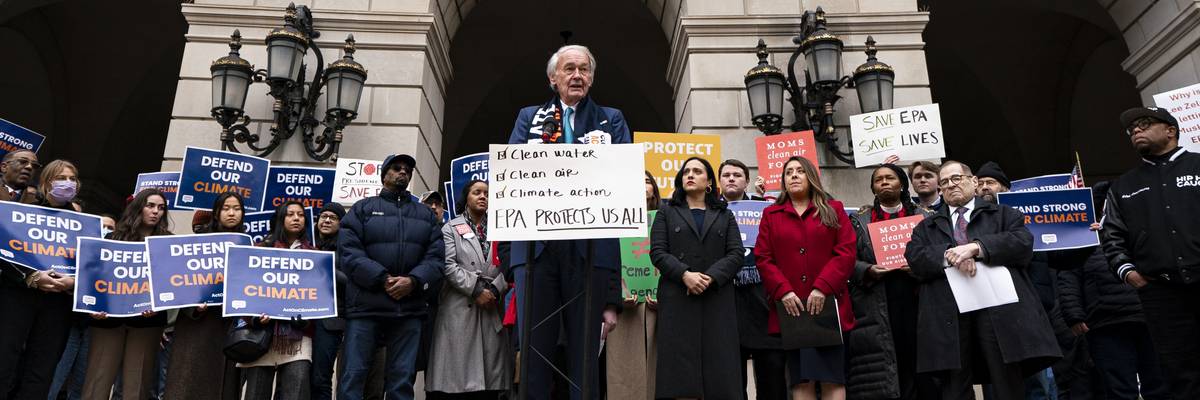
Sen. Edward Markey (D-Mass.) speaks during a demonstration following being blocked from entering the Environmental Protection Agency (EPA) to meet with Department of Government Efficiency (DOGE) officials, on February 6, 2025 in Washington, D.C.
Saving the EPA's Research Arm From Trump Will Save Lives
The scientific community won’t stand by while this critical office is at risk of being dismantled.
When I was an undergraduate, I landed a paid internship that set me on a trajectory to a career in science policy—though of course I didn’t know it at the time. Like many college students, I had no idea what I wanted to do for work.
But my summer with the U.S. Environmental Protection Agency’s Office of Research and Development in North Carolina opened my eyes. The smart, thoughtful federal scientists I worked with were using their scientific expertise to serve the public good. It was a revelation for a student who wanted to choose a path that positively impacted the world.
Already, the global reputation of the United States as a scientific powerhouse, where scientists from countries around the world come to learn and make discoveries freely, is in tatters.
Over the summer, I learned from a team of hard-working people about everything from pesticide research to health effects of air pollution to detecting water quality contamination. In my mentors, I saw their pride in being federal scientists, part of a robust scientific enterprise, and in advancing the public health and environmental mission of the EPA. I observed the tremendous impact they had improving environmental conditions for the nation, all because they chose to devote their expertise to federal service.
And after that experience, and throughout the years of my career at the Union of Concerned Scientists (UCS) and in government, I continued to witness firsthand the incredible impact of the EPA Office of Research and Development in Washington, D.C., and across the country.
What Does the Office Do?
The Research and Development Office is the scientific research arm of the EPA. Its scientists research and communicate the science that serves as the foundation for public health protections for the nation. The office’s work informs decisions on issues that affect our health: from groundbreaking work on the cumulative impacts of pollution on our bodies, to advancing detection and prevention of water and soil pollution, to air quality monitoring and modeling advances, and the integration of climate change and its effects across disciplines.
Despite a long record of world-class research and demonstrated success in its mission, the Trump administration has indicated plans to close the Research and Development Office. But the scientific community won’t stand by while this critical office is at risk of being dismantled.
Earlier this spring, UCS organized and delivered a sign-on letter from 54 scientific societies representing more than 100,000 scientists, demanding that Congress protect and restore life-saving and essential scientific research that benefits families and communities in the U.S.—including the research done by the Research and Development Office.
U.S. Science Is in Danger
The threats to this specific office join a growing list of attacks on federal research activities at large. At the National Institutes of Health (NIH), which conducts medical research and funds such projects at other institutions, measures implemented by the so-called Department of Government Efficiency (DOGE) are hindering federal scientists’ ability to do their jobs within the agency. Cuts to NIH funding for more than 2,500 universities, medical schools, and other research institutions across the country have resulted in canceled clinical trials and studies on diseases, job losses for promising young researchers, and an abrupt end to any research that doesn’t align with the Trump administration’s incoherent preferences.
How amazing, I thought, to be the first to look at a dataset like that, and to have the potential to discover something new that might help us better protect people from harmful pollution.
Cuts to federal funding of academic research are threatening to upend the U.S. university research enterprise and set back the infrastructure and people supporting U.S.-produced science and research by decades. Already, the global reputation of the United States as a scientific powerhouse, where scientists from countries around the world come to learn and make discoveries freely, is in tatters.
Shutting down the research operations of the federal government means closing the door on bright-eyed students like me and other early career researchers, limiting their options in this country (and in many cases, driving them to work abroad). It means missed opportunities to bring young talented scientists into government, creating a brain drain with lasting effects. Shutting down research means chipping away at the scaffolding that upholds federal policy decisions across issue areas, and threatening our ability to make evidence-based policy choices as a nation. And that’s why we cannot allow this to happen.
For Policy Decisions Today and Scientific Progress Tomorrow
As an intern with the EPA Research and Development Office, my project that summer was to analyze air pollution measurements collected in Detroit neighborhoods. The study was intended to help us better understand people’s exposure to air pollution—near roads, in their homes, in the central city, and everywhere in between. How amazing, I thought, to be the first to look at a dataset like that, and to have the potential to discover something new that might help us better protect people from harmful pollution. The sense of wonder I experienced in that lab sparked a personal mission to apply science to help people that has carried me throughout my career.
I think of the wealth of science that’s been produced, the many evidence-based environmental policy decisions made, and the lives saved from air pollution standards in the years since that summer. We’ve come a long way since I was an ambitious young researcher on that tree-covered campus. We can’t give up now. Join us in fighting against these attacks with our Save Science, Save Lives campaign.
We are at a crossroads
This country and this world are at a monumental crossroads. In a few short weeks, US voters will have an opportunity to beat back the forces of fascism and confront the billionaires who are rigging the economy, our media system, and our democracy, making it increasingly impossible for ordinary people to get by. We’re not just talking about the election. We’re talking about what must be done once these fascist elements are vanquished from power. We need a bolder set of solutions than what either major party has so far been willing to offer and a working-class movement ready to fight like hell for it. Trump didn't emerge from nowhere. The conditions that fueled MAGA authoritarianism were created by decades of radical neoliberal economic policies and a corrupt political system dominated by corporate interests. They slashed taxes on the super-rich, promising that the benefits would trickle down. They said giveaways to the corporate titans would make life more affordable for the rest of us. It was all bullshit. And when a bitter, betrayed populace searches for someone to blame, right-wing demagogues have little trouble finding scapegoats. People know when they're being lied to, but you won't hear any of this from the corporate media. Only independent journalism—powered and funded by people who believe in building a better world—can deliver truly trustworthy daily news. Our Fall Campaign is underway, and we need your help. To power our newsroom through the rest of the year, we need to raise $125,000 by midnight on October 31. So if you share our vision, please contribute whatever you can to sustain our work. |
When I was an undergraduate, I landed a paid internship that set me on a trajectory to a career in science policy—though of course I didn’t know it at the time. Like many college students, I had no idea what I wanted to do for work.
But my summer with the U.S. Environmental Protection Agency’s Office of Research and Development in North Carolina opened my eyes. The smart, thoughtful federal scientists I worked with were using their scientific expertise to serve the public good. It was a revelation for a student who wanted to choose a path that positively impacted the world.
Already, the global reputation of the United States as a scientific powerhouse, where scientists from countries around the world come to learn and make discoveries freely, is in tatters.
Over the summer, I learned from a team of hard-working people about everything from pesticide research to health effects of air pollution to detecting water quality contamination. In my mentors, I saw their pride in being federal scientists, part of a robust scientific enterprise, and in advancing the public health and environmental mission of the EPA. I observed the tremendous impact they had improving environmental conditions for the nation, all because they chose to devote their expertise to federal service.
And after that experience, and throughout the years of my career at the Union of Concerned Scientists (UCS) and in government, I continued to witness firsthand the incredible impact of the EPA Office of Research and Development in Washington, D.C., and across the country.
What Does the Office Do?
The Research and Development Office is the scientific research arm of the EPA. Its scientists research and communicate the science that serves as the foundation for public health protections for the nation. The office’s work informs decisions on issues that affect our health: from groundbreaking work on the cumulative impacts of pollution on our bodies, to advancing detection and prevention of water and soil pollution, to air quality monitoring and modeling advances, and the integration of climate change and its effects across disciplines.
Despite a long record of world-class research and demonstrated success in its mission, the Trump administration has indicated plans to close the Research and Development Office. But the scientific community won’t stand by while this critical office is at risk of being dismantled.
Earlier this spring, UCS organized and delivered a sign-on letter from 54 scientific societies representing more than 100,000 scientists, demanding that Congress protect and restore life-saving and essential scientific research that benefits families and communities in the U.S.—including the research done by the Research and Development Office.
U.S. Science Is in Danger
The threats to this specific office join a growing list of attacks on federal research activities at large. At the National Institutes of Health (NIH), which conducts medical research and funds such projects at other institutions, measures implemented by the so-called Department of Government Efficiency (DOGE) are hindering federal scientists’ ability to do their jobs within the agency. Cuts to NIH funding for more than 2,500 universities, medical schools, and other research institutions across the country have resulted in canceled clinical trials and studies on diseases, job losses for promising young researchers, and an abrupt end to any research that doesn’t align with the Trump administration’s incoherent preferences.
How amazing, I thought, to be the first to look at a dataset like that, and to have the potential to discover something new that might help us better protect people from harmful pollution.
Cuts to federal funding of academic research are threatening to upend the U.S. university research enterprise and set back the infrastructure and people supporting U.S.-produced science and research by decades. Already, the global reputation of the United States as a scientific powerhouse, where scientists from countries around the world come to learn and make discoveries freely, is in tatters.
Shutting down the research operations of the federal government means closing the door on bright-eyed students like me and other early career researchers, limiting their options in this country (and in many cases, driving them to work abroad). It means missed opportunities to bring young talented scientists into government, creating a brain drain with lasting effects. Shutting down research means chipping away at the scaffolding that upholds federal policy decisions across issue areas, and threatening our ability to make evidence-based policy choices as a nation. And that’s why we cannot allow this to happen.
For Policy Decisions Today and Scientific Progress Tomorrow
As an intern with the EPA Research and Development Office, my project that summer was to analyze air pollution measurements collected in Detroit neighborhoods. The study was intended to help us better understand people’s exposure to air pollution—near roads, in their homes, in the central city, and everywhere in between. How amazing, I thought, to be the first to look at a dataset like that, and to have the potential to discover something new that might help us better protect people from harmful pollution. The sense of wonder I experienced in that lab sparked a personal mission to apply science to help people that has carried me throughout my career.
I think of the wealth of science that’s been produced, the many evidence-based environmental policy decisions made, and the lives saved from air pollution standards in the years since that summer. We’ve come a long way since I was an ambitious young researcher on that tree-covered campus. We can’t give up now. Join us in fighting against these attacks with our Save Science, Save Lives campaign.
- Trump’s Cabinet of Planet-Wreckers Are Destroying What They’ve Sworn to Protect ›
- 'Billionaires Over Life on Earth': Trump EPA Guts Vast Array of Environmental Protections ›
- This Right-Wing US Supreme Court Is an Enemy of the Environment ›
- Opinion | How to Research Your Way to a Better World | Common Dreams ›
When I was an undergraduate, I landed a paid internship that set me on a trajectory to a career in science policy—though of course I didn’t know it at the time. Like many college students, I had no idea what I wanted to do for work.
But my summer with the U.S. Environmental Protection Agency’s Office of Research and Development in North Carolina opened my eyes. The smart, thoughtful federal scientists I worked with were using their scientific expertise to serve the public good. It was a revelation for a student who wanted to choose a path that positively impacted the world.
Already, the global reputation of the United States as a scientific powerhouse, where scientists from countries around the world come to learn and make discoveries freely, is in tatters.
Over the summer, I learned from a team of hard-working people about everything from pesticide research to health effects of air pollution to detecting water quality contamination. In my mentors, I saw their pride in being federal scientists, part of a robust scientific enterprise, and in advancing the public health and environmental mission of the EPA. I observed the tremendous impact they had improving environmental conditions for the nation, all because they chose to devote their expertise to federal service.
And after that experience, and throughout the years of my career at the Union of Concerned Scientists (UCS) and in government, I continued to witness firsthand the incredible impact of the EPA Office of Research and Development in Washington, D.C., and across the country.
What Does the Office Do?
The Research and Development Office is the scientific research arm of the EPA. Its scientists research and communicate the science that serves as the foundation for public health protections for the nation. The office’s work informs decisions on issues that affect our health: from groundbreaking work on the cumulative impacts of pollution on our bodies, to advancing detection and prevention of water and soil pollution, to air quality monitoring and modeling advances, and the integration of climate change and its effects across disciplines.
Despite a long record of world-class research and demonstrated success in its mission, the Trump administration has indicated plans to close the Research and Development Office. But the scientific community won’t stand by while this critical office is at risk of being dismantled.
Earlier this spring, UCS organized and delivered a sign-on letter from 54 scientific societies representing more than 100,000 scientists, demanding that Congress protect and restore life-saving and essential scientific research that benefits families and communities in the U.S.—including the research done by the Research and Development Office.
U.S. Science Is in Danger
The threats to this specific office join a growing list of attacks on federal research activities at large. At the National Institutes of Health (NIH), which conducts medical research and funds such projects at other institutions, measures implemented by the so-called Department of Government Efficiency (DOGE) are hindering federal scientists’ ability to do their jobs within the agency. Cuts to NIH funding for more than 2,500 universities, medical schools, and other research institutions across the country have resulted in canceled clinical trials and studies on diseases, job losses for promising young researchers, and an abrupt end to any research that doesn’t align with the Trump administration’s incoherent preferences.
How amazing, I thought, to be the first to look at a dataset like that, and to have the potential to discover something new that might help us better protect people from harmful pollution.
Cuts to federal funding of academic research are threatening to upend the U.S. university research enterprise and set back the infrastructure and people supporting U.S.-produced science and research by decades. Already, the global reputation of the United States as a scientific powerhouse, where scientists from countries around the world come to learn and make discoveries freely, is in tatters.
Shutting down the research operations of the federal government means closing the door on bright-eyed students like me and other early career researchers, limiting their options in this country (and in many cases, driving them to work abroad). It means missed opportunities to bring young talented scientists into government, creating a brain drain with lasting effects. Shutting down research means chipping away at the scaffolding that upholds federal policy decisions across issue areas, and threatening our ability to make evidence-based policy choices as a nation. And that’s why we cannot allow this to happen.
For Policy Decisions Today and Scientific Progress Tomorrow
As an intern with the EPA Research and Development Office, my project that summer was to analyze air pollution measurements collected in Detroit neighborhoods. The study was intended to help us better understand people’s exposure to air pollution—near roads, in their homes, in the central city, and everywhere in between. How amazing, I thought, to be the first to look at a dataset like that, and to have the potential to discover something new that might help us better protect people from harmful pollution. The sense of wonder I experienced in that lab sparked a personal mission to apply science to help people that has carried me throughout my career.
I think of the wealth of science that’s been produced, the many evidence-based environmental policy decisions made, and the lives saved from air pollution standards in the years since that summer. We’ve come a long way since I was an ambitious young researcher on that tree-covered campus. We can’t give up now. Join us in fighting against these attacks with our Save Science, Save Lives campaign.
- Trump’s Cabinet of Planet-Wreckers Are Destroying What They’ve Sworn to Protect ›
- 'Billionaires Over Life on Earth': Trump EPA Guts Vast Array of Environmental Protections ›
- This Right-Wing US Supreme Court Is an Enemy of the Environment ›
- Opinion | How to Research Your Way to a Better World | Common Dreams ›