

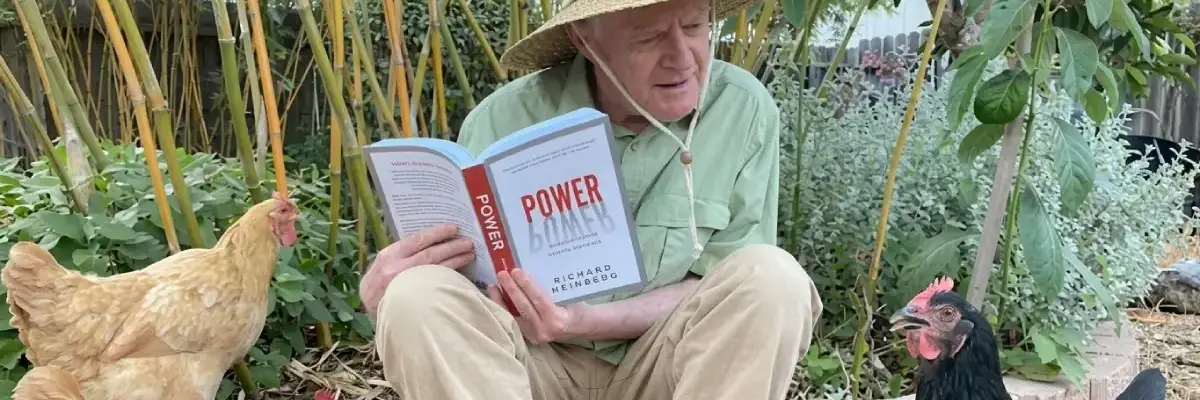
Richard Heinberg, formerly a senior fellow of the Post Carbon Institute, reads aloud to a chicken from his book Power: Limits and Prospects for Human Survival.
Remembering Richard Heinberg, Who Challenged Us to Live Well and Love the Earth
What Richard would want is for each of us to redouble our efforts toward his vision of people and nature thriving within ecological limits. One full of bird song, music, and laughter.
This is the hardest article I’ve ever had to write.
On Sunday July 19th we lost our kind, brilliant friend and colleague, Richard Heinberg.
The world has lost a voice of clear, truth-telling wisdom—a man whose work reached millions of people and fundamentally changed the lives of thousands. Perhaps that includes you. It certainly does me.
Richard died after a short, brutal illness. He was diagnosed with pancreatic cancer just two weeks before his passing. As you can imagine, we’re reeling and gutted.
In ways big and small, Richard displayed humility, gentleness, and joy—especially for someone grappling with such complex and difficult subject matter.
If Richard’s contributions impacted you in any way, we’d love to hear your reflections. Please visit his memorial site to share your own stories or learn more about Richard.
Countless people came to know Richard only through his books, articles, lectures, and interviews. Yet many felt as though they knew him personally. That was one of his remarkable gifts. He challenged people to face difficult truths without giving up on beauty, community, or the possibility of living well within Earth’s limits.
There’s so much I can and simply cannot say about Richard as a person and as a writer and teacher. Working alongside Richard for the last 18 years has been one of the biggest gifts in my life. In ways big and small, Richard displayed humility, gentleness, and joy—especially for someone grappling with such complex and difficult subject matter. An inveterate introvert, Richard was often quiet in groups but when he spoke it was additive, given with generosity, kindness, and humor, and always with a focus on the greater good.
When he wrote, on the other hand, it was with such powerful clarity, unflinching truth telling, and a talent for presenting complex issues in a brilliantly accessible way. He could weave together ecology, thermodynamics, history, anthropology, behavioral psychology, politics, and more into expansive explorations, as he did with his 14th and final book, Power: Limits and Prospects for Human Survival, or into succinct storytelling, as he did when narrating the award-winning animation, “300 Years of Fossil Fuels in 300 Seconds.” He could jump from writing about the collapse of industrial civilization to writing about what he learned from chickens. Perhaps the best example of Richard’s breadth is this recording of him playing the violin and giving a talk on “Post-Carbon Music” at the New England Conservatory of Music.
I’ll miss Richard’s smile, his laugh. I’ll miss the few times when I got to see him get mad at the stupidity or cowardice of those in power. I’ll miss hearing him talk about trying to conquer an early jazz tune or the simple joy he got from his afternoon chocolate or shot of espresso. I’ll desperately miss the way he could take my meandering ideas for topics to explore and turn them into brilliantly cogent essays in a matter of hours or days. I simply loved our collaborations.
While grieving and in shock, and frankly a little lost about how Post Carbon Institute will find its voice without him, I think what Richard would want is for each of us to redouble our efforts toward his vision of people and nature thriving within ecological limits. One full of bird song, music, and laughter.
We would love to hear from you. Please share your remembrances of Richard here.
With a heavy heart,
Asher Miller
We are at a crossroads
This country and this world are at a monumental crossroads. In a few short weeks, US voters will have an opportunity to beat back the forces of fascism and confront the billionaires who are rigging the economy, our media system, and our democracy, making it increasingly impossible for ordinary people to get by. We’re not just talking about the election. We’re talking about what must be done once these fascist elements are vanquished from power. We need a bolder set of solutions than what either major party has so far been willing to offer and a working-class movement ready to fight like hell for it. Trump didn't emerge from nowhere. The conditions that fueled MAGA authoritarianism were created by decades of radical neoliberal economic policies and a corrupt political system dominated by corporate interests. They slashed taxes on the super-rich, promising that the benefits would trickle down. They said giveaways to the corporate titans would make life more affordable for the rest of us. It was all bullshit. And when a bitter, betrayed populace searches for someone to blame, right-wing demagogues have little trouble finding scapegoats. People know when they're being lied to, but you won't hear any of this from the corporate media. Only independent journalism—powered and funded by people who believe in building a better world—can deliver truly trustworthy daily news. Our Fall Campaign is underway, and we need your help. To power our newsroom through the rest of the year, we need to raise $125,000 by midnight on October 31. So if you share our vision, please contribute whatever you can to sustain our work. |
This is the hardest article I’ve ever had to write.
On Sunday July 19th we lost our kind, brilliant friend and colleague, Richard Heinberg.
The world has lost a voice of clear, truth-telling wisdom—a man whose work reached millions of people and fundamentally changed the lives of thousands. Perhaps that includes you. It certainly does me.
Richard died after a short, brutal illness. He was diagnosed with pancreatic cancer just two weeks before his passing. As you can imagine, we’re reeling and gutted.
In ways big and small, Richard displayed humility, gentleness, and joy—especially for someone grappling with such complex and difficult subject matter.
If Richard’s contributions impacted you in any way, we’d love to hear your reflections. Please visit his memorial site to share your own stories or learn more about Richard.
Countless people came to know Richard only through his books, articles, lectures, and interviews. Yet many felt as though they knew him personally. That was one of his remarkable gifts. He challenged people to face difficult truths without giving up on beauty, community, or the possibility of living well within Earth’s limits.
There’s so much I can and simply cannot say about Richard as a person and as a writer and teacher. Working alongside Richard for the last 18 years has been one of the biggest gifts in my life. In ways big and small, Richard displayed humility, gentleness, and joy—especially for someone grappling with such complex and difficult subject matter. An inveterate introvert, Richard was often quiet in groups but when he spoke it was additive, given with generosity, kindness, and humor, and always with a focus on the greater good.
When he wrote, on the other hand, it was with such powerful clarity, unflinching truth telling, and a talent for presenting complex issues in a brilliantly accessible way. He could weave together ecology, thermodynamics, history, anthropology, behavioral psychology, politics, and more into expansive explorations, as he did with his 14th and final book, Power: Limits and Prospects for Human Survival, or into succinct storytelling, as he did when narrating the award-winning animation, “300 Years of Fossil Fuels in 300 Seconds.” He could jump from writing about the collapse of industrial civilization to writing about what he learned from chickens. Perhaps the best example of Richard’s breadth is this recording of him playing the violin and giving a talk on “Post-Carbon Music” at the New England Conservatory of Music.
I’ll miss Richard’s smile, his laugh. I’ll miss the few times when I got to see him get mad at the stupidity or cowardice of those in power. I’ll miss hearing him talk about trying to conquer an early jazz tune or the simple joy he got from his afternoon chocolate or shot of espresso. I’ll desperately miss the way he could take my meandering ideas for topics to explore and turn them into brilliantly cogent essays in a matter of hours or days. I simply loved our collaborations.
While grieving and in shock, and frankly a little lost about how Post Carbon Institute will find its voice without him, I think what Richard would want is for each of us to redouble our efforts toward his vision of people and nature thriving within ecological limits. One full of bird song, music, and laughter.
We would love to hear from you. Please share your remembrances of Richard here.
With a heavy heart,
Asher Miller
This is the hardest article I’ve ever had to write.
On Sunday July 19th we lost our kind, brilliant friend and colleague, Richard Heinberg.
The world has lost a voice of clear, truth-telling wisdom—a man whose work reached millions of people and fundamentally changed the lives of thousands. Perhaps that includes you. It certainly does me.
Richard died after a short, brutal illness. He was diagnosed with pancreatic cancer just two weeks before his passing. As you can imagine, we’re reeling and gutted.
In ways big and small, Richard displayed humility, gentleness, and joy—especially for someone grappling with such complex and difficult subject matter.
If Richard’s contributions impacted you in any way, we’d love to hear your reflections. Please visit his memorial site to share your own stories or learn more about Richard.
Countless people came to know Richard only through his books, articles, lectures, and interviews. Yet many felt as though they knew him personally. That was one of his remarkable gifts. He challenged people to face difficult truths without giving up on beauty, community, or the possibility of living well within Earth’s limits.
There’s so much I can and simply cannot say about Richard as a person and as a writer and teacher. Working alongside Richard for the last 18 years has been one of the biggest gifts in my life. In ways big and small, Richard displayed humility, gentleness, and joy—especially for someone grappling with such complex and difficult subject matter. An inveterate introvert, Richard was often quiet in groups but when he spoke it was additive, given with generosity, kindness, and humor, and always with a focus on the greater good.
When he wrote, on the other hand, it was with such powerful clarity, unflinching truth telling, and a talent for presenting complex issues in a brilliantly accessible way. He could weave together ecology, thermodynamics, history, anthropology, behavioral psychology, politics, and more into expansive explorations, as he did with his 14th and final book, Power: Limits and Prospects for Human Survival, or into succinct storytelling, as he did when narrating the award-winning animation, “300 Years of Fossil Fuels in 300 Seconds.” He could jump from writing about the collapse of industrial civilization to writing about what he learned from chickens. Perhaps the best example of Richard’s breadth is this recording of him playing the violin and giving a talk on “Post-Carbon Music” at the New England Conservatory of Music.
I’ll miss Richard’s smile, his laugh. I’ll miss the few times when I got to see him get mad at the stupidity or cowardice of those in power. I’ll miss hearing him talk about trying to conquer an early jazz tune or the simple joy he got from his afternoon chocolate or shot of espresso. I’ll desperately miss the way he could take my meandering ideas for topics to explore and turn them into brilliantly cogent essays in a matter of hours or days. I simply loved our collaborations.
While grieving and in shock, and frankly a little lost about how Post Carbon Institute will find its voice without him, I think what Richard would want is for each of us to redouble our efforts toward his vision of people and nature thriving within ecological limits. One full of bird song, music, and laughter.
We would love to hear from you. Please share your remembrances of Richard here.
With a heavy heart,
Asher Miller