SUBSCRIBE TO OUR FREE NEWSLETTER
Daily news & progressive opinion—funded by the people, not the corporations—delivered straight to your inbox.
5
#000000
#FFFFFF
To donate by check, phone, or other method, see our More Ways to Give page.
Daily news & progressive opinion—funded by the people, not the corporations—delivered straight to your inbox.
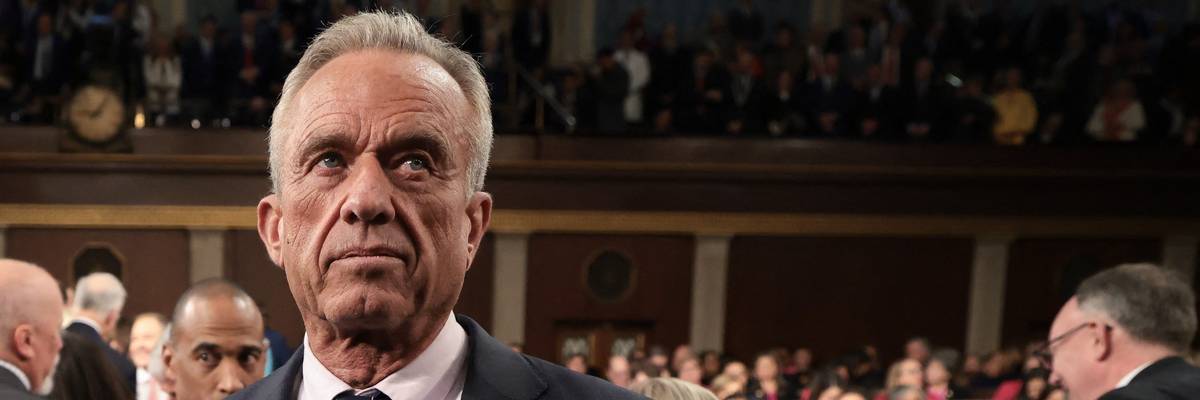
U.S. Secretary of Health and Human Services Robert F. Kennedy Jr. attends U.S. President Donald Trump's address to a joint session of Congress at the U.S. Capitol in Washington, D.C., on March 4, 2025.
At the same time Trump is pledging to reverse childhood cancer rates, he and his attack doge Elon Musk are gutting federal health agencies to help pay for huge tax breaks for corporations and the uber rich.
During his marathon, fact-free speech to Congress last week, President Donald Trump announced that his administration plans to address the growing incidence of childhood cancer.
“Since 1975, rates of child cancer have increased by more than 40%,” Trump said. “Reversing this trend is one of the top priorities for our new presidential commission to make America healthy again, chaired by our new Secretary of Health and Human Services Robert F. Kennedy Jr. …Our goal is to get toxins out of our environment, poisons out of our food supply, and keep our children healthy and strong.”
As usual, Trump got the statistic wrong. In fact, childhood cancer rates increased 33% since 1975, according to a study published in the journal PLOS One in January (and verified by the American Cancer Society), and the uptick in cases can be at least partly attributed to improved detection technology.
What would a major loss of federal scientific expertise mean for HHS Secretary Kennedy’s childhood cancer commission? Given that Kennedy, a prominent anti-vaccine activist, is not known for paying attention to scientific evidence, it may not matter much.
That said, the PLOS One study did find that some childhood cancers—notably leukemia, lymphoma, brain tumors, liver tumors, and gonadal tumors—are on the rise, so by all means, the federal government should do more to try to reduce them.
But at the same time Trump is pledging to reverse childhood cancer rates and “get toxins out of our environment,” he and his attack doge Elon Musk are gutting federal health agencies to help pay for huge tax breaks for corporations and the uber rich.
All of the agencies that protect public health are on the chopping block.
Just a few weeks ago, for example, his administration illegally fired some 5,200 employees at Kennedy’s Department of Health and Human Services (HHS), including nearly 1,300 staff members at the Centers for Disease Control and Prevention (CDC), roughly a tenth of the agency’s workforce.
Meanwhile, over at the Environmental Protection Agency (EPA), the new administrator, Lee Zeldin, is threatening a budget cut of at least 65%. That would leave the agency with an annual budget of about $3.2 billion, less than a third of its budget in fiscal year (FY) 1970—the year it began—in inflation-adjusted 2024 dollars. Such a meager budget would destroy the agency, exactly what the fossil fuel industry-funded Republican Party has been wanting to do for years.
The Trump administration is also trying to ax a key portion of National Institutes of Health (NIH) biomedical research funding, which would undermine any effort to curtail childhood cancer—not to mention research on other deadly diseases.
On February 7, it announced it will cut an estimated $4 billion from NIH grants by capping funding for “indirect” overhead costs that cover such expenses as facilities, electric utilities, and administrative and janitorial services at 15%, half the current average rate. About $26 billion of NIH’s $35 billion in FY2023 grants that went to more than 2,500 universities, medical schools, and other research institutions covered direct costs—researchers and laboratories. The balance—$9 billion—paid for overhead.
Experts warn that without adequate overhead support, researchers would not be able to do their work.
Three days after the administration announced its intention to cut the NIH budget, five medical associations and 22 states filed lawsuits challenging the plan. Later that day, U.S. District Judge Angel Kelley in Boston granted a temporary restraining order. She followed up on March 5, the day after Trump’s speech to Congress, by filing a preliminary injunction that put the cuts on hold while the lawsuits proceed. “The risk of harm to research institutions and beyond,” Kelley wrote in a 76-page order, “is immediate, devastating, and irreparable.”
Trump’s zeal to hobble federal medical and scientific research should not come as a surprise. To a great extent, his current budget-chopping campaign reflects the FY2018 budget he proposed in May 2017. That radical proposal called for shrinking the budgets of NIH by 18%; EPA by 31%, the Food and Drug Administration by 31%, and the CDC by 17%, which would have been its lowest budget since 1997. It also called for hacking $610 billion from Medicaid over the following decade on top of an $880-billion cut a Republican healthcare plan advocated.
That budget was dead on arrival, despite the fact that Republicans controlled the White House, the House, and the Senate, albeit by only a 51 to 49 margin. Oklahoma Republican Tom Cole, then-chair of the House spending subcommittee that funds NIH, told Scientific American that he did not expect Congress to support Trump’s proposed cuts. Other legislators from both sides of the aisle also rejected the president’s NIH budget proposal. (Nevertheless, Trump’s previous administration did a lot of damage by eliminating or weakening over 100 environmental safeguards.)
Today, Republicans have the White House and slim majorities in both houses of Congress. Unlike 2017, however, congressional Republicans are in lockstep with Trump, and thus far have been cheering him and Musk on from the sidelines as they dismantle the federal government.
What would a major loss of federal scientific expertise mean for HHS Secretary Kennedy’s childhood cancer commission? Given that Kennedy, a prominent anti-vaccine activist, is not known for paying attention to scientific evidence, it may not matter much. It’s been widely reported that Kennedy has been telling children and adults in Texas to try Vitamin A, cod liver oil, and other dubious treatments if they get measles instead of urging them to get vaccinated, so one could only imagine what he would recommend that parents give their children to protect them from cancer. Aloe? Emu oil? Kombucha? All of the above?
This column was originally posted on Money Trail, a new Substack site co-founded by Elliott Negin.
Dear Common Dreams reader, It’s been nearly 30 years since I co-founded Common Dreams with my late wife, Lina Newhouser. We had the radical notion that journalism should serve the public good, not corporate profits. It was clear to us from the outset what it would take to build such a project. No paid advertisements. No corporate sponsors. No millionaire publisher telling us what to think or do. Many people said we wouldn't last a year, but we proved those doubters wrong. Together with a tremendous team of journalists and dedicated staff, we built an independent media outlet free from the constraints of profits and corporate control. Our mission has always been simple: To inform. To inspire. To ignite change for the common good. Building Common Dreams was not easy. Our survival was never guaranteed. When you take on the most powerful forces—Wall Street greed, fossil fuel industry destruction, Big Tech lobbyists, and uber-rich oligarchs who have spent billions upon billions rigging the economy and democracy in their favor—the only bulwark you have is supporters who believe in your work. But here’s the urgent message from me today. It's never been this bad out there. And it's never been this hard to keep us going. At the very moment Common Dreams is most needed, the threats we face are intensifying. We need your support now more than ever. We don't accept corporate advertising and never will. We don't have a paywall because we don't think people should be blocked from critical news based on their ability to pay. Everything we do is funded by the donations of readers like you. When everyone does the little they can afford, we are strong. But if that support retreats or dries up, so do we. Will you donate now to make sure Common Dreams not only survives but thrives? —Craig Brown, Co-founder |
During his marathon, fact-free speech to Congress last week, President Donald Trump announced that his administration plans to address the growing incidence of childhood cancer.
“Since 1975, rates of child cancer have increased by more than 40%,” Trump said. “Reversing this trend is one of the top priorities for our new presidential commission to make America healthy again, chaired by our new Secretary of Health and Human Services Robert F. Kennedy Jr. …Our goal is to get toxins out of our environment, poisons out of our food supply, and keep our children healthy and strong.”
As usual, Trump got the statistic wrong. In fact, childhood cancer rates increased 33% since 1975, according to a study published in the journal PLOS One in January (and verified by the American Cancer Society), and the uptick in cases can be at least partly attributed to improved detection technology.
What would a major loss of federal scientific expertise mean for HHS Secretary Kennedy’s childhood cancer commission? Given that Kennedy, a prominent anti-vaccine activist, is not known for paying attention to scientific evidence, it may not matter much.
That said, the PLOS One study did find that some childhood cancers—notably leukemia, lymphoma, brain tumors, liver tumors, and gonadal tumors—are on the rise, so by all means, the federal government should do more to try to reduce them.
But at the same time Trump is pledging to reverse childhood cancer rates and “get toxins out of our environment,” he and his attack doge Elon Musk are gutting federal health agencies to help pay for huge tax breaks for corporations and the uber rich.
All of the agencies that protect public health are on the chopping block.
Just a few weeks ago, for example, his administration illegally fired some 5,200 employees at Kennedy’s Department of Health and Human Services (HHS), including nearly 1,300 staff members at the Centers for Disease Control and Prevention (CDC), roughly a tenth of the agency’s workforce.
Meanwhile, over at the Environmental Protection Agency (EPA), the new administrator, Lee Zeldin, is threatening a budget cut of at least 65%. That would leave the agency with an annual budget of about $3.2 billion, less than a third of its budget in fiscal year (FY) 1970—the year it began—in inflation-adjusted 2024 dollars. Such a meager budget would destroy the agency, exactly what the fossil fuel industry-funded Republican Party has been wanting to do for years.
The Trump administration is also trying to ax a key portion of National Institutes of Health (NIH) biomedical research funding, which would undermine any effort to curtail childhood cancer—not to mention research on other deadly diseases.
On February 7, it announced it will cut an estimated $4 billion from NIH grants by capping funding for “indirect” overhead costs that cover such expenses as facilities, electric utilities, and administrative and janitorial services at 15%, half the current average rate. About $26 billion of NIH’s $35 billion in FY2023 grants that went to more than 2,500 universities, medical schools, and other research institutions covered direct costs—researchers and laboratories. The balance—$9 billion—paid for overhead.
Experts warn that without adequate overhead support, researchers would not be able to do their work.
Three days after the administration announced its intention to cut the NIH budget, five medical associations and 22 states filed lawsuits challenging the plan. Later that day, U.S. District Judge Angel Kelley in Boston granted a temporary restraining order. She followed up on March 5, the day after Trump’s speech to Congress, by filing a preliminary injunction that put the cuts on hold while the lawsuits proceed. “The risk of harm to research institutions and beyond,” Kelley wrote in a 76-page order, “is immediate, devastating, and irreparable.”
Trump’s zeal to hobble federal medical and scientific research should not come as a surprise. To a great extent, his current budget-chopping campaign reflects the FY2018 budget he proposed in May 2017. That radical proposal called for shrinking the budgets of NIH by 18%; EPA by 31%, the Food and Drug Administration by 31%, and the CDC by 17%, which would have been its lowest budget since 1997. It also called for hacking $610 billion from Medicaid over the following decade on top of an $880-billion cut a Republican healthcare plan advocated.
That budget was dead on arrival, despite the fact that Republicans controlled the White House, the House, and the Senate, albeit by only a 51 to 49 margin. Oklahoma Republican Tom Cole, then-chair of the House spending subcommittee that funds NIH, told Scientific American that he did not expect Congress to support Trump’s proposed cuts. Other legislators from both sides of the aisle also rejected the president’s NIH budget proposal. (Nevertheless, Trump’s previous administration did a lot of damage by eliminating or weakening over 100 environmental safeguards.)
Today, Republicans have the White House and slim majorities in both houses of Congress. Unlike 2017, however, congressional Republicans are in lockstep with Trump, and thus far have been cheering him and Musk on from the sidelines as they dismantle the federal government.
What would a major loss of federal scientific expertise mean for HHS Secretary Kennedy’s childhood cancer commission? Given that Kennedy, a prominent anti-vaccine activist, is not known for paying attention to scientific evidence, it may not matter much. It’s been widely reported that Kennedy has been telling children and adults in Texas to try Vitamin A, cod liver oil, and other dubious treatments if they get measles instead of urging them to get vaccinated, so one could only imagine what he would recommend that parents give their children to protect them from cancer. Aloe? Emu oil? Kombucha? All of the above?
This column was originally posted on Money Trail, a new Substack site co-founded by Elliott Negin.
During his marathon, fact-free speech to Congress last week, President Donald Trump announced that his administration plans to address the growing incidence of childhood cancer.
“Since 1975, rates of child cancer have increased by more than 40%,” Trump said. “Reversing this trend is one of the top priorities for our new presidential commission to make America healthy again, chaired by our new Secretary of Health and Human Services Robert F. Kennedy Jr. …Our goal is to get toxins out of our environment, poisons out of our food supply, and keep our children healthy and strong.”
As usual, Trump got the statistic wrong. In fact, childhood cancer rates increased 33% since 1975, according to a study published in the journal PLOS One in January (and verified by the American Cancer Society), and the uptick in cases can be at least partly attributed to improved detection technology.
What would a major loss of federal scientific expertise mean for HHS Secretary Kennedy’s childhood cancer commission? Given that Kennedy, a prominent anti-vaccine activist, is not known for paying attention to scientific evidence, it may not matter much.
That said, the PLOS One study did find that some childhood cancers—notably leukemia, lymphoma, brain tumors, liver tumors, and gonadal tumors—are on the rise, so by all means, the federal government should do more to try to reduce them.
But at the same time Trump is pledging to reverse childhood cancer rates and “get toxins out of our environment,” he and his attack doge Elon Musk are gutting federal health agencies to help pay for huge tax breaks for corporations and the uber rich.
All of the agencies that protect public health are on the chopping block.
Just a few weeks ago, for example, his administration illegally fired some 5,200 employees at Kennedy’s Department of Health and Human Services (HHS), including nearly 1,300 staff members at the Centers for Disease Control and Prevention (CDC), roughly a tenth of the agency’s workforce.
Meanwhile, over at the Environmental Protection Agency (EPA), the new administrator, Lee Zeldin, is threatening a budget cut of at least 65%. That would leave the agency with an annual budget of about $3.2 billion, less than a third of its budget in fiscal year (FY) 1970—the year it began—in inflation-adjusted 2024 dollars. Such a meager budget would destroy the agency, exactly what the fossil fuel industry-funded Republican Party has been wanting to do for years.
The Trump administration is also trying to ax a key portion of National Institutes of Health (NIH) biomedical research funding, which would undermine any effort to curtail childhood cancer—not to mention research on other deadly diseases.
On February 7, it announced it will cut an estimated $4 billion from NIH grants by capping funding for “indirect” overhead costs that cover such expenses as facilities, electric utilities, and administrative and janitorial services at 15%, half the current average rate. About $26 billion of NIH’s $35 billion in FY2023 grants that went to more than 2,500 universities, medical schools, and other research institutions covered direct costs—researchers and laboratories. The balance—$9 billion—paid for overhead.
Experts warn that without adequate overhead support, researchers would not be able to do their work.
Three days after the administration announced its intention to cut the NIH budget, five medical associations and 22 states filed lawsuits challenging the plan. Later that day, U.S. District Judge Angel Kelley in Boston granted a temporary restraining order. She followed up on March 5, the day after Trump’s speech to Congress, by filing a preliminary injunction that put the cuts on hold while the lawsuits proceed. “The risk of harm to research institutions and beyond,” Kelley wrote in a 76-page order, “is immediate, devastating, and irreparable.”
Trump’s zeal to hobble federal medical and scientific research should not come as a surprise. To a great extent, his current budget-chopping campaign reflects the FY2018 budget he proposed in May 2017. That radical proposal called for shrinking the budgets of NIH by 18%; EPA by 31%, the Food and Drug Administration by 31%, and the CDC by 17%, which would have been its lowest budget since 1997. It also called for hacking $610 billion from Medicaid over the following decade on top of an $880-billion cut a Republican healthcare plan advocated.
That budget was dead on arrival, despite the fact that Republicans controlled the White House, the House, and the Senate, albeit by only a 51 to 49 margin. Oklahoma Republican Tom Cole, then-chair of the House spending subcommittee that funds NIH, told Scientific American that he did not expect Congress to support Trump’s proposed cuts. Other legislators from both sides of the aisle also rejected the president’s NIH budget proposal. (Nevertheless, Trump’s previous administration did a lot of damage by eliminating or weakening over 100 environmental safeguards.)
Today, Republicans have the White House and slim majorities in both houses of Congress. Unlike 2017, however, congressional Republicans are in lockstep with Trump, and thus far have been cheering him and Musk on from the sidelines as they dismantle the federal government.
What would a major loss of federal scientific expertise mean for HHS Secretary Kennedy’s childhood cancer commission? Given that Kennedy, a prominent anti-vaccine activist, is not known for paying attention to scientific evidence, it may not matter much. It’s been widely reported that Kennedy has been telling children and adults in Texas to try Vitamin A, cod liver oil, and other dubious treatments if they get measles instead of urging them to get vaccinated, so one could only imagine what he would recommend that parents give their children to protect them from cancer. Aloe? Emu oil? Kombucha? All of the above?
This column was originally posted on Money Trail, a new Substack site co-founded by Elliott Negin.