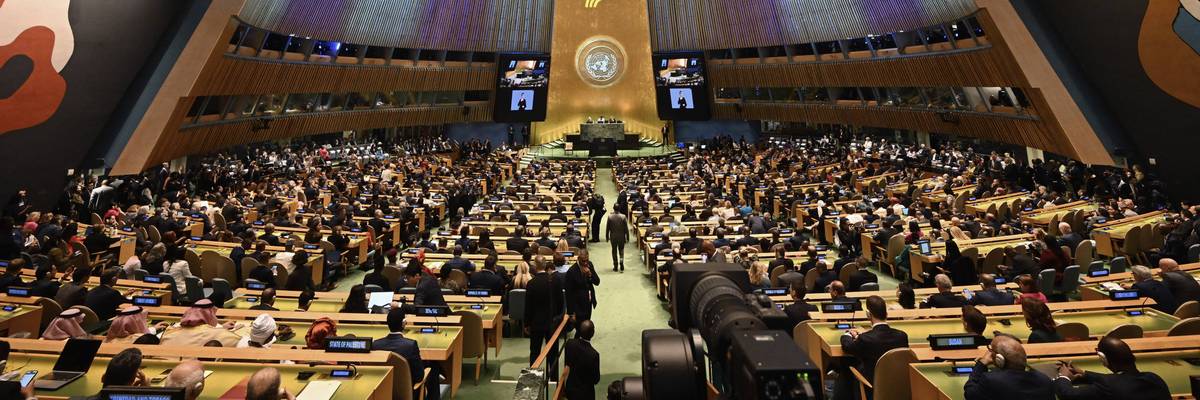
A view of the General Assembly Hall at the opening of the "Summit of the Future" on the sidelines of the UN General Assembly at the United Nations Headquarters in New York, September 22, 2024.
Reimagine the United Nations Rather Than Replacing It With a Farcical 'Board of Peace'
Let us now weave a garment of our own, one suitable for weathering the storms, exploring the vistas, and reaching for the promise of the 21st century.
In April of 1945 a number of grand historical projects were simultaneously underway. In Europe, more than ten million battle-hardened soldiers were converging upon Germany, from the east and from the west, to drive the final nail into the coffin of the odious Nazi regime. (They succeeded on May 8th.) In Asia and the Pacific, a similar effort was underway to force Imperial Japan to accept “unconditional surrender.” (They succeeded on August 15th.) In the deserts of New Mexico and elsewhere in the United States, in total secrecy, thousands of scientists were laboring to invent a bomb that could destroy a city in a second, and give humanity for the first time the ability to bring about its own extinction by its own hands. (They succeeded on July 16th.)
And at the same time, hundreds of individuals were preparing to convene in San Francisco to invent a new global political body, which might – as the eventual United Nations Charter they produced boldly proclaimed – “save succeeding generations from the scourge of war.” (They succeeded, at least with the new international organization part, by signing that Charter on June 26th, and bringing the new United Nations into being on October 24th.)
But on April 12th the president of the United States died.
The conference opened as scheduled on April 25th. But just four days into their project the framers made a trek across the Golden Gate Bridge, to spend some time, in quiet and contemplation, among some of the oldest living things on Earth. And they set into the ground there a heavy metal plaque, which contained these words.
“Here in this grove of enduring redwoods, preserved for posterity, members of the United Nations Conference on International Organizations met on April 29th, 1945, to honor the memory of Franklin Delano Roosevelt: Thirty Second President of the United States, Chief Architect of the United Nations, and Apostle of Lasting Peace for All Mankind.”
ARCHITECTURAL RENOVATION? MEET POLITICAL OBSTRUCTION
Now we have passed the 80th anniversary year of the United Nations. The scourge that apostle chose to confront is at least as acute today as it was eight decades ago. And a whole host of new challenges have emerged, ones not on anyone’s radar screen in 1945. So as abundant as our admiration for FDR and his fellow architects might be, the time has come to take a look at the structural integrity of that edifice for the challenges facing humanity in 2025 and beyond. As we will see, it’s hard to avoid the conclusion that the United Nations is long overdue for some renewal, renovation, and rejuvenation.
There’s only one problem. What in the world can we do, about the San Francisco Charter’s Article 109 Clause Two?
That provision decrees that anything that might come out of a conference to review that Charter must be approved by all five of the Security Council’s “permanent members” – France, Russia, China, the United Kingdom and the United States. These five states were already given the ability in Article 27 Clause Three to command the whole of humanity into inaction and impotence. This is “the veto,” which many observers have long asserted to be the greatest flaw in the San Francisco Charter. It degrades the democratic legitimacy of the entire construction. It insulates those five members from any kind of UN sanction (e.g., Russia regarding its war in Ukraine since 2022), as well as other states those five wish to protect from UN sanction (e.g., the United States regarding Israel’s actions in Gaza since 2023). And even when not actually cast, veto calculations dominate virtually every decision the Security Council makes, because it’s always necessary to get all five on board. It's what the late U.S. Senator Paul Wellstone, citing the renowned late political scientist Walter Dean Burnham, often called “the politics of excluded alternatives.”
And when we turn our view from Article 27 to Article 109, we learn that these five states can also veto any kind of modification to their unique perch overlooking the rest of humanity. In 1992, as similar conversations were brewing in anticipation of the organization’s impending 50th anniversary, The Economist magazine tossed a cold bucket of water on UN makeover enthusiasts, when it reminded them that “the vetoers would veto a veto veto.” Is there any way out of this enduring cul-de-sac of realpolitik?
THE CASE FOR REINVENTING THE UNITED NATIONS
Let’s take a look beyond the veto, at several other incongruities between the United Nations design of yesterday and the big questions of today.
The absence of any reference to climate or environment in the UN Charter, and the absence of actual success (by the UN or anyone else) in surmounting our looming climate catastrophes.
Piecemeal and insufficient national regulation of the multiple potential dangers from runaway artificial intelligence, which clearly won’t be enough to constrain this quintessentially global technology.
A funding system both inadequate and unreliable, dependent exclusively on voluntary national contributions. Sometimes they arrive. Sometimes they don't. But either way they give major donors the ability to bully and blackmail the recipient.
Pervasive gender oppression in many areas of the world, a country like Afghanistan openly depriving half its population of the right to education, and the outside world wholly impotent to do anything more than express outrage.
Perpetual poverty, inequality and injustice for billions, propagated by the globally unregulated might of global capital.
Lessons hopefully learned from the COVID-19 pandemic, which must now be incorporated into global public policy preparation for the next ones which are sure to come.
A UN General Assembly with three fundamental flaws. First, its basic operating principle – where India’s 1.45 billion and Vanuatu’s 327,000 people exercise the same “one nation one vote” – could hardly be more undemocratic or absurd. Second, it holds no power whatsoever to enact (let alone to enforce) binding international law. Finally, it provides no voice for anyone beyond “ambassadors” appointed by the executive branches of national governments – e.g., parliamentarians, the economically impoverished and other marginalized groups, and every single voter who did not support the current head of state.
The UN playing virtually no role in confronting what we might call “the scourge of perpetual preparation for war,” in forever newly-invented technologies of mass slaughter.
And if the looming competition between China and the United States increasingly emerges as the centerpiece of international relations in the second quarter of the 21st Century – a new and even more dangerous Cold War – one can confidently predict that the UN will most likely again be relegated entirely to the sidelines.
So a creative package of amendments to the UN Charter beckons to us as both practical necessity and moral imperative. Because many of these problems of the modern age are coming at us like a runaway freight train, brakes out, heading downhill. And in the immortal words of Neil Young, our Cadillac has got a wheel in the ditch and a wheel on the track.
VOX CLAMANTIS IN DESERTO
A number of civil society initiatives have emerged in recent years, aimed at inventing new tools of global governance that might help to slow down these multiple locomotives of future catastrophe.
One of these is the “Coalition for the UN We Need,” launched during the UN’s 75th anniversary year in 2020. Its name conveys its central conviction that the UN we got ain’t what we need. It focuses largely (but not exclusively) upon innovations that wouldn’t require Charter amendment – precisely because of the political realities this article explores. And its “coalition” consists today of 382 organizations, focusing upon a widely-differing array of issue areas themselves, from dozens of countries around the world.
Another is the “Article 109: For a Renewed UN Charter” coalition, launched just last year. Perhaps the most important word in its name is “a.” It does not push any specific “renewed Charter” complete in every detail. It argues instead that peace, justice, planetary protection, and widespread improvements in the human condition can be pursued by transforming the UN Charter – and that the provision included by the framers themselves for doing so is the vehicle to make that happen. It’s already been endorsed by hundreds of prominent global affairs thinkers and practitioners, more than 40 civil society organizations, and dozens of former diplomats, ministers, heads of state, and Nobel laureates.
And finally, in 2023 a transnational NGO known as the Global Governance Forum initiated a project to frame a “Second United Nations Charter.” This one also enlists a somewhat different group of former ministers, heads of state, and Nobel laureates among the framers. It offers a specific and comprehensive package of amendments, performing a line-by-line revision of the present Charter from beginning to end.
Some of their proposals, drawing upon longstanding conceptual ground tilled by others, are quite ingenious. One is an "Earth Systems Council," to address the health of our imperiled planetary biosphere. Another is a “UN Parliamentary Assembly,” to represent those left out of the present General Assembly and perhaps to encourage the emergence of transnational political parties. And another is a standing “UN Peace Force,” that could initially intervene in places like Bosnia and Rwanda yesterday, Sudan and Haiti today, and who knows where tomorrow – conflagrations where no states appear willing to put their own forces at risk for conflicts that have nothing to do with them – and eventually serve as the United Nations arm for peace enforcement.
In addition, in order to cultivate a sense of planetary patriotism, the framers decided to replace the opening line of the present Charter, “We the peoples of the United Nations,” with their own formulation, “We the People of the World.” The project seeks to strike just the right balance between optimal outcomes and contemporary political reality. Perhaps we might call this the Global Goldilocks Zone. A reimagined international organization not too hot (and thus politically unlikely to be realized), not too cold (and thus unlikely to make much difference surmounting big problems), but perhaps just right.
THE OBSTACLE OF 109 (2)
There is, however, sometimes an air of weary resignation among these global governance innovators. “A redesigned, democratized, and empowered United Nations could tackle so many of humanity’s problems! But we need to lower our sights. We’ll never get anything like that, because the P5 will forever block that.”
Or will they?
Article 109 Clause Two reads: “Any alteration of the present Charter recommended by a two-thirds vote of the conference shall take effect when ratified in accordance with their respective constitutional processes by two thirds of the Members of the United Nations including all the permanent members of the Security Council.”
But cold calculations of national self-interest might lead to P5 calculations beyond intractable opposition to change. The veto could only serve as a tool of absolute self-interest if it was held not by five states, but only one. The U.S. government, e.g., might benefit from its ability to block UN activities it does not desire. But it also suffers from Moscow’s and Beijing’s equal ability to put a stop to Washington’s pursuit of its own objectives through the United Nations. The benefits of the power to wield the veto must be balanced against the costs of one’s own initiatives being vetoable.
In addition, let’s consider the calculations specifically in Washington at perhaps its apogee of political and economic power. A Republican or Democratic administration just might conclude that the moment might be fleeting for the U.S. to shape and lead an emerging UN Charter review process. Better, perhaps, to seize that leadership role today, rather than letting China do so tomorrow.
And finally, surely someone inside the councils of P5 governments will someday make the case that the veto isn’t actually going to serve anyone’s national interest if the planet is on fire, if WWIII is over the horizon, if the killer AI robots are coming for us all.
And even in the face of implacable P5 opposition to change, civil society can ramp up the pressure upon them. When I talk to my buddies at the bar, most of them know vaguely that five countries can block the UN from doing pretty much everything, but none of them know those same five can also block the UN from ever changing anything about the UN. (More than once I’ve talked to global affairs professionals who don’t know that either.) Public education and civil society agitation about the monstrous unfairness of 109 (2) can surely turn up the heat on the P5.
Especially because there is more to Article 109 than its second clause.
THE OPPORTUNITY OF 109 (1)
The first clause of Article 109 reads: “A General Conference of the Members of the United Nations for the purpose of reviewing the present Charter may be held at a date and place to be fixed by a two-thirds vote of the members of the General Assembly and by a vote of any nine members of the Security Council. …” That word “any” opens up a universe of possibility. The summoning of a comprehensive UN Charter review conference is not, repeat not, subject to the veto. This is unlike almost everything of major consequence at the UN, where the P5 always seem to wield decisive influence. Here is one thing, of potentially infinite consequence, where they don’t. Even if all those five states vote nay, an Article 109 conference still might be called to order.
My buddies at the bar (and some of those global affairs professionals) don’t know that either. Just as we should draw public attention to the inequity of Clause Two, we should do the same regarding the potential of Clause One. Because the call to activate Article 109 could become a powerful mobilizing force in civil society.
It can provide something tangible and specific to urge upon policymakers, while leaving open what might ultimately emerge from the process. It can bring together a wide variety of activist organizations already working on other issues, who could pursue imaginative planetary governance upgrades to advance their own particular agendas. It can assemble a broad coalition of supporters who might hold widely different visions of the human future, but who could all agree on pursuing the process laid out in the Charter itself to define the most appropriate vision for our unfolding 21st century.
All these calculations, regarding both Clause Two and Clause One, may eventually bring us to the stage of vote counting, where enough states are poised to vote yea for a “General Conference.” As momentum grows, from what we might call the “P188” states, from civil society pressure inside the five states, and from a surging world public opinion, it just might mobilize a grand global movement that the P5 will find impossible to resist.
And so they may show up to that General Conference, whether they had voted to summon it or not. And they may negotiate in good faith at that General Conference, rather than adamantly refusing even to discuss any diminution of their Article 27 special privilege. And if an imaginative world organization proposal emerges from that General Conference, one obviously more fit for present purposes than the present Charter, they may choose not to deploy their Article 109 special privilege to prevent its establishment.
Especially when they realize that the General Conference may not need their votes after all.
LET HISTORY BE OUR GUIDE
Has anything like this ever happened? Yep. Twice. (At least.) And the protagonists both times found a way to dodge their own veto dilemmas.
As every American schoolchild learns, when delegates from the 13 newly independent American states met in Philadelphia in 1787, their official purpose was to amend the 1777 Articles of Confederation. After they had invented their very new kind of government, it was assumed they would use the amendment process set out in those Articles to legally bring their new nation into being.
What was that process? It was unanimity. All 13 needed to agree on everything in order for anything to go forward. (Columbia University Professor Jeffrey Sachs recently suggested that we might call them “the P13.”) So the American framers chose a different path. Their new document contained its own procedures for coming into force. When 9 of the 13 state legislatures had voted to join the new federation, the United States Constitution would take effect. That happened on June 21st, 1788, when New Hampshire voted yea. And on March 4th, 1789, a new thing in history was born.
Our second example is more recent and even more apropos. It is the invention of the United Nations. The framers in San Francisco might have set out to establish what they created via the amendment procedures set out in the League of Nations Covenant of 1920. That document required both a majority of its “Assembly” and unanimity from its “Council” for amendments. But the UN Charter instead contained its own procedures for coming into force. It required the approval of a majority of the San Francisco signatories, and all of the newly designated five permanent members. And when that requirement was met on October 24th, 1945, a new thing in history was born.
In addition, note well that in both cases the framers could have chosen a piecemeal revision of the old document. Instead, they wrote a new one from scratch. An Article 109 conference might adopt either approach. The reframers might choose to dive into the San Francisco Charter and make line-by-line revisions (the method chosen by the Second Charter Project). Or they might choose to draft a brand new document (the approach taken in Philadelphia in 1787 and San Francisco in 1945).
So let us imagine an Article 109 UN Charter review conference unfolding in much the same way as these historical precedents in 1787 and 1945. This isn't the only possible scenario, but it's certainly one scenario. The conference is convened - perhaps with the participation of all the P5 or perhaps with none. The conference produces a new document - perhaps with an elaborate package of amendments or perhaps written out on a blank sheet of paper. But that new document makes no reference to Article 109 (2). It contains its own rules for entry into force. And at some point, those criteria are met.
What might happen after that is anyone's guess. Yes, it's possible that after all that, all of the P5 will stand obstinately apart indefinitely. But perhaps it’s just as likely, as the far greater suitability of this new organization for our 21st Century world becomes apparent, that more and more states, eventually including the P5, will conclude that coming aboard will serve their individual national interests and the common human interest, will turn the tide from despair to hope, and will give homo sapiens a fighting chance to save ourselves from ourselves.
And then a new thing in history will be born.
HELP WANTED: ARCHITECTS AND APOSTLES FOR THE 21ST CENTURY
My buddies at the bar may not know much about Article 109, but they know the name of the President of the United States. And whenever I talk about this stuff with them (not often), it doesn’t take long before one of them says, “Trump’s not going to go for that.” But this work is not about this political hour. These are likely not immediate objectives, but instead a positive and hopeful vision of what humanity might do to build the future we need, desire and deserve. Someday, perhaps, the prevailing political winds will all be blowing together in the right direction. Maybe even before it’s too late.
So after you make your visit to that FDR plaque among those ancient and towering redwoods, make your way back to San Francisco, take the BART over to Oakland, climb aboard an Amtrak, and don’t get off until you arrive at Union Station in Washington, D.C. Then stroll over to the Tidal Basin and step inside the Jefferson Memorial. There you will find emblazoned upon the walls an abbreviated version of a letter Thomas Jefferson wrote to one Samuel Kercheval in 1816. That was not 80 years, but only 27 years after the launch of the U.S. Constitution. But his sentiment about that document already?
“Some men look at constitutions with sanctimonious reverence, and deem them like the arc of the covenant, too sacred to be touched. … I am certainly not an advocate for frequent and untried changes in laws and constitutions. … But I know also that laws and institutions must go hand in hand with the progress of the human mind … We might as well require a man to wear still the coat which fitted him when a boy, as civilized society to remain ever under the regimen of their barbarous ancestors."
So let us now weave a garment of our own, one suitable for weathering the storms, exploring the vistas, and reaching for the promise of the 21st century. Let us now act as chief architects of a reinvented United Nations. And let us now serve as apostles of lasting peace for all of humankind, as we proceed on our endless journey from the caves to the stars.
We are at a crossroads
This country and this world are at a monumental crossroads. In a few short weeks, US voters will have an opportunity to beat back the forces of fascism and confront the billionaires who are rigging the economy, our media system, and our democracy, making it increasingly impossible for ordinary people to get by. We’re not just talking about the election. We’re talking about what must be done once these fascist elements are vanquished from power. We need a bolder set of solutions than what either major party has so far been willing to offer and a working-class movement ready to fight like hell for it. Trump didn't emerge from nowhere. The conditions that fueled MAGA authoritarianism were created by decades of radical neoliberal economic policies and a corrupt political system dominated by corporate interests. They slashed taxes on the super-rich, promising that the benefits would trickle down. They said giveaways to the corporate titans would make life more affordable for the rest of us. It was all bullshit. And when a bitter, betrayed populace searches for someone to blame, right-wing demagogues have little trouble finding scapegoats. People know when they're being lied to, but you won't hear any of this from the corporate media. Only independent journalism—powered and funded by people who believe in building a better world—can deliver truly trustworthy daily news. Our Fall Campaign is underway, and we need your help. To power our newsroom through the rest of the year, we need to raise $125,000 by midnight on October 31. So if you share our vision, please contribute whatever you can to sustain our work. |
In April of 1945 a number of grand historical projects were simultaneously underway. In Europe, more than ten million battle-hardened soldiers were converging upon Germany, from the east and from the west, to drive the final nail into the coffin of the odious Nazi regime. (They succeeded on May 8th.) In Asia and the Pacific, a similar effort was underway to force Imperial Japan to accept “unconditional surrender.” (They succeeded on August 15th.) In the deserts of New Mexico and elsewhere in the United States, in total secrecy, thousands of scientists were laboring to invent a bomb that could destroy a city in a second, and give humanity for the first time the ability to bring about its own extinction by its own hands. (They succeeded on July 16th.)
And at the same time, hundreds of individuals were preparing to convene in San Francisco to invent a new global political body, which might – as the eventual United Nations Charter they produced boldly proclaimed – “save succeeding generations from the scourge of war.” (They succeeded, at least with the new international organization part, by signing that Charter on June 26th, and bringing the new United Nations into being on October 24th.)
But on April 12th the president of the United States died.
The conference opened as scheduled on April 25th. But just four days into their project the framers made a trek across the Golden Gate Bridge, to spend some time, in quiet and contemplation, among some of the oldest living things on Earth. And they set into the ground there a heavy metal plaque, which contained these words.
“Here in this grove of enduring redwoods, preserved for posterity, members of the United Nations Conference on International Organizations met on April 29th, 1945, to honor the memory of Franklin Delano Roosevelt: Thirty Second President of the United States, Chief Architect of the United Nations, and Apostle of Lasting Peace for All Mankind.”
ARCHITECTURAL RENOVATION? MEET POLITICAL OBSTRUCTION
Now we have passed the 80th anniversary year of the United Nations. The scourge that apostle chose to confront is at least as acute today as it was eight decades ago. And a whole host of new challenges have emerged, ones not on anyone’s radar screen in 1945. So as abundant as our admiration for FDR and his fellow architects might be, the time has come to take a look at the structural integrity of that edifice for the challenges facing humanity in 2025 and beyond. As we will see, it’s hard to avoid the conclusion that the United Nations is long overdue for some renewal, renovation, and rejuvenation.
There’s only one problem. What in the world can we do, about the San Francisco Charter’s Article 109 Clause Two?
That provision decrees that anything that might come out of a conference to review that Charter must be approved by all five of the Security Council’s “permanent members” – France, Russia, China, the United Kingdom and the United States. These five states were already given the ability in Article 27 Clause Three to command the whole of humanity into inaction and impotence. This is “the veto,” which many observers have long asserted to be the greatest flaw in the San Francisco Charter. It degrades the democratic legitimacy of the entire construction. It insulates those five members from any kind of UN sanction (e.g., Russia regarding its war in Ukraine since 2022), as well as other states those five wish to protect from UN sanction (e.g., the United States regarding Israel’s actions in Gaza since 2023). And even when not actually cast, veto calculations dominate virtually every decision the Security Council makes, because it’s always necessary to get all five on board. It's what the late U.S. Senator Paul Wellstone, citing the renowned late political scientist Walter Dean Burnham, often called “the politics of excluded alternatives.”
And when we turn our view from Article 27 to Article 109, we learn that these five states can also veto any kind of modification to their unique perch overlooking the rest of humanity. In 1992, as similar conversations were brewing in anticipation of the organization’s impending 50th anniversary, The Economist magazine tossed a cold bucket of water on UN makeover enthusiasts, when it reminded them that “the vetoers would veto a veto veto.” Is there any way out of this enduring cul-de-sac of realpolitik?
THE CASE FOR REINVENTING THE UNITED NATIONS
Let’s take a look beyond the veto, at several other incongruities between the United Nations design of yesterday and the big questions of today.
The absence of any reference to climate or environment in the UN Charter, and the absence of actual success (by the UN or anyone else) in surmounting our looming climate catastrophes.
Piecemeal and insufficient national regulation of the multiple potential dangers from runaway artificial intelligence, which clearly won’t be enough to constrain this quintessentially global technology.
A funding system both inadequate and unreliable, dependent exclusively on voluntary national contributions. Sometimes they arrive. Sometimes they don't. But either way they give major donors the ability to bully and blackmail the recipient.
Pervasive gender oppression in many areas of the world, a country like Afghanistan openly depriving half its population of the right to education, and the outside world wholly impotent to do anything more than express outrage.
Perpetual poverty, inequality and injustice for billions, propagated by the globally unregulated might of global capital.
Lessons hopefully learned from the COVID-19 pandemic, which must now be incorporated into global public policy preparation for the next ones which are sure to come.
A UN General Assembly with three fundamental flaws. First, its basic operating principle – where India’s 1.45 billion and Vanuatu’s 327,000 people exercise the same “one nation one vote” – could hardly be more undemocratic or absurd. Second, it holds no power whatsoever to enact (let alone to enforce) binding international law. Finally, it provides no voice for anyone beyond “ambassadors” appointed by the executive branches of national governments – e.g., parliamentarians, the economically impoverished and other marginalized groups, and every single voter who did not support the current head of state.
The UN playing virtually no role in confronting what we might call “the scourge of perpetual preparation for war,” in forever newly-invented technologies of mass slaughter.
And if the looming competition between China and the United States increasingly emerges as the centerpiece of international relations in the second quarter of the 21st Century – a new and even more dangerous Cold War – one can confidently predict that the UN will most likely again be relegated entirely to the sidelines.
So a creative package of amendments to the UN Charter beckons to us as both practical necessity and moral imperative. Because many of these problems of the modern age are coming at us like a runaway freight train, brakes out, heading downhill. And in the immortal words of Neil Young, our Cadillac has got a wheel in the ditch and a wheel on the track.
VOX CLAMANTIS IN DESERTO
A number of civil society initiatives have emerged in recent years, aimed at inventing new tools of global governance that might help to slow down these multiple locomotives of future catastrophe.
One of these is the “Coalition for the UN We Need,” launched during the UN’s 75th anniversary year in 2020. Its name conveys its central conviction that the UN we got ain’t what we need. It focuses largely (but not exclusively) upon innovations that wouldn’t require Charter amendment – precisely because of the political realities this article explores. And its “coalition” consists today of 382 organizations, focusing upon a widely-differing array of issue areas themselves, from dozens of countries around the world.
Another is the “Article 109: For a Renewed UN Charter” coalition, launched just last year. Perhaps the most important word in its name is “a.” It does not push any specific “renewed Charter” complete in every detail. It argues instead that peace, justice, planetary protection, and widespread improvements in the human condition can be pursued by transforming the UN Charter – and that the provision included by the framers themselves for doing so is the vehicle to make that happen. It’s already been endorsed by hundreds of prominent global affairs thinkers and practitioners, more than 40 civil society organizations, and dozens of former diplomats, ministers, heads of state, and Nobel laureates.
And finally, in 2023 a transnational NGO known as the Global Governance Forum initiated a project to frame a “Second United Nations Charter.” This one also enlists a somewhat different group of former ministers, heads of state, and Nobel laureates among the framers. It offers a specific and comprehensive package of amendments, performing a line-by-line revision of the present Charter from beginning to end.
Some of their proposals, drawing upon longstanding conceptual ground tilled by others, are quite ingenious. One is an "Earth Systems Council," to address the health of our imperiled planetary biosphere. Another is a “UN Parliamentary Assembly,” to represent those left out of the present General Assembly and perhaps to encourage the emergence of transnational political parties. And another is a standing “UN Peace Force,” that could initially intervene in places like Bosnia and Rwanda yesterday, Sudan and Haiti today, and who knows where tomorrow – conflagrations where no states appear willing to put their own forces at risk for conflicts that have nothing to do with them – and eventually serve as the United Nations arm for peace enforcement.
In addition, in order to cultivate a sense of planetary patriotism, the framers decided to replace the opening line of the present Charter, “We the peoples of the United Nations,” with their own formulation, “We the People of the World.” The project seeks to strike just the right balance between optimal outcomes and contemporary political reality. Perhaps we might call this the Global Goldilocks Zone. A reimagined international organization not too hot (and thus politically unlikely to be realized), not too cold (and thus unlikely to make much difference surmounting big problems), but perhaps just right.
THE OBSTACLE OF 109 (2)
There is, however, sometimes an air of weary resignation among these global governance innovators. “A redesigned, democratized, and empowered United Nations could tackle so many of humanity’s problems! But we need to lower our sights. We’ll never get anything like that, because the P5 will forever block that.”
Or will they?
Article 109 Clause Two reads: “Any alteration of the present Charter recommended by a two-thirds vote of the conference shall take effect when ratified in accordance with their respective constitutional processes by two thirds of the Members of the United Nations including all the permanent members of the Security Council.”
But cold calculations of national self-interest might lead to P5 calculations beyond intractable opposition to change. The veto could only serve as a tool of absolute self-interest if it was held not by five states, but only one. The U.S. government, e.g., might benefit from its ability to block UN activities it does not desire. But it also suffers from Moscow’s and Beijing’s equal ability to put a stop to Washington’s pursuit of its own objectives through the United Nations. The benefits of the power to wield the veto must be balanced against the costs of one’s own initiatives being vetoable.
In addition, let’s consider the calculations specifically in Washington at perhaps its apogee of political and economic power. A Republican or Democratic administration just might conclude that the moment might be fleeting for the U.S. to shape and lead an emerging UN Charter review process. Better, perhaps, to seize that leadership role today, rather than letting China do so tomorrow.
And finally, surely someone inside the councils of P5 governments will someday make the case that the veto isn’t actually going to serve anyone’s national interest if the planet is on fire, if WWIII is over the horizon, if the killer AI robots are coming for us all.
And even in the face of implacable P5 opposition to change, civil society can ramp up the pressure upon them. When I talk to my buddies at the bar, most of them know vaguely that five countries can block the UN from doing pretty much everything, but none of them know those same five can also block the UN from ever changing anything about the UN. (More than once I’ve talked to global affairs professionals who don’t know that either.) Public education and civil society agitation about the monstrous unfairness of 109 (2) can surely turn up the heat on the P5.
Especially because there is more to Article 109 than its second clause.
THE OPPORTUNITY OF 109 (1)
The first clause of Article 109 reads: “A General Conference of the Members of the United Nations for the purpose of reviewing the present Charter may be held at a date and place to be fixed by a two-thirds vote of the members of the General Assembly and by a vote of any nine members of the Security Council. …” That word “any” opens up a universe of possibility. The summoning of a comprehensive UN Charter review conference is not, repeat not, subject to the veto. This is unlike almost everything of major consequence at the UN, where the P5 always seem to wield decisive influence. Here is one thing, of potentially infinite consequence, where they don’t. Even if all those five states vote nay, an Article 109 conference still might be called to order.
My buddies at the bar (and some of those global affairs professionals) don’t know that either. Just as we should draw public attention to the inequity of Clause Two, we should do the same regarding the potential of Clause One. Because the call to activate Article 109 could become a powerful mobilizing force in civil society.
It can provide something tangible and specific to urge upon policymakers, while leaving open what might ultimately emerge from the process. It can bring together a wide variety of activist organizations already working on other issues, who could pursue imaginative planetary governance upgrades to advance their own particular agendas. It can assemble a broad coalition of supporters who might hold widely different visions of the human future, but who could all agree on pursuing the process laid out in the Charter itself to define the most appropriate vision for our unfolding 21st century.
All these calculations, regarding both Clause Two and Clause One, may eventually bring us to the stage of vote counting, where enough states are poised to vote yea for a “General Conference.” As momentum grows, from what we might call the “P188” states, from civil society pressure inside the five states, and from a surging world public opinion, it just might mobilize a grand global movement that the P5 will find impossible to resist.
And so they may show up to that General Conference, whether they had voted to summon it or not. And they may negotiate in good faith at that General Conference, rather than adamantly refusing even to discuss any diminution of their Article 27 special privilege. And if an imaginative world organization proposal emerges from that General Conference, one obviously more fit for present purposes than the present Charter, they may choose not to deploy their Article 109 special privilege to prevent its establishment.
Especially when they realize that the General Conference may not need their votes after all.
LET HISTORY BE OUR GUIDE
Has anything like this ever happened? Yep. Twice. (At least.) And the protagonists both times found a way to dodge their own veto dilemmas.
As every American schoolchild learns, when delegates from the 13 newly independent American states met in Philadelphia in 1787, their official purpose was to amend the 1777 Articles of Confederation. After they had invented their very new kind of government, it was assumed they would use the amendment process set out in those Articles to legally bring their new nation into being.
What was that process? It was unanimity. All 13 needed to agree on everything in order for anything to go forward. (Columbia University Professor Jeffrey Sachs recently suggested that we might call them “the P13.”) So the American framers chose a different path. Their new document contained its own procedures for coming into force. When 9 of the 13 state legislatures had voted to join the new federation, the United States Constitution would take effect. That happened on June 21st, 1788, when New Hampshire voted yea. And on March 4th, 1789, a new thing in history was born.
Our second example is more recent and even more apropos. It is the invention of the United Nations. The framers in San Francisco might have set out to establish what they created via the amendment procedures set out in the League of Nations Covenant of 1920. That document required both a majority of its “Assembly” and unanimity from its “Council” for amendments. But the UN Charter instead contained its own procedures for coming into force. It required the approval of a majority of the San Francisco signatories, and all of the newly designated five permanent members. And when that requirement was met on October 24th, 1945, a new thing in history was born.
In addition, note well that in both cases the framers could have chosen a piecemeal revision of the old document. Instead, they wrote a new one from scratch. An Article 109 conference might adopt either approach. The reframers might choose to dive into the San Francisco Charter and make line-by-line revisions (the method chosen by the Second Charter Project). Or they might choose to draft a brand new document (the approach taken in Philadelphia in 1787 and San Francisco in 1945).
So let us imagine an Article 109 UN Charter review conference unfolding in much the same way as these historical precedents in 1787 and 1945. This isn't the only possible scenario, but it's certainly one scenario. The conference is convened - perhaps with the participation of all the P5 or perhaps with none. The conference produces a new document - perhaps with an elaborate package of amendments or perhaps written out on a blank sheet of paper. But that new document makes no reference to Article 109 (2). It contains its own rules for entry into force. And at some point, those criteria are met.
What might happen after that is anyone's guess. Yes, it's possible that after all that, all of the P5 will stand obstinately apart indefinitely. But perhaps it’s just as likely, as the far greater suitability of this new organization for our 21st Century world becomes apparent, that more and more states, eventually including the P5, will conclude that coming aboard will serve their individual national interests and the common human interest, will turn the tide from despair to hope, and will give homo sapiens a fighting chance to save ourselves from ourselves.
And then a new thing in history will be born.
HELP WANTED: ARCHITECTS AND APOSTLES FOR THE 21ST CENTURY
My buddies at the bar may not know much about Article 109, but they know the name of the President of the United States. And whenever I talk about this stuff with them (not often), it doesn’t take long before one of them says, “Trump’s not going to go for that.” But this work is not about this political hour. These are likely not immediate objectives, but instead a positive and hopeful vision of what humanity might do to build the future we need, desire and deserve. Someday, perhaps, the prevailing political winds will all be blowing together in the right direction. Maybe even before it’s too late.
So after you make your visit to that FDR plaque among those ancient and towering redwoods, make your way back to San Francisco, take the BART over to Oakland, climb aboard an Amtrak, and don’t get off until you arrive at Union Station in Washington, D.C. Then stroll over to the Tidal Basin and step inside the Jefferson Memorial. There you will find emblazoned upon the walls an abbreviated version of a letter Thomas Jefferson wrote to one Samuel Kercheval in 1816. That was not 80 years, but only 27 years after the launch of the U.S. Constitution. But his sentiment about that document already?
“Some men look at constitutions with sanctimonious reverence, and deem them like the arc of the covenant, too sacred to be touched. … I am certainly not an advocate for frequent and untried changes in laws and constitutions. … But I know also that laws and institutions must go hand in hand with the progress of the human mind … We might as well require a man to wear still the coat which fitted him when a boy, as civilized society to remain ever under the regimen of their barbarous ancestors."
So let us now weave a garment of our own, one suitable for weathering the storms, exploring the vistas, and reaching for the promise of the 21st century. Let us now act as chief architects of a reinvented United Nations. And let us now serve as apostles of lasting peace for all of humankind, as we proceed on our endless journey from the caves to the stars.
- The Gaza Genocide Reveals That the UN Needs Serious Reform ›
- Opinion | In the Nation’s Capital, 2 Visions of 'Peace' Stand Side By Side | Common Dreams ›
- Opinion | Will We Choose Endless War or a UN-Centered Global Peace System? | Common Dreams ›
- Opinion | Humanity's Journey to Peace: From a Chicago Lunchroom to the World Stage | Common Dreams ›
In April of 1945 a number of grand historical projects were simultaneously underway. In Europe, more than ten million battle-hardened soldiers were converging upon Germany, from the east and from the west, to drive the final nail into the coffin of the odious Nazi regime. (They succeeded on May 8th.) In Asia and the Pacific, a similar effort was underway to force Imperial Japan to accept “unconditional surrender.” (They succeeded on August 15th.) In the deserts of New Mexico and elsewhere in the United States, in total secrecy, thousands of scientists were laboring to invent a bomb that could destroy a city in a second, and give humanity for the first time the ability to bring about its own extinction by its own hands. (They succeeded on July 16th.)
And at the same time, hundreds of individuals were preparing to convene in San Francisco to invent a new global political body, which might – as the eventual United Nations Charter they produced boldly proclaimed – “save succeeding generations from the scourge of war.” (They succeeded, at least with the new international organization part, by signing that Charter on June 26th, and bringing the new United Nations into being on October 24th.)
But on April 12th the president of the United States died.
The conference opened as scheduled on April 25th. But just four days into their project the framers made a trek across the Golden Gate Bridge, to spend some time, in quiet and contemplation, among some of the oldest living things on Earth. And they set into the ground there a heavy metal plaque, which contained these words.
“Here in this grove of enduring redwoods, preserved for posterity, members of the United Nations Conference on International Organizations met on April 29th, 1945, to honor the memory of Franklin Delano Roosevelt: Thirty Second President of the United States, Chief Architect of the United Nations, and Apostle of Lasting Peace for All Mankind.”
ARCHITECTURAL RENOVATION? MEET POLITICAL OBSTRUCTION
Now we have passed the 80th anniversary year of the United Nations. The scourge that apostle chose to confront is at least as acute today as it was eight decades ago. And a whole host of new challenges have emerged, ones not on anyone’s radar screen in 1945. So as abundant as our admiration for FDR and his fellow architects might be, the time has come to take a look at the structural integrity of that edifice for the challenges facing humanity in 2025 and beyond. As we will see, it’s hard to avoid the conclusion that the United Nations is long overdue for some renewal, renovation, and rejuvenation.
There’s only one problem. What in the world can we do, about the San Francisco Charter’s Article 109 Clause Two?
That provision decrees that anything that might come out of a conference to review that Charter must be approved by all five of the Security Council’s “permanent members” – France, Russia, China, the United Kingdom and the United States. These five states were already given the ability in Article 27 Clause Three to command the whole of humanity into inaction and impotence. This is “the veto,” which many observers have long asserted to be the greatest flaw in the San Francisco Charter. It degrades the democratic legitimacy of the entire construction. It insulates those five members from any kind of UN sanction (e.g., Russia regarding its war in Ukraine since 2022), as well as other states those five wish to protect from UN sanction (e.g., the United States regarding Israel’s actions in Gaza since 2023). And even when not actually cast, veto calculations dominate virtually every decision the Security Council makes, because it’s always necessary to get all five on board. It's what the late U.S. Senator Paul Wellstone, citing the renowned late political scientist Walter Dean Burnham, often called “the politics of excluded alternatives.”
And when we turn our view from Article 27 to Article 109, we learn that these five states can also veto any kind of modification to their unique perch overlooking the rest of humanity. In 1992, as similar conversations were brewing in anticipation of the organization’s impending 50th anniversary, The Economist magazine tossed a cold bucket of water on UN makeover enthusiasts, when it reminded them that “the vetoers would veto a veto veto.” Is there any way out of this enduring cul-de-sac of realpolitik?
THE CASE FOR REINVENTING THE UNITED NATIONS
Let’s take a look beyond the veto, at several other incongruities between the United Nations design of yesterday and the big questions of today.
The absence of any reference to climate or environment in the UN Charter, and the absence of actual success (by the UN or anyone else) in surmounting our looming climate catastrophes.
Piecemeal and insufficient national regulation of the multiple potential dangers from runaway artificial intelligence, which clearly won’t be enough to constrain this quintessentially global technology.
A funding system both inadequate and unreliable, dependent exclusively on voluntary national contributions. Sometimes they arrive. Sometimes they don't. But either way they give major donors the ability to bully and blackmail the recipient.
Pervasive gender oppression in many areas of the world, a country like Afghanistan openly depriving half its population of the right to education, and the outside world wholly impotent to do anything more than express outrage.
Perpetual poverty, inequality and injustice for billions, propagated by the globally unregulated might of global capital.
Lessons hopefully learned from the COVID-19 pandemic, which must now be incorporated into global public policy preparation for the next ones which are sure to come.
A UN General Assembly with three fundamental flaws. First, its basic operating principle – where India’s 1.45 billion and Vanuatu’s 327,000 people exercise the same “one nation one vote” – could hardly be more undemocratic or absurd. Second, it holds no power whatsoever to enact (let alone to enforce) binding international law. Finally, it provides no voice for anyone beyond “ambassadors” appointed by the executive branches of national governments – e.g., parliamentarians, the economically impoverished and other marginalized groups, and every single voter who did not support the current head of state.
The UN playing virtually no role in confronting what we might call “the scourge of perpetual preparation for war,” in forever newly-invented technologies of mass slaughter.
And if the looming competition between China and the United States increasingly emerges as the centerpiece of international relations in the second quarter of the 21st Century – a new and even more dangerous Cold War – one can confidently predict that the UN will most likely again be relegated entirely to the sidelines.
So a creative package of amendments to the UN Charter beckons to us as both practical necessity and moral imperative. Because many of these problems of the modern age are coming at us like a runaway freight train, brakes out, heading downhill. And in the immortal words of Neil Young, our Cadillac has got a wheel in the ditch and a wheel on the track.
VOX CLAMANTIS IN DESERTO
A number of civil society initiatives have emerged in recent years, aimed at inventing new tools of global governance that might help to slow down these multiple locomotives of future catastrophe.
One of these is the “Coalition for the UN We Need,” launched during the UN’s 75th anniversary year in 2020. Its name conveys its central conviction that the UN we got ain’t what we need. It focuses largely (but not exclusively) upon innovations that wouldn’t require Charter amendment – precisely because of the political realities this article explores. And its “coalition” consists today of 382 organizations, focusing upon a widely-differing array of issue areas themselves, from dozens of countries around the world.
Another is the “Article 109: For a Renewed UN Charter” coalition, launched just last year. Perhaps the most important word in its name is “a.” It does not push any specific “renewed Charter” complete in every detail. It argues instead that peace, justice, planetary protection, and widespread improvements in the human condition can be pursued by transforming the UN Charter – and that the provision included by the framers themselves for doing so is the vehicle to make that happen. It’s already been endorsed by hundreds of prominent global affairs thinkers and practitioners, more than 40 civil society organizations, and dozens of former diplomats, ministers, heads of state, and Nobel laureates.
And finally, in 2023 a transnational NGO known as the Global Governance Forum initiated a project to frame a “Second United Nations Charter.” This one also enlists a somewhat different group of former ministers, heads of state, and Nobel laureates among the framers. It offers a specific and comprehensive package of amendments, performing a line-by-line revision of the present Charter from beginning to end.
Some of their proposals, drawing upon longstanding conceptual ground tilled by others, are quite ingenious. One is an "Earth Systems Council," to address the health of our imperiled planetary biosphere. Another is a “UN Parliamentary Assembly,” to represent those left out of the present General Assembly and perhaps to encourage the emergence of transnational political parties. And another is a standing “UN Peace Force,” that could initially intervene in places like Bosnia and Rwanda yesterday, Sudan and Haiti today, and who knows where tomorrow – conflagrations where no states appear willing to put their own forces at risk for conflicts that have nothing to do with them – and eventually serve as the United Nations arm for peace enforcement.
In addition, in order to cultivate a sense of planetary patriotism, the framers decided to replace the opening line of the present Charter, “We the peoples of the United Nations,” with their own formulation, “We the People of the World.” The project seeks to strike just the right balance between optimal outcomes and contemporary political reality. Perhaps we might call this the Global Goldilocks Zone. A reimagined international organization not too hot (and thus politically unlikely to be realized), not too cold (and thus unlikely to make much difference surmounting big problems), but perhaps just right.
THE OBSTACLE OF 109 (2)
There is, however, sometimes an air of weary resignation among these global governance innovators. “A redesigned, democratized, and empowered United Nations could tackle so many of humanity’s problems! But we need to lower our sights. We’ll never get anything like that, because the P5 will forever block that.”
Or will they?
Article 109 Clause Two reads: “Any alteration of the present Charter recommended by a two-thirds vote of the conference shall take effect when ratified in accordance with their respective constitutional processes by two thirds of the Members of the United Nations including all the permanent members of the Security Council.”
But cold calculations of national self-interest might lead to P5 calculations beyond intractable opposition to change. The veto could only serve as a tool of absolute self-interest if it was held not by five states, but only one. The U.S. government, e.g., might benefit from its ability to block UN activities it does not desire. But it also suffers from Moscow’s and Beijing’s equal ability to put a stop to Washington’s pursuit of its own objectives through the United Nations. The benefits of the power to wield the veto must be balanced against the costs of one’s own initiatives being vetoable.
In addition, let’s consider the calculations specifically in Washington at perhaps its apogee of political and economic power. A Republican or Democratic administration just might conclude that the moment might be fleeting for the U.S. to shape and lead an emerging UN Charter review process. Better, perhaps, to seize that leadership role today, rather than letting China do so tomorrow.
And finally, surely someone inside the councils of P5 governments will someday make the case that the veto isn’t actually going to serve anyone’s national interest if the planet is on fire, if WWIII is over the horizon, if the killer AI robots are coming for us all.
And even in the face of implacable P5 opposition to change, civil society can ramp up the pressure upon them. When I talk to my buddies at the bar, most of them know vaguely that five countries can block the UN from doing pretty much everything, but none of them know those same five can also block the UN from ever changing anything about the UN. (More than once I’ve talked to global affairs professionals who don’t know that either.) Public education and civil society agitation about the monstrous unfairness of 109 (2) can surely turn up the heat on the P5.
Especially because there is more to Article 109 than its second clause.
THE OPPORTUNITY OF 109 (1)
The first clause of Article 109 reads: “A General Conference of the Members of the United Nations for the purpose of reviewing the present Charter may be held at a date and place to be fixed by a two-thirds vote of the members of the General Assembly and by a vote of any nine members of the Security Council. …” That word “any” opens up a universe of possibility. The summoning of a comprehensive UN Charter review conference is not, repeat not, subject to the veto. This is unlike almost everything of major consequence at the UN, where the P5 always seem to wield decisive influence. Here is one thing, of potentially infinite consequence, where they don’t. Even if all those five states vote nay, an Article 109 conference still might be called to order.
My buddies at the bar (and some of those global affairs professionals) don’t know that either. Just as we should draw public attention to the inequity of Clause Two, we should do the same regarding the potential of Clause One. Because the call to activate Article 109 could become a powerful mobilizing force in civil society.
It can provide something tangible and specific to urge upon policymakers, while leaving open what might ultimately emerge from the process. It can bring together a wide variety of activist organizations already working on other issues, who could pursue imaginative planetary governance upgrades to advance their own particular agendas. It can assemble a broad coalition of supporters who might hold widely different visions of the human future, but who could all agree on pursuing the process laid out in the Charter itself to define the most appropriate vision for our unfolding 21st century.
All these calculations, regarding both Clause Two and Clause One, may eventually bring us to the stage of vote counting, where enough states are poised to vote yea for a “General Conference.” As momentum grows, from what we might call the “P188” states, from civil society pressure inside the five states, and from a surging world public opinion, it just might mobilize a grand global movement that the P5 will find impossible to resist.
And so they may show up to that General Conference, whether they had voted to summon it or not. And they may negotiate in good faith at that General Conference, rather than adamantly refusing even to discuss any diminution of their Article 27 special privilege. And if an imaginative world organization proposal emerges from that General Conference, one obviously more fit for present purposes than the present Charter, they may choose not to deploy their Article 109 special privilege to prevent its establishment.
Especially when they realize that the General Conference may not need their votes after all.
LET HISTORY BE OUR GUIDE
Has anything like this ever happened? Yep. Twice. (At least.) And the protagonists both times found a way to dodge their own veto dilemmas.
As every American schoolchild learns, when delegates from the 13 newly independent American states met in Philadelphia in 1787, their official purpose was to amend the 1777 Articles of Confederation. After they had invented their very new kind of government, it was assumed they would use the amendment process set out in those Articles to legally bring their new nation into being.
What was that process? It was unanimity. All 13 needed to agree on everything in order for anything to go forward. (Columbia University Professor Jeffrey Sachs recently suggested that we might call them “the P13.”) So the American framers chose a different path. Their new document contained its own procedures for coming into force. When 9 of the 13 state legislatures had voted to join the new federation, the United States Constitution would take effect. That happened on June 21st, 1788, when New Hampshire voted yea. And on March 4th, 1789, a new thing in history was born.
Our second example is more recent and even more apropos. It is the invention of the United Nations. The framers in San Francisco might have set out to establish what they created via the amendment procedures set out in the League of Nations Covenant of 1920. That document required both a majority of its “Assembly” and unanimity from its “Council” for amendments. But the UN Charter instead contained its own procedures for coming into force. It required the approval of a majority of the San Francisco signatories, and all of the newly designated five permanent members. And when that requirement was met on October 24th, 1945, a new thing in history was born.
In addition, note well that in both cases the framers could have chosen a piecemeal revision of the old document. Instead, they wrote a new one from scratch. An Article 109 conference might adopt either approach. The reframers might choose to dive into the San Francisco Charter and make line-by-line revisions (the method chosen by the Second Charter Project). Or they might choose to draft a brand new document (the approach taken in Philadelphia in 1787 and San Francisco in 1945).
So let us imagine an Article 109 UN Charter review conference unfolding in much the same way as these historical precedents in 1787 and 1945. This isn't the only possible scenario, but it's certainly one scenario. The conference is convened - perhaps with the participation of all the P5 or perhaps with none. The conference produces a new document - perhaps with an elaborate package of amendments or perhaps written out on a blank sheet of paper. But that new document makes no reference to Article 109 (2). It contains its own rules for entry into force. And at some point, those criteria are met.
What might happen after that is anyone's guess. Yes, it's possible that after all that, all of the P5 will stand obstinately apart indefinitely. But perhaps it’s just as likely, as the far greater suitability of this new organization for our 21st Century world becomes apparent, that more and more states, eventually including the P5, will conclude that coming aboard will serve their individual national interests and the common human interest, will turn the tide from despair to hope, and will give homo sapiens a fighting chance to save ourselves from ourselves.
And then a new thing in history will be born.
HELP WANTED: ARCHITECTS AND APOSTLES FOR THE 21ST CENTURY
My buddies at the bar may not know much about Article 109, but they know the name of the President of the United States. And whenever I talk about this stuff with them (not often), it doesn’t take long before one of them says, “Trump’s not going to go for that.” But this work is not about this political hour. These are likely not immediate objectives, but instead a positive and hopeful vision of what humanity might do to build the future we need, desire and deserve. Someday, perhaps, the prevailing political winds will all be blowing together in the right direction. Maybe even before it’s too late.
So after you make your visit to that FDR plaque among those ancient and towering redwoods, make your way back to San Francisco, take the BART over to Oakland, climb aboard an Amtrak, and don’t get off until you arrive at Union Station in Washington, D.C. Then stroll over to the Tidal Basin and step inside the Jefferson Memorial. There you will find emblazoned upon the walls an abbreviated version of a letter Thomas Jefferson wrote to one Samuel Kercheval in 1816. That was not 80 years, but only 27 years after the launch of the U.S. Constitution. But his sentiment about that document already?
“Some men look at constitutions with sanctimonious reverence, and deem them like the arc of the covenant, too sacred to be touched. … I am certainly not an advocate for frequent and untried changes in laws and constitutions. … But I know also that laws and institutions must go hand in hand with the progress of the human mind … We might as well require a man to wear still the coat which fitted him when a boy, as civilized society to remain ever under the regimen of their barbarous ancestors."
So let us now weave a garment of our own, one suitable for weathering the storms, exploring the vistas, and reaching for the promise of the 21st century. Let us now act as chief architects of a reinvented United Nations. And let us now serve as apostles of lasting peace for all of humankind, as we proceed on our endless journey from the caves to the stars.
- The Gaza Genocide Reveals That the UN Needs Serious Reform ›
- Opinion | In the Nation’s Capital, 2 Visions of 'Peace' Stand Side By Side | Common Dreams ›
- Opinion | Will We Choose Endless War or a UN-Centered Global Peace System? | Common Dreams ›
- Opinion | Humanity's Journey to Peace: From a Chicago Lunchroom to the World Stage | Common Dreams ›