
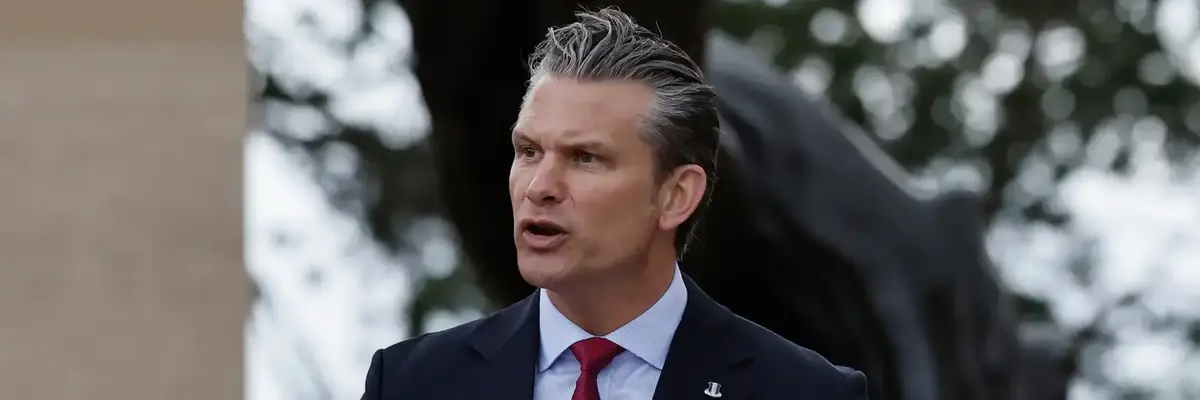
Defense Secretary Pete Hegseth at the U.S. cemetery in Colleville-sur-Mer, France, at a D-Day commemoration, on Saturday, June 6, 2026.
A Disgraceful Hegseth Dishonors Those Who Gave Their Lives on D-Day
It is not surprising that Hegseth cannot identify with the men who fought on D-Day.
If you have ever had the opportunity to visit the Normandy American Cemetery in Colleville-sur-Mer, France it is something that stays with you. The rows of white gravestones silhouetted against green grass and blue sky bear silent and eloquent witness to what happened on June 6, 1944. The cemetery contains the graves of 9,389 of Americans, most of whom lost their lives in the D-Day landings and the battles in France in 1944.
From the cemetery, you can see down to Omaha Beach the bloodiest part of the D-Day battlefield. While estimates vary, 2,400 to 3,600 total American casualties (including killed, wounded, and missing) occurred on Omaha Beach on D-Day, June 6, 1944. For me, the most moving part of the Cemetery is the Walls of the Missing where inscribed 1,557 names of the soldiers and sailors who were missing in action and have never had their bodies recovered.
For decades, American politicians have been visiting the Normandy Beaches to pay tribute to all the Americans and Allies (primarily British and Canadian) who fought on June 6, 1944. Particularly well-known is the speech that President Ronald Reagan made in June of 1984:
The men of Normandy had faith that what they were doing was right, faith that they fought for all humanity, faith that a just God would grant them mercy on this beachhead or on the next. It was the deep knowledge—and pray God we have not lost it—that there is a profound, moral difference between the use of force for liberation and the use of force for conquest. You were here to liberate, not to conquer, and so you and those others did not doubt your cause. And you were right not to doubt. You all knew that some things are worth dying for.
For an American politician, remarks at the Normandy beaches ought to be simple and straightforward. All you have to do is pay tribute as best you can to the extraordinary sacrifice made on June 6, 1944. As hard as it is to believe, US Defense Secretary Pete Hegseth failed this simple task. Rather than just pay tribute to the efforts of those who “hit the beach” on June 6, 1944, Hegseth launched into an anti-immigrant and far-right rant. As the New York Times reported:
In his remarks, Mr. Hegseth said that “freedom is not free” and especially praised the role played by American troops, but said that over the past eight or so decades, some European countries had grown “comfortable.” “Today, different European beaches are stormed by different dangerous ideologies,” he said. “Boats and men arrive. When will European capitals do something about that invasion? Or is it too late?”
I am sure it escaped Hegseth the fact that many of the Americans he heralds for their sacrifice were the sons of immigrants to the United States. To compare refugees coming to Europe fleeing war and economic oppression with Nazi tyranny defies belief.
It is not surprising that Hegseth cannot identify with the men who fought on D-Day. They were not the much hyped “war fighters” ignoring politically correct rules of engagement that Hegseth celebrates. Instead, they were ordinary men doing extraordinary things to defeat the most terrible tyranny the world has ever seen. History will remember the deeds of those who defeated Nazi tyranny, while Hegseth's far-right rhetoric will be nothing more than a footnote to a sad chapter in American history.
We are at a crossroads
This country and this world are at a monumental crossroads. In a few short weeks, US voters will have an opportunity to beat back the forces of fascism and confront the billionaires who are rigging the economy, our media system, and our democracy, making it increasingly impossible for ordinary people to get by. We’re not just talking about the election. We’re talking about what must be done once these fascist elements are vanquished from power. We need a bolder set of solutions than what either major party has so far been willing to offer and a working-class movement ready to fight like hell for it. Trump didn't emerge from nowhere. The conditions that fueled MAGA authoritarianism were created by decades of radical neoliberal economic policies and a corrupt political system dominated by corporate interests. They slashed taxes on the super-rich, promising that the benefits would trickle down. They said giveaways to the corporate titans would make life more affordable for the rest of us. It was all bullshit. And when a bitter, betrayed populace searches for someone to blame, right-wing demagogues have little trouble finding scapegoats. People know when they're being lied to, but you won't hear any of this from the corporate media. Only independent journalism—powered and funded by people who believe in building a better world—can deliver truly trustworthy daily news. Our Fall Campaign is underway, and we need your help. To power our newsroom through the rest of the year, we need to raise $125,000 by midnight on October 31. So if you share our vision, please contribute whatever you can to sustain our work. |
If you have ever had the opportunity to visit the Normandy American Cemetery in Colleville-sur-Mer, France it is something that stays with you. The rows of white gravestones silhouetted against green grass and blue sky bear silent and eloquent witness to what happened on June 6, 1944. The cemetery contains the graves of 9,389 of Americans, most of whom lost their lives in the D-Day landings and the battles in France in 1944.
From the cemetery, you can see down to Omaha Beach the bloodiest part of the D-Day battlefield. While estimates vary, 2,400 to 3,600 total American casualties (including killed, wounded, and missing) occurred on Omaha Beach on D-Day, June 6, 1944. For me, the most moving part of the Cemetery is the Walls of the Missing where inscribed 1,557 names of the soldiers and sailors who were missing in action and have never had their bodies recovered.
For decades, American politicians have been visiting the Normandy Beaches to pay tribute to all the Americans and Allies (primarily British and Canadian) who fought on June 6, 1944. Particularly well-known is the speech that President Ronald Reagan made in June of 1984:
The men of Normandy had faith that what they were doing was right, faith that they fought for all humanity, faith that a just God would grant them mercy on this beachhead or on the next. It was the deep knowledge—and pray God we have not lost it—that there is a profound, moral difference between the use of force for liberation and the use of force for conquest. You were here to liberate, not to conquer, and so you and those others did not doubt your cause. And you were right not to doubt. You all knew that some things are worth dying for.
For an American politician, remarks at the Normandy beaches ought to be simple and straightforward. All you have to do is pay tribute as best you can to the extraordinary sacrifice made on June 6, 1944. As hard as it is to believe, US Defense Secretary Pete Hegseth failed this simple task. Rather than just pay tribute to the efforts of those who “hit the beach” on June 6, 1944, Hegseth launched into an anti-immigrant and far-right rant. As the New York Times reported:
In his remarks, Mr. Hegseth said that “freedom is not free” and especially praised the role played by American troops, but said that over the past eight or so decades, some European countries had grown “comfortable.” “Today, different European beaches are stormed by different dangerous ideologies,” he said. “Boats and men arrive. When will European capitals do something about that invasion? Or is it too late?”
I am sure it escaped Hegseth the fact that many of the Americans he heralds for their sacrifice were the sons of immigrants to the United States. To compare refugees coming to Europe fleeing war and economic oppression with Nazi tyranny defies belief.
It is not surprising that Hegseth cannot identify with the men who fought on D-Day. They were not the much hyped “war fighters” ignoring politically correct rules of engagement that Hegseth celebrates. Instead, they were ordinary men doing extraordinary things to defeat the most terrible tyranny the world has ever seen. History will remember the deeds of those who defeated Nazi tyranny, while Hegseth's far-right rhetoric will be nothing more than a footnote to a sad chapter in American history.
If you have ever had the opportunity to visit the Normandy American Cemetery in Colleville-sur-Mer, France it is something that stays with you. The rows of white gravestones silhouetted against green grass and blue sky bear silent and eloquent witness to what happened on June 6, 1944. The cemetery contains the graves of 9,389 of Americans, most of whom lost their lives in the D-Day landings and the battles in France in 1944.
From the cemetery, you can see down to Omaha Beach the bloodiest part of the D-Day battlefield. While estimates vary, 2,400 to 3,600 total American casualties (including killed, wounded, and missing) occurred on Omaha Beach on D-Day, June 6, 1944. For me, the most moving part of the Cemetery is the Walls of the Missing where inscribed 1,557 names of the soldiers and sailors who were missing in action and have never had their bodies recovered.
For decades, American politicians have been visiting the Normandy Beaches to pay tribute to all the Americans and Allies (primarily British and Canadian) who fought on June 6, 1944. Particularly well-known is the speech that President Ronald Reagan made in June of 1984:
The men of Normandy had faith that what they were doing was right, faith that they fought for all humanity, faith that a just God would grant them mercy on this beachhead or on the next. It was the deep knowledge—and pray God we have not lost it—that there is a profound, moral difference between the use of force for liberation and the use of force for conquest. You were here to liberate, not to conquer, and so you and those others did not doubt your cause. And you were right not to doubt. You all knew that some things are worth dying for.
For an American politician, remarks at the Normandy beaches ought to be simple and straightforward. All you have to do is pay tribute as best you can to the extraordinary sacrifice made on June 6, 1944. As hard as it is to believe, US Defense Secretary Pete Hegseth failed this simple task. Rather than just pay tribute to the efforts of those who “hit the beach” on June 6, 1944, Hegseth launched into an anti-immigrant and far-right rant. As the New York Times reported:
In his remarks, Mr. Hegseth said that “freedom is not free” and especially praised the role played by American troops, but said that over the past eight or so decades, some European countries had grown “comfortable.” “Today, different European beaches are stormed by different dangerous ideologies,” he said. “Boats and men arrive. When will European capitals do something about that invasion? Or is it too late?”
I am sure it escaped Hegseth the fact that many of the Americans he heralds for their sacrifice were the sons of immigrants to the United States. To compare refugees coming to Europe fleeing war and economic oppression with Nazi tyranny defies belief.
It is not surprising that Hegseth cannot identify with the men who fought on D-Day. They were not the much hyped “war fighters” ignoring politically correct rules of engagement that Hegseth celebrates. Instead, they were ordinary men doing extraordinary things to defeat the most terrible tyranny the world has ever seen. History will remember the deeds of those who defeated Nazi tyranny, while Hegseth's far-right rhetoric will be nothing more than a footnote to a sad chapter in American history.