SUBSCRIBE TO OUR FREE NEWSLETTER
Daily news & progressive opinion—funded by the people, not the corporations—delivered straight to your inbox.
5
#000000
#FFFFFF
To donate by check, phone, or other method, see our More Ways to Give page.
Daily news & progressive opinion—funded by the people, not the corporations—delivered straight to your inbox.
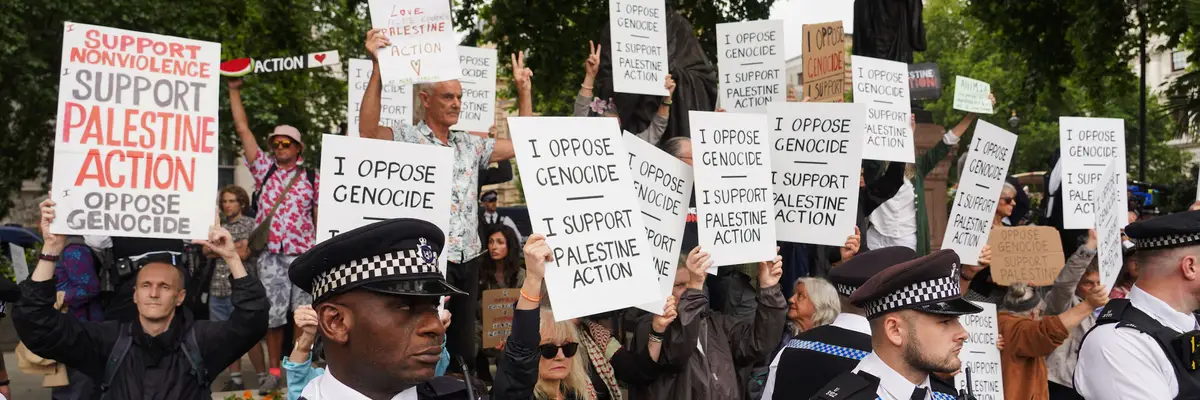
Members of the group Defend Our Juries publicly declare their opposition to Israel's genocidal assault on Gaza and their support for the proscribed group Palestine Action while Metropolitan Police officers look on before arresting them during a July 4, 2025 demonstration in London.
Not only is taking a stand against the overwhelming devastation that has been unleashed on Palestinians a duty, but also an obligation for people desiring peace and liberation for all.
Earlier this year a number of participants announced their withdrawal from Australia’s Adelaide Festival’s "Writer’s Week" following the disinviting of Australian-Palestinian author, Randa Abdel-Fattah. The event was subsequently cancelled.
This made me think of United Nations Special Rapporteur on the Occupied Palestinian Territories, Francesca Albanese’s words—“The occupation of Palestine must be understood as part of a broader project of domination. This is not merely about the physical borders of historical Palestine. It is a systematic assertion of permanent supremacy that knows no border…”—delivered in her Nelson Mandela Lecture.
Indeed, the impact of the ongoing genocide and occupation not only echo far beyond Palestine, because of our shared humanity, but also because of the impact it is having on freedoms across the globe. The censorship of Abdel-Fattah is yet another example of this, and it is not only happening in Australia. Even in South Africa, a country that charged Israel with genocide at the International Court of Justice (ICJ), artists are facing attempts to constrain their work.
The global wave of solidarity with Palestine has been used by some governments as a pretext to diminish freedoms by attacking the right to protest and political participation. While some did this by using laws that were already in place, others enacted ambiguous or unduly expansive legislation criminalizing Palestine solidarity and weaponizing the battle against antisemitism.
Protecting the freedom to advocate for Palestine is essential to protecting the right to protest, a fundamental tenet of democracy.
For instance in the US, Project Esther was released by the Heritage Foundation, a right-wing think tank also responsible for the odious Project 2025. The strategy’s recommendations have made their way into the policy of the Trump administration. This includes suing, firing, deporting, and defaming activists, organizations, and institutions by effectively claiming that involvement in advocacy for Palestine is material support of "a terrorist support network.” And also clamping down on college and university campuses where “more than 3,100 people have been arrested or detained.”
The United Kingdom, on the other hand, used counterterrorism legislation to ban Palestine Action. This despite an intelligence assessment report undermining the government’s claims by finding that most of the groups’ activities are “not terrorism” and the ban risked wrongfully criminalizing people. While the ban has been found to be unlawful, since put into effect in July 2025 terrorism arrests have increased by 660%, with the majority of these linked to it.
Across Europe Palestine solidarity was particularly targeted, like in Germany where the homes of pro-Palestinian activists have been raided and support for Israel has become a prerequisite for citizenship.
The effects of these actions will not be limited to Palestine advocacy and puts all movements at risk by diminishing freedoms that enable organizing across issues. So protecting the freedom to advocate for Palestine is essential to protecting the right to protest, a fundamental tenet of democracy.
Research by investigative journalist and author of The Palestine Laboratory, Andrew Loewenstein, identified over 120 countries that have bought weapons or some form of repressive technology from Israel, all principally tested on Palestinians.
Israel provided military and strategic support to apartheid South Africa’s invasion of Angola, resulting in mass casualties; it is among the countries that armed perpetrators of Rwanda’s genocide and Myanmar at a time it was found to be committing a “textbook example of ethnic cleansing” against its Rohingya Muslim population.
In modern times Israel’s offerings have included drones, spyware, and surveillance tools. Like the Israeli-made spyware being used by US Immigration and Customs Enforcement, an immigration agency that has been found to not only undertake abusive practices, but also violate its own policies.
For us in South Africa though, this is no surprise. The "homeland" of Bophuthatswana, where I was born and raised, was a product of the South African apartheid regime’s segregationist policies—which Israel took interest in—and stripped Black people of South African citizenship.
Like other homelands when it declared "independence" in 1977, it was shunned by the world. Despite its official stance, Israel was the only country to quietly recognize Bophuthatswana through informal connections and a quasi-diplomatic mission. A Jerusalem Post editorial in 1992 even referred to Bophuthatswana as "Africa’s Little Israel."
The backdrop of this relationship was the “clandestine alliance” between Israel and South Africa’s apartheid regime. Not only did the two countries collaborate on nuclear, but Israel would also become South Africa's largest weapons importer after the 1977 UN arms embargo and support the regime’s attempt to undermine sanctions.
It was a relationship of mutual admiration, an ideological alignment that in recent times is only matched by India’s admiration of Israel.
Apartheid had far-reaching consequences that extended beyond South Africa's borders. Along with unlawfully occupying Namibia, a colonial legacy embraced by the regime, it also launched hostilities in countries like Zambia and Zimbabwe. Similarly, Israel continues to conduct atrocities and aggression not only against the Palestinian people, but also in places like Lebanon, Yemen, and Syria. More recently, more than 300 people have been killed and scores injured following Israel's 10 minute assault in Lebanon—despite a two-week Middle East ceasefire, which Israel would afterwards claim did not include Lebanon. In the same way apartheid was deemed a threat to international peace and security, so too is the occupation and genocide in Palestine.
Not only is taking a stand against the overwhelming devastation that has been unleashed on Palestinians a duty, but also an obligation for people desiring peace and liberation for all. Because beyond the bombs, Israel has used international humanitarian law to try to justify the murder of civilians—a template being adopted by others like the Rapid Support Forces in Sudan.
Like the people of South Africa and oppressed people everywhere, the people of Palestine too will continue to make their rightful claim to freedom. And for the sake of humanity everywhere, people of conscience must continue to stand with them and keep the fire of freedom within reach.
Dear Common Dreams reader, It’s been nearly 30 years since I co-founded Common Dreams with my late wife, Lina Newhouser. We had the radical notion that journalism should serve the public good, not corporate profits. It was clear to us from the outset what it would take to build such a project. No paid advertisements. No corporate sponsors. No millionaire publisher telling us what to think or do. Many people said we wouldn't last a year, but we proved those doubters wrong. Together with a tremendous team of journalists and dedicated staff, we built an independent media outlet free from the constraints of profits and corporate control. Our mission has always been simple: To inform. To inspire. To ignite change for the common good. Building Common Dreams was not easy. Our survival was never guaranteed. When you take on the most powerful forces—Wall Street greed, fossil fuel industry destruction, Big Tech lobbyists, and uber-rich oligarchs who have spent billions upon billions rigging the economy and democracy in their favor—the only bulwark you have is supporters who believe in your work. But here’s the urgent message from me today. It's never been this bad out there. And it's never been this hard to keep us going. At the very moment Common Dreams is most needed, the threats we face are intensifying. We need your support now more than ever. We don't accept corporate advertising and never will. We don't have a paywall because we don't think people should be blocked from critical news based on their ability to pay. Everything we do is funded by the donations of readers like you. When everyone does the little they can afford, we are strong. But if that support retreats or dries up, so do we. Will you donate now to make sure Common Dreams not only survives but thrives? —Craig Brown, Co-founder |
Earlier this year a number of participants announced their withdrawal from Australia’s Adelaide Festival’s "Writer’s Week" following the disinviting of Australian-Palestinian author, Randa Abdel-Fattah. The event was subsequently cancelled.
This made me think of United Nations Special Rapporteur on the Occupied Palestinian Territories, Francesca Albanese’s words—“The occupation of Palestine must be understood as part of a broader project of domination. This is not merely about the physical borders of historical Palestine. It is a systematic assertion of permanent supremacy that knows no border…”—delivered in her Nelson Mandela Lecture.
Indeed, the impact of the ongoing genocide and occupation not only echo far beyond Palestine, because of our shared humanity, but also because of the impact it is having on freedoms across the globe. The censorship of Abdel-Fattah is yet another example of this, and it is not only happening in Australia. Even in South Africa, a country that charged Israel with genocide at the International Court of Justice (ICJ), artists are facing attempts to constrain their work.
The global wave of solidarity with Palestine has been used by some governments as a pretext to diminish freedoms by attacking the right to protest and political participation. While some did this by using laws that were already in place, others enacted ambiguous or unduly expansive legislation criminalizing Palestine solidarity and weaponizing the battle against antisemitism.
Protecting the freedom to advocate for Palestine is essential to protecting the right to protest, a fundamental tenet of democracy.
For instance in the US, Project Esther was released by the Heritage Foundation, a right-wing think tank also responsible for the odious Project 2025. The strategy’s recommendations have made their way into the policy of the Trump administration. This includes suing, firing, deporting, and defaming activists, organizations, and institutions by effectively claiming that involvement in advocacy for Palestine is material support of "a terrorist support network.” And also clamping down on college and university campuses where “more than 3,100 people have been arrested or detained.”
The United Kingdom, on the other hand, used counterterrorism legislation to ban Palestine Action. This despite an intelligence assessment report undermining the government’s claims by finding that most of the groups’ activities are “not terrorism” and the ban risked wrongfully criminalizing people. While the ban has been found to be unlawful, since put into effect in July 2025 terrorism arrests have increased by 660%, with the majority of these linked to it.
Across Europe Palestine solidarity was particularly targeted, like in Germany where the homes of pro-Palestinian activists have been raided and support for Israel has become a prerequisite for citizenship.
The effects of these actions will not be limited to Palestine advocacy and puts all movements at risk by diminishing freedoms that enable organizing across issues. So protecting the freedom to advocate for Palestine is essential to protecting the right to protest, a fundamental tenet of democracy.
Research by investigative journalist and author of The Palestine Laboratory, Andrew Loewenstein, identified over 120 countries that have bought weapons or some form of repressive technology from Israel, all principally tested on Palestinians.
Israel provided military and strategic support to apartheid South Africa’s invasion of Angola, resulting in mass casualties; it is among the countries that armed perpetrators of Rwanda’s genocide and Myanmar at a time it was found to be committing a “textbook example of ethnic cleansing” against its Rohingya Muslim population.
In modern times Israel’s offerings have included drones, spyware, and surveillance tools. Like the Israeli-made spyware being used by US Immigration and Customs Enforcement, an immigration agency that has been found to not only undertake abusive practices, but also violate its own policies.
For us in South Africa though, this is no surprise. The "homeland" of Bophuthatswana, where I was born and raised, was a product of the South African apartheid regime’s segregationist policies—which Israel took interest in—and stripped Black people of South African citizenship.
Like other homelands when it declared "independence" in 1977, it was shunned by the world. Despite its official stance, Israel was the only country to quietly recognize Bophuthatswana through informal connections and a quasi-diplomatic mission. A Jerusalem Post editorial in 1992 even referred to Bophuthatswana as "Africa’s Little Israel."
The backdrop of this relationship was the “clandestine alliance” between Israel and South Africa’s apartheid regime. Not only did the two countries collaborate on nuclear, but Israel would also become South Africa's largest weapons importer after the 1977 UN arms embargo and support the regime’s attempt to undermine sanctions.
It was a relationship of mutual admiration, an ideological alignment that in recent times is only matched by India’s admiration of Israel.
Apartheid had far-reaching consequences that extended beyond South Africa's borders. Along with unlawfully occupying Namibia, a colonial legacy embraced by the regime, it also launched hostilities in countries like Zambia and Zimbabwe. Similarly, Israel continues to conduct atrocities and aggression not only against the Palestinian people, but also in places like Lebanon, Yemen, and Syria. More recently, more than 300 people have been killed and scores injured following Israel's 10 minute assault in Lebanon—despite a two-week Middle East ceasefire, which Israel would afterwards claim did not include Lebanon. In the same way apartheid was deemed a threat to international peace and security, so too is the occupation and genocide in Palestine.
Not only is taking a stand against the overwhelming devastation that has been unleashed on Palestinians a duty, but also an obligation for people desiring peace and liberation for all. Because beyond the bombs, Israel has used international humanitarian law to try to justify the murder of civilians—a template being adopted by others like the Rapid Support Forces in Sudan.
Like the people of South Africa and oppressed people everywhere, the people of Palestine too will continue to make their rightful claim to freedom. And for the sake of humanity everywhere, people of conscience must continue to stand with them and keep the fire of freedom within reach.
Earlier this year a number of participants announced their withdrawal from Australia’s Adelaide Festival’s "Writer’s Week" following the disinviting of Australian-Palestinian author, Randa Abdel-Fattah. The event was subsequently cancelled.
This made me think of United Nations Special Rapporteur on the Occupied Palestinian Territories, Francesca Albanese’s words—“The occupation of Palestine must be understood as part of a broader project of domination. This is not merely about the physical borders of historical Palestine. It is a systematic assertion of permanent supremacy that knows no border…”—delivered in her Nelson Mandela Lecture.
Indeed, the impact of the ongoing genocide and occupation not only echo far beyond Palestine, because of our shared humanity, but also because of the impact it is having on freedoms across the globe. The censorship of Abdel-Fattah is yet another example of this, and it is not only happening in Australia. Even in South Africa, a country that charged Israel with genocide at the International Court of Justice (ICJ), artists are facing attempts to constrain their work.
The global wave of solidarity with Palestine has been used by some governments as a pretext to diminish freedoms by attacking the right to protest and political participation. While some did this by using laws that were already in place, others enacted ambiguous or unduly expansive legislation criminalizing Palestine solidarity and weaponizing the battle against antisemitism.
Protecting the freedom to advocate for Palestine is essential to protecting the right to protest, a fundamental tenet of democracy.
For instance in the US, Project Esther was released by the Heritage Foundation, a right-wing think tank also responsible for the odious Project 2025. The strategy’s recommendations have made their way into the policy of the Trump administration. This includes suing, firing, deporting, and defaming activists, organizations, and institutions by effectively claiming that involvement in advocacy for Palestine is material support of "a terrorist support network.” And also clamping down on college and university campuses where “more than 3,100 people have been arrested or detained.”
The United Kingdom, on the other hand, used counterterrorism legislation to ban Palestine Action. This despite an intelligence assessment report undermining the government’s claims by finding that most of the groups’ activities are “not terrorism” and the ban risked wrongfully criminalizing people. While the ban has been found to be unlawful, since put into effect in July 2025 terrorism arrests have increased by 660%, with the majority of these linked to it.
Across Europe Palestine solidarity was particularly targeted, like in Germany where the homes of pro-Palestinian activists have been raided and support for Israel has become a prerequisite for citizenship.
The effects of these actions will not be limited to Palestine advocacy and puts all movements at risk by diminishing freedoms that enable organizing across issues. So protecting the freedom to advocate for Palestine is essential to protecting the right to protest, a fundamental tenet of democracy.
Research by investigative journalist and author of The Palestine Laboratory, Andrew Loewenstein, identified over 120 countries that have bought weapons or some form of repressive technology from Israel, all principally tested on Palestinians.
Israel provided military and strategic support to apartheid South Africa’s invasion of Angola, resulting in mass casualties; it is among the countries that armed perpetrators of Rwanda’s genocide and Myanmar at a time it was found to be committing a “textbook example of ethnic cleansing” against its Rohingya Muslim population.
In modern times Israel’s offerings have included drones, spyware, and surveillance tools. Like the Israeli-made spyware being used by US Immigration and Customs Enforcement, an immigration agency that has been found to not only undertake abusive practices, but also violate its own policies.
For us in South Africa though, this is no surprise. The "homeland" of Bophuthatswana, where I was born and raised, was a product of the South African apartheid regime’s segregationist policies—which Israel took interest in—and stripped Black people of South African citizenship.
Like other homelands when it declared "independence" in 1977, it was shunned by the world. Despite its official stance, Israel was the only country to quietly recognize Bophuthatswana through informal connections and a quasi-diplomatic mission. A Jerusalem Post editorial in 1992 even referred to Bophuthatswana as "Africa’s Little Israel."
The backdrop of this relationship was the “clandestine alliance” between Israel and South Africa’s apartheid regime. Not only did the two countries collaborate on nuclear, but Israel would also become South Africa's largest weapons importer after the 1977 UN arms embargo and support the regime’s attempt to undermine sanctions.
It was a relationship of mutual admiration, an ideological alignment that in recent times is only matched by India’s admiration of Israel.
Apartheid had far-reaching consequences that extended beyond South Africa's borders. Along with unlawfully occupying Namibia, a colonial legacy embraced by the regime, it also launched hostilities in countries like Zambia and Zimbabwe. Similarly, Israel continues to conduct atrocities and aggression not only against the Palestinian people, but also in places like Lebanon, Yemen, and Syria. More recently, more than 300 people have been killed and scores injured following Israel's 10 minute assault in Lebanon—despite a two-week Middle East ceasefire, which Israel would afterwards claim did not include Lebanon. In the same way apartheid was deemed a threat to international peace and security, so too is the occupation and genocide in Palestine.
Not only is taking a stand against the overwhelming devastation that has been unleashed on Palestinians a duty, but also an obligation for people desiring peace and liberation for all. Because beyond the bombs, Israel has used international humanitarian law to try to justify the murder of civilians—a template being adopted by others like the Rapid Support Forces in Sudan.
Like the people of South Africa and oppressed people everywhere, the people of Palestine too will continue to make their rightful claim to freedom. And for the sake of humanity everywhere, people of conscience must continue to stand with them and keep the fire of freedom within reach.