SUBSCRIBE TO OUR FREE NEWSLETTER
Daily news & progressive opinion—funded by the people, not the corporations—delivered straight to your inbox.
5
#000000
#FFFFFF
To donate by check, phone, or other method, see our More Ways to Give page.
Daily news & progressive opinion—funded by the people, not the corporations—delivered straight to your inbox.
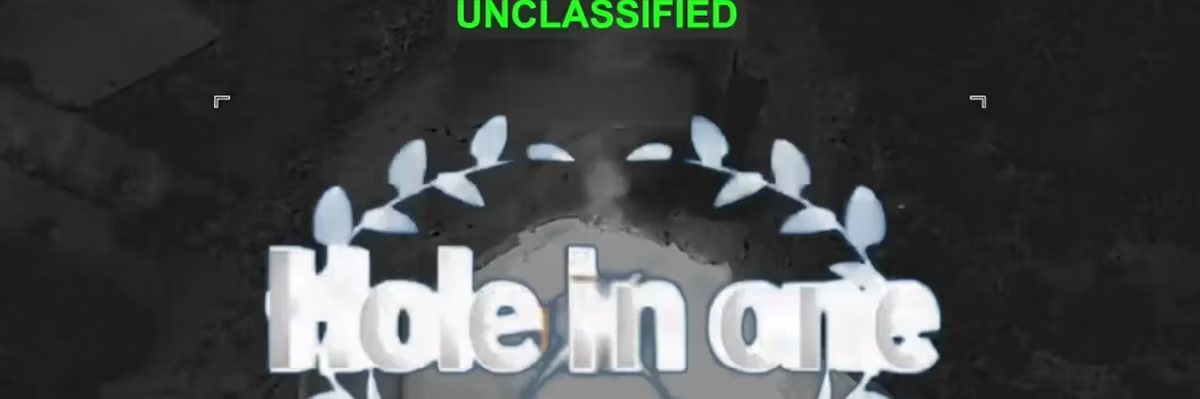
A video shared by the White House combines footage from Wii golf with video of US strikes on Iran.
By saying the quiet part out loud, Trump is revealing that war is based on the least of who we are, the least mature aspect of human nature.
Boys will be boys. Just ask the president.
At a gathering of Republicans a few days ago, Donald Trump talked nonchalantly about the recent sinking of an apparently unarmed Iranian frigate by the US Navy—in the Indian Ocean, more than 2,000 miles from the Persian Gulf. A total of 104 crew members were killed and 32 more were injured.
The president proceeded to make this more than merely another brutal, pointless act of war. He turned it into a glaring—shocking—revelation of truth... about the American-Israeli war on Iran and, quite possibly about all wars: about war itself. He was upset at first, he told the crowd, that the Navy sank the frigate rather than capturing it. But when he expressed this to the military officials, one of them responded, “It’s more fun to sink them.”
And the crowd laughed. Uh... are we “playing” war or waging it, with that trillion-dollar annual military budget America has? No doubt we’re doing both, but normally the “fun” part of war—the dehumanization of the enemy, the abstraction of people’s deaths (including those of children)—is airbrushed from public discussion by politically correct strategic and political blather. But this is Trump, spouting the quiet part out loud—in the process, causing the global infrastructure of nation-states, borders, and militarism to tremble. Could it be that war is based on the least of who we are, the least mature aspect of human nature?
A “global structure of nonviolence” is emerging—pushing, pushing against the deeply embedded infrastructure of war and us-vs.-them consciousness.
In contrast, I quote from a recent essay written by my friend Laura Hassler, founder and director of Musicians Without Borders:
Well, guess what. There are other forces alive in today’s world. Decades of resistance to domination and colonialism, the learnings of movements across the Global South, the freedom that Western hegemony for a few decades inadvertently released on its majority population, and access through social media to some of the reality of the actual horrors perpetrated in our names have together led to a worldwide awakening to fundamental injustices, and a worldwide longing for a livable, connected, survivable future.
She calls this worldwide awakening “Radical Empathy,” a term in widespread use, which means a deeply rooted sense of connection among people, well beyond merely sympathy and shared feelings. We are one planet, one people, and we will survive together or not at all.
“Radical Empathy must be fierce, stubborn, creative, persistent,” she continues. “We must hold on to each other, build community, be willing to take risks and accept consequences. Seek alternatives. Stand in solidarity with all who resist oppression and the violence of power and greed...
“And we artists must nurture artistic bravery, using the power of the arts to tell truth, to build community, to turn our capacity for radical empathy into a force for good.”
In other words, Radical Empathy isn’t simply emotional. You can say it’s spiritual, but it’s also political. It’s a movement: ever changing, ever manifesting in the moment, ever addressing conflict by reaching for connection and understanding. Yes, global nationalism still maintains the power to wage war. And war is everywhere these days. As Jeffrey Sachs noted in a recent interview, “World War III is here...” from Ukraine and Gaza and Iran to Asia to the Western Hemisphere. And the fighting across the world is linked.
But at the same time the world is changing. A “global structure of nonviolence” is emerging—pushing, pushing against the deeply embedded infrastructure of war and us-vs.-them consciousness. Finding understanding with your enemy—connecting with “the other”—can be incredibly difficult, especially in the midst of conflict, but Radical Empathy is making it a reality across the planet.
Laura Hassler’s organization, Musicians Without Borders, exemplifies this movement. The organization was founded in 1999, in Alkamaar, a city in the Netherlands. Laura, who was a choir director and organized music events, had put together a concert for the town’s annual honoring of the dead of World War II.
But as I wrote in a column several years ago:
The bloody war in Kosovo was then raging: Thousands had died; nearly a million refugees were streaming across Europe. Its horror dominated the daily news, and Laura couldn’t ignore it. She couldn’t simply focus on the war dead of half a century ago, not when the hell of war was alive in the present moment, pulling at her soul.
She decided, "We’ll perform music from the people suffering from war now—folk songs from Eastern Europe," she told me. Her impulse was to reach out, to connect, somehow, with those suffering right now, on the other side of Europe. And something happened the night of the concert. When it ended, there was a moment of profound silence... and then, as the audience stood, applause so thunderous that the rafters shook. It went on for 20 minutes.
One of the musicians, a political refugee from Turkey, said to her afterwards: "This concert was special. We should put it on a train, send it to Kosovo and stop the war!”
And they went to Kosovo. Gradually, Musicians Without Borders became global, working with local people in war-torn regions all over the world—people on both sides of the divide—to create music that transcends the war of the moment. The organization currently has long-term projects in the Balkans, West Asia, Eastern Africa, and Europe.
This is Radical Empathy, or at least one example of it—our complex force of hope even as the world’s leaders continue bleeding away the planet’s resources in order to play war. Radical Empathy transcends war. It’s who we are—when we find ourselves.
Dear Common Dreams reader, It’s been nearly 30 years since I co-founded Common Dreams with my late wife, Lina Newhouser. We had the radical notion that journalism should serve the public good, not corporate profits. It was clear to us from the outset what it would take to build such a project. No paid advertisements. No corporate sponsors. No millionaire publisher telling us what to think or do. Many people said we wouldn't last a year, but we proved those doubters wrong. Together with a tremendous team of journalists and dedicated staff, we built an independent media outlet free from the constraints of profits and corporate control. Our mission has always been simple: To inform. To inspire. To ignite change for the common good. Building Common Dreams was not easy. Our survival was never guaranteed. When you take on the most powerful forces—Wall Street greed, fossil fuel industry destruction, Big Tech lobbyists, and uber-rich oligarchs who have spent billions upon billions rigging the economy and democracy in their favor—the only bulwark you have is supporters who believe in your work. But here’s the urgent message from me today. It's never been this bad out there. And it's never been this hard to keep us going. At the very moment Common Dreams is most needed, the threats we face are intensifying. We need your support now more than ever. We don't accept corporate advertising and never will. We don't have a paywall because we don't think people should be blocked from critical news based on their ability to pay. Everything we do is funded by the donations of readers like you. When everyone does the little they can afford, we are strong. But if that support retreats or dries up, so do we. Will you donate now to make sure Common Dreams not only survives but thrives? —Craig Brown, Co-founder |
Boys will be boys. Just ask the president.
At a gathering of Republicans a few days ago, Donald Trump talked nonchalantly about the recent sinking of an apparently unarmed Iranian frigate by the US Navy—in the Indian Ocean, more than 2,000 miles from the Persian Gulf. A total of 104 crew members were killed and 32 more were injured.
The president proceeded to make this more than merely another brutal, pointless act of war. He turned it into a glaring—shocking—revelation of truth... about the American-Israeli war on Iran and, quite possibly about all wars: about war itself. He was upset at first, he told the crowd, that the Navy sank the frigate rather than capturing it. But when he expressed this to the military officials, one of them responded, “It’s more fun to sink them.”
And the crowd laughed. Uh... are we “playing” war or waging it, with that trillion-dollar annual military budget America has? No doubt we’re doing both, but normally the “fun” part of war—the dehumanization of the enemy, the abstraction of people’s deaths (including those of children)—is airbrushed from public discussion by politically correct strategic and political blather. But this is Trump, spouting the quiet part out loud—in the process, causing the global infrastructure of nation-states, borders, and militarism to tremble. Could it be that war is based on the least of who we are, the least mature aspect of human nature?
A “global structure of nonviolence” is emerging—pushing, pushing against the deeply embedded infrastructure of war and us-vs.-them consciousness.
In contrast, I quote from a recent essay written by my friend Laura Hassler, founder and director of Musicians Without Borders:
Well, guess what. There are other forces alive in today’s world. Decades of resistance to domination and colonialism, the learnings of movements across the Global South, the freedom that Western hegemony for a few decades inadvertently released on its majority population, and access through social media to some of the reality of the actual horrors perpetrated in our names have together led to a worldwide awakening to fundamental injustices, and a worldwide longing for a livable, connected, survivable future.
She calls this worldwide awakening “Radical Empathy,” a term in widespread use, which means a deeply rooted sense of connection among people, well beyond merely sympathy and shared feelings. We are one planet, one people, and we will survive together or not at all.
“Radical Empathy must be fierce, stubborn, creative, persistent,” she continues. “We must hold on to each other, build community, be willing to take risks and accept consequences. Seek alternatives. Stand in solidarity with all who resist oppression and the violence of power and greed...
“And we artists must nurture artistic bravery, using the power of the arts to tell truth, to build community, to turn our capacity for radical empathy into a force for good.”
In other words, Radical Empathy isn’t simply emotional. You can say it’s spiritual, but it’s also political. It’s a movement: ever changing, ever manifesting in the moment, ever addressing conflict by reaching for connection and understanding. Yes, global nationalism still maintains the power to wage war. And war is everywhere these days. As Jeffrey Sachs noted in a recent interview, “World War III is here...” from Ukraine and Gaza and Iran to Asia to the Western Hemisphere. And the fighting across the world is linked.
But at the same time the world is changing. A “global structure of nonviolence” is emerging—pushing, pushing against the deeply embedded infrastructure of war and us-vs.-them consciousness. Finding understanding with your enemy—connecting with “the other”—can be incredibly difficult, especially in the midst of conflict, but Radical Empathy is making it a reality across the planet.
Laura Hassler’s organization, Musicians Without Borders, exemplifies this movement. The organization was founded in 1999, in Alkamaar, a city in the Netherlands. Laura, who was a choir director and organized music events, had put together a concert for the town’s annual honoring of the dead of World War II.
But as I wrote in a column several years ago:
The bloody war in Kosovo was then raging: Thousands had died; nearly a million refugees were streaming across Europe. Its horror dominated the daily news, and Laura couldn’t ignore it. She couldn’t simply focus on the war dead of half a century ago, not when the hell of war was alive in the present moment, pulling at her soul.
She decided, "We’ll perform music from the people suffering from war now—folk songs from Eastern Europe," she told me. Her impulse was to reach out, to connect, somehow, with those suffering right now, on the other side of Europe. And something happened the night of the concert. When it ended, there was a moment of profound silence... and then, as the audience stood, applause so thunderous that the rafters shook. It went on for 20 minutes.
One of the musicians, a political refugee from Turkey, said to her afterwards: "This concert was special. We should put it on a train, send it to Kosovo and stop the war!”
And they went to Kosovo. Gradually, Musicians Without Borders became global, working with local people in war-torn regions all over the world—people on both sides of the divide—to create music that transcends the war of the moment. The organization currently has long-term projects in the Balkans, West Asia, Eastern Africa, and Europe.
This is Radical Empathy, or at least one example of it—our complex force of hope even as the world’s leaders continue bleeding away the planet’s resources in order to play war. Radical Empathy transcends war. It’s who we are—when we find ourselves.
Boys will be boys. Just ask the president.
At a gathering of Republicans a few days ago, Donald Trump talked nonchalantly about the recent sinking of an apparently unarmed Iranian frigate by the US Navy—in the Indian Ocean, more than 2,000 miles from the Persian Gulf. A total of 104 crew members were killed and 32 more were injured.
The president proceeded to make this more than merely another brutal, pointless act of war. He turned it into a glaring—shocking—revelation of truth... about the American-Israeli war on Iran and, quite possibly about all wars: about war itself. He was upset at first, he told the crowd, that the Navy sank the frigate rather than capturing it. But when he expressed this to the military officials, one of them responded, “It’s more fun to sink them.”
And the crowd laughed. Uh... are we “playing” war or waging it, with that trillion-dollar annual military budget America has? No doubt we’re doing both, but normally the “fun” part of war—the dehumanization of the enemy, the abstraction of people’s deaths (including those of children)—is airbrushed from public discussion by politically correct strategic and political blather. But this is Trump, spouting the quiet part out loud—in the process, causing the global infrastructure of nation-states, borders, and militarism to tremble. Could it be that war is based on the least of who we are, the least mature aspect of human nature?
A “global structure of nonviolence” is emerging—pushing, pushing against the deeply embedded infrastructure of war and us-vs.-them consciousness.
In contrast, I quote from a recent essay written by my friend Laura Hassler, founder and director of Musicians Without Borders:
Well, guess what. There are other forces alive in today’s world. Decades of resistance to domination and colonialism, the learnings of movements across the Global South, the freedom that Western hegemony for a few decades inadvertently released on its majority population, and access through social media to some of the reality of the actual horrors perpetrated in our names have together led to a worldwide awakening to fundamental injustices, and a worldwide longing for a livable, connected, survivable future.
She calls this worldwide awakening “Radical Empathy,” a term in widespread use, which means a deeply rooted sense of connection among people, well beyond merely sympathy and shared feelings. We are one planet, one people, and we will survive together or not at all.
“Radical Empathy must be fierce, stubborn, creative, persistent,” she continues. “We must hold on to each other, build community, be willing to take risks and accept consequences. Seek alternatives. Stand in solidarity with all who resist oppression and the violence of power and greed...
“And we artists must nurture artistic bravery, using the power of the arts to tell truth, to build community, to turn our capacity for radical empathy into a force for good.”
In other words, Radical Empathy isn’t simply emotional. You can say it’s spiritual, but it’s also political. It’s a movement: ever changing, ever manifesting in the moment, ever addressing conflict by reaching for connection and understanding. Yes, global nationalism still maintains the power to wage war. And war is everywhere these days. As Jeffrey Sachs noted in a recent interview, “World War III is here...” from Ukraine and Gaza and Iran to Asia to the Western Hemisphere. And the fighting across the world is linked.
But at the same time the world is changing. A “global structure of nonviolence” is emerging—pushing, pushing against the deeply embedded infrastructure of war and us-vs.-them consciousness. Finding understanding with your enemy—connecting with “the other”—can be incredibly difficult, especially in the midst of conflict, but Radical Empathy is making it a reality across the planet.
Laura Hassler’s organization, Musicians Without Borders, exemplifies this movement. The organization was founded in 1999, in Alkamaar, a city in the Netherlands. Laura, who was a choir director and organized music events, had put together a concert for the town’s annual honoring of the dead of World War II.
But as I wrote in a column several years ago:
The bloody war in Kosovo was then raging: Thousands had died; nearly a million refugees were streaming across Europe. Its horror dominated the daily news, and Laura couldn’t ignore it. She couldn’t simply focus on the war dead of half a century ago, not when the hell of war was alive in the present moment, pulling at her soul.
She decided, "We’ll perform music from the people suffering from war now—folk songs from Eastern Europe," she told me. Her impulse was to reach out, to connect, somehow, with those suffering right now, on the other side of Europe. And something happened the night of the concert. When it ended, there was a moment of profound silence... and then, as the audience stood, applause so thunderous that the rafters shook. It went on for 20 minutes.
One of the musicians, a political refugee from Turkey, said to her afterwards: "This concert was special. We should put it on a train, send it to Kosovo and stop the war!”
And they went to Kosovo. Gradually, Musicians Without Borders became global, working with local people in war-torn regions all over the world—people on both sides of the divide—to create music that transcends the war of the moment. The organization currently has long-term projects in the Balkans, West Asia, Eastern Africa, and Europe.
This is Radical Empathy, or at least one example of it—our complex force of hope even as the world’s leaders continue bleeding away the planet’s resources in order to play war. Radical Empathy transcends war. It’s who we are—when we find ourselves.