SUBSCRIBE TO OUR FREE NEWSLETTER
Daily news & progressive opinion—funded by the people, not the corporations—delivered straight to your inbox.
5
#000000
#FFFFFF
To donate by check, phone, or other method, see our More Ways to Give page.
Daily news & progressive opinion—funded by the people, not the corporations—delivered straight to your inbox.
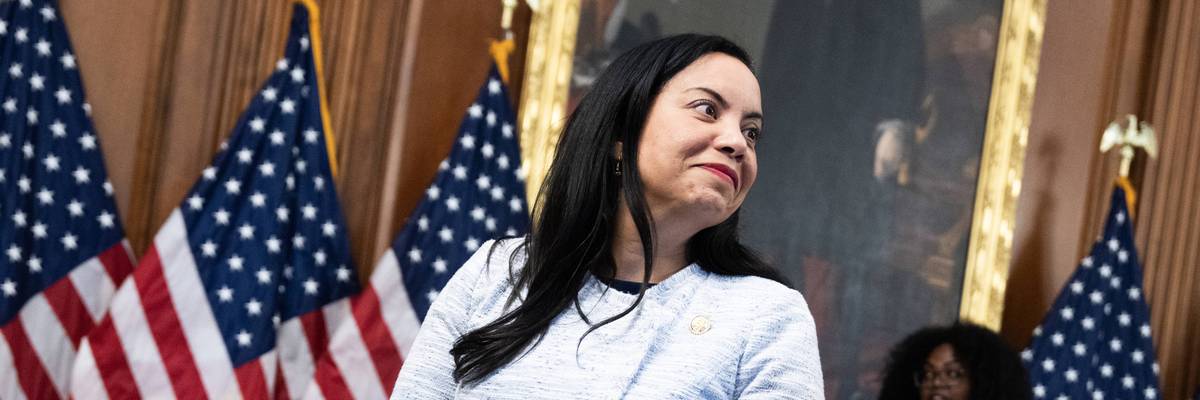
Rep. Analilia Mejia (D-NJ) is seen before her swearing in ceremony on Monday, April 20, 2026.
Poll after poll shows majorities of the public back taxing corporations and the very rich, prefer a Medicare for All healthcare system to our patchwork private insurance system, and are deeply concerned about climate change.
The re-election of Donald Trump reignited a simmering feud between the progressive and centrist wings of the Democratic Party. While centrists have cautioned against alienating “moderate” voters, progressives have urged the party to rally around universal healthcare, raising wages, and other populist measures.
If recent elections are any indication, moderate voters seem plenty receptive to progressive appeals.
Newly minted Rep. Analilia Mejia recently won a special election for New Jersey’s 11th district in the House of Representatives. Mejia replaces moderate Democrat Mikie Sherill, who vacated her seat in the affluent, suburban district after winning the state’s gubernatorial election.
Mejia gave a fiery inaugural address on April 20 calling on her colleagues to “Stand up, defend, and restore not only our democracy, but also a just economy that actually works for working people.”
Centrism means preserving the status quo—and the status quo is a failure for most Americans.
Mejia has built a political career championing economic populism. Not only did she serve as Sen. Bernie Sanders’ (I-Vt.) 2020 campaign political director, but was also co-executive director of the Center for Popular Democracy and director of the New Jersey Working Families Alliance.
Poll after poll shows majorities of the public back taxing corporations and the very rich, prefer a Medicare for All healthcare system to our patchwork private insurance system, and are deeply concerned about climate change. Mejia says that makes those issues good politics as well as policy.
I talked to Mejia in the run-up to the 2022 midterms. “The policies that really motivate people, that work for working families,” she told me then, “are also popular ideas.”
She’s right. This year, Mejia won her suburban district handily, beating out Republicans and more centrist or conservative Democrats. Her populist, morally unambiguous platform included a demand to abolish Immigration and Customs Enforcement (ICE) and a denunciation of Israel’s genocide in Gaza.
In November 2026, Mejia will run for the same congressional seat, facing Republican candidate Joe Hathaway, a man who labeled her a “radical socialist.”
But there’s nothing radical about popular programs that address affordability.
Pundits have claimed for years that tacking to the center is a surefire way to win political power. When Vice President Kamala Harris ran for president on a centrist campaign in 2024, many explained her loss to Donald Trump as the result of her identity rather than her politics.
But centrism means preserving the status quo—and the status quo is a failure for most Americans. Sharp analysts such as Tressie McMillan Cottom identified the real reason Harris lost, saying her “promise was that nothing much would change about the country but the race and gender of the one in charge.”
At a time when some members of Harris’ party are giving in to a white supremacist resurgence by backing away from people of color in positions of power, Mejia leans into her racial and ethnic identity to connect with voters of all backgrounds. “I am the daughter of a Dominican factory worker and a Colombian seamstress who knew struggle,” she said during her inaugural speech.
Indeed, candidates like Mejia—and progressive populist politicians such as Rep. Delia Ramirez (D-Ill.), Rep. Summer Lee (D-Pa.), and New York Mayor Zohran Mamdani—have proven that demographic diversity is not a liability for candidates who embrace justice-driven platforms and take principled stands on issues.
“The ideas that we support are popular ideas, are transformative ideas, and if we get together and raise our voices, we can and must win,” Mejia told me in 2022. “Everything depends on it.”
She added, “Democracy is not a spectator sport. You have to jump in and participate.” And that’s precisely what she did.
Dear Common Dreams reader, It’s been nearly 30 years since I co-founded Common Dreams with my late wife, Lina Newhouser. We had the radical notion that journalism should serve the public good, not corporate profits. It was clear to us from the outset what it would take to build such a project. No paid advertisements. No corporate sponsors. No millionaire publisher telling us what to think or do. Many people said we wouldn't last a year, but we proved those doubters wrong. Together with a tremendous team of journalists and dedicated staff, we built an independent media outlet free from the constraints of profits and corporate control. Our mission has always been simple: To inform. To inspire. To ignite change for the common good. Building Common Dreams was not easy. Our survival was never guaranteed. When you take on the most powerful forces—Wall Street greed, fossil fuel industry destruction, Big Tech lobbyists, and uber-rich oligarchs who have spent billions upon billions rigging the economy and democracy in their favor—the only bulwark you have is supporters who believe in your work. But here’s the urgent message from me today. It's never been this bad out there. And it's never been this hard to keep us going. At the very moment Common Dreams is most needed, the threats we face are intensifying. We need your support now more than ever. We don't accept corporate advertising and never will. We don't have a paywall because we don't think people should be blocked from critical news based on their ability to pay. Everything we do is funded by the donations of readers like you. When everyone does the little they can afford, we are strong. But if that support retreats or dries up, so do we. Will you donate now to make sure Common Dreams not only survives but thrives? —Craig Brown, Co-founder |
The re-election of Donald Trump reignited a simmering feud between the progressive and centrist wings of the Democratic Party. While centrists have cautioned against alienating “moderate” voters, progressives have urged the party to rally around universal healthcare, raising wages, and other populist measures.
If recent elections are any indication, moderate voters seem plenty receptive to progressive appeals.
Newly minted Rep. Analilia Mejia recently won a special election for New Jersey’s 11th district in the House of Representatives. Mejia replaces moderate Democrat Mikie Sherill, who vacated her seat in the affluent, suburban district after winning the state’s gubernatorial election.
Mejia gave a fiery inaugural address on April 20 calling on her colleagues to “Stand up, defend, and restore not only our democracy, but also a just economy that actually works for working people.”
Centrism means preserving the status quo—and the status quo is a failure for most Americans.
Mejia has built a political career championing economic populism. Not only did she serve as Sen. Bernie Sanders’ (I-Vt.) 2020 campaign political director, but was also co-executive director of the Center for Popular Democracy and director of the New Jersey Working Families Alliance.
Poll after poll shows majorities of the public back taxing corporations and the very rich, prefer a Medicare for All healthcare system to our patchwork private insurance system, and are deeply concerned about climate change. Mejia says that makes those issues good politics as well as policy.
I talked to Mejia in the run-up to the 2022 midterms. “The policies that really motivate people, that work for working families,” she told me then, “are also popular ideas.”
She’s right. This year, Mejia won her suburban district handily, beating out Republicans and more centrist or conservative Democrats. Her populist, morally unambiguous platform included a demand to abolish Immigration and Customs Enforcement (ICE) and a denunciation of Israel’s genocide in Gaza.
In November 2026, Mejia will run for the same congressional seat, facing Republican candidate Joe Hathaway, a man who labeled her a “radical socialist.”
But there’s nothing radical about popular programs that address affordability.
Pundits have claimed for years that tacking to the center is a surefire way to win political power. When Vice President Kamala Harris ran for president on a centrist campaign in 2024, many explained her loss to Donald Trump as the result of her identity rather than her politics.
But centrism means preserving the status quo—and the status quo is a failure for most Americans. Sharp analysts such as Tressie McMillan Cottom identified the real reason Harris lost, saying her “promise was that nothing much would change about the country but the race and gender of the one in charge.”
At a time when some members of Harris’ party are giving in to a white supremacist resurgence by backing away from people of color in positions of power, Mejia leans into her racial and ethnic identity to connect with voters of all backgrounds. “I am the daughter of a Dominican factory worker and a Colombian seamstress who knew struggle,” she said during her inaugural speech.
Indeed, candidates like Mejia—and progressive populist politicians such as Rep. Delia Ramirez (D-Ill.), Rep. Summer Lee (D-Pa.), and New York Mayor Zohran Mamdani—have proven that demographic diversity is not a liability for candidates who embrace justice-driven platforms and take principled stands on issues.
“The ideas that we support are popular ideas, are transformative ideas, and if we get together and raise our voices, we can and must win,” Mejia told me in 2022. “Everything depends on it.”
She added, “Democracy is not a spectator sport. You have to jump in and participate.” And that’s precisely what she did.
The re-election of Donald Trump reignited a simmering feud between the progressive and centrist wings of the Democratic Party. While centrists have cautioned against alienating “moderate” voters, progressives have urged the party to rally around universal healthcare, raising wages, and other populist measures.
If recent elections are any indication, moderate voters seem plenty receptive to progressive appeals.
Newly minted Rep. Analilia Mejia recently won a special election for New Jersey’s 11th district in the House of Representatives. Mejia replaces moderate Democrat Mikie Sherill, who vacated her seat in the affluent, suburban district after winning the state’s gubernatorial election.
Mejia gave a fiery inaugural address on April 20 calling on her colleagues to “Stand up, defend, and restore not only our democracy, but also a just economy that actually works for working people.”
Centrism means preserving the status quo—and the status quo is a failure for most Americans.
Mejia has built a political career championing economic populism. Not only did she serve as Sen. Bernie Sanders’ (I-Vt.) 2020 campaign political director, but was also co-executive director of the Center for Popular Democracy and director of the New Jersey Working Families Alliance.
Poll after poll shows majorities of the public back taxing corporations and the very rich, prefer a Medicare for All healthcare system to our patchwork private insurance system, and are deeply concerned about climate change. Mejia says that makes those issues good politics as well as policy.
I talked to Mejia in the run-up to the 2022 midterms. “The policies that really motivate people, that work for working families,” she told me then, “are also popular ideas.”
She’s right. This year, Mejia won her suburban district handily, beating out Republicans and more centrist or conservative Democrats. Her populist, morally unambiguous platform included a demand to abolish Immigration and Customs Enforcement (ICE) and a denunciation of Israel’s genocide in Gaza.
In November 2026, Mejia will run for the same congressional seat, facing Republican candidate Joe Hathaway, a man who labeled her a “radical socialist.”
But there’s nothing radical about popular programs that address affordability.
Pundits have claimed for years that tacking to the center is a surefire way to win political power. When Vice President Kamala Harris ran for president on a centrist campaign in 2024, many explained her loss to Donald Trump as the result of her identity rather than her politics.
But centrism means preserving the status quo—and the status quo is a failure for most Americans. Sharp analysts such as Tressie McMillan Cottom identified the real reason Harris lost, saying her “promise was that nothing much would change about the country but the race and gender of the one in charge.”
At a time when some members of Harris’ party are giving in to a white supremacist resurgence by backing away from people of color in positions of power, Mejia leans into her racial and ethnic identity to connect with voters of all backgrounds. “I am the daughter of a Dominican factory worker and a Colombian seamstress who knew struggle,” she said during her inaugural speech.
Indeed, candidates like Mejia—and progressive populist politicians such as Rep. Delia Ramirez (D-Ill.), Rep. Summer Lee (D-Pa.), and New York Mayor Zohran Mamdani—have proven that demographic diversity is not a liability for candidates who embrace justice-driven platforms and take principled stands on issues.
“The ideas that we support are popular ideas, are transformative ideas, and if we get together and raise our voices, we can and must win,” Mejia told me in 2022. “Everything depends on it.”
She added, “Democracy is not a spectator sport. You have to jump in and participate.” And that’s precisely what she did.