SUBSCRIBE TO OUR FREE NEWSLETTER
Daily news & progressive opinion—funded by the people, not the corporations—delivered straight to your inbox.
5
#000000
#FFFFFF
To donate by check, phone, or other method, see our More Ways to Give page.
Daily news & progressive opinion—funded by the people, not the corporations—delivered straight to your inbox.
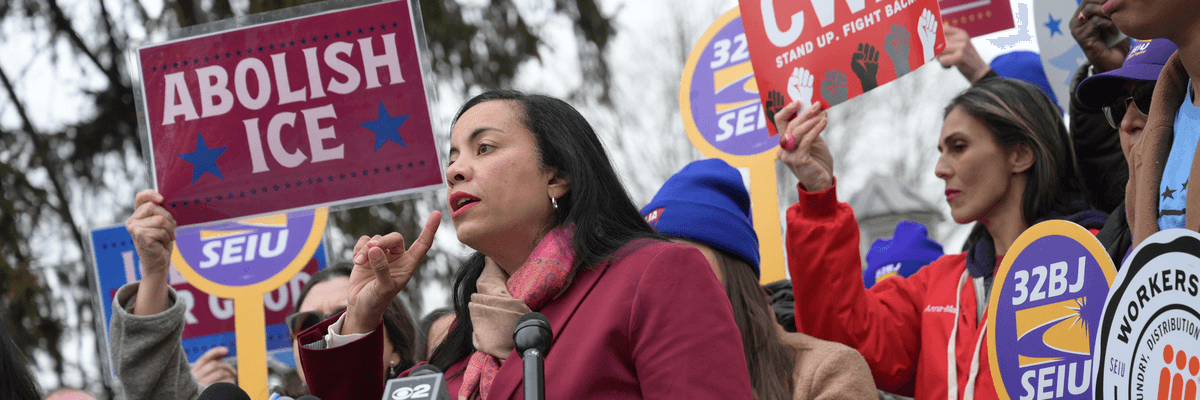
Analilia Mejía speaks at a rally ahead of her February 10, 2026 victory in the Democratic primary in New Jersey’s 11th Congressional District.
The special primary election in New Jersey's 11th Congressional District was the first real chance Democrats have had to express their disapproval of the party leadership; it will certainly not be the last.
For months now, Democrats have expressed frustration with their party’s inability to oppose Trump 2.0 and the failure to construct an alternative. In October 2025, the Pew Research Foundation found that
The Pew research builds on earlier research from the AP-NORC. In an open-ended question (meaning that respondents are free to volunteer anything), roughly 15% of Democrats described their party using words like "weak," or "apathetic," while an additional 10% believe it is broadly "ineffective" or "disorganized." Only 2 in 10 (20%) Democrats use positive words to describe their party. The most popular positive adjectives are “empathetic” and “inclusive.”
There are certainly Democrats on Capitol Hill who express frustration with their party for not doing enough to oppose President Donald Trump and put forth an alternative. Though he is not technically a Democrat (he is an Independent who caucuses with the Democrats), Vermont Sen. Bernie Sanders is a regular critic of the Democratic Party. Over the last few months, Sanders has been joined by others. The Washington Post reported back in September 2025 that Sen. Chris Van Hollen (D-Md.) has come to join those dissatisfied with the Democratic response to Trump:
During more than two decades in Congress, Sen. Chris Van Hollen of Maryland has earned a reputation as a mainstream policy wonk and loyal lieutenant to Democratic leaders. So, it came as something of a shock this month when Van Hollen derided top Democrats for failing to endorse New York mayoral candidate Zohran Mamdani, a 33-year-old democratic socialist. “Many Democratic members of the Senate and the House representing New York have stayed on the sidelines” in the race, even as Mamdani has captured the public’s imagination by focusing on “ensuring that people can afford to live in the place where they work,” Van Hollen told a cheering crowd of party activists in Des Moines. “That kind of spineless politics is what people are sick of.”
Democrat rank and file were frustrated by their party’s breaking ranks in the Senate on the government shutdown in November. To many Democrats, including a number of Democrats on Capitol Hill, their party ended the shutdown without winning anything. MS described the situation as:
By breaking ranks, the eight Democrats effectively stripped their caucus of leverage to force an extension of the healthcare tax credits—and decided on their own, how the party’s shutdown strategy would end. It came as a shock to most Democrats.
Disgruntled Democrats have not had many opportunities to express their frustration with their party. There have not been any real Democratic primaries. All of this changed in dramatic form with the Democratic primary February 5 for New Jersey’s vacant 11th District (the former incumbent Mikie Sherrill was elected New Jersey governor). It is certainly fair to say that the 11th District is a Democratic one, but it is not one where you would expect a progressive to do well. It is mostly affluent suburbs where many commute to work in New York City.
In a result that shocked the Democratic establishment in both New Jersey and Washington, DC, Analilia Mejia, director of the New Jersey Working Families Alliance, and the political director for Bernie Sanders 2020 campaign, won a tightly contested multi-candidate field including former Congressman Tom Malinowski who had the backing of New Jersey Sen. Andy Kim. Also in the race was Lt. Gov. Tahesha Way and Essex County Commissioner Brendan Gill.
In her campaign, Mejia spent far less than her opponents and lacked endorsement by county Democratic officials. She compensated for this by building an impressive get-out-the-vote operation and by emphasizing her opposition to the Trump administration’s immigration policies.
Mejia’s campaign was also helped by the American Israel Public Affairs Committee (AIPAC), which spent over $2 million in negative advertising attacking Malinowski. Many of the ads attacked him for a vote connected to US Immigration and Customs Enforcement (ICE) funding; the group had made it clear they felt Malinowski’s openness to conditioning aid to Israel was not sufficiently supportive of Israel. AIPAC’s involvement in the race certainly hurt Malinowski, but I doubt whether it was decisive. Mejia’s win was the result of her longtime organizing in New Jersey and fact that her campaign’s message fit the mood of the electorate.
New York Times columnist Michele Goldberg recounts her conversation with a longtime New Jersey pollster:
But the longtime New Jersey pollster Patrick Murray told me he wasn’t surprised, because “this is an incredibly angry Democratic electorate.” New Jersey suburbanites, he argues, didn’t suddenly turn into democratic socialists. But they think the Democratic establishment has been feckless, and they want representatives who won’t consult a focus group before battling the president. “The underlying message,” he said, is that Democratic voters believe their party “should be on a war footing with Donald Trump.”
Mejia still must win a special general election in April before she can take her seat in Congress. However, given the district’s partisan tilt, it seems like a pretty safe bet.
The special primary election in New Jersey's 11th Congressional District was the first real chance Democrats have had to express their disapproval of the party leadership. It will certainly not be the last opportunity for restive Democrats to express their frustrations with their party. Based on what happened in New Jersey’s 11th Congressional District, status-quo Democrats have much to be worried about. On February 11, Axios reported on a conversation with Sen. Sanders:
Asked in a phone interview where else he thinks the left can win upset victories, Sanders pointed to a "Fighting Oligarchy" rally he is doing on Friday with Nida Allam, who is challenging Rep. Valerie Foushee (D-NC). "That might be another area where progressives can win a strong victory," he said. Brad Lander, the former New York City comptroller challenging Rep. Dan Goldman (D-NY), also has "a strong chance to win," Sanders said.
Mejia’s win in New Jersey may well be the harbinger of more wins for the left wing of the Democratic Party as Democrats look to send a message to their leadership on Capitol Hill. The Democratic leadership in Washington, DC has yet to come to terms with how frustrated and angry ordinary Democrats are not only with Trump but with their leadership as well.
Dear Common Dreams reader, It’s been nearly 30 years since I co-founded Common Dreams with my late wife, Lina Newhouser. We had the radical notion that journalism should serve the public good, not corporate profits. It was clear to us from the outset what it would take to build such a project. No paid advertisements. No corporate sponsors. No millionaire publisher telling us what to think or do. Many people said we wouldn't last a year, but we proved those doubters wrong. Together with a tremendous team of journalists and dedicated staff, we built an independent media outlet free from the constraints of profits and corporate control. Our mission has always been simple: To inform. To inspire. To ignite change for the common good. Building Common Dreams was not easy. Our survival was never guaranteed. When you take on the most powerful forces—Wall Street greed, fossil fuel industry destruction, Big Tech lobbyists, and uber-rich oligarchs who have spent billions upon billions rigging the economy and democracy in their favor—the only bulwark you have is supporters who believe in your work. But here’s the urgent message from me today. It's never been this bad out there. And it's never been this hard to keep us going. At the very moment Common Dreams is most needed, the threats we face are intensifying. We need your support now more than ever. We don't accept corporate advertising and never will. We don't have a paywall because we don't think people should be blocked from critical news based on their ability to pay. Everything we do is funded by the donations of readers like you. When everyone does the little they can afford, we are strong. But if that support retreats or dries up, so do we. Will you donate now to make sure Common Dreams not only survives but thrives? —Craig Brown, Co-founder |
For months now, Democrats have expressed frustration with their party’s inability to oppose Trump 2.0 and the failure to construct an alternative. In October 2025, the Pew Research Foundation found that
The Pew research builds on earlier research from the AP-NORC. In an open-ended question (meaning that respondents are free to volunteer anything), roughly 15% of Democrats described their party using words like "weak," or "apathetic," while an additional 10% believe it is broadly "ineffective" or "disorganized." Only 2 in 10 (20%) Democrats use positive words to describe their party. The most popular positive adjectives are “empathetic” and “inclusive.”
There are certainly Democrats on Capitol Hill who express frustration with their party for not doing enough to oppose President Donald Trump and put forth an alternative. Though he is not technically a Democrat (he is an Independent who caucuses with the Democrats), Vermont Sen. Bernie Sanders is a regular critic of the Democratic Party. Over the last few months, Sanders has been joined by others. The Washington Post reported back in September 2025 that Sen. Chris Van Hollen (D-Md.) has come to join those dissatisfied with the Democratic response to Trump:
During more than two decades in Congress, Sen. Chris Van Hollen of Maryland has earned a reputation as a mainstream policy wonk and loyal lieutenant to Democratic leaders. So, it came as something of a shock this month when Van Hollen derided top Democrats for failing to endorse New York mayoral candidate Zohran Mamdani, a 33-year-old democratic socialist. “Many Democratic members of the Senate and the House representing New York have stayed on the sidelines” in the race, even as Mamdani has captured the public’s imagination by focusing on “ensuring that people can afford to live in the place where they work,” Van Hollen told a cheering crowd of party activists in Des Moines. “That kind of spineless politics is what people are sick of.”
Democrat rank and file were frustrated by their party’s breaking ranks in the Senate on the government shutdown in November. To many Democrats, including a number of Democrats on Capitol Hill, their party ended the shutdown without winning anything. MS described the situation as:
By breaking ranks, the eight Democrats effectively stripped their caucus of leverage to force an extension of the healthcare tax credits—and decided on their own, how the party’s shutdown strategy would end. It came as a shock to most Democrats.
Disgruntled Democrats have not had many opportunities to express their frustration with their party. There have not been any real Democratic primaries. All of this changed in dramatic form with the Democratic primary February 5 for New Jersey’s vacant 11th District (the former incumbent Mikie Sherrill was elected New Jersey governor). It is certainly fair to say that the 11th District is a Democratic one, but it is not one where you would expect a progressive to do well. It is mostly affluent suburbs where many commute to work in New York City.
In a result that shocked the Democratic establishment in both New Jersey and Washington, DC, Analilia Mejia, director of the New Jersey Working Families Alliance, and the political director for Bernie Sanders 2020 campaign, won a tightly contested multi-candidate field including former Congressman Tom Malinowski who had the backing of New Jersey Sen. Andy Kim. Also in the race was Lt. Gov. Tahesha Way and Essex County Commissioner Brendan Gill.
In her campaign, Mejia spent far less than her opponents and lacked endorsement by county Democratic officials. She compensated for this by building an impressive get-out-the-vote operation and by emphasizing her opposition to the Trump administration’s immigration policies.
Mejia’s campaign was also helped by the American Israel Public Affairs Committee (AIPAC), which spent over $2 million in negative advertising attacking Malinowski. Many of the ads attacked him for a vote connected to US Immigration and Customs Enforcement (ICE) funding; the group had made it clear they felt Malinowski’s openness to conditioning aid to Israel was not sufficiently supportive of Israel. AIPAC’s involvement in the race certainly hurt Malinowski, but I doubt whether it was decisive. Mejia’s win was the result of her longtime organizing in New Jersey and fact that her campaign’s message fit the mood of the electorate.
New York Times columnist Michele Goldberg recounts her conversation with a longtime New Jersey pollster:
But the longtime New Jersey pollster Patrick Murray told me he wasn’t surprised, because “this is an incredibly angry Democratic electorate.” New Jersey suburbanites, he argues, didn’t suddenly turn into democratic socialists. But they think the Democratic establishment has been feckless, and they want representatives who won’t consult a focus group before battling the president. “The underlying message,” he said, is that Democratic voters believe their party “should be on a war footing with Donald Trump.”
Mejia still must win a special general election in April before she can take her seat in Congress. However, given the district’s partisan tilt, it seems like a pretty safe bet.
The special primary election in New Jersey's 11th Congressional District was the first real chance Democrats have had to express their disapproval of the party leadership. It will certainly not be the last opportunity for restive Democrats to express their frustrations with their party. Based on what happened in New Jersey’s 11th Congressional District, status-quo Democrats have much to be worried about. On February 11, Axios reported on a conversation with Sen. Sanders:
Asked in a phone interview where else he thinks the left can win upset victories, Sanders pointed to a "Fighting Oligarchy" rally he is doing on Friday with Nida Allam, who is challenging Rep. Valerie Foushee (D-NC). "That might be another area where progressives can win a strong victory," he said. Brad Lander, the former New York City comptroller challenging Rep. Dan Goldman (D-NY), also has "a strong chance to win," Sanders said.
Mejia’s win in New Jersey may well be the harbinger of more wins for the left wing of the Democratic Party as Democrats look to send a message to their leadership on Capitol Hill. The Democratic leadership in Washington, DC has yet to come to terms with how frustrated and angry ordinary Democrats are not only with Trump but with their leadership as well.
For months now, Democrats have expressed frustration with their party’s inability to oppose Trump 2.0 and the failure to construct an alternative. In October 2025, the Pew Research Foundation found that
The Pew research builds on earlier research from the AP-NORC. In an open-ended question (meaning that respondents are free to volunteer anything), roughly 15% of Democrats described their party using words like "weak," or "apathetic," while an additional 10% believe it is broadly "ineffective" or "disorganized." Only 2 in 10 (20%) Democrats use positive words to describe their party. The most popular positive adjectives are “empathetic” and “inclusive.”
There are certainly Democrats on Capitol Hill who express frustration with their party for not doing enough to oppose President Donald Trump and put forth an alternative. Though he is not technically a Democrat (he is an Independent who caucuses with the Democrats), Vermont Sen. Bernie Sanders is a regular critic of the Democratic Party. Over the last few months, Sanders has been joined by others. The Washington Post reported back in September 2025 that Sen. Chris Van Hollen (D-Md.) has come to join those dissatisfied with the Democratic response to Trump:
During more than two decades in Congress, Sen. Chris Van Hollen of Maryland has earned a reputation as a mainstream policy wonk and loyal lieutenant to Democratic leaders. So, it came as something of a shock this month when Van Hollen derided top Democrats for failing to endorse New York mayoral candidate Zohran Mamdani, a 33-year-old democratic socialist. “Many Democratic members of the Senate and the House representing New York have stayed on the sidelines” in the race, even as Mamdani has captured the public’s imagination by focusing on “ensuring that people can afford to live in the place where they work,” Van Hollen told a cheering crowd of party activists in Des Moines. “That kind of spineless politics is what people are sick of.”
Democrat rank and file were frustrated by their party’s breaking ranks in the Senate on the government shutdown in November. To many Democrats, including a number of Democrats on Capitol Hill, their party ended the shutdown without winning anything. MS described the situation as:
By breaking ranks, the eight Democrats effectively stripped their caucus of leverage to force an extension of the healthcare tax credits—and decided on their own, how the party’s shutdown strategy would end. It came as a shock to most Democrats.
Disgruntled Democrats have not had many opportunities to express their frustration with their party. There have not been any real Democratic primaries. All of this changed in dramatic form with the Democratic primary February 5 for New Jersey’s vacant 11th District (the former incumbent Mikie Sherrill was elected New Jersey governor). It is certainly fair to say that the 11th District is a Democratic one, but it is not one where you would expect a progressive to do well. It is mostly affluent suburbs where many commute to work in New York City.
In a result that shocked the Democratic establishment in both New Jersey and Washington, DC, Analilia Mejia, director of the New Jersey Working Families Alliance, and the political director for Bernie Sanders 2020 campaign, won a tightly contested multi-candidate field including former Congressman Tom Malinowski who had the backing of New Jersey Sen. Andy Kim. Also in the race was Lt. Gov. Tahesha Way and Essex County Commissioner Brendan Gill.
In her campaign, Mejia spent far less than her opponents and lacked endorsement by county Democratic officials. She compensated for this by building an impressive get-out-the-vote operation and by emphasizing her opposition to the Trump administration’s immigration policies.
Mejia’s campaign was also helped by the American Israel Public Affairs Committee (AIPAC), which spent over $2 million in negative advertising attacking Malinowski. Many of the ads attacked him for a vote connected to US Immigration and Customs Enforcement (ICE) funding; the group had made it clear they felt Malinowski’s openness to conditioning aid to Israel was not sufficiently supportive of Israel. AIPAC’s involvement in the race certainly hurt Malinowski, but I doubt whether it was decisive. Mejia’s win was the result of her longtime organizing in New Jersey and fact that her campaign’s message fit the mood of the electorate.
New York Times columnist Michele Goldberg recounts her conversation with a longtime New Jersey pollster:
But the longtime New Jersey pollster Patrick Murray told me he wasn’t surprised, because “this is an incredibly angry Democratic electorate.” New Jersey suburbanites, he argues, didn’t suddenly turn into democratic socialists. But they think the Democratic establishment has been feckless, and they want representatives who won’t consult a focus group before battling the president. “The underlying message,” he said, is that Democratic voters believe their party “should be on a war footing with Donald Trump.”
Mejia still must win a special general election in April before she can take her seat in Congress. However, given the district’s partisan tilt, it seems like a pretty safe bet.
The special primary election in New Jersey's 11th Congressional District was the first real chance Democrats have had to express their disapproval of the party leadership. It will certainly not be the last opportunity for restive Democrats to express their frustrations with their party. Based on what happened in New Jersey’s 11th Congressional District, status-quo Democrats have much to be worried about. On February 11, Axios reported on a conversation with Sen. Sanders:
Asked in a phone interview where else he thinks the left can win upset victories, Sanders pointed to a "Fighting Oligarchy" rally he is doing on Friday with Nida Allam, who is challenging Rep. Valerie Foushee (D-NC). "That might be another area where progressives can win a strong victory," he said. Brad Lander, the former New York City comptroller challenging Rep. Dan Goldman (D-NY), also has "a strong chance to win," Sanders said.
Mejia’s win in New Jersey may well be the harbinger of more wins for the left wing of the Democratic Party as Democrats look to send a message to their leadership on Capitol Hill. The Democratic leadership in Washington, DC has yet to come to terms with how frustrated and angry ordinary Democrats are not only with Trump but with their leadership as well.