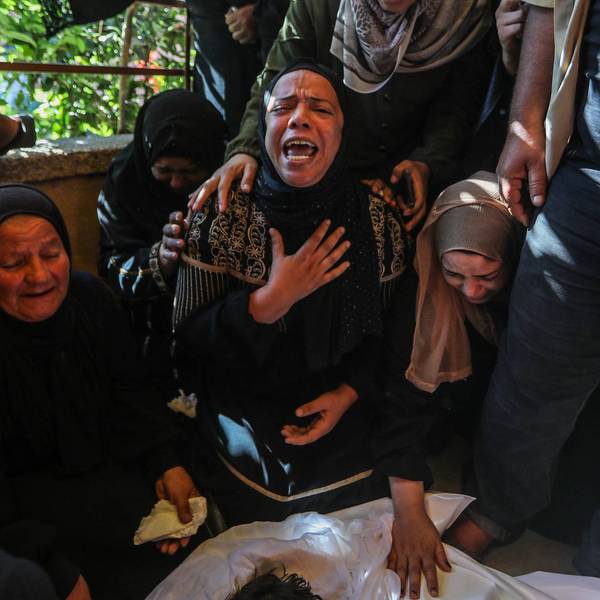
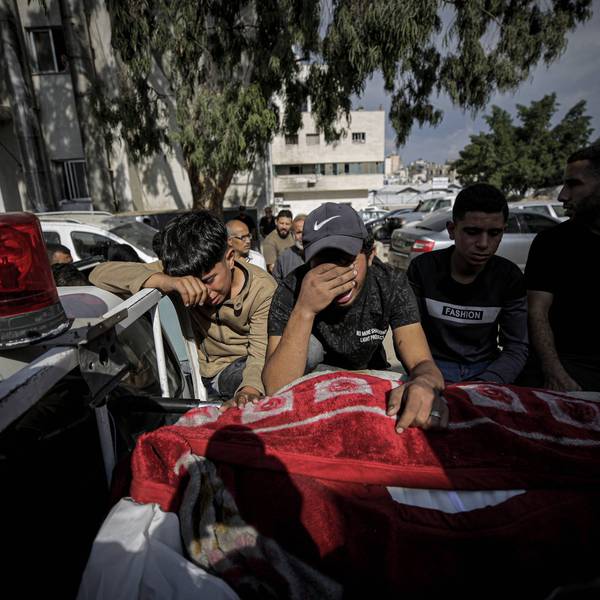
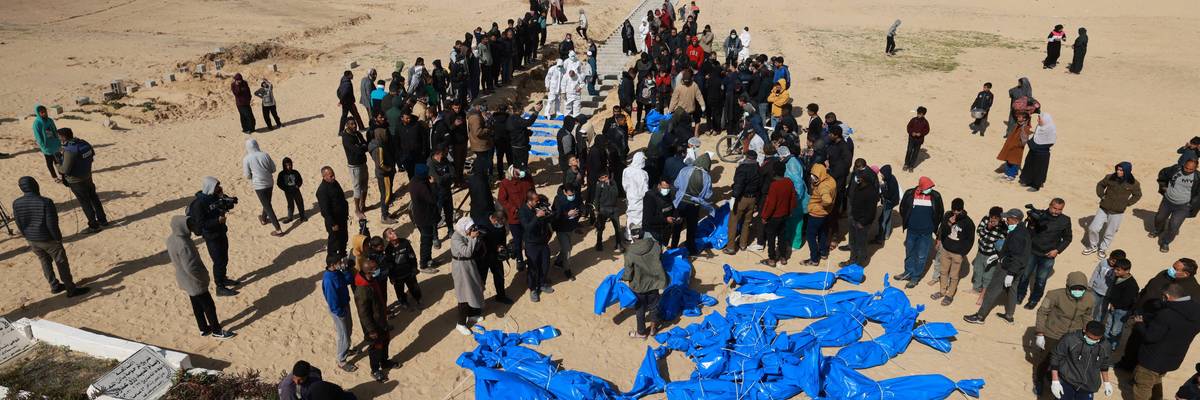
Civilians watch as Gaza-based Palestinian Health Ministry workers prepare to bury the bodies of unidentified Palestinians whose date of death is not known after they were returned by Israel earlier on the same day through the Kerem Shalom crossing, at a mass grave east of Rafah in the southern Gaza Strip on January 30, 2024.
Gaza Is Still Waiting to Bury Its Dead
Recovering the dead has become a final test of human dignity
In every war, there is supposed to come a moment when the guns fall silent and families carry their dead to the cemetery.
In Gaza, that moment has still not fully arrived.
Nearly three years into the war, thousands of Palestinian families are still waiting—not to learn whether their loved ones survived, but for the chance to recover what remains of them from beneath collapsed homes and buried streets.
Many families know almost exactly where their relatives are: beneath a particular building, under a collapsed staircase, behind layers of concrete too heavy to move by hand. Across Gaza, rubble is no longer only evidence of destruction. In many places, it is also a grave.
There should be no disagreement over one principle: The dead have a right to be recovered and buried with dignity, and families have a right to know where their loved ones lie.
The urgent humanitarian question is therefore not only how many people were killed. It is how many are still waiting to be recovered, identified, and buried.
On August 4, 2026, Gaza held a mass funeral for 112 members of the al-Hassayna and Abu Sharia extended family. Their remains had been recovered from homes destroyed in Gaza City’s Sabra neighborhood in November 2023. For nearly three years, their families had waited to bury them.
That funeral was a warning about what time does to the dead—and to those left behind.
The longer remains stay beneath collapsed buildings, the harder identification becomes. Decomposition advances. Bones separate. Personal belongings are displaced. Forensic evidence deteriorates. Gaza’s forensic capacity also remains severely limited.
For families, identification is not a technical detail. It is the difference between a missing person and a known grave. It is the ability to perform a funeral, visit a burial place, and begin mourning with certainty rather than suspicion.
For relatives, the waiting is its own form of suffering. Some families return again and again to the same ruins, pointing to the place where a bedroom, kitchen, or stairwell once stood. They are not asking for certainty about survival; they are asking for the basic certainty of a grave. Until recovery happens, mourning is suspended between memory and rubble.
There are legal consequences as well. Without formal recovery and identification, families can face prolonged uncertainty over death registration, inheritance, guardianship, and other civil matters. A person may be gone in every human sense and still remain unresolved on paper.
The physical challenge is enormous. A 2026 damage and needs assessment by the United Nations, the European Union, and the World Bank estimated that the war had generated more than 68 million metric tons of rubble in Gaza. Some debris are contaminated by unexploded ordnance, asbestos, and other hazardous materials.
Recovering the dead is therefore not a matter of sending people into ruins with shovels. It requires excavators, cranes, fuel, protective equipment, forensic teams, DNA identification capacity, safe humanitarian access, and protection for civil-defense and rescue workers.
Heavy machinery is not a luxury. It is the difference between a body remaining beneath concrete and a family finally being able to bury its dead.
In July 2026, the United Nations Development Programme and the European Union launched a €15 million initiative to support emergency debris removal and strengthen Gaza’s capacity for the dignified recovery and identification of human remains. It is important, but the need is far greater than any single project.
That is why debris removal must treat the recovery of human remains as a central humanitarian priority, not as an afterthought to reconstruction. Sites where people are believed to be buried should be mapped and handled carefully, with procedures for documenting remains, preserving evidence, and notifying families. Rebuilding Gaza cannot mean building over the missing.
What is required now is neither complicated nor impossible.
Humanitarian teams need safe and unhindered access to recovery sites. Excavators, cranes, fuel, spare parts, and specialized equipment must be allowed in without delay. Forensic capacity must be expanded, including DNA identification and proper preservation of remains. Civil-defense, rescue, forensic, and humanitarian teams must be protected.
These are not maximalist political demands. They are the minimum requirements of human dignity.
People will continue to disagree about politics and the future of this conflict. But there should be no disagreement over one principle: The dead have a right to be recovered and buried with dignity, and families have a right to know where their loved ones lie.
A bulldozer should not become a diplomatic bargaining chip. A crane should not require a political breakthrough. Reaching the body of a child should not become another battle.
Civilization is measured not only by what it builds for the living, but by the dignity it preserves for the dead.
Open the crossings and humanitarian routes. Allow the heavy machinery and forensic equipment in. Protect the teams recovering the dead. Give families the chance to bury their loved ones.
Because even after war has taken a life, it should not be allowed to take away a name, a grave, and a final goodbye.
Human dignity does not end with death.
Let Gaza bury its dead.
We are at a crossroads
This country and this world are at a monumental crossroads. In a few short weeks, US voters will have an opportunity to beat back the forces of fascism and confront the billionaires who are rigging the economy, our media system, and our democracy, making it increasingly impossible for ordinary people to get by. We’re not just talking about the election. We’re talking about what must be done once these fascist elements are vanquished from power. We need a bolder set of solutions than what either major party has so far been willing to offer and a working-class movement ready to fight like hell for it. Trump didn't emerge from nowhere. The conditions that fueled MAGA authoritarianism were created by decades of radical neoliberal economic policies and a corrupt political system dominated by corporate interests. They slashed taxes on the super-rich, promising that the benefits would trickle down. They said giveaways to the corporate titans would make life more affordable for the rest of us. It was all bullshit. And when a bitter, betrayed populace searches for someone to blame, right-wing demagogues have little trouble finding scapegoats. People know when they're being lied to, but you won't hear any of this from the corporate media. Only independent journalism—powered and funded by people who believe in building a better world—can deliver truly trustworthy daily news. Our Fall Campaign is underway, and we need your help. To power our newsroom through the rest of the year, we need to raise $125,000 by midnight on October 31. So if you share our vision, please contribute whatever you can to sustain our work. |
In every war, there is supposed to come a moment when the guns fall silent and families carry their dead to the cemetery.
In Gaza, that moment has still not fully arrived.
Nearly three years into the war, thousands of Palestinian families are still waiting—not to learn whether their loved ones survived, but for the chance to recover what remains of them from beneath collapsed homes and buried streets.
Many families know almost exactly where their relatives are: beneath a particular building, under a collapsed staircase, behind layers of concrete too heavy to move by hand. Across Gaza, rubble is no longer only evidence of destruction. In many places, it is also a grave.
There should be no disagreement over one principle: The dead have a right to be recovered and buried with dignity, and families have a right to know where their loved ones lie.
The urgent humanitarian question is therefore not only how many people were killed. It is how many are still waiting to be recovered, identified, and buried.
On August 4, 2026, Gaza held a mass funeral for 112 members of the al-Hassayna and Abu Sharia extended family. Their remains had been recovered from homes destroyed in Gaza City’s Sabra neighborhood in November 2023. For nearly three years, their families had waited to bury them.
That funeral was a warning about what time does to the dead—and to those left behind.
The longer remains stay beneath collapsed buildings, the harder identification becomes. Decomposition advances. Bones separate. Personal belongings are displaced. Forensic evidence deteriorates. Gaza’s forensic capacity also remains severely limited.
For families, identification is not a technical detail. It is the difference between a missing person and a known grave. It is the ability to perform a funeral, visit a burial place, and begin mourning with certainty rather than suspicion.
For relatives, the waiting is its own form of suffering. Some families return again and again to the same ruins, pointing to the place where a bedroom, kitchen, or stairwell once stood. They are not asking for certainty about survival; they are asking for the basic certainty of a grave. Until recovery happens, mourning is suspended between memory and rubble.
There are legal consequences as well. Without formal recovery and identification, families can face prolonged uncertainty over death registration, inheritance, guardianship, and other civil matters. A person may be gone in every human sense and still remain unresolved on paper.
The physical challenge is enormous. A 2026 damage and needs assessment by the United Nations, the European Union, and the World Bank estimated that the war had generated more than 68 million metric tons of rubble in Gaza. Some debris are contaminated by unexploded ordnance, asbestos, and other hazardous materials.
Recovering the dead is therefore not a matter of sending people into ruins with shovels. It requires excavators, cranes, fuel, protective equipment, forensic teams, DNA identification capacity, safe humanitarian access, and protection for civil-defense and rescue workers.
Heavy machinery is not a luxury. It is the difference between a body remaining beneath concrete and a family finally being able to bury its dead.
In July 2026, the United Nations Development Programme and the European Union launched a €15 million initiative to support emergency debris removal and strengthen Gaza’s capacity for the dignified recovery and identification of human remains. It is important, but the need is far greater than any single project.
That is why debris removal must treat the recovery of human remains as a central humanitarian priority, not as an afterthought to reconstruction. Sites where people are believed to be buried should be mapped and handled carefully, with procedures for documenting remains, preserving evidence, and notifying families. Rebuilding Gaza cannot mean building over the missing.
What is required now is neither complicated nor impossible.
Humanitarian teams need safe and unhindered access to recovery sites. Excavators, cranes, fuel, spare parts, and specialized equipment must be allowed in without delay. Forensic capacity must be expanded, including DNA identification and proper preservation of remains. Civil-defense, rescue, forensic, and humanitarian teams must be protected.
These are not maximalist political demands. They are the minimum requirements of human dignity.
People will continue to disagree about politics and the future of this conflict. But there should be no disagreement over one principle: The dead have a right to be recovered and buried with dignity, and families have a right to know where their loved ones lie.
A bulldozer should not become a diplomatic bargaining chip. A crane should not require a political breakthrough. Reaching the body of a child should not become another battle.
Civilization is measured not only by what it builds for the living, but by the dignity it preserves for the dead.
Open the crossings and humanitarian routes. Allow the heavy machinery and forensic equipment in. Protect the teams recovering the dead. Give families the chance to bury their loved ones.
Because even after war has taken a life, it should not be allowed to take away a name, a grave, and a final goodbye.
Human dignity does not end with death.
Let Gaza bury its dead.
- Gaza Holds Mass Funeral for 112 Palestinians Slaughtered by Israel in 2023 ›
- This Is How We Live: People Come Together, Die Together, Are Buried Together In the Same Shroud ›
- After 2 Years of Denial, IDF Confirms 70,000+ Killed in Gaza—But Denies Famine ›
- No Outside Probe, US Reiterates as Gazans Reportedly Buried Alive in Mass Grave ›
- Israeli Analysis Affirms Gaza Health Ministry’s Official Palestinian Death Count ›
- 'We Have Run Out of Body Bags to Bury the Dead' in Gaza ›
In every war, there is supposed to come a moment when the guns fall silent and families carry their dead to the cemetery.
In Gaza, that moment has still not fully arrived.
Nearly three years into the war, thousands of Palestinian families are still waiting—not to learn whether their loved ones survived, but for the chance to recover what remains of them from beneath collapsed homes and buried streets.
Many families know almost exactly where their relatives are: beneath a particular building, under a collapsed staircase, behind layers of concrete too heavy to move by hand. Across Gaza, rubble is no longer only evidence of destruction. In many places, it is also a grave.
There should be no disagreement over one principle: The dead have a right to be recovered and buried with dignity, and families have a right to know where their loved ones lie.
The urgent humanitarian question is therefore not only how many people were killed. It is how many are still waiting to be recovered, identified, and buried.
On August 4, 2026, Gaza held a mass funeral for 112 members of the al-Hassayna and Abu Sharia extended family. Their remains had been recovered from homes destroyed in Gaza City’s Sabra neighborhood in November 2023. For nearly three years, their families had waited to bury them.
That funeral was a warning about what time does to the dead—and to those left behind.
The longer remains stay beneath collapsed buildings, the harder identification becomes. Decomposition advances. Bones separate. Personal belongings are displaced. Forensic evidence deteriorates. Gaza’s forensic capacity also remains severely limited.
For families, identification is not a technical detail. It is the difference between a missing person and a known grave. It is the ability to perform a funeral, visit a burial place, and begin mourning with certainty rather than suspicion.
For relatives, the waiting is its own form of suffering. Some families return again and again to the same ruins, pointing to the place where a bedroom, kitchen, or stairwell once stood. They are not asking for certainty about survival; they are asking for the basic certainty of a grave. Until recovery happens, mourning is suspended between memory and rubble.
There are legal consequences as well. Without formal recovery and identification, families can face prolonged uncertainty over death registration, inheritance, guardianship, and other civil matters. A person may be gone in every human sense and still remain unresolved on paper.
The physical challenge is enormous. A 2026 damage and needs assessment by the United Nations, the European Union, and the World Bank estimated that the war had generated more than 68 million metric tons of rubble in Gaza. Some debris are contaminated by unexploded ordnance, asbestos, and other hazardous materials.
Recovering the dead is therefore not a matter of sending people into ruins with shovels. It requires excavators, cranes, fuel, protective equipment, forensic teams, DNA identification capacity, safe humanitarian access, and protection for civil-defense and rescue workers.
Heavy machinery is not a luxury. It is the difference between a body remaining beneath concrete and a family finally being able to bury its dead.
In July 2026, the United Nations Development Programme and the European Union launched a €15 million initiative to support emergency debris removal and strengthen Gaza’s capacity for the dignified recovery and identification of human remains. It is important, but the need is far greater than any single project.
That is why debris removal must treat the recovery of human remains as a central humanitarian priority, not as an afterthought to reconstruction. Sites where people are believed to be buried should be mapped and handled carefully, with procedures for documenting remains, preserving evidence, and notifying families. Rebuilding Gaza cannot mean building over the missing.
What is required now is neither complicated nor impossible.
Humanitarian teams need safe and unhindered access to recovery sites. Excavators, cranes, fuel, spare parts, and specialized equipment must be allowed in without delay. Forensic capacity must be expanded, including DNA identification and proper preservation of remains. Civil-defense, rescue, forensic, and humanitarian teams must be protected.
These are not maximalist political demands. They are the minimum requirements of human dignity.
People will continue to disagree about politics and the future of this conflict. But there should be no disagreement over one principle: The dead have a right to be recovered and buried with dignity, and families have a right to know where their loved ones lie.
A bulldozer should not become a diplomatic bargaining chip. A crane should not require a political breakthrough. Reaching the body of a child should not become another battle.
Civilization is measured not only by what it builds for the living, but by the dignity it preserves for the dead.
Open the crossings and humanitarian routes. Allow the heavy machinery and forensic equipment in. Protect the teams recovering the dead. Give families the chance to bury their loved ones.
Because even after war has taken a life, it should not be allowed to take away a name, a grave, and a final goodbye.
Human dignity does not end with death.
Let Gaza bury its dead.
- Gaza Holds Mass Funeral for 112 Palestinians Slaughtered by Israel in 2023 ›
- This Is How We Live: People Come Together, Die Together, Are Buried Together In the Same Shroud ›
- After 2 Years of Denial, IDF Confirms 70,000+ Killed in Gaza—But Denies Famine ›
- No Outside Probe, US Reiterates as Gazans Reportedly Buried Alive in Mass Grave ›
- Israeli Analysis Affirms Gaza Health Ministry’s Official Palestinian Death Count ›
- 'We Have Run Out of Body Bags to Bury the Dead' in Gaza ›