SUBSCRIBE TO OUR FREE NEWSLETTER
Daily news & progressive opinion—funded by the people, not the corporations—delivered straight to your inbox.
5
#000000
#FFFFFF
To donate by check, phone, or other method, see our More Ways to Give page.
Daily news & progressive opinion—funded by the people, not the corporations—delivered straight to your inbox.
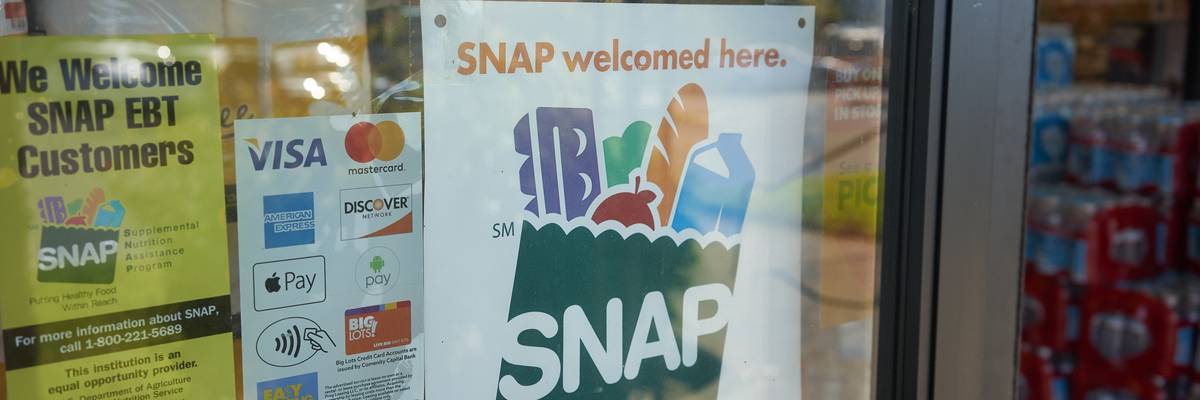
A "SNAP welcomed here" sign is seen at the entrance to a Big Lots store in Portland, Oregon.
By focusing on the facts and the program’s broad benefits, Americans can move past partisan divides and recognize the Supplemental Nutrition Assistance Program for the bipartisan, practical tool it truly is.
On January 31, 1964, President Lyndon B. Johnson requested that Congress pass federal legislation to make the Food Stamp Program permanent. Up to that point, the program had operated as a pilot in select counties and states, serving about 380,000 participants. The Food Stamp Program expanded dramatically in the ensuing decades, driven largely by a recognition of domestic hunger. It has also undergone many changes—notably 2008 legislation that changed the name to the Supplemental Nutrition Assistance Program, or SNAP, in part to fight the politicized stigma of receiving food assistance.
Today, the program is without a doubt one of the most effective food assistance programs in reducing food insecurity and poverty across the United States. The US Census Bureau reports that supplemental nutrition assistance lifted nearly 3.6 million people out of poverty in 2024, the most recent year for which full data are available.
What’s more, every dollar in SNAP benefits generates about $1.50 in economic activity, as recipients spend their benefits at grocery stores, farmers’ markets, and small businesses. This ripple effect strengthens communities, keeping businesses open and workers employed.
Looking solely at the data, it would seem the anti-hunger program would be viewed by the vast majority of US voters as a practical solution that helps families put food on the table while also supporting local economies. After all, the vast majority of SNAP recipients are children, seniors, and people with disabilities, not the able-bodied adults who are often misrepresented as the main beneficiaries in political debates. And many rural communities, which tend to vote conservatively, rely heavily on this nutrition assistance, with some of the highest SNAP participation rates found in states that lean Republican.
The politicization of social welfare programs generated long-lasting shifts in voting behavior.
Yet in spite of its broad social and economic benefits, food assistance has been a politically contested issue ever since it was enacted more than five decades ago, often shaped by ideological and racialized narratives. This polarization persists today, exemplified by the massive cuts to the Supplemental Nutrition Assistance Program in the 2025 Republican budget reconciliation bill (commonly referred to as the “One Big Beautiful Bill Act”) that was passed by the 119th US Congress and signed into law by President Donald Trump in July 2025.
In new research, I, together with co-authors Troup Howard at the University of Utah and William Mullins at the University of California, San Diego, examine the process through which policy-based polarization emerges and persists over time. Using the historical expansion of the federal Food Stamp Program between 1961 and 1975 as a case study, we provide empirical evidence that the politicization of social welfare programs generated long-lasting shifts in voting behavior. Understanding this history and its persistence is essential to making sense of current debates over the Supplemental Nutrition Assistance Program.
The historical rollout of the Food Stamp Program provides a case study in how social and economic policies become polarized and how those divisions persist across generations. Political views on food assistance are emblematic of the deeply partisan divide over social insurance programs and racial attitudes, which consistently emerge as key fault lines in US politics, reflecting deep-seated ideological and historical divisions.
Even though political polarization is often framed as a natural consequence of personal preferences and ideological sorting, such an interpretation overlooks the strategic role of political parties in shaping public perception for electoral advantage. We find that these behaviors persisted well beyond the first two decades—through 2020, as detailed in our research, and arguably even more so today.
The Food Stamp Program, now known as the Supplemental Nutrition Assistance Program, has played a critical role in the network of US social programs for more than half a century. After state- and federal-level experimentation, the program was rolled out nationwide between 1964 and 1975 to combat food insecurity and improve nutrition among low-income Americans. The program currently supports 42 million people, including nearly 1 in 5 American children. Research consistently demonstrates its effectiveness in reducing poverty, stabilizing household food consumption, and improving long-term health and economic outcomes.
The initial rollout of the Food Stamp Program coincided with a period of intense legal and political transformation, marked by the Civil Rights Act of 1964, the Voting Rights Act of 1965, and the broader dismantling of Jim Crow laws that legally discriminated against Black Americans across the South. In this context, the introduction of a federal food assistance program was not merely a policy shift but also became a political flash point.
Our analysis provides, to the best of our knowledge, the first causal estimates on the racial politicization of social programs. Using individual-level voting data, we find three key results:
When a government program is first implemented, voters are often uncertain about its long-term effects. This initial ambiguity provides political parties with an opportunity to shape public perception through strategic political moves, particularly in the early stages of a policy’s rollout. Politicians can change the narrative framing surrounding discussions about the program. Or they can steer political resources away from the program and bring into focus other politically polarizing issues. Or they can set agendas that cater to specific groups of voters in an effort to offset any political advantages the opposing party might be accruing from public discussion about the policy.
These are classic partisan political strategies, and we show in our research that political parties, recognizing the potential to consolidate their voter base, have incentives to selectively target different demographic groups with distinct messaging. Even when a policy itself does not explicitly favor one group over another, partisan political moves can amplify political divisions and solidify long-term realignments in voter preferences.
To implement our analysis, we used a comprehensive dataset covering the universe of US voters as of 2020. We then compared the voting behavior between individuals who were adults when the Food Stamp Program was introduced in their county and those who were younger at the time. This methodology, which incorporates a rich set of fixed effects and demographic controls, including age, race, and gender, ensures that our findings are not driven by geographic variation, cohort effects, or broader shifts in political attitudes between 1960 and 2020.
SNAP is often misunderstood or misrepresented, but at its core, it is a practical program that helps families meet basic nutritional needs.
The results reveal the lasting impact of the Food Stamp Program on partisan affiliations. White voters who lived through the Food Stamp rollout as adults were significantly more likely to be registered as Republicans—and less likely to be Democrats—in 2020, compared with White voters who were younger, especially those who were born in a world where the Food Stamp Program was already an established feature of US social programs.
In contrast, Black and Hispanic voters who lived through the Food Stamp rollout as adults were significantly more likely to be registered as Democrats or Independents than Black and Hispanic voters who were younger. Racial polarization in partisan affiliations is an order of magnitude larger than electorate-wide effects, underscoring the extent to which food assistance became a racialized political issue.
Further analysis of voting behavior conditional on party affiliation reveals additional layers of polarization. Exposure to the rollout of the program increased the likelihood of white Republicans turning out to vote while simultaneously boosting turnout among Black and Hispanic Democrats. This divergence suggests that the politicization of food assistance not only influenced party registration but also reinforced voting engagement along racial and ideological lines.
Moreover, when focusing on individuals who registered to vote before the age of 25—a group likely to be more politically engaged—we observe even stronger effects, highlighting the formative role of early political experiences in shaping long-term partisan identity.
Taken together, these findings illustrate how social policy can serve as a catalyst for enduring political realignments. The case of the Food Stamp Program suggests that initial framing and partisan efforts can have consequences that extend well beyond the policy itself, shaping voting behavior for generations.
The program’s name shift in 2008 to the Supplemental Nutrition Assistance Program and its catchy acronym SNAP was intended to partially address this polarization that had developed over many decades. Beyond reducing the stigma associated with “food stamps,” the rebranding sought to counter the racialized and partisan narratives that had taken root during the program’s early rollout by emphasizing nutrition, work, and temporary assistance. By reframing food assistance as a modern, employment-adjacent social support rather than a form of welfare, policymakers aimed to make the program more politically durable amid persistent partisan scrutiny—even as the underlying political divisions documented in our analysis continued to shape debates over the program’s scope and funding.
As contemporary debates over social programs continue—not just about SNAP benefits but also in the context of the expansion of Medicaid in the Affordable Care Act of 2010 and the recent cuts to Medicaid in 2025—understanding the historical roots of this polarization is critical. The long-run political consequences of early policy framing should be a central consideration in both policymaking and electoral strategy. And the long-run economic fallout if partisan politics are successful in further diminishing social insurance programs could include substantial contractions in local economic activity as federal SNAP dollars are withdrawn from communities.
To make discussions about SNAP benefits less partisan, it is important that views about the program become decoupled from partisan politics. Yet separating the program from political narratives and stereotypes can be challenging. SNAP is often misunderstood or misrepresented, but at its core, it is a practical program that helps families meet basic nutritional needs.
By focusing on the facts and the program’s broad benefits, as documented in this issue brief, Americans can move past partisan divides and recognize the Supplemental Nutrition Assistance Program for what it truly is—a bipartisan investment in food security, economic stability, and the well-being of US families.
This piece was first published by the Washington Center for Equitable Growth.
Dear Common Dreams reader, It’s been nearly 30 years since I co-founded Common Dreams with my late wife, Lina Newhouser. We had the radical notion that journalism should serve the public good, not corporate profits. It was clear to us from the outset what it would take to build such a project. No paid advertisements. No corporate sponsors. No millionaire publisher telling us what to think or do. Many people said we wouldn't last a year, but we proved those doubters wrong. Together with a tremendous team of journalists and dedicated staff, we built an independent media outlet free from the constraints of profits and corporate control. Our mission has always been simple: To inform. To inspire. To ignite change for the common good. Building Common Dreams was not easy. Our survival was never guaranteed. When you take on the most powerful forces—Wall Street greed, fossil fuel industry destruction, Big Tech lobbyists, and uber-rich oligarchs who have spent billions upon billions rigging the economy and democracy in their favor—the only bulwark you have is supporters who believe in your work. But here’s the urgent message from me today. It's never been this bad out there. And it's never been this hard to keep us going. At the very moment Common Dreams is most needed, the threats we face are intensifying. We need your support now more than ever. We don't accept corporate advertising and never will. We don't have a paywall because we don't think people should be blocked from critical news based on their ability to pay. Everything we do is funded by the donations of readers like you. When everyone does the little they can afford, we are strong. But if that support retreats or dries up, so do we. Will you donate now to make sure Common Dreams not only survives but thrives? —Craig Brown, Co-founder |
On January 31, 1964, President Lyndon B. Johnson requested that Congress pass federal legislation to make the Food Stamp Program permanent. Up to that point, the program had operated as a pilot in select counties and states, serving about 380,000 participants. The Food Stamp Program expanded dramatically in the ensuing decades, driven largely by a recognition of domestic hunger. It has also undergone many changes—notably 2008 legislation that changed the name to the Supplemental Nutrition Assistance Program, or SNAP, in part to fight the politicized stigma of receiving food assistance.
Today, the program is without a doubt one of the most effective food assistance programs in reducing food insecurity and poverty across the United States. The US Census Bureau reports that supplemental nutrition assistance lifted nearly 3.6 million people out of poverty in 2024, the most recent year for which full data are available.
What’s more, every dollar in SNAP benefits generates about $1.50 in economic activity, as recipients spend their benefits at grocery stores, farmers’ markets, and small businesses. This ripple effect strengthens communities, keeping businesses open and workers employed.
Looking solely at the data, it would seem the anti-hunger program would be viewed by the vast majority of US voters as a practical solution that helps families put food on the table while also supporting local economies. After all, the vast majority of SNAP recipients are children, seniors, and people with disabilities, not the able-bodied adults who are often misrepresented as the main beneficiaries in political debates. And many rural communities, which tend to vote conservatively, rely heavily on this nutrition assistance, with some of the highest SNAP participation rates found in states that lean Republican.
The politicization of social welfare programs generated long-lasting shifts in voting behavior.
Yet in spite of its broad social and economic benefits, food assistance has been a politically contested issue ever since it was enacted more than five decades ago, often shaped by ideological and racialized narratives. This polarization persists today, exemplified by the massive cuts to the Supplemental Nutrition Assistance Program in the 2025 Republican budget reconciliation bill (commonly referred to as the “One Big Beautiful Bill Act”) that was passed by the 119th US Congress and signed into law by President Donald Trump in July 2025.
In new research, I, together with co-authors Troup Howard at the University of Utah and William Mullins at the University of California, San Diego, examine the process through which policy-based polarization emerges and persists over time. Using the historical expansion of the federal Food Stamp Program between 1961 and 1975 as a case study, we provide empirical evidence that the politicization of social welfare programs generated long-lasting shifts in voting behavior. Understanding this history and its persistence is essential to making sense of current debates over the Supplemental Nutrition Assistance Program.
The historical rollout of the Food Stamp Program provides a case study in how social and economic policies become polarized and how those divisions persist across generations. Political views on food assistance are emblematic of the deeply partisan divide over social insurance programs and racial attitudes, which consistently emerge as key fault lines in US politics, reflecting deep-seated ideological and historical divisions.
Even though political polarization is often framed as a natural consequence of personal preferences and ideological sorting, such an interpretation overlooks the strategic role of political parties in shaping public perception for electoral advantage. We find that these behaviors persisted well beyond the first two decades—through 2020, as detailed in our research, and arguably even more so today.
The Food Stamp Program, now known as the Supplemental Nutrition Assistance Program, has played a critical role in the network of US social programs for more than half a century. After state- and federal-level experimentation, the program was rolled out nationwide between 1964 and 1975 to combat food insecurity and improve nutrition among low-income Americans. The program currently supports 42 million people, including nearly 1 in 5 American children. Research consistently demonstrates its effectiveness in reducing poverty, stabilizing household food consumption, and improving long-term health and economic outcomes.
The initial rollout of the Food Stamp Program coincided with a period of intense legal and political transformation, marked by the Civil Rights Act of 1964, the Voting Rights Act of 1965, and the broader dismantling of Jim Crow laws that legally discriminated against Black Americans across the South. In this context, the introduction of a federal food assistance program was not merely a policy shift but also became a political flash point.
Our analysis provides, to the best of our knowledge, the first causal estimates on the racial politicization of social programs. Using individual-level voting data, we find three key results:
When a government program is first implemented, voters are often uncertain about its long-term effects. This initial ambiguity provides political parties with an opportunity to shape public perception through strategic political moves, particularly in the early stages of a policy’s rollout. Politicians can change the narrative framing surrounding discussions about the program. Or they can steer political resources away from the program and bring into focus other politically polarizing issues. Or they can set agendas that cater to specific groups of voters in an effort to offset any political advantages the opposing party might be accruing from public discussion about the policy.
These are classic partisan political strategies, and we show in our research that political parties, recognizing the potential to consolidate their voter base, have incentives to selectively target different demographic groups with distinct messaging. Even when a policy itself does not explicitly favor one group over another, partisan political moves can amplify political divisions and solidify long-term realignments in voter preferences.
To implement our analysis, we used a comprehensive dataset covering the universe of US voters as of 2020. We then compared the voting behavior between individuals who were adults when the Food Stamp Program was introduced in their county and those who were younger at the time. This methodology, which incorporates a rich set of fixed effects and demographic controls, including age, race, and gender, ensures that our findings are not driven by geographic variation, cohort effects, or broader shifts in political attitudes between 1960 and 2020.
SNAP is often misunderstood or misrepresented, but at its core, it is a practical program that helps families meet basic nutritional needs.
The results reveal the lasting impact of the Food Stamp Program on partisan affiliations. White voters who lived through the Food Stamp rollout as adults were significantly more likely to be registered as Republicans—and less likely to be Democrats—in 2020, compared with White voters who were younger, especially those who were born in a world where the Food Stamp Program was already an established feature of US social programs.
In contrast, Black and Hispanic voters who lived through the Food Stamp rollout as adults were significantly more likely to be registered as Democrats or Independents than Black and Hispanic voters who were younger. Racial polarization in partisan affiliations is an order of magnitude larger than electorate-wide effects, underscoring the extent to which food assistance became a racialized political issue.
Further analysis of voting behavior conditional on party affiliation reveals additional layers of polarization. Exposure to the rollout of the program increased the likelihood of white Republicans turning out to vote while simultaneously boosting turnout among Black and Hispanic Democrats. This divergence suggests that the politicization of food assistance not only influenced party registration but also reinforced voting engagement along racial and ideological lines.
Moreover, when focusing on individuals who registered to vote before the age of 25—a group likely to be more politically engaged—we observe even stronger effects, highlighting the formative role of early political experiences in shaping long-term partisan identity.
Taken together, these findings illustrate how social policy can serve as a catalyst for enduring political realignments. The case of the Food Stamp Program suggests that initial framing and partisan efforts can have consequences that extend well beyond the policy itself, shaping voting behavior for generations.
The program’s name shift in 2008 to the Supplemental Nutrition Assistance Program and its catchy acronym SNAP was intended to partially address this polarization that had developed over many decades. Beyond reducing the stigma associated with “food stamps,” the rebranding sought to counter the racialized and partisan narratives that had taken root during the program’s early rollout by emphasizing nutrition, work, and temporary assistance. By reframing food assistance as a modern, employment-adjacent social support rather than a form of welfare, policymakers aimed to make the program more politically durable amid persistent partisan scrutiny—even as the underlying political divisions documented in our analysis continued to shape debates over the program’s scope and funding.
As contemporary debates over social programs continue—not just about SNAP benefits but also in the context of the expansion of Medicaid in the Affordable Care Act of 2010 and the recent cuts to Medicaid in 2025—understanding the historical roots of this polarization is critical. The long-run political consequences of early policy framing should be a central consideration in both policymaking and electoral strategy. And the long-run economic fallout if partisan politics are successful in further diminishing social insurance programs could include substantial contractions in local economic activity as federal SNAP dollars are withdrawn from communities.
To make discussions about SNAP benefits less partisan, it is important that views about the program become decoupled from partisan politics. Yet separating the program from political narratives and stereotypes can be challenging. SNAP is often misunderstood or misrepresented, but at its core, it is a practical program that helps families meet basic nutritional needs.
By focusing on the facts and the program’s broad benefits, as documented in this issue brief, Americans can move past partisan divides and recognize the Supplemental Nutrition Assistance Program for what it truly is—a bipartisan investment in food security, economic stability, and the well-being of US families.
This piece was first published by the Washington Center for Equitable Growth.
On January 31, 1964, President Lyndon B. Johnson requested that Congress pass federal legislation to make the Food Stamp Program permanent. Up to that point, the program had operated as a pilot in select counties and states, serving about 380,000 participants. The Food Stamp Program expanded dramatically in the ensuing decades, driven largely by a recognition of domestic hunger. It has also undergone many changes—notably 2008 legislation that changed the name to the Supplemental Nutrition Assistance Program, or SNAP, in part to fight the politicized stigma of receiving food assistance.
Today, the program is without a doubt one of the most effective food assistance programs in reducing food insecurity and poverty across the United States. The US Census Bureau reports that supplemental nutrition assistance lifted nearly 3.6 million people out of poverty in 2024, the most recent year for which full data are available.
What’s more, every dollar in SNAP benefits generates about $1.50 in economic activity, as recipients spend their benefits at grocery stores, farmers’ markets, and small businesses. This ripple effect strengthens communities, keeping businesses open and workers employed.
Looking solely at the data, it would seem the anti-hunger program would be viewed by the vast majority of US voters as a practical solution that helps families put food on the table while also supporting local economies. After all, the vast majority of SNAP recipients are children, seniors, and people with disabilities, not the able-bodied adults who are often misrepresented as the main beneficiaries in political debates. And many rural communities, which tend to vote conservatively, rely heavily on this nutrition assistance, with some of the highest SNAP participation rates found in states that lean Republican.
The politicization of social welfare programs generated long-lasting shifts in voting behavior.
Yet in spite of its broad social and economic benefits, food assistance has been a politically contested issue ever since it was enacted more than five decades ago, often shaped by ideological and racialized narratives. This polarization persists today, exemplified by the massive cuts to the Supplemental Nutrition Assistance Program in the 2025 Republican budget reconciliation bill (commonly referred to as the “One Big Beautiful Bill Act”) that was passed by the 119th US Congress and signed into law by President Donald Trump in July 2025.
In new research, I, together with co-authors Troup Howard at the University of Utah and William Mullins at the University of California, San Diego, examine the process through which policy-based polarization emerges and persists over time. Using the historical expansion of the federal Food Stamp Program between 1961 and 1975 as a case study, we provide empirical evidence that the politicization of social welfare programs generated long-lasting shifts in voting behavior. Understanding this history and its persistence is essential to making sense of current debates over the Supplemental Nutrition Assistance Program.
The historical rollout of the Food Stamp Program provides a case study in how social and economic policies become polarized and how those divisions persist across generations. Political views on food assistance are emblematic of the deeply partisan divide over social insurance programs and racial attitudes, which consistently emerge as key fault lines in US politics, reflecting deep-seated ideological and historical divisions.
Even though political polarization is often framed as a natural consequence of personal preferences and ideological sorting, such an interpretation overlooks the strategic role of political parties in shaping public perception for electoral advantage. We find that these behaviors persisted well beyond the first two decades—through 2020, as detailed in our research, and arguably even more so today.
The Food Stamp Program, now known as the Supplemental Nutrition Assistance Program, has played a critical role in the network of US social programs for more than half a century. After state- and federal-level experimentation, the program was rolled out nationwide between 1964 and 1975 to combat food insecurity and improve nutrition among low-income Americans. The program currently supports 42 million people, including nearly 1 in 5 American children. Research consistently demonstrates its effectiveness in reducing poverty, stabilizing household food consumption, and improving long-term health and economic outcomes.
The initial rollout of the Food Stamp Program coincided with a period of intense legal and political transformation, marked by the Civil Rights Act of 1964, the Voting Rights Act of 1965, and the broader dismantling of Jim Crow laws that legally discriminated against Black Americans across the South. In this context, the introduction of a federal food assistance program was not merely a policy shift but also became a political flash point.
Our analysis provides, to the best of our knowledge, the first causal estimates on the racial politicization of social programs. Using individual-level voting data, we find three key results:
When a government program is first implemented, voters are often uncertain about its long-term effects. This initial ambiguity provides political parties with an opportunity to shape public perception through strategic political moves, particularly in the early stages of a policy’s rollout. Politicians can change the narrative framing surrounding discussions about the program. Or they can steer political resources away from the program and bring into focus other politically polarizing issues. Or they can set agendas that cater to specific groups of voters in an effort to offset any political advantages the opposing party might be accruing from public discussion about the policy.
These are classic partisan political strategies, and we show in our research that political parties, recognizing the potential to consolidate their voter base, have incentives to selectively target different demographic groups with distinct messaging. Even when a policy itself does not explicitly favor one group over another, partisan political moves can amplify political divisions and solidify long-term realignments in voter preferences.
To implement our analysis, we used a comprehensive dataset covering the universe of US voters as of 2020. We then compared the voting behavior between individuals who were adults when the Food Stamp Program was introduced in their county and those who were younger at the time. This methodology, which incorporates a rich set of fixed effects and demographic controls, including age, race, and gender, ensures that our findings are not driven by geographic variation, cohort effects, or broader shifts in political attitudes between 1960 and 2020.
SNAP is often misunderstood or misrepresented, but at its core, it is a practical program that helps families meet basic nutritional needs.
The results reveal the lasting impact of the Food Stamp Program on partisan affiliations. White voters who lived through the Food Stamp rollout as adults were significantly more likely to be registered as Republicans—and less likely to be Democrats—in 2020, compared with White voters who were younger, especially those who were born in a world where the Food Stamp Program was already an established feature of US social programs.
In contrast, Black and Hispanic voters who lived through the Food Stamp rollout as adults were significantly more likely to be registered as Democrats or Independents than Black and Hispanic voters who were younger. Racial polarization in partisan affiliations is an order of magnitude larger than electorate-wide effects, underscoring the extent to which food assistance became a racialized political issue.
Further analysis of voting behavior conditional on party affiliation reveals additional layers of polarization. Exposure to the rollout of the program increased the likelihood of white Republicans turning out to vote while simultaneously boosting turnout among Black and Hispanic Democrats. This divergence suggests that the politicization of food assistance not only influenced party registration but also reinforced voting engagement along racial and ideological lines.
Moreover, when focusing on individuals who registered to vote before the age of 25—a group likely to be more politically engaged—we observe even stronger effects, highlighting the formative role of early political experiences in shaping long-term partisan identity.
Taken together, these findings illustrate how social policy can serve as a catalyst for enduring political realignments. The case of the Food Stamp Program suggests that initial framing and partisan efforts can have consequences that extend well beyond the policy itself, shaping voting behavior for generations.
The program’s name shift in 2008 to the Supplemental Nutrition Assistance Program and its catchy acronym SNAP was intended to partially address this polarization that had developed over many decades. Beyond reducing the stigma associated with “food stamps,” the rebranding sought to counter the racialized and partisan narratives that had taken root during the program’s early rollout by emphasizing nutrition, work, and temporary assistance. By reframing food assistance as a modern, employment-adjacent social support rather than a form of welfare, policymakers aimed to make the program more politically durable amid persistent partisan scrutiny—even as the underlying political divisions documented in our analysis continued to shape debates over the program’s scope and funding.
As contemporary debates over social programs continue—not just about SNAP benefits but also in the context of the expansion of Medicaid in the Affordable Care Act of 2010 and the recent cuts to Medicaid in 2025—understanding the historical roots of this polarization is critical. The long-run political consequences of early policy framing should be a central consideration in both policymaking and electoral strategy. And the long-run economic fallout if partisan politics are successful in further diminishing social insurance programs could include substantial contractions in local economic activity as federal SNAP dollars are withdrawn from communities.
To make discussions about SNAP benefits less partisan, it is important that views about the program become decoupled from partisan politics. Yet separating the program from political narratives and stereotypes can be challenging. SNAP is often misunderstood or misrepresented, but at its core, it is a practical program that helps families meet basic nutritional needs.
By focusing on the facts and the program’s broad benefits, as documented in this issue brief, Americans can move past partisan divides and recognize the Supplemental Nutrition Assistance Program for what it truly is—a bipartisan investment in food security, economic stability, and the well-being of US families.
This piece was first published by the Washington Center for Equitable Growth.