SUBSCRIBE TO OUR FREE NEWSLETTER
Daily news & progressive opinion—funded by the people, not the corporations—delivered straight to your inbox.
5
#000000
#FFFFFF
To donate by check, phone, or other method, see our More Ways to Give page.
Daily news & progressive opinion—funded by the people, not the corporations—delivered straight to your inbox.
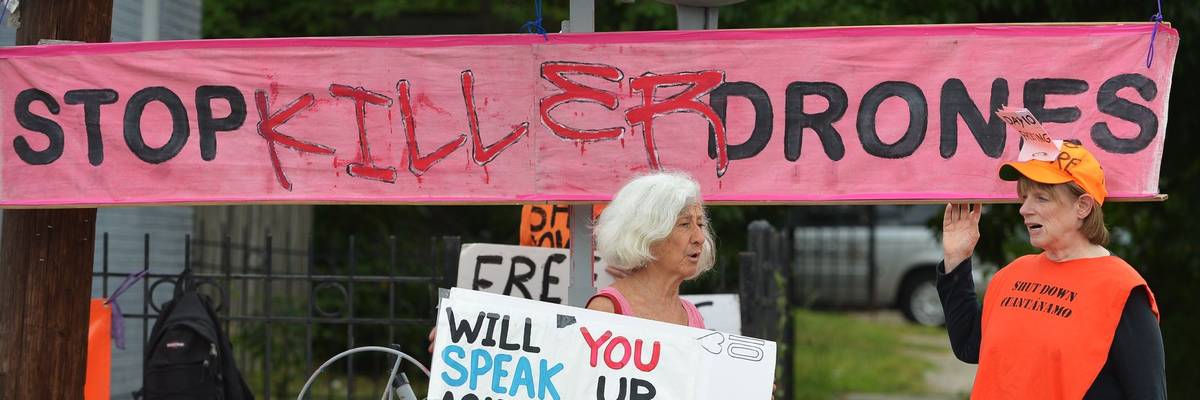
Protesters stand next to a model of a drone during a demonstration calling for an end to targeted killings and indefinite detentions outside of Fort McNair on May 23, in Washington, DC. US President Barack Obama was due to speak on counterterrorism policy at the National Defense University at Fort McNair.
If Obama could kill a 16-year-old American boy without accountability, why wouldn’t Trump believe he has the same power to snuff out the lives of civilians with no due process?
In May 2013, as President Barack Obama delivered a major foreign-policy speech in Washington, I managed to slip inside. As he was winding up, I stood and interrupted, condemning his use of lethal drone strikes in Yemen, Pakistan, and Somalia.
“How can you, a constitutional lawyer, authorize the extrajudicial killing of people—including a 16-year-old American boy in Yemen, Abdulrahman al-Awlaki—without charge, without trial, without even an explanation?”
As security dragged me out, Obama responded, “The voice of that woman is worth paying attention to.” Perhaps my questions touched a chord in his conscience, but the drone attacks did not stop.
Just before that incident, I had returned from Yemen, where a small delegation of us met with Abdulrahman’s grandfather, Nasser al-Awlaki—a dignified man with a PhD from an American university, someone who genuinely believed in the values this country claims to represent. He looked at us, grief etched into his face, and asked, “How can a nation that speaks of law and justice kill an American child without apology, without even a justification?”
Under Obama, drone strikes killed thousands of people. Entire communities lived under the constant terror of buzzing drones—never knowing whether a flash in the sky meant death for them, their children, or the neighbors who ran to help.
We heard these horrors firsthand in 2012, when CODEPINK traveled to Pakistan to meet with victims’ families. A tribal leader from Waziristan described attending a peaceful jirga—a gathering of elders—when a US missile obliterated the meeting. Dozens were instantly killed. As survivors rushed to help the wounded, a second missile struck.
Forty-two people died, including elders and local officials. No one in Washington was held accountable. Not one person.
Faced with mounting outrage, Obama eventually scaled back the drone program—not because the killings were illegal, immoral, or strategically disastrous, but because the political cost was rising. The truth is that Obama’s drone war normalized the idea that the United States can kill whoever it wants, wherever it wants, without due process or oversight.
That normalization is the bridge to where we are today.
The Trump administration is now carrying out extrajudicial assassinations at sea, including “double taps.” With the latest December 15 strikes, 95 people have been blown to bits in the bombing of 25 boats. Meanwhile, the administration is refusing to release the memo that supposedly explains the legal basis for these killings or to release the video showing the September bombing that killed two shipwrecked sailors who survived an initial strike.
But let’s be clear: the actions of the Trump administration are not an aberration—they are the logical sequel to Obama’s drone killings. If Obama could kill a 16-year-old American boy without accountability, why wouldn’t Trump believe he has the same power to snuff out the lives of civilians with no due process?
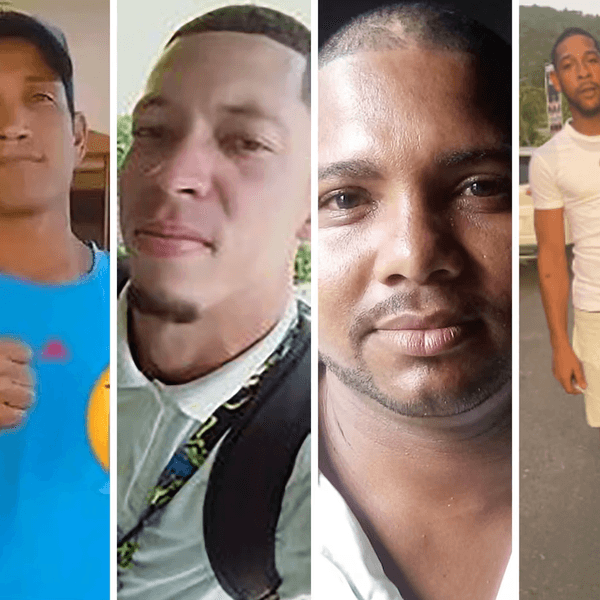
One of the victims of Trump’s maritime strikes was Alejandro Carranza Medina, a Colombian fisherman killed on September 15 when a US missile tore apart his vessel. His family has filed a complaint with the Inter-American Commission on Human Rights. The family says he was working—fishing, not fighting—when the US government ended his life.
And even in cases where drugs are on board, let’s say the obvious: Smuggling narcotics does not turn the open sea into a battlefield, and it does not strip civilians of their right to due process simply because the Trump administration says so. The US cannot declare people “enemy fighters” to disguise what are, in reality, unlawful killings.
Civil liberties groups are suing the government to secure the release of the Office of Legal Counsel opinion and other documents related to these strikes on civilian boats in international waters. The public deserves to see this information. The American people also deserve to see the full video of the September “double tap” that killed two survivors desperately clinging to their overturned boat, as a bipartisan group of lawmakers is demanding. We deserve transparency, accountability, and answers—the same things we demanded under Obama and never received.
For more than twenty years, human rights advocates have warned that unchecked drone warfare would shred the boundaries between war and peace, between combatants and civilians, between military force and basic law enforcement.
Trump’s maritime killings are the predictable collapse of a system the Obama administration cemented into place: killing people far from any battlefield, without legal authority, without congressional approval, and without the slightest regard for human rights.
Once an administration insists that due process in the use of lethal force is optional, every future president inherits a blank check for murder.
Dear Common Dreams reader, It’s been nearly 30 years since I co-founded Common Dreams with my late wife, Lina Newhouser. We had the radical notion that journalism should serve the public good, not corporate profits. It was clear to us from the outset what it would take to build such a project. No paid advertisements. No corporate sponsors. No millionaire publisher telling us what to think or do. Many people said we wouldn't last a year, but we proved those doubters wrong. Together with a tremendous team of journalists and dedicated staff, we built an independent media outlet free from the constraints of profits and corporate control. Our mission has always been simple: To inform. To inspire. To ignite change for the common good. Building Common Dreams was not easy. Our survival was never guaranteed. When you take on the most powerful forces—Wall Street greed, fossil fuel industry destruction, Big Tech lobbyists, and uber-rich oligarchs who have spent billions upon billions rigging the economy and democracy in their favor—the only bulwark you have is supporters who believe in your work. But here’s the urgent message from me today. It's never been this bad out there. And it's never been this hard to keep us going. At the very moment Common Dreams is most needed, the threats we face are intensifying. We need your support now more than ever. We don't accept corporate advertising and never will. We don't have a paywall because we don't think people should be blocked from critical news based on their ability to pay. Everything we do is funded by the donations of readers like you. When everyone does the little they can afford, we are strong. But if that support retreats or dries up, so do we. Will you donate now to make sure Common Dreams not only survives but thrives? —Craig Brown, Co-founder |
In May 2013, as President Barack Obama delivered a major foreign-policy speech in Washington, I managed to slip inside. As he was winding up, I stood and interrupted, condemning his use of lethal drone strikes in Yemen, Pakistan, and Somalia.
“How can you, a constitutional lawyer, authorize the extrajudicial killing of people—including a 16-year-old American boy in Yemen, Abdulrahman al-Awlaki—without charge, without trial, without even an explanation?”
As security dragged me out, Obama responded, “The voice of that woman is worth paying attention to.” Perhaps my questions touched a chord in his conscience, but the drone attacks did not stop.
Just before that incident, I had returned from Yemen, where a small delegation of us met with Abdulrahman’s grandfather, Nasser al-Awlaki—a dignified man with a PhD from an American university, someone who genuinely believed in the values this country claims to represent. He looked at us, grief etched into his face, and asked, “How can a nation that speaks of law and justice kill an American child without apology, without even a justification?”
Under Obama, drone strikes killed thousands of people. Entire communities lived under the constant terror of buzzing drones—never knowing whether a flash in the sky meant death for them, their children, or the neighbors who ran to help.
We heard these horrors firsthand in 2012, when CODEPINK traveled to Pakistan to meet with victims’ families. A tribal leader from Waziristan described attending a peaceful jirga—a gathering of elders—when a US missile obliterated the meeting. Dozens were instantly killed. As survivors rushed to help the wounded, a second missile struck.
Forty-two people died, including elders and local officials. No one in Washington was held accountable. Not one person.
Faced with mounting outrage, Obama eventually scaled back the drone program—not because the killings were illegal, immoral, or strategically disastrous, but because the political cost was rising. The truth is that Obama’s drone war normalized the idea that the United States can kill whoever it wants, wherever it wants, without due process or oversight.
That normalization is the bridge to where we are today.
The Trump administration is now carrying out extrajudicial assassinations at sea, including “double taps.” With the latest December 15 strikes, 95 people have been blown to bits in the bombing of 25 boats. Meanwhile, the administration is refusing to release the memo that supposedly explains the legal basis for these killings or to release the video showing the September bombing that killed two shipwrecked sailors who survived an initial strike.
But let’s be clear: the actions of the Trump administration are not an aberration—they are the logical sequel to Obama’s drone killings. If Obama could kill a 16-year-old American boy without accountability, why wouldn’t Trump believe he has the same power to snuff out the lives of civilians with no due process?
One of the victims of Trump’s maritime strikes was Alejandro Carranza Medina, a Colombian fisherman killed on September 15 when a US missile tore apart his vessel. His family has filed a complaint with the Inter-American Commission on Human Rights. The family says he was working—fishing, not fighting—when the US government ended his life.
And even in cases where drugs are on board, let’s say the obvious: Smuggling narcotics does not turn the open sea into a battlefield, and it does not strip civilians of their right to due process simply because the Trump administration says so. The US cannot declare people “enemy fighters” to disguise what are, in reality, unlawful killings.
Civil liberties groups are suing the government to secure the release of the Office of Legal Counsel opinion and other documents related to these strikes on civilian boats in international waters. The public deserves to see this information. The American people also deserve to see the full video of the September “double tap” that killed two survivors desperately clinging to their overturned boat, as a bipartisan group of lawmakers is demanding. We deserve transparency, accountability, and answers—the same things we demanded under Obama and never received.
For more than twenty years, human rights advocates have warned that unchecked drone warfare would shred the boundaries between war and peace, between combatants and civilians, between military force and basic law enforcement.
Trump’s maritime killings are the predictable collapse of a system the Obama administration cemented into place: killing people far from any battlefield, without legal authority, without congressional approval, and without the slightest regard for human rights.
Once an administration insists that due process in the use of lethal force is optional, every future president inherits a blank check for murder.
In May 2013, as President Barack Obama delivered a major foreign-policy speech in Washington, I managed to slip inside. As he was winding up, I stood and interrupted, condemning his use of lethal drone strikes in Yemen, Pakistan, and Somalia.
“How can you, a constitutional lawyer, authorize the extrajudicial killing of people—including a 16-year-old American boy in Yemen, Abdulrahman al-Awlaki—without charge, without trial, without even an explanation?”
As security dragged me out, Obama responded, “The voice of that woman is worth paying attention to.” Perhaps my questions touched a chord in his conscience, but the drone attacks did not stop.
Just before that incident, I had returned from Yemen, where a small delegation of us met with Abdulrahman’s grandfather, Nasser al-Awlaki—a dignified man with a PhD from an American university, someone who genuinely believed in the values this country claims to represent. He looked at us, grief etched into his face, and asked, “How can a nation that speaks of law and justice kill an American child without apology, without even a justification?”
Under Obama, drone strikes killed thousands of people. Entire communities lived under the constant terror of buzzing drones—never knowing whether a flash in the sky meant death for them, their children, or the neighbors who ran to help.
We heard these horrors firsthand in 2012, when CODEPINK traveled to Pakistan to meet with victims’ families. A tribal leader from Waziristan described attending a peaceful jirga—a gathering of elders—when a US missile obliterated the meeting. Dozens were instantly killed. As survivors rushed to help the wounded, a second missile struck.
Forty-two people died, including elders and local officials. No one in Washington was held accountable. Not one person.
Faced with mounting outrage, Obama eventually scaled back the drone program—not because the killings were illegal, immoral, or strategically disastrous, but because the political cost was rising. The truth is that Obama’s drone war normalized the idea that the United States can kill whoever it wants, wherever it wants, without due process or oversight.
That normalization is the bridge to where we are today.
The Trump administration is now carrying out extrajudicial assassinations at sea, including “double taps.” With the latest December 15 strikes, 95 people have been blown to bits in the bombing of 25 boats. Meanwhile, the administration is refusing to release the memo that supposedly explains the legal basis for these killings or to release the video showing the September bombing that killed two shipwrecked sailors who survived an initial strike.
But let’s be clear: the actions of the Trump administration are not an aberration—they are the logical sequel to Obama’s drone killings. If Obama could kill a 16-year-old American boy without accountability, why wouldn’t Trump believe he has the same power to snuff out the lives of civilians with no due process?
One of the victims of Trump’s maritime strikes was Alejandro Carranza Medina, a Colombian fisherman killed on September 15 when a US missile tore apart his vessel. His family has filed a complaint with the Inter-American Commission on Human Rights. The family says he was working—fishing, not fighting—when the US government ended his life.
And even in cases where drugs are on board, let’s say the obvious: Smuggling narcotics does not turn the open sea into a battlefield, and it does not strip civilians of their right to due process simply because the Trump administration says so. The US cannot declare people “enemy fighters” to disguise what are, in reality, unlawful killings.
Civil liberties groups are suing the government to secure the release of the Office of Legal Counsel opinion and other documents related to these strikes on civilian boats in international waters. The public deserves to see this information. The American people also deserve to see the full video of the September “double tap” that killed two survivors desperately clinging to their overturned boat, as a bipartisan group of lawmakers is demanding. We deserve transparency, accountability, and answers—the same things we demanded under Obama and never received.
For more than twenty years, human rights advocates have warned that unchecked drone warfare would shred the boundaries between war and peace, between combatants and civilians, between military force and basic law enforcement.
Trump’s maritime killings are the predictable collapse of a system the Obama administration cemented into place: killing people far from any battlefield, without legal authority, without congressional approval, and without the slightest regard for human rights.
Once an administration insists that due process in the use of lethal force is optional, every future president inherits a blank check for murder.