SUBSCRIBE TO OUR FREE NEWSLETTER
Daily news & progressive opinion—funded by the people, not the corporations—delivered straight to your inbox.
5
#000000
#FFFFFF
To donate by check, phone, or other method, see our More Ways to Give page.
Daily news & progressive opinion—funded by the people, not the corporations—delivered straight to your inbox.
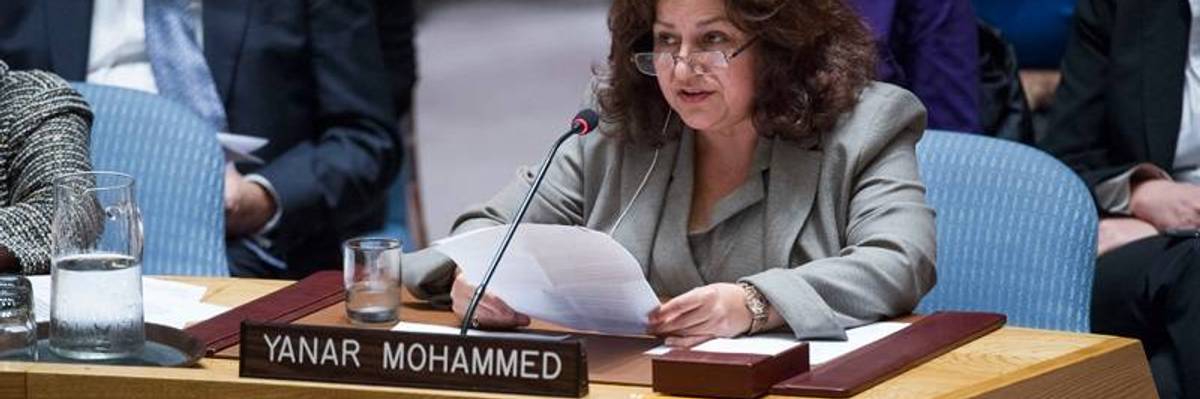
Yanar Mohammed is shown.
Yanar knew that wherever there is terrible violence, there are people behaving magnificently. She was one of them.
The first time someone threatened to kill Yanar was in 2003.
That was the year she returned to Baghdad, after having fled with her infant son during the first US war seven years earlier.
With Iraq now under US occupation, Yanar noticed something that the media did not: The US had unleashed and empowered Iraq’s most reactionary political forces, and like fundamentalists everywhere, their first priority was to subjugate Iraqi women and girls.
Yanar wasn’t having it.
Yanar would also want us to remember that the timing of her murder has everything to do with the war on Iran launched by the US and Israel just three days before she was killed.
She saw what was happening and launched the Organization of Women’s Freedom in Iraq (OWFI) to fight against the dismantlement of women’s rights and the terrible rise in violence against women. The organization’s first office was a bombed-out bank in central Baghdad.
From that moment, Yanar became a lightning rod for anti-feminist attacks, and very soon after, the threats began.
In 2004, I published an open letter to the chief of the US administration in Baghdad, reminding him that the United States was legally obligated to protect Yanar’s life and the lives of all Iraqi civilians under occupation. I didn’t know Yanar yet, but she wrote to thank me, and we arranged to meet in New York.
We sat on a lumpy couch in MADRE’s old office and talked about building a network of safe houses, where women fleeing violence could find safety and solidarity. Then we went to Macy’s, and Yanar tried on every single lipstick at the makeup counter.
Over the next 22 years, Yanar became one of MADRE’s closest partners, and to me, she became family.
MADRE accompanied Yanar as she brought her visions for revolutionary feminism to life again and again, founding a network of shelters for women and keeping them operational through attacks by clans, militias, and the State.
She launched a feminist newspaper and radio station and staffed them with women who rebuilt their shattered lives through the care, feminist education, and job training that OWFI provided.
She created safe spaces for young people to come together across sectarian lines to defy the logic of the US-caused civil war and create art, music, and poetry.
She co-founded the first organization of Afro-Iraqis, understanding that there is no feminism without racial justice.
She built an underground railroad to free women who were enslaved by ISIS.
She fought like hell to defend women’s legal rights, understanding that the more we lost, the more critical every victory became.
She led protests, campaigns, and coalitions that brought down a corrupt government and forced its successor to answer to demands for accountability from Iraq’s most marginalized people.
Yet, as extraordinary as Yanar’s legacy is, she was so much more than the sum of her accomplishments.
Yanar loved jazz, sushi, and beer. She also worried about her son and spent years hoping to find love. She loved her husband, who made her so happy these last few years.
Yanar was also despondent at times. More focused on all that was left to do than on what she had achieved. Her moments of exhaustion and frustration always reminded me that we don’t have to be infallible heroes in this work; we just have to keep doing our part and take care of each other along the way.
Yanar would also want us to remember that the timing of her murder has everything to do with the war on Iran launched by the US and Israel just three days before she was killed. The Iranian-backed militias that had threatened Yanar for years have been galvanized like never before by this war.
In January, when Yanar and I spoke about the killing of Renee Goode in Minneapolis, we were both struck by the parallels between those militias in Iraq and Immigration and Customs Enforcement in the United States.
“Now you have what the US brought to Iraq,” Yanar said, “A paramilitary force working for the worst reactionaries in government, terrorizing communities and committing extrajudicial executions.”
We talked about the beauty and the power of the organizing to protect immigrants, and the militant joy of people coming together to remake the world: in Minneapolis, in Baghdad, in Gaza, in Darfur, and in Haiti.
Yanar knew that wherever there is terrible violence, there are people behaving magnificently:
Heating soup and handing out blankets,
Offering sanctuary to those who are under attack,
Spinning the ideas that will move everything forward,
And putting their bodies on the line again and again.
Yanar did all of these things. And she did them with joy in her heart and fire in her belly. I loved her for that.
Two years ago, when I was in Jerusalem, where I lived as a child, Yanar wrote to me about her hopes for the future:
My plan for the coming decade is to have a small house with a big garden in a Baghdad suburb, where I will get a dog, and plant all the flowering trees and vegetables. And I hope the day will come when we can both visit each other in our home cities without any fear.
This is the legacy Yanar leaves us to enact—to fight for each other and spend time together in the flowering gardens we’ve planted.
Dear Common Dreams reader, It’s been nearly 30 years since I co-founded Common Dreams with my late wife, Lina Newhouser. We had the radical notion that journalism should serve the public good, not corporate profits. It was clear to us from the outset what it would take to build such a project. No paid advertisements. No corporate sponsors. No millionaire publisher telling us what to think or do. Many people said we wouldn't last a year, but we proved those doubters wrong. Together with a tremendous team of journalists and dedicated staff, we built an independent media outlet free from the constraints of profits and corporate control. Our mission has always been simple: To inform. To inspire. To ignite change for the common good. Building Common Dreams was not easy. Our survival was never guaranteed. When you take on the most powerful forces—Wall Street greed, fossil fuel industry destruction, Big Tech lobbyists, and uber-rich oligarchs who have spent billions upon billions rigging the economy and democracy in their favor—the only bulwark you have is supporters who believe in your work. But here’s the urgent message from me today. It's never been this bad out there. And it's never been this hard to keep us going. At the very moment Common Dreams is most needed, the threats we face are intensifying. We need your support now more than ever. We don't accept corporate advertising and never will. We don't have a paywall because we don't think people should be blocked from critical news based on their ability to pay. Everything we do is funded by the donations of readers like you. When everyone does the little they can afford, we are strong. But if that support retreats or dries up, so do we. Will you donate now to make sure Common Dreams not only survives but thrives? —Craig Brown, Co-founder |
The first time someone threatened to kill Yanar was in 2003.
That was the year she returned to Baghdad, after having fled with her infant son during the first US war seven years earlier.
With Iraq now under US occupation, Yanar noticed something that the media did not: The US had unleashed and empowered Iraq’s most reactionary political forces, and like fundamentalists everywhere, their first priority was to subjugate Iraqi women and girls.
Yanar wasn’t having it.
Yanar would also want us to remember that the timing of her murder has everything to do with the war on Iran launched by the US and Israel just three days before she was killed.
She saw what was happening and launched the Organization of Women’s Freedom in Iraq (OWFI) to fight against the dismantlement of women’s rights and the terrible rise in violence against women. The organization’s first office was a bombed-out bank in central Baghdad.
From that moment, Yanar became a lightning rod for anti-feminist attacks, and very soon after, the threats began.
In 2004, I published an open letter to the chief of the US administration in Baghdad, reminding him that the United States was legally obligated to protect Yanar’s life and the lives of all Iraqi civilians under occupation. I didn’t know Yanar yet, but she wrote to thank me, and we arranged to meet in New York.
We sat on a lumpy couch in MADRE’s old office and talked about building a network of safe houses, where women fleeing violence could find safety and solidarity. Then we went to Macy’s, and Yanar tried on every single lipstick at the makeup counter.
Over the next 22 years, Yanar became one of MADRE’s closest partners, and to me, she became family.
MADRE accompanied Yanar as she brought her visions for revolutionary feminism to life again and again, founding a network of shelters for women and keeping them operational through attacks by clans, militias, and the State.
She launched a feminist newspaper and radio station and staffed them with women who rebuilt their shattered lives through the care, feminist education, and job training that OWFI provided.
She created safe spaces for young people to come together across sectarian lines to defy the logic of the US-caused civil war and create art, music, and poetry.
She co-founded the first organization of Afro-Iraqis, understanding that there is no feminism without racial justice.
She built an underground railroad to free women who were enslaved by ISIS.
She fought like hell to defend women’s legal rights, understanding that the more we lost, the more critical every victory became.
She led protests, campaigns, and coalitions that brought down a corrupt government and forced its successor to answer to demands for accountability from Iraq’s most marginalized people.
Yet, as extraordinary as Yanar’s legacy is, she was so much more than the sum of her accomplishments.
Yanar loved jazz, sushi, and beer. She also worried about her son and spent years hoping to find love. She loved her husband, who made her so happy these last few years.
Yanar was also despondent at times. More focused on all that was left to do than on what she had achieved. Her moments of exhaustion and frustration always reminded me that we don’t have to be infallible heroes in this work; we just have to keep doing our part and take care of each other along the way.
Yanar would also want us to remember that the timing of her murder has everything to do with the war on Iran launched by the US and Israel just three days before she was killed. The Iranian-backed militias that had threatened Yanar for years have been galvanized like never before by this war.
In January, when Yanar and I spoke about the killing of Renee Goode in Minneapolis, we were both struck by the parallels between those militias in Iraq and Immigration and Customs Enforcement in the United States.
“Now you have what the US brought to Iraq,” Yanar said, “A paramilitary force working for the worst reactionaries in government, terrorizing communities and committing extrajudicial executions.”
We talked about the beauty and the power of the organizing to protect immigrants, and the militant joy of people coming together to remake the world: in Minneapolis, in Baghdad, in Gaza, in Darfur, and in Haiti.
Yanar knew that wherever there is terrible violence, there are people behaving magnificently:
Heating soup and handing out blankets,
Offering sanctuary to those who are under attack,
Spinning the ideas that will move everything forward,
And putting their bodies on the line again and again.
Yanar did all of these things. And she did them with joy in her heart and fire in her belly. I loved her for that.
Two years ago, when I was in Jerusalem, where I lived as a child, Yanar wrote to me about her hopes for the future:
My plan for the coming decade is to have a small house with a big garden in a Baghdad suburb, where I will get a dog, and plant all the flowering trees and vegetables. And I hope the day will come when we can both visit each other in our home cities without any fear.
This is the legacy Yanar leaves us to enact—to fight for each other and spend time together in the flowering gardens we’ve planted.
The first time someone threatened to kill Yanar was in 2003.
That was the year she returned to Baghdad, after having fled with her infant son during the first US war seven years earlier.
With Iraq now under US occupation, Yanar noticed something that the media did not: The US had unleashed and empowered Iraq’s most reactionary political forces, and like fundamentalists everywhere, their first priority was to subjugate Iraqi women and girls.
Yanar wasn’t having it.
Yanar would also want us to remember that the timing of her murder has everything to do with the war on Iran launched by the US and Israel just three days before she was killed.
She saw what was happening and launched the Organization of Women’s Freedom in Iraq (OWFI) to fight against the dismantlement of women’s rights and the terrible rise in violence against women. The organization’s first office was a bombed-out bank in central Baghdad.
From that moment, Yanar became a lightning rod for anti-feminist attacks, and very soon after, the threats began.
In 2004, I published an open letter to the chief of the US administration in Baghdad, reminding him that the United States was legally obligated to protect Yanar’s life and the lives of all Iraqi civilians under occupation. I didn’t know Yanar yet, but she wrote to thank me, and we arranged to meet in New York.
We sat on a lumpy couch in MADRE’s old office and talked about building a network of safe houses, where women fleeing violence could find safety and solidarity. Then we went to Macy’s, and Yanar tried on every single lipstick at the makeup counter.
Over the next 22 years, Yanar became one of MADRE’s closest partners, and to me, she became family.
MADRE accompanied Yanar as she brought her visions for revolutionary feminism to life again and again, founding a network of shelters for women and keeping them operational through attacks by clans, militias, and the State.
She launched a feminist newspaper and radio station and staffed them with women who rebuilt their shattered lives through the care, feminist education, and job training that OWFI provided.
She created safe spaces for young people to come together across sectarian lines to defy the logic of the US-caused civil war and create art, music, and poetry.
She co-founded the first organization of Afro-Iraqis, understanding that there is no feminism without racial justice.
She built an underground railroad to free women who were enslaved by ISIS.
She fought like hell to defend women’s legal rights, understanding that the more we lost, the more critical every victory became.
She led protests, campaigns, and coalitions that brought down a corrupt government and forced its successor to answer to demands for accountability from Iraq’s most marginalized people.
Yet, as extraordinary as Yanar’s legacy is, she was so much more than the sum of her accomplishments.
Yanar loved jazz, sushi, and beer. She also worried about her son and spent years hoping to find love. She loved her husband, who made her so happy these last few years.
Yanar was also despondent at times. More focused on all that was left to do than on what she had achieved. Her moments of exhaustion and frustration always reminded me that we don’t have to be infallible heroes in this work; we just have to keep doing our part and take care of each other along the way.
Yanar would also want us to remember that the timing of her murder has everything to do with the war on Iran launched by the US and Israel just three days before she was killed. The Iranian-backed militias that had threatened Yanar for years have been galvanized like never before by this war.
In January, when Yanar and I spoke about the killing of Renee Goode in Minneapolis, we were both struck by the parallels between those militias in Iraq and Immigration and Customs Enforcement in the United States.
“Now you have what the US brought to Iraq,” Yanar said, “A paramilitary force working for the worst reactionaries in government, terrorizing communities and committing extrajudicial executions.”
We talked about the beauty and the power of the organizing to protect immigrants, and the militant joy of people coming together to remake the world: in Minneapolis, in Baghdad, in Gaza, in Darfur, and in Haiti.
Yanar knew that wherever there is terrible violence, there are people behaving magnificently:
Heating soup and handing out blankets,
Offering sanctuary to those who are under attack,
Spinning the ideas that will move everything forward,
And putting their bodies on the line again and again.
Yanar did all of these things. And she did them with joy in her heart and fire in her belly. I loved her for that.
Two years ago, when I was in Jerusalem, where I lived as a child, Yanar wrote to me about her hopes for the future:
My plan for the coming decade is to have a small house with a big garden in a Baghdad suburb, where I will get a dog, and plant all the flowering trees and vegetables. And I hope the day will come when we can both visit each other in our home cities without any fear.
This is the legacy Yanar leaves us to enact—to fight for each other and spend time together in the flowering gardens we’ve planted.