

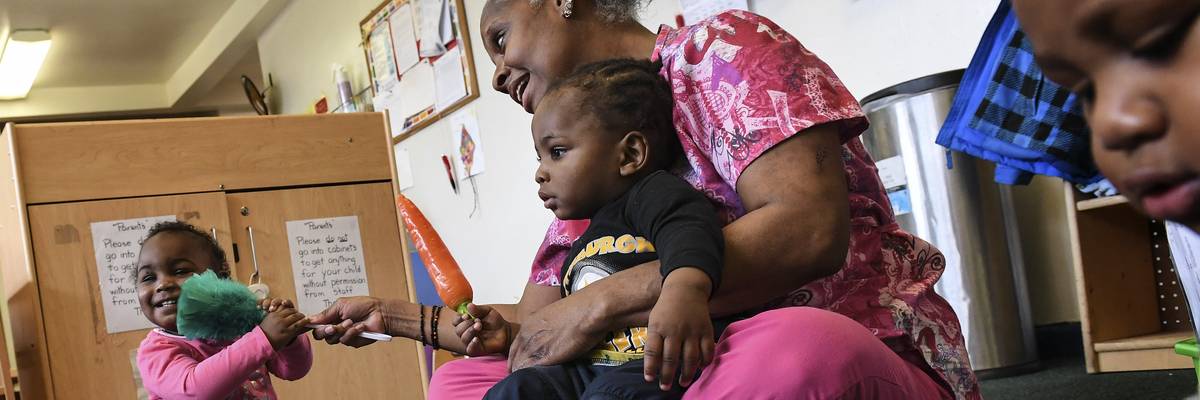
Childcare worker Debbie James-Dean uses a feather duster to tickle Aubrey Albritton, 16 months, as she goes over the color "green" during an activity at a Kids Are Us Learning Center in Southeast Washington, DC, on Friday, March 24, 2017.
Will Employers Invest in Our Kids? An Interview with Nancy Folbre
Children are getting more expensive for parents even as investment in future workers is becoming less cost-effective for employers. What should be done about it?
The Trump administration has suspended over $10 billion of federal childcare funds for five Democratic-led states over alleged fraud. So what if childcare in the United States is already outrageously expensive, much higher than in other developed countries? And why is it that childcare in the US is so expensive?
Socialist and feminist economist Nancy Folbre sheds light on these questions in the interview that follows by pointing out the various changes that have taken place over time in the organization of social reproduction and argues, in turn, that universal childcare, an idea that is becoming increasingly popular with voters across many parts of the United States, is very much needed.
Nancy Folbre is professor emerita of economics and director of the Program on Gender and Care Work at the Political Economy Research Institute (PERI) at the University of Massachusetts Amherst.
C. J. Polychroniou: You’ve written widely about the rising price of parenting. Despite concerns about a national birthrate that is now below replacement level, there seems to be relatively little public effort to increase economic support for parents and children in this country. Why?
Nancy Folbre: The undeclared wars the Trump administration is conducting include a brazen process of reducing public support for the next generation. This process began last spring when billionaire Elon Musk spearheaded budget cuts and layoffs in programs benefiting children and began dismantling the Department of Education. It escalated in the first week of 2026 when the administration used accusations of fraud from a partisan video of childcare centers in Minnesota as an excuse to freeze federal childcare funds to five Democratic states.
The strategy is transparent: Tar all social spending with a sticky claim of fraud and abuse. This includes spending on parents and children, already hurt by cuts to Medicaid, the Affordable Care Act, and the Supplemental Nutritional Assistance Program. These cuts have reduced the affordability of family care for all but the affluent, making a mockery of the Trump administration’s promises of prosperity for all.
An understanding of the deeper forces driving this strategy requires a deep dive into historical changes in the organization of our social reproduction.
A similar logic applies in a different direction to investments in us and our children—why risk them if they are not cost-effective? Robots may soon be cheaper, and they never go on strike OR vote.
Children are getting more expensive for parents even as investment in future workers is becoming less cost-effective for employers. Economic pressures became evident centuries ago when child labor was outlawed and technological change increased the demand for skilled labor. This shift in demand helped incentivize investments in public health and education that were financed by higher taxes. The need for future workers—and soldiers—also intensified the need for wages sufficient to support at least a modicum of family care.
While employers constantly sought ways to reduce labor costs, their need for an ample supply of skilled labor at least partially aligned their incentives with those of workers themselves through support for the so-called welfare state (better termed a “social investment” state) that helped develop and maintain the capabilities of the working population.
Fast forward to the present. The huge amounts of money being invested in artificial intelligence represent a new bet on reducing labor costs both directly (through reduced employment and wages) and indirectly (through reduced investment in health, education, and social services).
A recent Wall Street Journal headline put it this way: “AI Job Losses Are Coming, Tech Execs Say. The Question: Who’s Most at Risk?” The answer: most of us—because general artificial intelligence (AI) is likely to reduce private incentives to invest in humans rather than data centers. Elon Musk, who spearheaded efforts to cut federal spending in early 2025, is happily promoting Tesla’s new Optimus robot.
C. J. Polychroniou: You seem to be suggesting that class conflict affects public policies, which affect demographic outcomes (and vice versa). How do most economists think about these issues?
Nancy Folbre: Mainstream economists seldom pay much attention to collective identities or interests such as those based on class, gender, citizenship, or parenthood. Their general confidence in the efficiency of market forces makes them hopeful that that the labor market will adjust to changing prices—that new jobs will replace those rendered obsolete. However, college-educated, entry-level workers in the US are already experiencing diminished job prospects. Some economists predict that the “adjustment costs” will be high—a polite way of saying that the younger generation is in for an unpleasant economic shock.
Some ideological adjustment is also underway. The theory of “human capital” successfully promoted the view that the labor market would reward the skills represented by a college degree, reinforcing the claim that employees are generally paid according to the value of what they produce. The very term “human capital” suggests that there is no real distinction between capitalists and workers—everyone can be a capitalist by investing in their own earning power.
This utopian fantasy has long been countered by evidence that the environment people grow up in—including many factors well beyond their own control—shapes their economic trajectory. The fantasy is countered even more powerfully by evidence that the returns to a college education are now declining for individuals coming from low-income families. The surge of investment in AI raises the distinct possibility that the supply of “human capital” is likely to further exceed the demand for it, threatening downward mobility for a segment of the paid labor force once considered relatively secure.
Of course, even conservative economists recognize that a good education—from preschool to college--does more than merely increase lifetime earnings. It enhances the skills that people need to manage their own lives—skills like troubleshooting phones, making good decisions about what to buy, how to save, how to vote, and how to parent. Well-educated people live longer—and not just because they tend to earn more money.
But these benefits are not as profitable as increased productivity for a private firm.
Because they have characteristics of a public good, their economic contribution is difficult to measure, much less privately capture. Policies such as universal childcare, paid family or sick leave, and options to engage in employment from home yield significant economic returns, but these are not channeled directly to those who pay for them.
Standard economics textbooks note that firms have economic incentives to pollute the environment if this increases profitability, even if future inhabitants of the planet will pay a high price. A similar logic applies in a different direction to investments in us and our children—why risk them if they are not cost-effective? Robots may soon be cheaper, and they never go on strike OR vote.
C. J. Polychroniou: It sounds like you’re arguing that the theory of “human capital” no longer holds much water. But there are some economists out there who have articulated larger criticisms of capitalist institutions in general. How do these criticisms connect the rising private cost of children, fertility decline, and the possible obsolescence of the white-collar labor force?
Nancy Folbre: Kind of a long story, but I’ll keep it short! Economists like myself, influenced by socialist and feminist ideas, highlight the institutional arrangements that shape the distribution of the costs of raising children and the reproduction of human society itself. In many precapitalist societies, parents enjoyed at least partial payback for the costs of childrearing, as adult children contributed to family income and the support of their elders. Capitalist institutions encouraged labor mobility and reliance on individual earnings, weakening such family and community-based transfers.
Democratic engagement and bargaining over the role of the state gradually led to a different system of intergenerational transfers, taxing employers and the working-age population to help finance public education for the young and pensions and healthcare for the elderly.
This institutional compromise helped stabilize the process of “social reproduction” but also led to unequal distribution of its costs. It allowed employers to keep their contributions to the production of the next generation relatively low. It delivered fewer benefits to parents (those devoting time and money to producing new workers and taxpayers) than to non-parents. It also reinforced a gender division of labor that imposed a disproportionate share of the private costs of family care on women.
We can’t continue to treat care as a kind of expensive hobby rather than a productive contribution to our collective future.
These inequalities amplified increases in the private cost of raising children (for mothers in particular), encouraging efforts to limit family size. New technologies, increased demand for skills, and opportunities for employment outside the home also played an obvious role.
Until recently, fertility decline was considered an economic boon, allowing more women to enter paid employment and promoting the growth of Gross Domestic Product. As is now widely recognized, however, below-replacement fertility poses problems of its own. When women bear less than about 2.1 children over their lifetime, they don’t generate enough surviving children to “replace” their biological parents.
If this rate persists, the size of the youngest generation declines steadily over time, increasing the share of the elderly population relative to the employment-age, tax-paying population. The economic burden of increased old-age dependency increases political conflict over who should pay the costs—and can intensify the economic stresses of caring for younger dependents as well.
Reduction in the size of the global population offers some potential benefits, given current threats to the global environment (not to mention the dicey future of decent jobs). But if we prove unable to get back up to replacement levels of fertility at some point in the future, we will render ourselves extinct. I’d call that a pretty acute crisis of social reproduction.
C. J. Polychroniou: How can we avert such a crisis? Are you suggesting that we adopt pronatalist policies? How do responses in other countries differ from those in the US?
Nancy Folbre: No. We’re not in a state of demographic emergency and we don’t need to encourage a higher birth rate. Much of the global population is suffering from lack of decent employment. And the number of children in the US harmed by poverty makes investment in child health and education a much higher priority than increasing births here.
However, investments in child “quality” can help stabilize and strengthen private commitments. Many other countries are implementing policies designed to make family care more affordable. As is well-known, most affluent European countries have put such policies in place. South Korea began providing universal childcare services in 2013 and is now increasing parental leave allowances. Canada is a more nearby example, with its rollout of a new federal childcare system that will offer universal childcare services at a private cost of $10 a day. Within the US, both New Mexico and New York City are setting an example with new initiatives.
The US as a whole is lagging beyond for several reasons. Racial and ethnic divisions, regional differences, and exceptionally high levels of earnings inequality have weakened the solidarity needed to build a “pro-care” coalition. Imperialist rhetoric and illegal military actions have literally bloodied the water.
As I argue in my forthcoming book, Making Care Work, we need to do a better job explaining the public benefits of investment in human capabilities, including the care of people experiencing illness, frailty, or disability. We can’t continue to treat care as a kind of expensive hobby rather than a productive contribution to our collective future.
Let’s talk about how to move forward in another interview—I think that a universal basic income will be part of the solution, even though it will face vehement opposition. Will employers invest in our kids? Only if we can make them.
We are at a crossroads
This country and this world are at a monumental crossroads. In a few short weeks, US voters will have an opportunity to beat back the forces of fascism and confront the billionaires who are rigging the economy, our media system, and our democracy, making it increasingly impossible for ordinary people to get by. We’re not just talking about the election. We’re talking about what must be done once these fascist elements are vanquished from power. We need a bolder set of solutions than what either major party has so far been willing to offer and a working-class movement ready to fight like hell for it. Trump didn't emerge from nowhere. The conditions that fueled MAGA authoritarianism were created by decades of radical neoliberal economic policies and a corrupt political system dominated by corporate interests. They slashed taxes on the super-rich, promising that the benefits would trickle down. They said giveaways to the corporate titans would make life more affordable for the rest of us. It was all bullshit. And when a bitter, betrayed populace searches for someone to blame, right-wing demagogues have little trouble finding scapegoats. People know when they're being lied to, but you won't hear any of this from the corporate media. Only independent journalism—powered and funded by people who believe in building a better world—can deliver truly trustworthy daily news. Our Fall Campaign is underway, and we need your help. To power our newsroom through the rest of the year, we need to raise $125,000 by midnight on October 31. So if you share our vision, please contribute whatever you can to sustain our work. |
The Trump administration has suspended over $10 billion of federal childcare funds for five Democratic-led states over alleged fraud. So what if childcare in the United States is already outrageously expensive, much higher than in other developed countries? And why is it that childcare in the US is so expensive?
Socialist and feminist economist Nancy Folbre sheds light on these questions in the interview that follows by pointing out the various changes that have taken place over time in the organization of social reproduction and argues, in turn, that universal childcare, an idea that is becoming increasingly popular with voters across many parts of the United States, is very much needed.
Nancy Folbre is professor emerita of economics and director of the Program on Gender and Care Work at the Political Economy Research Institute (PERI) at the University of Massachusetts Amherst.
C. J. Polychroniou: You’ve written widely about the rising price of parenting. Despite concerns about a national birthrate that is now below replacement level, there seems to be relatively little public effort to increase economic support for parents and children in this country. Why?
Nancy Folbre: The undeclared wars the Trump administration is conducting include a brazen process of reducing public support for the next generation. This process began last spring when billionaire Elon Musk spearheaded budget cuts and layoffs in programs benefiting children and began dismantling the Department of Education. It escalated in the first week of 2026 when the administration used accusations of fraud from a partisan video of childcare centers in Minnesota as an excuse to freeze federal childcare funds to five Democratic states.
The strategy is transparent: Tar all social spending with a sticky claim of fraud and abuse. This includes spending on parents and children, already hurt by cuts to Medicaid, the Affordable Care Act, and the Supplemental Nutritional Assistance Program. These cuts have reduced the affordability of family care for all but the affluent, making a mockery of the Trump administration’s promises of prosperity for all.
An understanding of the deeper forces driving this strategy requires a deep dive into historical changes in the organization of our social reproduction.
A similar logic applies in a different direction to investments in us and our children—why risk them if they are not cost-effective? Robots may soon be cheaper, and they never go on strike OR vote.
Children are getting more expensive for parents even as investment in future workers is becoming less cost-effective for employers. Economic pressures became evident centuries ago when child labor was outlawed and technological change increased the demand for skilled labor. This shift in demand helped incentivize investments in public health and education that were financed by higher taxes. The need for future workers—and soldiers—also intensified the need for wages sufficient to support at least a modicum of family care.
While employers constantly sought ways to reduce labor costs, their need for an ample supply of skilled labor at least partially aligned their incentives with those of workers themselves through support for the so-called welfare state (better termed a “social investment” state) that helped develop and maintain the capabilities of the working population.
Fast forward to the present. The huge amounts of money being invested in artificial intelligence represent a new bet on reducing labor costs both directly (through reduced employment and wages) and indirectly (through reduced investment in health, education, and social services).
A recent Wall Street Journal headline put it this way: “AI Job Losses Are Coming, Tech Execs Say. The Question: Who’s Most at Risk?” The answer: most of us—because general artificial intelligence (AI) is likely to reduce private incentives to invest in humans rather than data centers. Elon Musk, who spearheaded efforts to cut federal spending in early 2025, is happily promoting Tesla’s new Optimus robot.
C. J. Polychroniou: You seem to be suggesting that class conflict affects public policies, which affect demographic outcomes (and vice versa). How do most economists think about these issues?
Nancy Folbre: Mainstream economists seldom pay much attention to collective identities or interests such as those based on class, gender, citizenship, or parenthood. Their general confidence in the efficiency of market forces makes them hopeful that that the labor market will adjust to changing prices—that new jobs will replace those rendered obsolete. However, college-educated, entry-level workers in the US are already experiencing diminished job prospects. Some economists predict that the “adjustment costs” will be high—a polite way of saying that the younger generation is in for an unpleasant economic shock.
Some ideological adjustment is also underway. The theory of “human capital” successfully promoted the view that the labor market would reward the skills represented by a college degree, reinforcing the claim that employees are generally paid according to the value of what they produce. The very term “human capital” suggests that there is no real distinction between capitalists and workers—everyone can be a capitalist by investing in their own earning power.
This utopian fantasy has long been countered by evidence that the environment people grow up in—including many factors well beyond their own control—shapes their economic trajectory. The fantasy is countered even more powerfully by evidence that the returns to a college education are now declining for individuals coming from low-income families. The surge of investment in AI raises the distinct possibility that the supply of “human capital” is likely to further exceed the demand for it, threatening downward mobility for a segment of the paid labor force once considered relatively secure.
Of course, even conservative economists recognize that a good education—from preschool to college--does more than merely increase lifetime earnings. It enhances the skills that people need to manage their own lives—skills like troubleshooting phones, making good decisions about what to buy, how to save, how to vote, and how to parent. Well-educated people live longer—and not just because they tend to earn more money.
But these benefits are not as profitable as increased productivity for a private firm.
Because they have characteristics of a public good, their economic contribution is difficult to measure, much less privately capture. Policies such as universal childcare, paid family or sick leave, and options to engage in employment from home yield significant economic returns, but these are not channeled directly to those who pay for them.
Standard economics textbooks note that firms have economic incentives to pollute the environment if this increases profitability, even if future inhabitants of the planet will pay a high price. A similar logic applies in a different direction to investments in us and our children—why risk them if they are not cost-effective? Robots may soon be cheaper, and they never go on strike OR vote.
C. J. Polychroniou: It sounds like you’re arguing that the theory of “human capital” no longer holds much water. But there are some economists out there who have articulated larger criticisms of capitalist institutions in general. How do these criticisms connect the rising private cost of children, fertility decline, and the possible obsolescence of the white-collar labor force?
Nancy Folbre: Kind of a long story, but I’ll keep it short! Economists like myself, influenced by socialist and feminist ideas, highlight the institutional arrangements that shape the distribution of the costs of raising children and the reproduction of human society itself. In many precapitalist societies, parents enjoyed at least partial payback for the costs of childrearing, as adult children contributed to family income and the support of their elders. Capitalist institutions encouraged labor mobility and reliance on individual earnings, weakening such family and community-based transfers.
Democratic engagement and bargaining over the role of the state gradually led to a different system of intergenerational transfers, taxing employers and the working-age population to help finance public education for the young and pensions and healthcare for the elderly.
This institutional compromise helped stabilize the process of “social reproduction” but also led to unequal distribution of its costs. It allowed employers to keep their contributions to the production of the next generation relatively low. It delivered fewer benefits to parents (those devoting time and money to producing new workers and taxpayers) than to non-parents. It also reinforced a gender division of labor that imposed a disproportionate share of the private costs of family care on women.
We can’t continue to treat care as a kind of expensive hobby rather than a productive contribution to our collective future.
These inequalities amplified increases in the private cost of raising children (for mothers in particular), encouraging efforts to limit family size. New technologies, increased demand for skills, and opportunities for employment outside the home also played an obvious role.
Until recently, fertility decline was considered an economic boon, allowing more women to enter paid employment and promoting the growth of Gross Domestic Product. As is now widely recognized, however, below-replacement fertility poses problems of its own. When women bear less than about 2.1 children over their lifetime, they don’t generate enough surviving children to “replace” their biological parents.
If this rate persists, the size of the youngest generation declines steadily over time, increasing the share of the elderly population relative to the employment-age, tax-paying population. The economic burden of increased old-age dependency increases political conflict over who should pay the costs—and can intensify the economic stresses of caring for younger dependents as well.
Reduction in the size of the global population offers some potential benefits, given current threats to the global environment (not to mention the dicey future of decent jobs). But if we prove unable to get back up to replacement levels of fertility at some point in the future, we will render ourselves extinct. I’d call that a pretty acute crisis of social reproduction.
C. J. Polychroniou: How can we avert such a crisis? Are you suggesting that we adopt pronatalist policies? How do responses in other countries differ from those in the US?
Nancy Folbre: No. We’re not in a state of demographic emergency and we don’t need to encourage a higher birth rate. Much of the global population is suffering from lack of decent employment. And the number of children in the US harmed by poverty makes investment in child health and education a much higher priority than increasing births here.
However, investments in child “quality” can help stabilize and strengthen private commitments. Many other countries are implementing policies designed to make family care more affordable. As is well-known, most affluent European countries have put such policies in place. South Korea began providing universal childcare services in 2013 and is now increasing parental leave allowances. Canada is a more nearby example, with its rollout of a new federal childcare system that will offer universal childcare services at a private cost of $10 a day. Within the US, both New Mexico and New York City are setting an example with new initiatives.
The US as a whole is lagging beyond for several reasons. Racial and ethnic divisions, regional differences, and exceptionally high levels of earnings inequality have weakened the solidarity needed to build a “pro-care” coalition. Imperialist rhetoric and illegal military actions have literally bloodied the water.
As I argue in my forthcoming book, Making Care Work, we need to do a better job explaining the public benefits of investment in human capabilities, including the care of people experiencing illness, frailty, or disability. We can’t continue to treat care as a kind of expensive hobby rather than a productive contribution to our collective future.
Let’s talk about how to move forward in another interview—I think that a universal basic income will be part of the solution, even though it will face vehement opposition. Will employers invest in our kids? Only if we can make them.
The Trump administration has suspended over $10 billion of federal childcare funds for five Democratic-led states over alleged fraud. So what if childcare in the United States is already outrageously expensive, much higher than in other developed countries? And why is it that childcare in the US is so expensive?
Socialist and feminist economist Nancy Folbre sheds light on these questions in the interview that follows by pointing out the various changes that have taken place over time in the organization of social reproduction and argues, in turn, that universal childcare, an idea that is becoming increasingly popular with voters across many parts of the United States, is very much needed.
Nancy Folbre is professor emerita of economics and director of the Program on Gender and Care Work at the Political Economy Research Institute (PERI) at the University of Massachusetts Amherst.
C. J. Polychroniou: You’ve written widely about the rising price of parenting. Despite concerns about a national birthrate that is now below replacement level, there seems to be relatively little public effort to increase economic support for parents and children in this country. Why?
Nancy Folbre: The undeclared wars the Trump administration is conducting include a brazen process of reducing public support for the next generation. This process began last spring when billionaire Elon Musk spearheaded budget cuts and layoffs in programs benefiting children and began dismantling the Department of Education. It escalated in the first week of 2026 when the administration used accusations of fraud from a partisan video of childcare centers in Minnesota as an excuse to freeze federal childcare funds to five Democratic states.
The strategy is transparent: Tar all social spending with a sticky claim of fraud and abuse. This includes spending on parents and children, already hurt by cuts to Medicaid, the Affordable Care Act, and the Supplemental Nutritional Assistance Program. These cuts have reduced the affordability of family care for all but the affluent, making a mockery of the Trump administration’s promises of prosperity for all.
An understanding of the deeper forces driving this strategy requires a deep dive into historical changes in the organization of our social reproduction.
A similar logic applies in a different direction to investments in us and our children—why risk them if they are not cost-effective? Robots may soon be cheaper, and they never go on strike OR vote.
Children are getting more expensive for parents even as investment in future workers is becoming less cost-effective for employers. Economic pressures became evident centuries ago when child labor was outlawed and technological change increased the demand for skilled labor. This shift in demand helped incentivize investments in public health and education that were financed by higher taxes. The need for future workers—and soldiers—also intensified the need for wages sufficient to support at least a modicum of family care.
While employers constantly sought ways to reduce labor costs, their need for an ample supply of skilled labor at least partially aligned their incentives with those of workers themselves through support for the so-called welfare state (better termed a “social investment” state) that helped develop and maintain the capabilities of the working population.
Fast forward to the present. The huge amounts of money being invested in artificial intelligence represent a new bet on reducing labor costs both directly (through reduced employment and wages) and indirectly (through reduced investment in health, education, and social services).
A recent Wall Street Journal headline put it this way: “AI Job Losses Are Coming, Tech Execs Say. The Question: Who’s Most at Risk?” The answer: most of us—because general artificial intelligence (AI) is likely to reduce private incentives to invest in humans rather than data centers. Elon Musk, who spearheaded efforts to cut federal spending in early 2025, is happily promoting Tesla’s new Optimus robot.
C. J. Polychroniou: You seem to be suggesting that class conflict affects public policies, which affect demographic outcomes (and vice versa). How do most economists think about these issues?
Nancy Folbre: Mainstream economists seldom pay much attention to collective identities or interests such as those based on class, gender, citizenship, or parenthood. Their general confidence in the efficiency of market forces makes them hopeful that that the labor market will adjust to changing prices—that new jobs will replace those rendered obsolete. However, college-educated, entry-level workers in the US are already experiencing diminished job prospects. Some economists predict that the “adjustment costs” will be high—a polite way of saying that the younger generation is in for an unpleasant economic shock.
Some ideological adjustment is also underway. The theory of “human capital” successfully promoted the view that the labor market would reward the skills represented by a college degree, reinforcing the claim that employees are generally paid according to the value of what they produce. The very term “human capital” suggests that there is no real distinction between capitalists and workers—everyone can be a capitalist by investing in their own earning power.
This utopian fantasy has long been countered by evidence that the environment people grow up in—including many factors well beyond their own control—shapes their economic trajectory. The fantasy is countered even more powerfully by evidence that the returns to a college education are now declining for individuals coming from low-income families. The surge of investment in AI raises the distinct possibility that the supply of “human capital” is likely to further exceed the demand for it, threatening downward mobility for a segment of the paid labor force once considered relatively secure.
Of course, even conservative economists recognize that a good education—from preschool to college--does more than merely increase lifetime earnings. It enhances the skills that people need to manage their own lives—skills like troubleshooting phones, making good decisions about what to buy, how to save, how to vote, and how to parent. Well-educated people live longer—and not just because they tend to earn more money.
But these benefits are not as profitable as increased productivity for a private firm.
Because they have characteristics of a public good, their economic contribution is difficult to measure, much less privately capture. Policies such as universal childcare, paid family or sick leave, and options to engage in employment from home yield significant economic returns, but these are not channeled directly to those who pay for them.
Standard economics textbooks note that firms have economic incentives to pollute the environment if this increases profitability, even if future inhabitants of the planet will pay a high price. A similar logic applies in a different direction to investments in us and our children—why risk them if they are not cost-effective? Robots may soon be cheaper, and they never go on strike OR vote.
C. J. Polychroniou: It sounds like you’re arguing that the theory of “human capital” no longer holds much water. But there are some economists out there who have articulated larger criticisms of capitalist institutions in general. How do these criticisms connect the rising private cost of children, fertility decline, and the possible obsolescence of the white-collar labor force?
Nancy Folbre: Kind of a long story, but I’ll keep it short! Economists like myself, influenced by socialist and feminist ideas, highlight the institutional arrangements that shape the distribution of the costs of raising children and the reproduction of human society itself. In many precapitalist societies, parents enjoyed at least partial payback for the costs of childrearing, as adult children contributed to family income and the support of their elders. Capitalist institutions encouraged labor mobility and reliance on individual earnings, weakening such family and community-based transfers.
Democratic engagement and bargaining over the role of the state gradually led to a different system of intergenerational transfers, taxing employers and the working-age population to help finance public education for the young and pensions and healthcare for the elderly.
This institutional compromise helped stabilize the process of “social reproduction” but also led to unequal distribution of its costs. It allowed employers to keep their contributions to the production of the next generation relatively low. It delivered fewer benefits to parents (those devoting time and money to producing new workers and taxpayers) than to non-parents. It also reinforced a gender division of labor that imposed a disproportionate share of the private costs of family care on women.
We can’t continue to treat care as a kind of expensive hobby rather than a productive contribution to our collective future.
These inequalities amplified increases in the private cost of raising children (for mothers in particular), encouraging efforts to limit family size. New technologies, increased demand for skills, and opportunities for employment outside the home also played an obvious role.
Until recently, fertility decline was considered an economic boon, allowing more women to enter paid employment and promoting the growth of Gross Domestic Product. As is now widely recognized, however, below-replacement fertility poses problems of its own. When women bear less than about 2.1 children over their lifetime, they don’t generate enough surviving children to “replace” their biological parents.
If this rate persists, the size of the youngest generation declines steadily over time, increasing the share of the elderly population relative to the employment-age, tax-paying population. The economic burden of increased old-age dependency increases political conflict over who should pay the costs—and can intensify the economic stresses of caring for younger dependents as well.
Reduction in the size of the global population offers some potential benefits, given current threats to the global environment (not to mention the dicey future of decent jobs). But if we prove unable to get back up to replacement levels of fertility at some point in the future, we will render ourselves extinct. I’d call that a pretty acute crisis of social reproduction.
C. J. Polychroniou: How can we avert such a crisis? Are you suggesting that we adopt pronatalist policies? How do responses in other countries differ from those in the US?
Nancy Folbre: No. We’re not in a state of demographic emergency and we don’t need to encourage a higher birth rate. Much of the global population is suffering from lack of decent employment. And the number of children in the US harmed by poverty makes investment in child health and education a much higher priority than increasing births here.
However, investments in child “quality” can help stabilize and strengthen private commitments. Many other countries are implementing policies designed to make family care more affordable. As is well-known, most affluent European countries have put such policies in place. South Korea began providing universal childcare services in 2013 and is now increasing parental leave allowances. Canada is a more nearby example, with its rollout of a new federal childcare system that will offer universal childcare services at a private cost of $10 a day. Within the US, both New Mexico and New York City are setting an example with new initiatives.
The US as a whole is lagging beyond for several reasons. Racial and ethnic divisions, regional differences, and exceptionally high levels of earnings inequality have weakened the solidarity needed to build a “pro-care” coalition. Imperialist rhetoric and illegal military actions have literally bloodied the water.
As I argue in my forthcoming book, Making Care Work, we need to do a better job explaining the public benefits of investment in human capabilities, including the care of people experiencing illness, frailty, or disability. We can’t continue to treat care as a kind of expensive hobby rather than a productive contribution to our collective future.
Let’s talk about how to move forward in another interview—I think that a universal basic income will be part of the solution, even though it will face vehement opposition. Will employers invest in our kids? Only if we can make them.