SUBSCRIBE TO OUR FREE NEWSLETTER
Daily news & progressive opinion—funded by the people, not the corporations—delivered straight to your inbox.
5
#000000
#FFFFFF
To donate by check, phone, or other method, see our More Ways to Give page.
Daily news & progressive opinion—funded by the people, not the corporations—delivered straight to your inbox.
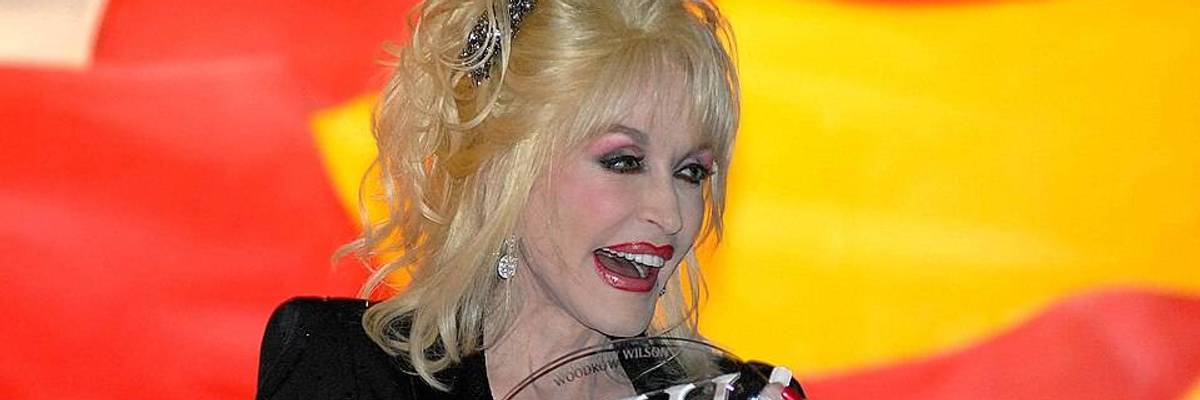
Dolly Parton accepts the Woodrow Wilson Public Service Award in 2007.
I admired Parton not so much for singing, like millions did globally, but for something else: her literacy promotion.
Dolly Parton, actress, entrepreneur, and singer extraordinaire, passed away at the age of 80 on August 25, 2026. She rose from poverty in Appalachia to global fame and a loyal following.
Tributes have been pouring in and rightly so. I admired Parton not so much for singing, like millions did globally, but for something else: her literacy promotion. Let me explain.
Parton donated some 200 million books in her lifetime. Think about that. Reading is a key process to self-discovery in an increasingly confused and confusing world.
As a youth growing up in a vanilla neighborhood attending an integrated middle school, reading Manchild in the Promised Land by Claude Brown, was an eye-opener. Brown’s autobiography of growing up in Harlem during the 1940s and 1950s was unlike anything else that I had read.
Parton actively facilitated reading and one of its outcomes. I mean critical thinking. That’s never been more important.
My parents had union jobs, and the schools I attended had libraries. My fortune in life is increasingly rare in America now, where 1,000 billionaires rent politicians to get government contracts and favorable laws and policies to accumulate more wealth, as ordinary people struggle to pay for food, fuel, and rent—the affordability crisis.
Later as a young adult, I learned that my father was in Harlem during an uprising against police brutality and economic marginality, of March 19-20, 1935, a history that deepened my appreciation for Brown’s work. Harlem “was where the action was,” my father shared with me. I began to grasp a bigger picture of personal and national history, encompassing Brown's autobiography.
Parton actively facilitated reading and one of its outcomes. I mean critical thinking. That’s never been more important in the current post-truth moment of online disinformation about domestic and foreign affairs, of, by, and for the benefit of billionaires and corporations, a symptom of the overall rot in US economics and politics.
Further, in a nation built with the stolen labor of enslaved Africans that in part relied upon depriving them of learning to read, Parton’s gift of 200 million books to poor and working people is, I argue, a revolutionary act. That she hailed from a community of poor whites long susceptible to the ideology of anti-blackness, a centuries-long ruling class divide-and-conquer strategy, speaks volumes of her revolutionary devotion to humanity.
Parton appeared to be electorally independent of the two-party duopoly, a great thing. Meanwhile, she publicly endorsed the movements of African Americans (Black Lives Matter) and LGBT folks for full recognition of their human rights. In a racist and warrior nation such as the US, where buying a gun is easier than receiving healthcare, her support of the maligned and oppressed via the promotion of reading books should be emulated.
Dear Common Dreams reader, It’s been nearly 30 years since I co-founded Common Dreams with my late wife, Lina Newhouser. We had the radical notion that journalism should serve the public good, not corporate profits. It was clear to us from the outset what it would take to build such a project. No paid advertisements. No corporate sponsors. No millionaire publisher telling us what to think or do. Many people said we wouldn't last a year, but we proved those doubters wrong. Together with a tremendous team of journalists and dedicated staff, we built an independent media outlet free from the constraints of profits and corporate control. Our mission has always been simple: To inform. To inspire. To ignite change for the common good. Building Common Dreams was not easy. Our survival was never guaranteed. When you take on the most powerful forces—Wall Street greed, fossil fuel industry destruction, Big Tech lobbyists, and uber-rich oligarchs who have spent billions upon billions rigging the economy and democracy in their favor—the only bulwark you have is supporters who believe in your work. But here’s the urgent message from me today. It's never been this bad out there. And it's never been this hard to keep us going. At the very moment Common Dreams is most needed, the threats we face are intensifying. We need your support now more than ever. We don't accept corporate advertising and never will. We don't have a paywall because we don't think people should be blocked from critical news based on their ability to pay. Everything we do is funded by the donations of readers like you. When everyone does the little they can afford, we are strong. But if that support retreats or dries up, so do we. Will you donate now to make sure Common Dreams not only survives but thrives? —Craig Brown, Co-founder |
Dolly Parton, actress, entrepreneur, and singer extraordinaire, passed away at the age of 80 on August 25, 2026. She rose from poverty in Appalachia to global fame and a loyal following.
Tributes have been pouring in and rightly so. I admired Parton not so much for singing, like millions did globally, but for something else: her literacy promotion. Let me explain.
Parton donated some 200 million books in her lifetime. Think about that. Reading is a key process to self-discovery in an increasingly confused and confusing world.
As a youth growing up in a vanilla neighborhood attending an integrated middle school, reading Manchild in the Promised Land by Claude Brown, was an eye-opener. Brown’s autobiography of growing up in Harlem during the 1940s and 1950s was unlike anything else that I had read.
Parton actively facilitated reading and one of its outcomes. I mean critical thinking. That’s never been more important.
My parents had union jobs, and the schools I attended had libraries. My fortune in life is increasingly rare in America now, where 1,000 billionaires rent politicians to get government contracts and favorable laws and policies to accumulate more wealth, as ordinary people struggle to pay for food, fuel, and rent—the affordability crisis.
Later as a young adult, I learned that my father was in Harlem during an uprising against police brutality and economic marginality, of March 19-20, 1935, a history that deepened my appreciation for Brown’s work. Harlem “was where the action was,” my father shared with me. I began to grasp a bigger picture of personal and national history, encompassing Brown's autobiography.
Parton actively facilitated reading and one of its outcomes. I mean critical thinking. That’s never been more important in the current post-truth moment of online disinformation about domestic and foreign affairs, of, by, and for the benefit of billionaires and corporations, a symptom of the overall rot in US economics and politics.
Further, in a nation built with the stolen labor of enslaved Africans that in part relied upon depriving them of learning to read, Parton’s gift of 200 million books to poor and working people is, I argue, a revolutionary act. That she hailed from a community of poor whites long susceptible to the ideology of anti-blackness, a centuries-long ruling class divide-and-conquer strategy, speaks volumes of her revolutionary devotion to humanity.
Parton appeared to be electorally independent of the two-party duopoly, a great thing. Meanwhile, she publicly endorsed the movements of African Americans (Black Lives Matter) and LGBT folks for full recognition of their human rights. In a racist and warrior nation such as the US, where buying a gun is easier than receiving healthcare, her support of the maligned and oppressed via the promotion of reading books should be emulated.
Dolly Parton, actress, entrepreneur, and singer extraordinaire, passed away at the age of 80 on August 25, 2026. She rose from poverty in Appalachia to global fame and a loyal following.
Tributes have been pouring in and rightly so. I admired Parton not so much for singing, like millions did globally, but for something else: her literacy promotion. Let me explain.
Parton donated some 200 million books in her lifetime. Think about that. Reading is a key process to self-discovery in an increasingly confused and confusing world.
As a youth growing up in a vanilla neighborhood attending an integrated middle school, reading Manchild in the Promised Land by Claude Brown, was an eye-opener. Brown’s autobiography of growing up in Harlem during the 1940s and 1950s was unlike anything else that I had read.
Parton actively facilitated reading and one of its outcomes. I mean critical thinking. That’s never been more important.
My parents had union jobs, and the schools I attended had libraries. My fortune in life is increasingly rare in America now, where 1,000 billionaires rent politicians to get government contracts and favorable laws and policies to accumulate more wealth, as ordinary people struggle to pay for food, fuel, and rent—the affordability crisis.
Later as a young adult, I learned that my father was in Harlem during an uprising against police brutality and economic marginality, of March 19-20, 1935, a history that deepened my appreciation for Brown’s work. Harlem “was where the action was,” my father shared with me. I began to grasp a bigger picture of personal and national history, encompassing Brown's autobiography.
Parton actively facilitated reading and one of its outcomes. I mean critical thinking. That’s never been more important in the current post-truth moment of online disinformation about domestic and foreign affairs, of, by, and for the benefit of billionaires and corporations, a symptom of the overall rot in US economics and politics.
Further, in a nation built with the stolen labor of enslaved Africans that in part relied upon depriving them of learning to read, Parton’s gift of 200 million books to poor and working people is, I argue, a revolutionary act. That she hailed from a community of poor whites long susceptible to the ideology of anti-blackness, a centuries-long ruling class divide-and-conquer strategy, speaks volumes of her revolutionary devotion to humanity.
Parton appeared to be electorally independent of the two-party duopoly, a great thing. Meanwhile, she publicly endorsed the movements of African Americans (Black Lives Matter) and LGBT folks for full recognition of their human rights. In a racist and warrior nation such as the US, where buying a gun is easier than receiving healthcare, her support of the maligned and oppressed via the promotion of reading books should be emulated.