SUBSCRIBE TO OUR FREE NEWSLETTER
Daily news & progressive opinion—funded by the people, not the corporations—delivered straight to your inbox.
5
#000000
#FFFFFF
To donate by check, phone, or other method, see our More Ways to Give page.
Daily news & progressive opinion—funded by the people, not the corporations—delivered straight to your inbox.
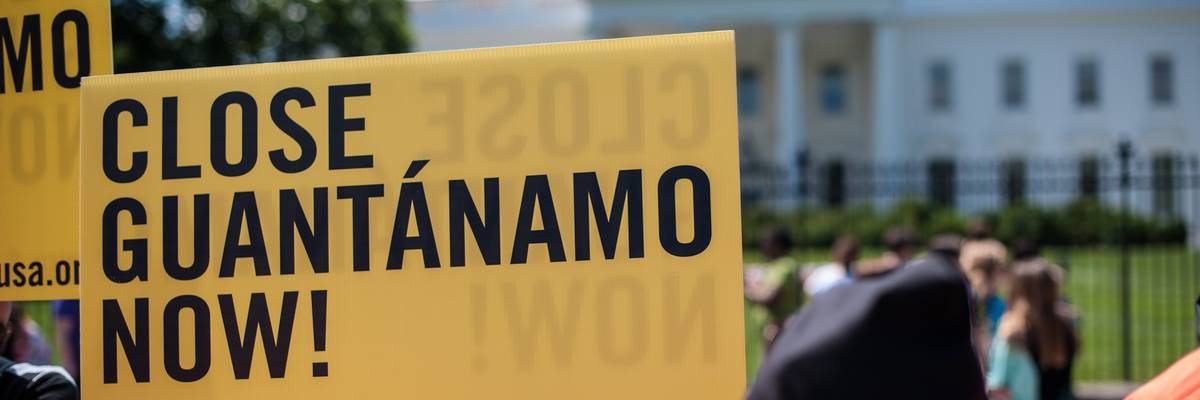
Protestors hold a sign and wear orange prisoners' jumpsuits as they call for the closing of the Guantánamo Bay detention facility during a global day of action for the closing of the prison and the end of indefinite detention in front of the White House in Washington, D.C. on May 23, 2014.
The mass deportation and detention of asylum-seekers is not only unlawful but cruel—and not a real immigration solution.
In a deeply disturbing and unprecedented move, the U.S. has begun transferring immigrant detainees to Guantánamo Bay, Cuba. They’re being held without access to their lawyers and families.
President Donald Trump has ordered up to 30,000 “high-priority” migrants to be imprisoned there as part of his larger mass deportation and detention campaign.
Trump claims these migrants are the “worst criminal aliens threatening the American people.” But recent investigations of those detainees have already challenged this narrative. And a large percentage of immigrants arrested in the U.S. have no criminal record.
We should also shut down the “War on Terror” prison at Guantánamo once and for all—and pursue accountability for its decades of abuses. Otherwise, it will only continue to expand.
Unfortunately, this isn’t the first time our government has invoked “national security” to deny marginalized communities their basic human rights. President George W. Bush created the infamous military prison at Guantánamo during the “War on Terror” to hold what his administration called the “worst of the worst.”
The prison has since become synonymous with indefinite detention—15 people still remain there today, over 20 years later. Notorious for its brutality and lawlessness, Guantánamo should be shut down, not expanded.
Of the 780 Muslim men and boys imprisoned there since January 2002, the vast majority have been held without charge or trial. Most were abducted and sold to the U.S. for bounty and “had no relationship whatsoever with the events that took place on 9/11,” reported the United Nation’s independent expert in 2023, who reiterated the global call to close Guantánamo.
The Bush administration designed the prison to circumvent the Constitution and the 1949 Geneva Conventions, refusing to treat the prisoners as either POWs or civilians. This legal fiction resulted in a range of human rights violations, including torture.
But the Constitution—and international law—still applies wherever the U.S. government operates. All prisoners, including immigrants, are still entitled to humane treatment, legal counsel, and due process.
“Never before have people been taken from U.S. soil and sent to Guantánamo, and then denied access to lawyers and the outside world,” said Lee Gelernt, the lead attorney in the ACLU case challenging Trump’s executive order.
However, the U.S. does have a sordid history of detaining migrants captured elsewhere at the base. As legal scholar Jeffrey S. Kahn points out, the U.S. has detained Haitians at Guantánamo on and off since the 1970s.
In the 1990s, thousands of Haitian refugees fleeing persecution following a military coup were captured at sea. The U.S. held them in horrific conditions at Guantánamo so they couldn’t reach U.S. shores to seek asylum—which is a fundamental human right long enshrined under U.S. law.
Shrouded in secrecy, the U.S. continues to capture and detain asylum-seekers fleeing Haiti, Cuba, and other Caribbean countries at Guantánamo. Last fall, the International Refugee Assistance Project reported that refugee families are kept in a dilapidated building with mold and sewage problems, suffer from a lack of medical care, and are “detained indefinitely in prison-like conditions without access to the outside world.”
Trump’s order would take these abuses to a horrifying new level.
Currently, the base’s existing immigration detention facility can hold up 120 people. Expanding it to 30,000 will require enormous resources. The “War on Terror” prison at Guantánamo already costs an estimated $540 million annually, making it one of the most expensive prisons in the world.
Then there are the moral costs.
The mass deportation and detention of asylum-seekers is not only unlawful but cruel—and not a real immigration solution. Instead, our government should prioritize meaningful immigration reform that recognizes the dignity of all people.
We should also shut down the “War on Terror” prison at Guantánamo once and for all—and pursue accountability for its decades of abuses. Otherwise, it will only continue to expand. “I can attest to the facility’s capacity for cruelty,” warned Mansoor Adayfi, who was subjected to torture and endured nearly 15 years at the prison.
Guantánamo’s legacy of injustice must end.
This country and this world are at a monumental crossroads. US voters have an opportunity to beat back the forces of fascism and confront the billionaires who are rigging the economy, our media system, and our democracy, making it increasingly impossible for ordinary people to get by. We’re not just talking about the election. We’re talking about what must be done once these fascist elements are vanquished from power. We need a bolder set of solutions than what either major party has so far been willing to offer and a working-class movement ready to fight like hell for it. Trump didn't emerge from nowhere. The conditions that fueled MAGA authoritarianism were created by decades of radical neoliberal economic policies and a corrupt political system dominated by corporate interests. They slashed taxes on the super-rich, promising that the benefits would trickle down. They said giveaways to the corporate titans would make life more affordable for the rest of us. It was all bullshit. And when a bitter, betrayed populace searches for someone to blame, right-wing demagogues have little trouble finding scapegoats. People know when they're being lied to, but you won't hear any of this from the corporate media. Only independent journalism—powered and funded by people who believe in building a better world—can deliver truly trustworthy daily news. If you share our vision, please contribute whatever you can to sustain our work. |
In a deeply disturbing and unprecedented move, the U.S. has begun transferring immigrant detainees to Guantánamo Bay, Cuba. They’re being held without access to their lawyers and families.
President Donald Trump has ordered up to 30,000 “high-priority” migrants to be imprisoned there as part of his larger mass deportation and detention campaign.
Trump claims these migrants are the “worst criminal aliens threatening the American people.” But recent investigations of those detainees have already challenged this narrative. And a large percentage of immigrants arrested in the U.S. have no criminal record.
We should also shut down the “War on Terror” prison at Guantánamo once and for all—and pursue accountability for its decades of abuses. Otherwise, it will only continue to expand.
Unfortunately, this isn’t the first time our government has invoked “national security” to deny marginalized communities their basic human rights. President George W. Bush created the infamous military prison at Guantánamo during the “War on Terror” to hold what his administration called the “worst of the worst.”
The prison has since become synonymous with indefinite detention—15 people still remain there today, over 20 years later. Notorious for its brutality and lawlessness, Guantánamo should be shut down, not expanded.
Of the 780 Muslim men and boys imprisoned there since January 2002, the vast majority have been held without charge or trial. Most were abducted and sold to the U.S. for bounty and “had no relationship whatsoever with the events that took place on 9/11,” reported the United Nation’s independent expert in 2023, who reiterated the global call to close Guantánamo.
The Bush administration designed the prison to circumvent the Constitution and the 1949 Geneva Conventions, refusing to treat the prisoners as either POWs or civilians. This legal fiction resulted in a range of human rights violations, including torture.
But the Constitution—and international law—still applies wherever the U.S. government operates. All prisoners, including immigrants, are still entitled to humane treatment, legal counsel, and due process.
“Never before have people been taken from U.S. soil and sent to Guantánamo, and then denied access to lawyers and the outside world,” said Lee Gelernt, the lead attorney in the ACLU case challenging Trump’s executive order.
However, the U.S. does have a sordid history of detaining migrants captured elsewhere at the base. As legal scholar Jeffrey S. Kahn points out, the U.S. has detained Haitians at Guantánamo on and off since the 1970s.
In the 1990s, thousands of Haitian refugees fleeing persecution following a military coup were captured at sea. The U.S. held them in horrific conditions at Guantánamo so they couldn’t reach U.S. shores to seek asylum—which is a fundamental human right long enshrined under U.S. law.
Shrouded in secrecy, the U.S. continues to capture and detain asylum-seekers fleeing Haiti, Cuba, and other Caribbean countries at Guantánamo. Last fall, the International Refugee Assistance Project reported that refugee families are kept in a dilapidated building with mold and sewage problems, suffer from a lack of medical care, and are “detained indefinitely in prison-like conditions without access to the outside world.”
Trump’s order would take these abuses to a horrifying new level.
Currently, the base’s existing immigration detention facility can hold up 120 people. Expanding it to 30,000 will require enormous resources. The “War on Terror” prison at Guantánamo already costs an estimated $540 million annually, making it one of the most expensive prisons in the world.
Then there are the moral costs.
The mass deportation and detention of asylum-seekers is not only unlawful but cruel—and not a real immigration solution. Instead, our government should prioritize meaningful immigration reform that recognizes the dignity of all people.
We should also shut down the “War on Terror” prison at Guantánamo once and for all—and pursue accountability for its decades of abuses. Otherwise, it will only continue to expand. “I can attest to the facility’s capacity for cruelty,” warned Mansoor Adayfi, who was subjected to torture and endured nearly 15 years at the prison.
Guantánamo’s legacy of injustice must end.