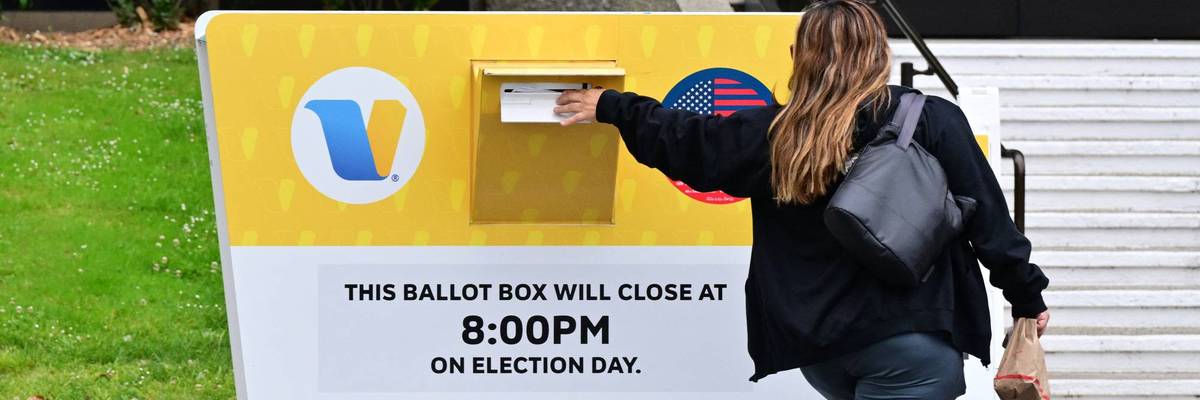
A voter drops off their ballot in a ballot drop box at the Los Angeles County Registrar during early voting in the state's primary election in Norwalk, California, on June 1, 2026.
California’s Choice: The Progressive Path or Centrist Stagnation
Today June 2, 2026, in California, voters have an opportunity to alter American history by electing progressives up and down the ballot.
Within national mythology, California is understood to be a progressive haven—with a ruling Democratic Party passing strong regulations, ever-higher taxes on the wealthy, and supporting unions to its heart’s desire.
Unfortunately, this is far from accurate. The Democratic Party may dominate California politics, but the wealthiest state in the union no longer leads the way with innovative laws and regulations, let alone serving the interests of working people, the poor, and the middle class.
Yes, California still has a progressive income tax, the nation’s highest gas taxes, relatively strong environmental regulations, and the world’s greatest public university system—but these are legacies of bygone eras. The story of the last 20 years of single-party Democratic rule is far less inspiring (unless you’re a Silicon Valley oligarch).
Now, as progressives are making significant gains across the country, revitalizing the Democratic Party in the process, the California party remains dominated by a caste of perennial incumbents committed to neoliberal centrism that, at best, generates incremental change.
Rest assured that progressives on the ballot are part of a national movement that understands that the Democratic Party has bifurcated into a vibrant progressive wing and an increasingly sclerotic moderate establishment.
Perhaps this shouldn’t be surprising. Once Democrats started winning supermajorities in both houses of the state legislature, corporations and big money interests stopped wasting their time courting Republicans. They focused their lobbying on Democrats, and to great effect. California’s Democratic Party, and its leading figures, are more beholden to big business and wealthy donors than almost any state Democratic Party. This, in turn, means Democratic incumbents accrue huge campaign war chests for their re-election.
The result is a more conservative party, one that is out of sync with the electorate. Want evidence? Ask yourself how many members of the Squad have come from California? The answer, of course, is zero. Yet all public opinion polling shows that the California electorate is decisively more progressive than the national average.
It’s true that Reps. Ro Khanna and Lateefah Simon are Squad adjacent, and a few others are solid progressives—but given that California represents about 20% of the Democratic Caucus in the US House, the state’s delegation is on balance middle-of-the-road.
This disconnect—between the political beliefs of Californians and the policies supported by their elected representatives at the national, state, and even local levels—is a major barrier to the necessary transformation of the Democratic Party into a force able to vanquish the fascist-authoritarian GOP before it consolidates power and brings down the curtain on American democracy.
Simply put, the American public increasingly understands that the status quo ante of neoliberal policy, which has organized the country’s economy since the 1980s, produces one result: ever-increasing wealth inequality. The Democratic Party must break from the economics of the Clinton and Obama administrations. The Democratic base and the general public want policies that boost the lives of working Americans, just as they want a sane foreign policy and an honest democracy. They want progressive policies.
Today June 2, 2026, in California, voters have an opportunity to alter American history by electing progressives up and down the ballot. This will transform the largest state Democratic Party, bringing it back in sync with the sentiment of the state’s population so that it can lead in the development of a new 21st century social justice compact.
There are many progressive champions with a real chance of victory today—and in the general election runoff on November 3. To start, there is a clear choice at the top of the ticket: Tom Steyer for governor.
Steyer is one of three viable candidates, two of which will make the runoff. In the best circumstance, the two democrats, Steyer and Xaiver Beccera, will take first and second—a result that will translate into more Democratic victories across the state in November. However, MAGA-supporting Republican Steve Hilton still looks likely to disrupt that result. So, it’s essential to vote, and get everyone you know to vote for Steyer by 8:00 pm PT today.
Admittedly, it sticks in the throat to be supporting a billionaire, but the simple truth is that Steyer will pursue a transformative progressive policy agenda. In contrast, Xavier Beccera, who 20 years ago seemed a sincere progressive, long ago redefined himself as an establishment Democrat. Becerra is committed to maintaining Gov. Gavin Newsom’s policies that have left California stranded with the nation’s co-equal highest poverty rate, an affordability crisis that makes New York City residents blush, and a pronounced failure to lead on environmental and social policies in the manner the world expects of California.
Tom Steyer, by contrast, supports a billionaire’s tax, meaningful living wage legislation, aggressive incentives to re-boost green energy production (and film production too), and, most tellingly, a single-payer universal healthcare system for everyone in the state. A top-two finish by Steyer will guarantee a powerful debate about the direction of the state over the next five months
Beyond the governor’s race, in nearly every US house district, state assembly, and senate race, and significant city and local elections, there are strong progressive candidates challenging the dominant California Democratic Party mainstream—many of whom are poised to advance to the November runoff. Still, it’s worth noting that this has been a very confusing election season due to redistricting (and the chaos of the governor’s race), such that down-ballot candidates have had a difficult time attracting adequate attention. But rest assured that progressives on the ballot are part of a national movement that understands that the Democratic Party has bifurcated into a vibrant progressive wing and an increasingly sclerotic moderate establishment. Please do the necessary research to learn who the progressives are in your district.
So far, it’s been a very good year for progressives—let’s continue the momentum tomorrow in New Jersey, Montana, Iowa, New Mexico, South Carolina, and the largest state and soon-to-be truest bastion of progressive public policy, California.
We are at a crossroads
This country and this world are at a monumental crossroads. In a few short weeks, US voters will have an opportunity to beat back the forces of fascism and confront the billionaires who are rigging the economy, our media system, and our democracy, making it increasingly impossible for ordinary people to get by. We’re not just talking about the election. We’re talking about what must be done once these fascist elements are vanquished from power. We need a bolder set of solutions than what either major party has so far been willing to offer and a working-class movement ready to fight like hell for it. Trump didn't emerge from nowhere. The conditions that fueled MAGA authoritarianism were created by decades of radical neoliberal economic policies and a corrupt political system dominated by corporate interests. They slashed taxes on the super-rich, promising that the benefits would trickle down. They said giveaways to the corporate titans would make life more affordable for the rest of us. It was all bullshit. And when a bitter, betrayed populace searches for someone to blame, right-wing demagogues have little trouble finding scapegoats. People know when they're being lied to, but you won't hear any of this from the corporate media. Only independent journalism—powered and funded by people who believe in building a better world—can deliver truly trustworthy daily news. Our Fall Campaign is underway, and we need your help. To power our newsroom through the rest of the year, we need to raise $125,000 by midnight on October 31. So if you share our vision, please contribute whatever you can to sustain our work. |
Within national mythology, California is understood to be a progressive haven—with a ruling Democratic Party passing strong regulations, ever-higher taxes on the wealthy, and supporting unions to its heart’s desire.
Unfortunately, this is far from accurate. The Democratic Party may dominate California politics, but the wealthiest state in the union no longer leads the way with innovative laws and regulations, let alone serving the interests of working people, the poor, and the middle class.
Yes, California still has a progressive income tax, the nation’s highest gas taxes, relatively strong environmental regulations, and the world’s greatest public university system—but these are legacies of bygone eras. The story of the last 20 years of single-party Democratic rule is far less inspiring (unless you’re a Silicon Valley oligarch).
Now, as progressives are making significant gains across the country, revitalizing the Democratic Party in the process, the California party remains dominated by a caste of perennial incumbents committed to neoliberal centrism that, at best, generates incremental change.
Rest assured that progressives on the ballot are part of a national movement that understands that the Democratic Party has bifurcated into a vibrant progressive wing and an increasingly sclerotic moderate establishment.
Perhaps this shouldn’t be surprising. Once Democrats started winning supermajorities in both houses of the state legislature, corporations and big money interests stopped wasting their time courting Republicans. They focused their lobbying on Democrats, and to great effect. California’s Democratic Party, and its leading figures, are more beholden to big business and wealthy donors than almost any state Democratic Party. This, in turn, means Democratic incumbents accrue huge campaign war chests for their re-election.
The result is a more conservative party, one that is out of sync with the electorate. Want evidence? Ask yourself how many members of the Squad have come from California? The answer, of course, is zero. Yet all public opinion polling shows that the California electorate is decisively more progressive than the national average.
It’s true that Reps. Ro Khanna and Lateefah Simon are Squad adjacent, and a few others are solid progressives—but given that California represents about 20% of the Democratic Caucus in the US House, the state’s delegation is on balance middle-of-the-road.
This disconnect—between the political beliefs of Californians and the policies supported by their elected representatives at the national, state, and even local levels—is a major barrier to the necessary transformation of the Democratic Party into a force able to vanquish the fascist-authoritarian GOP before it consolidates power and brings down the curtain on American democracy.
Simply put, the American public increasingly understands that the status quo ante of neoliberal policy, which has organized the country’s economy since the 1980s, produces one result: ever-increasing wealth inequality. The Democratic Party must break from the economics of the Clinton and Obama administrations. The Democratic base and the general public want policies that boost the lives of working Americans, just as they want a sane foreign policy and an honest democracy. They want progressive policies.
Today June 2, 2026, in California, voters have an opportunity to alter American history by electing progressives up and down the ballot. This will transform the largest state Democratic Party, bringing it back in sync with the sentiment of the state’s population so that it can lead in the development of a new 21st century social justice compact.
There are many progressive champions with a real chance of victory today—and in the general election runoff on November 3. To start, there is a clear choice at the top of the ticket: Tom Steyer for governor.
Steyer is one of three viable candidates, two of which will make the runoff. In the best circumstance, the two democrats, Steyer and Xaiver Beccera, will take first and second—a result that will translate into more Democratic victories across the state in November. However, MAGA-supporting Republican Steve Hilton still looks likely to disrupt that result. So, it’s essential to vote, and get everyone you know to vote for Steyer by 8:00 pm PT today.
Admittedly, it sticks in the throat to be supporting a billionaire, but the simple truth is that Steyer will pursue a transformative progressive policy agenda. In contrast, Xavier Beccera, who 20 years ago seemed a sincere progressive, long ago redefined himself as an establishment Democrat. Becerra is committed to maintaining Gov. Gavin Newsom’s policies that have left California stranded with the nation’s co-equal highest poverty rate, an affordability crisis that makes New York City residents blush, and a pronounced failure to lead on environmental and social policies in the manner the world expects of California.
Tom Steyer, by contrast, supports a billionaire’s tax, meaningful living wage legislation, aggressive incentives to re-boost green energy production (and film production too), and, most tellingly, a single-payer universal healthcare system for everyone in the state. A top-two finish by Steyer will guarantee a powerful debate about the direction of the state over the next five months
Beyond the governor’s race, in nearly every US house district, state assembly, and senate race, and significant city and local elections, there are strong progressive candidates challenging the dominant California Democratic Party mainstream—many of whom are poised to advance to the November runoff. Still, it’s worth noting that this has been a very confusing election season due to redistricting (and the chaos of the governor’s race), such that down-ballot candidates have had a difficult time attracting adequate attention. But rest assured that progressives on the ballot are part of a national movement that understands that the Democratic Party has bifurcated into a vibrant progressive wing and an increasingly sclerotic moderate establishment. Please do the necessary research to learn who the progressives are in your district.
So far, it’s been a very good year for progressives—let’s continue the momentum tomorrow in New Jersey, Montana, Iowa, New Mexico, South Carolina, and the largest state and soon-to-be truest bastion of progressive public policy, California.
- With a Spate of New Laws, California May Be the Most Progressive State in the Nation ›
- To Check Trump's Power Grab, Progressives Make Final Push for Prop 50 in California ›
- Dem Establishment Accused of ‘Putting Thumb on the Scale’ Against Progressive Candidate ›
- Running for California Governor, Tom Steyer Says Billionaires Like Him ‘Should Pay More Taxes’ ›
- California Voters Prefer 'Progressives' and 'Democratic Socialists' to 'Mainstream Democrats': Poll | Common Dreams ›
Within national mythology, California is understood to be a progressive haven—with a ruling Democratic Party passing strong regulations, ever-higher taxes on the wealthy, and supporting unions to its heart’s desire.
Unfortunately, this is far from accurate. The Democratic Party may dominate California politics, but the wealthiest state in the union no longer leads the way with innovative laws and regulations, let alone serving the interests of working people, the poor, and the middle class.
Yes, California still has a progressive income tax, the nation’s highest gas taxes, relatively strong environmental regulations, and the world’s greatest public university system—but these are legacies of bygone eras. The story of the last 20 years of single-party Democratic rule is far less inspiring (unless you’re a Silicon Valley oligarch).
Now, as progressives are making significant gains across the country, revitalizing the Democratic Party in the process, the California party remains dominated by a caste of perennial incumbents committed to neoliberal centrism that, at best, generates incremental change.
Rest assured that progressives on the ballot are part of a national movement that understands that the Democratic Party has bifurcated into a vibrant progressive wing and an increasingly sclerotic moderate establishment.
Perhaps this shouldn’t be surprising. Once Democrats started winning supermajorities in both houses of the state legislature, corporations and big money interests stopped wasting their time courting Republicans. They focused their lobbying on Democrats, and to great effect. California’s Democratic Party, and its leading figures, are more beholden to big business and wealthy donors than almost any state Democratic Party. This, in turn, means Democratic incumbents accrue huge campaign war chests for their re-election.
The result is a more conservative party, one that is out of sync with the electorate. Want evidence? Ask yourself how many members of the Squad have come from California? The answer, of course, is zero. Yet all public opinion polling shows that the California electorate is decisively more progressive than the national average.
It’s true that Reps. Ro Khanna and Lateefah Simon are Squad adjacent, and a few others are solid progressives—but given that California represents about 20% of the Democratic Caucus in the US House, the state’s delegation is on balance middle-of-the-road.
This disconnect—between the political beliefs of Californians and the policies supported by their elected representatives at the national, state, and even local levels—is a major barrier to the necessary transformation of the Democratic Party into a force able to vanquish the fascist-authoritarian GOP before it consolidates power and brings down the curtain on American democracy.
Simply put, the American public increasingly understands that the status quo ante of neoliberal policy, which has organized the country’s economy since the 1980s, produces one result: ever-increasing wealth inequality. The Democratic Party must break from the economics of the Clinton and Obama administrations. The Democratic base and the general public want policies that boost the lives of working Americans, just as they want a sane foreign policy and an honest democracy. They want progressive policies.
Today June 2, 2026, in California, voters have an opportunity to alter American history by electing progressives up and down the ballot. This will transform the largest state Democratic Party, bringing it back in sync with the sentiment of the state’s population so that it can lead in the development of a new 21st century social justice compact.
There are many progressive champions with a real chance of victory today—and in the general election runoff on November 3. To start, there is a clear choice at the top of the ticket: Tom Steyer for governor.
Steyer is one of three viable candidates, two of which will make the runoff. In the best circumstance, the two democrats, Steyer and Xaiver Beccera, will take first and second—a result that will translate into more Democratic victories across the state in November. However, MAGA-supporting Republican Steve Hilton still looks likely to disrupt that result. So, it’s essential to vote, and get everyone you know to vote for Steyer by 8:00 pm PT today.
Admittedly, it sticks in the throat to be supporting a billionaire, but the simple truth is that Steyer will pursue a transformative progressive policy agenda. In contrast, Xavier Beccera, who 20 years ago seemed a sincere progressive, long ago redefined himself as an establishment Democrat. Becerra is committed to maintaining Gov. Gavin Newsom’s policies that have left California stranded with the nation’s co-equal highest poverty rate, an affordability crisis that makes New York City residents blush, and a pronounced failure to lead on environmental and social policies in the manner the world expects of California.
Tom Steyer, by contrast, supports a billionaire’s tax, meaningful living wage legislation, aggressive incentives to re-boost green energy production (and film production too), and, most tellingly, a single-payer universal healthcare system for everyone in the state. A top-two finish by Steyer will guarantee a powerful debate about the direction of the state over the next five months
Beyond the governor’s race, in nearly every US house district, state assembly, and senate race, and significant city and local elections, there are strong progressive candidates challenging the dominant California Democratic Party mainstream—many of whom are poised to advance to the November runoff. Still, it’s worth noting that this has been a very confusing election season due to redistricting (and the chaos of the governor’s race), such that down-ballot candidates have had a difficult time attracting adequate attention. But rest assured that progressives on the ballot are part of a national movement that understands that the Democratic Party has bifurcated into a vibrant progressive wing and an increasingly sclerotic moderate establishment. Please do the necessary research to learn who the progressives are in your district.
So far, it’s been a very good year for progressives—let’s continue the momentum tomorrow in New Jersey, Montana, Iowa, New Mexico, South Carolina, and the largest state and soon-to-be truest bastion of progressive public policy, California.
- With a Spate of New Laws, California May Be the Most Progressive State in the Nation ›
- To Check Trump's Power Grab, Progressives Make Final Push for Prop 50 in California ›
- Dem Establishment Accused of ‘Putting Thumb on the Scale’ Against Progressive Candidate ›
- Running for California Governor, Tom Steyer Says Billionaires Like Him ‘Should Pay More Taxes’ ›
- California Voters Prefer 'Progressives' and 'Democratic Socialists' to 'Mainstream Democrats': Poll | Common Dreams ›