SUBSCRIBE TO OUR FREE NEWSLETTER
Daily news & progressive opinion—funded by the people, not the corporations—delivered straight to your inbox.
5
#000000
#FFFFFF
To donate by check, phone, or other method, see our More Ways to Give page.
Daily news & progressive opinion—funded by the people, not the corporations—delivered straight to your inbox.
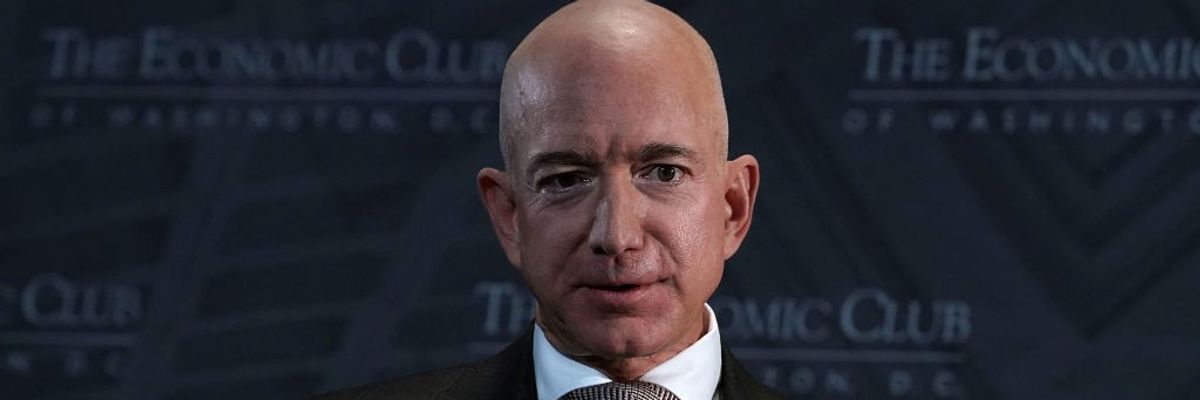
Founder of Amazon Jeff Bezos participates in a discussion during a Milestone Celebration dinner September 13, 2018 in Washington, D.C.
The longer we let inequality define our contemporary daily lives, new research helps us understand, the more the unethical behavior all around us will seem to reflect just the way our world naturally works.
Just what exactly happens when a society becomes substantially more unequal, when a few become fabulously richer than the many?
Defenders of our deepest pockets have a ready answer. What happens when wealth starts concentrating at a society’s summit? Nothing we need worry about. In fact, the richer our richest become, these cheerleaders for grand fortune posit, the better the lives the rest of us get to lead.
Or so the American Enterprise Institute’s James Pethokoukis would have us believe.
“Rather than wishing for a world without billionaires, as some radical thinkers do,” Pethokoukis declared last month, “we might want to think about the immense value that uber-successful entrepreneurs provide.”
People who live in highly unequal societies feel “a lower sense of control” and look less askance at unethical behaviors, either from others or from themselves, than do people who live in distinctly more equal societies.
“Without the possibility of amassing significant wealth,” this think-tanker went on to add, “we wouldn’t have benefited from the contributions of entrepreneurs like Bezos and Bill Gates.”
But those “contributions,” researchers have made plain over recent years, have all come at an exceptionally high price. People who live in societies with wide gaps between the wealthy and everyone else turn out to live briefer lives than people who call more equal societies home. People who live in more equal societies, meanwhile, tend to live happier lives than their unequal-society counterparts. They face less crime. Their economies crash less often.
Epidemiologists and economists the world over are exploring all these sorts of phenomena. So are sociologists and political scientists. And, over recent years, psychologists have been jumping big-time into the fray, as an analysis from Northwestern University’s Kellogg School of Management has just highlighted.
One example: Recent studies from Northwestern’s Maryam Kouchaki and her colleagues Christopher To from Rutgers and Dylan Wiwad, a former Kellogg postdoc, have been illuminating how unequal distributions of income and wealth are serving to increase “the acceptability of self-interested unethical behaviors.”
Why do unequal societies tend to be more accepting of this “immoral behavior”? Kouchaki and her colleagues have been exploring that question. They’ve dug deep into huge international data sets that go back decades. They’ve also conducted experiments to dig even deeper into the psyches of both high- and low-inequality societies.
One of these fascinating experiments, involving some 800 participants, used images of ladders to help show how levels of inequality can impact attitudes on the importance of behaving ethically. The research team showed the participants five different ten-rung ladders. Each ladder represented a different society, with each ladder rung representing 10% of each society’s population. The top rung represented the richest 10%, the bottom the poorest.
Upon each rung, the researchers placed images of money bags to indicate the total net worth of households in each particular 10%. In the most equal of these five ladder societies, no one rung carried many more money bags than any other rung. In the most unequal ladder societies, just the opposite. In these unequal societies, the overwhelming bulk of the money bags sat on the ladders’ top-most rungs.
Northwestern’s Kouchaki and her colleagues then asked their experiment’s participants to choose the ladder image that best reflected the distribution of wealth in their own real-life society. They also asked these participants to rate how acceptable unethical behaviors—everything from cheating on exams to illegally downloading software—have become in their own real-life societies.
The bottom line from this particular experiment matched up with the findings from all the rest of this research effort: People who live in highly unequal societies feel “a lower sense of control” and look less askance at unethical behaviors, either from others or from themselves, than do people who live in distinctly more equal societies.
“Overall,” Kouchaki and her colleagues conclude, “our results suggest inequality changes ethical standards.”
Other recent psychological research has come to the same core conclusion.
“When are people more open to cheating?” asked the Canadian researchers Anita Schmalor, Adrian Schroeder, and Steven Heine in a paper published earlier this year. “Economic inequality makes people expect more everyday unethical behavior.”
The longer we let inequality define our contemporary daily lives, this new research helps us understand, the more the unethical behavior all around us will seem to reflect just the way our world naturally works. Economic inequality, in effect, normalizes unethical behavior. The sun will always rise and set, we come to assume, on a deeply unequal world that no mere mortals can ever change.
We need, some observers of our fraying social fabric suggest, more people in public life noble enough to champion basic ethical norms. True, we do need those champions. But what we need even more: a world of distinctly more equal societies.
Dear Common Dreams reader, It’s been nearly 30 years since I co-founded Common Dreams with my late wife, Lina Newhouser. We had the radical notion that journalism should serve the public good, not corporate profits. It was clear to us from the outset what it would take to build such a project. No paid advertisements. No corporate sponsors. No millionaire publisher telling us what to think or do. Many people said we wouldn't last a year, but we proved those doubters wrong. Together with a tremendous team of journalists and dedicated staff, we built an independent media outlet free from the constraints of profits and corporate control. Our mission has always been simple: To inform. To inspire. To ignite change for the common good. Building Common Dreams was not easy. Our survival was never guaranteed. When you take on the most powerful forces—Wall Street greed, fossil fuel industry destruction, Big Tech lobbyists, and uber-rich oligarchs who have spent billions upon billions rigging the economy and democracy in their favor—the only bulwark you have is supporters who believe in your work. But here’s the urgent message from me today. It's never been this bad out there. And it's never been this hard to keep us going. At the very moment Common Dreams is most needed, the threats we face are intensifying. We need your support now more than ever. We don't accept corporate advertising and never will. We don't have a paywall because we don't think people should be blocked from critical news based on their ability to pay. Everything we do is funded by the donations of readers like you. When everyone does the little they can afford, we are strong. But if that support retreats or dries up, so do we. Will you donate now to make sure Common Dreams not only survives but thrives? —Craig Brown, Co-founder |
Just what exactly happens when a society becomes substantially more unequal, when a few become fabulously richer than the many?
Defenders of our deepest pockets have a ready answer. What happens when wealth starts concentrating at a society’s summit? Nothing we need worry about. In fact, the richer our richest become, these cheerleaders for grand fortune posit, the better the lives the rest of us get to lead.
Or so the American Enterprise Institute’s James Pethokoukis would have us believe.
“Rather than wishing for a world without billionaires, as some radical thinkers do,” Pethokoukis declared last month, “we might want to think about the immense value that uber-successful entrepreneurs provide.”
People who live in highly unequal societies feel “a lower sense of control” and look less askance at unethical behaviors, either from others or from themselves, than do people who live in distinctly more equal societies.
“Without the possibility of amassing significant wealth,” this think-tanker went on to add, “we wouldn’t have benefited from the contributions of entrepreneurs like Bezos and Bill Gates.”
But those “contributions,” researchers have made plain over recent years, have all come at an exceptionally high price. People who live in societies with wide gaps between the wealthy and everyone else turn out to live briefer lives than people who call more equal societies home. People who live in more equal societies, meanwhile, tend to live happier lives than their unequal-society counterparts. They face less crime. Their economies crash less often.
Epidemiologists and economists the world over are exploring all these sorts of phenomena. So are sociologists and political scientists. And, over recent years, psychologists have been jumping big-time into the fray, as an analysis from Northwestern University’s Kellogg School of Management has just highlighted.
One example: Recent studies from Northwestern’s Maryam Kouchaki and her colleagues Christopher To from Rutgers and Dylan Wiwad, a former Kellogg postdoc, have been illuminating how unequal distributions of income and wealth are serving to increase “the acceptability of self-interested unethical behaviors.”
Why do unequal societies tend to be more accepting of this “immoral behavior”? Kouchaki and her colleagues have been exploring that question. They’ve dug deep into huge international data sets that go back decades. They’ve also conducted experiments to dig even deeper into the psyches of both high- and low-inequality societies.
One of these fascinating experiments, involving some 800 participants, used images of ladders to help show how levels of inequality can impact attitudes on the importance of behaving ethically. The research team showed the participants five different ten-rung ladders. Each ladder represented a different society, with each ladder rung representing 10% of each society’s population. The top rung represented the richest 10%, the bottom the poorest.
Upon each rung, the researchers placed images of money bags to indicate the total net worth of households in each particular 10%. In the most equal of these five ladder societies, no one rung carried many more money bags than any other rung. In the most unequal ladder societies, just the opposite. In these unequal societies, the overwhelming bulk of the money bags sat on the ladders’ top-most rungs.
Northwestern’s Kouchaki and her colleagues then asked their experiment’s participants to choose the ladder image that best reflected the distribution of wealth in their own real-life society. They also asked these participants to rate how acceptable unethical behaviors—everything from cheating on exams to illegally downloading software—have become in their own real-life societies.
The bottom line from this particular experiment matched up with the findings from all the rest of this research effort: People who live in highly unequal societies feel “a lower sense of control” and look less askance at unethical behaviors, either from others or from themselves, than do people who live in distinctly more equal societies.
“Overall,” Kouchaki and her colleagues conclude, “our results suggest inequality changes ethical standards.”
Other recent psychological research has come to the same core conclusion.
“When are people more open to cheating?” asked the Canadian researchers Anita Schmalor, Adrian Schroeder, and Steven Heine in a paper published earlier this year. “Economic inequality makes people expect more everyday unethical behavior.”
The longer we let inequality define our contemporary daily lives, this new research helps us understand, the more the unethical behavior all around us will seem to reflect just the way our world naturally works. Economic inequality, in effect, normalizes unethical behavior. The sun will always rise and set, we come to assume, on a deeply unequal world that no mere mortals can ever change.
We need, some observers of our fraying social fabric suggest, more people in public life noble enough to champion basic ethical norms. True, we do need those champions. But what we need even more: a world of distinctly more equal societies.
Just what exactly happens when a society becomes substantially more unequal, when a few become fabulously richer than the many?
Defenders of our deepest pockets have a ready answer. What happens when wealth starts concentrating at a society’s summit? Nothing we need worry about. In fact, the richer our richest become, these cheerleaders for grand fortune posit, the better the lives the rest of us get to lead.
Or so the American Enterprise Institute’s James Pethokoukis would have us believe.
“Rather than wishing for a world without billionaires, as some radical thinkers do,” Pethokoukis declared last month, “we might want to think about the immense value that uber-successful entrepreneurs provide.”
People who live in highly unequal societies feel “a lower sense of control” and look less askance at unethical behaviors, either from others or from themselves, than do people who live in distinctly more equal societies.
“Without the possibility of amassing significant wealth,” this think-tanker went on to add, “we wouldn’t have benefited from the contributions of entrepreneurs like Bezos and Bill Gates.”
But those “contributions,” researchers have made plain over recent years, have all come at an exceptionally high price. People who live in societies with wide gaps between the wealthy and everyone else turn out to live briefer lives than people who call more equal societies home. People who live in more equal societies, meanwhile, tend to live happier lives than their unequal-society counterparts. They face less crime. Their economies crash less often.
Epidemiologists and economists the world over are exploring all these sorts of phenomena. So are sociologists and political scientists. And, over recent years, psychologists have been jumping big-time into the fray, as an analysis from Northwestern University’s Kellogg School of Management has just highlighted.
One example: Recent studies from Northwestern’s Maryam Kouchaki and her colleagues Christopher To from Rutgers and Dylan Wiwad, a former Kellogg postdoc, have been illuminating how unequal distributions of income and wealth are serving to increase “the acceptability of self-interested unethical behaviors.”
Why do unequal societies tend to be more accepting of this “immoral behavior”? Kouchaki and her colleagues have been exploring that question. They’ve dug deep into huge international data sets that go back decades. They’ve also conducted experiments to dig even deeper into the psyches of both high- and low-inequality societies.
One of these fascinating experiments, involving some 800 participants, used images of ladders to help show how levels of inequality can impact attitudes on the importance of behaving ethically. The research team showed the participants five different ten-rung ladders. Each ladder represented a different society, with each ladder rung representing 10% of each society’s population. The top rung represented the richest 10%, the bottom the poorest.
Upon each rung, the researchers placed images of money bags to indicate the total net worth of households in each particular 10%. In the most equal of these five ladder societies, no one rung carried many more money bags than any other rung. In the most unequal ladder societies, just the opposite. In these unequal societies, the overwhelming bulk of the money bags sat on the ladders’ top-most rungs.
Northwestern’s Kouchaki and her colleagues then asked their experiment’s participants to choose the ladder image that best reflected the distribution of wealth in their own real-life society. They also asked these participants to rate how acceptable unethical behaviors—everything from cheating on exams to illegally downloading software—have become in their own real-life societies.
The bottom line from this particular experiment matched up with the findings from all the rest of this research effort: People who live in highly unequal societies feel “a lower sense of control” and look less askance at unethical behaviors, either from others or from themselves, than do people who live in distinctly more equal societies.
“Overall,” Kouchaki and her colleagues conclude, “our results suggest inequality changes ethical standards.”
Other recent psychological research has come to the same core conclusion.
“When are people more open to cheating?” asked the Canadian researchers Anita Schmalor, Adrian Schroeder, and Steven Heine in a paper published earlier this year. “Economic inequality makes people expect more everyday unethical behavior.”
The longer we let inequality define our contemporary daily lives, this new research helps us understand, the more the unethical behavior all around us will seem to reflect just the way our world naturally works. Economic inequality, in effect, normalizes unethical behavior. The sun will always rise and set, we come to assume, on a deeply unequal world that no mere mortals can ever change.
We need, some observers of our fraying social fabric suggest, more people in public life noble enough to champion basic ethical norms. True, we do need those champions. But what we need even more: a world of distinctly more equal societies.