SUBSCRIBE TO OUR FREE NEWSLETTER
Daily news & progressive opinion—funded by the people, not the corporations—delivered straight to your inbox.
5
#000000
#FFFFFF
To donate by check, phone, or other method, see our More Ways to Give page.
Daily news & progressive opinion—funded by the people, not the corporations—delivered straight to your inbox.
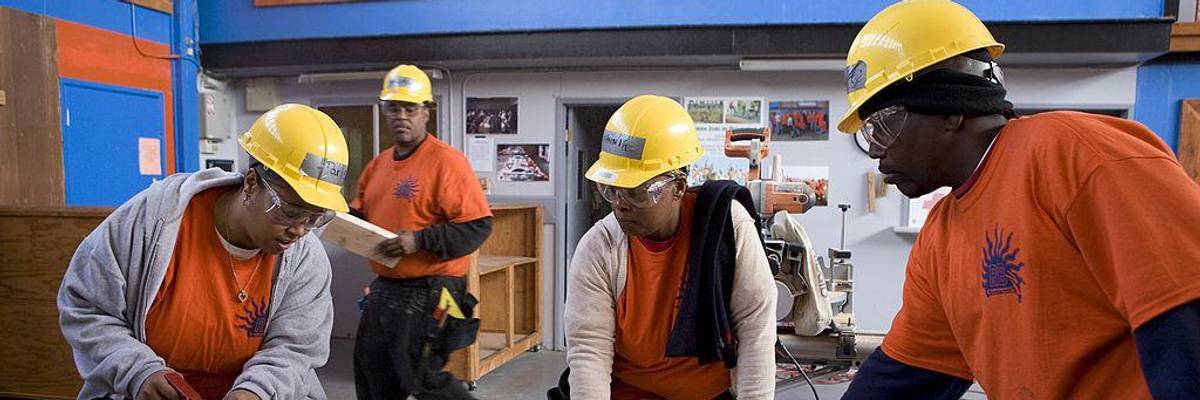
Last year, Black unemployment averaged 5.5%, a historic low. That’s good news, but it’s barely put a dent in the gap between Black and white employment.
To overcome centuries of inequality, we’ll need dedicated public policy such as Investment in quality education, access to affordable healthcare, affordable housing, job creation, and Baby Bonds.
As the country moves rapidly toward the 2024 elections, Black Americans are experiencing the best economic conditions they’ve had in generations. Record low unemployment rates, record low poverty rates, and record high levels of income and wealth paint a picture of Black prosperity.
Yet African Americans remain mired in great economic insecurity, reflected in their low opinion of the economy, widespread asset poverty, and ongoing economic inequality between Black and white households.
The best Black economy in generations, in short, isn’t enough. To overcome centuries of inequality, we’ll need dedicated public policy.
Black median income today is still nearly $30,000 lower than the white median—it’s not even caught up with the white median income of 1972.
Let’s look at some numbers from a new report we put out for the Joint Center and the Center for Economic and Policy Research.
From 1972 to 2022, the annual Black unemployment rate averaged 11.6%. Last year, it averaged 5.5%, a historic low. That’s good news, but it’s barely put a dent in the gap between Black and white employment.
We calculate that Black America would need an additional 1.4 million jobs for Black people to be employed at the same rate as white people. This employment gap cost Black Americans roughly $60 billion last year compared to what they’d have made if those jobless individuals were working.
So for African Americans, the racial employment divide remains quite costly. Other indicators tell a similar story.
For example, Black median household income is also at its highest point in a generation, growing from about $41,000 in 2011 to nearly $53,000 in 2022—a nearly 30% increase. That same year, median Black wealth also reached a new high of nearly $45,000, more than double the post-Great Recession low of about $17,000.
Still, Black median income today is still nearly $30,000 lower than the white median—it’s not even caught up with the white median income of 1972. And the average Black median wealth of about $45,000 means the vast majority of African Americans fall well short of the $190,000 to $570,000 estimated as necessary to reach middle-class status.
Will these disparities correct themselves on their own? Not likely.
As the Institute for Policy Studies and the National Community Reinvestment Coalition found in their 2023 “Still A Dream” report, the nation is still moving at a glacial pace when it comes to bridging Black/white economic inequality. If the country continues at the rate it’s been moving since the 1960s, it will take over 500 years to bridge the racial income gap—and nearly 800 years to bridge the racial wealth gap.
So while Black Americans are experiencing significant economic gains, these advances are insufficient to overcome entrenched inequalities. The economic progress we see today is a foundation, not a finish line. It speaks to the need for comprehensive policies that address ongoing barriers to economic security and wealth-building.
Investment in quality education, access to affordable healthcare, affordable housing, job creation targeted to high-unemployment communities, and new publicly financed asset building opportunities like Baby Bonds are essential. These measures can help ensure that the economic gains of today translate into sustained prosperity and security for future generations.
As we approach the presidential election, let’s not make this election a contest between individuals but of policies that can heal our deep wounds of racial and economic inequality.
Addressing these issues with urgency and commitment will not only improve the economic outlook for Black Americans—it will create the basis for a more united country.
Dear Common Dreams reader, It’s been nearly 30 years since I co-founded Common Dreams with my late wife, Lina Newhouser. We had the radical notion that journalism should serve the public good, not corporate profits. It was clear to us from the outset what it would take to build such a project. No paid advertisements. No corporate sponsors. No millionaire publisher telling us what to think or do. Many people said we wouldn't last a year, but we proved those doubters wrong. Together with a tremendous team of journalists and dedicated staff, we built an independent media outlet free from the constraints of profits and corporate control. Our mission has always been simple: To inform. To inspire. To ignite change for the common good. Building Common Dreams was not easy. Our survival was never guaranteed. When you take on the most powerful forces—Wall Street greed, fossil fuel industry destruction, Big Tech lobbyists, and uber-rich oligarchs who have spent billions upon billions rigging the economy and democracy in their favor—the only bulwark you have is supporters who believe in your work. But here’s the urgent message from me today. It's never been this bad out there. And it's never been this hard to keep us going. At the very moment Common Dreams is most needed, the threats we face are intensifying. We need your support now more than ever. We don't accept corporate advertising and never will. We don't have a paywall because we don't think people should be blocked from critical news based on their ability to pay. Everything we do is funded by the donations of readers like you. When everyone does the little they can afford, we are strong. But if that support retreats or dries up, so do we. Will you donate now to make sure Common Dreams not only survives but thrives? —Craig Brown, Co-founder |
As the country moves rapidly toward the 2024 elections, Black Americans are experiencing the best economic conditions they’ve had in generations. Record low unemployment rates, record low poverty rates, and record high levels of income and wealth paint a picture of Black prosperity.
Yet African Americans remain mired in great economic insecurity, reflected in their low opinion of the economy, widespread asset poverty, and ongoing economic inequality between Black and white households.
The best Black economy in generations, in short, isn’t enough. To overcome centuries of inequality, we’ll need dedicated public policy.
Black median income today is still nearly $30,000 lower than the white median—it’s not even caught up with the white median income of 1972.
Let’s look at some numbers from a new report we put out for the Joint Center and the Center for Economic and Policy Research.
From 1972 to 2022, the annual Black unemployment rate averaged 11.6%. Last year, it averaged 5.5%, a historic low. That’s good news, but it’s barely put a dent in the gap between Black and white employment.
We calculate that Black America would need an additional 1.4 million jobs for Black people to be employed at the same rate as white people. This employment gap cost Black Americans roughly $60 billion last year compared to what they’d have made if those jobless individuals were working.
So for African Americans, the racial employment divide remains quite costly. Other indicators tell a similar story.
For example, Black median household income is also at its highest point in a generation, growing from about $41,000 in 2011 to nearly $53,000 in 2022—a nearly 30% increase. That same year, median Black wealth also reached a new high of nearly $45,000, more than double the post-Great Recession low of about $17,000.
Still, Black median income today is still nearly $30,000 lower than the white median—it’s not even caught up with the white median income of 1972. And the average Black median wealth of about $45,000 means the vast majority of African Americans fall well short of the $190,000 to $570,000 estimated as necessary to reach middle-class status.
Will these disparities correct themselves on their own? Not likely.
As the Institute for Policy Studies and the National Community Reinvestment Coalition found in their 2023 “Still A Dream” report, the nation is still moving at a glacial pace when it comes to bridging Black/white economic inequality. If the country continues at the rate it’s been moving since the 1960s, it will take over 500 years to bridge the racial income gap—and nearly 800 years to bridge the racial wealth gap.
So while Black Americans are experiencing significant economic gains, these advances are insufficient to overcome entrenched inequalities. The economic progress we see today is a foundation, not a finish line. It speaks to the need for comprehensive policies that address ongoing barriers to economic security and wealth-building.
Investment in quality education, access to affordable healthcare, affordable housing, job creation targeted to high-unemployment communities, and new publicly financed asset building opportunities like Baby Bonds are essential. These measures can help ensure that the economic gains of today translate into sustained prosperity and security for future generations.
As we approach the presidential election, let’s not make this election a contest between individuals but of policies that can heal our deep wounds of racial and economic inequality.
Addressing these issues with urgency and commitment will not only improve the economic outlook for Black Americans—it will create the basis for a more united country.
As the country moves rapidly toward the 2024 elections, Black Americans are experiencing the best economic conditions they’ve had in generations. Record low unemployment rates, record low poverty rates, and record high levels of income and wealth paint a picture of Black prosperity.
Yet African Americans remain mired in great economic insecurity, reflected in their low opinion of the economy, widespread asset poverty, and ongoing economic inequality between Black and white households.
The best Black economy in generations, in short, isn’t enough. To overcome centuries of inequality, we’ll need dedicated public policy.
Black median income today is still nearly $30,000 lower than the white median—it’s not even caught up with the white median income of 1972.
Let’s look at some numbers from a new report we put out for the Joint Center and the Center for Economic and Policy Research.
From 1972 to 2022, the annual Black unemployment rate averaged 11.6%. Last year, it averaged 5.5%, a historic low. That’s good news, but it’s barely put a dent in the gap between Black and white employment.
We calculate that Black America would need an additional 1.4 million jobs for Black people to be employed at the same rate as white people. This employment gap cost Black Americans roughly $60 billion last year compared to what they’d have made if those jobless individuals were working.
So for African Americans, the racial employment divide remains quite costly. Other indicators tell a similar story.
For example, Black median household income is also at its highest point in a generation, growing from about $41,000 in 2011 to nearly $53,000 in 2022—a nearly 30% increase. That same year, median Black wealth also reached a new high of nearly $45,000, more than double the post-Great Recession low of about $17,000.
Still, Black median income today is still nearly $30,000 lower than the white median—it’s not even caught up with the white median income of 1972. And the average Black median wealth of about $45,000 means the vast majority of African Americans fall well short of the $190,000 to $570,000 estimated as necessary to reach middle-class status.
Will these disparities correct themselves on their own? Not likely.
As the Institute for Policy Studies and the National Community Reinvestment Coalition found in their 2023 “Still A Dream” report, the nation is still moving at a glacial pace when it comes to bridging Black/white economic inequality. If the country continues at the rate it’s been moving since the 1960s, it will take over 500 years to bridge the racial income gap—and nearly 800 years to bridge the racial wealth gap.
So while Black Americans are experiencing significant economic gains, these advances are insufficient to overcome entrenched inequalities. The economic progress we see today is a foundation, not a finish line. It speaks to the need for comprehensive policies that address ongoing barriers to economic security and wealth-building.
Investment in quality education, access to affordable healthcare, affordable housing, job creation targeted to high-unemployment communities, and new publicly financed asset building opportunities like Baby Bonds are essential. These measures can help ensure that the economic gains of today translate into sustained prosperity and security for future generations.
As we approach the presidential election, let’s not make this election a contest between individuals but of policies that can heal our deep wounds of racial and economic inequality.
Addressing these issues with urgency and commitment will not only improve the economic outlook for Black Americans—it will create the basis for a more united country.