SUBSCRIBE TO OUR FREE NEWSLETTER
Daily news & progressive opinion—funded by the people, not the corporations—delivered straight to your inbox.
5
#000000
#FFFFFF
To donate by check, phone, or other method, see our More Ways to Give page.

Amnesty International is a worldwide movement of people who campaign for internationally recognized human rights for all. Our supporters are outraged by human rights abuses but inspired by hope for a better world - so we work to improve human rights through campaigning and international solidarity. We have more than 2.2 million members and subscribers in more than 150 countries and regions and we coordinate this support to act for justice on a wide range of issues.





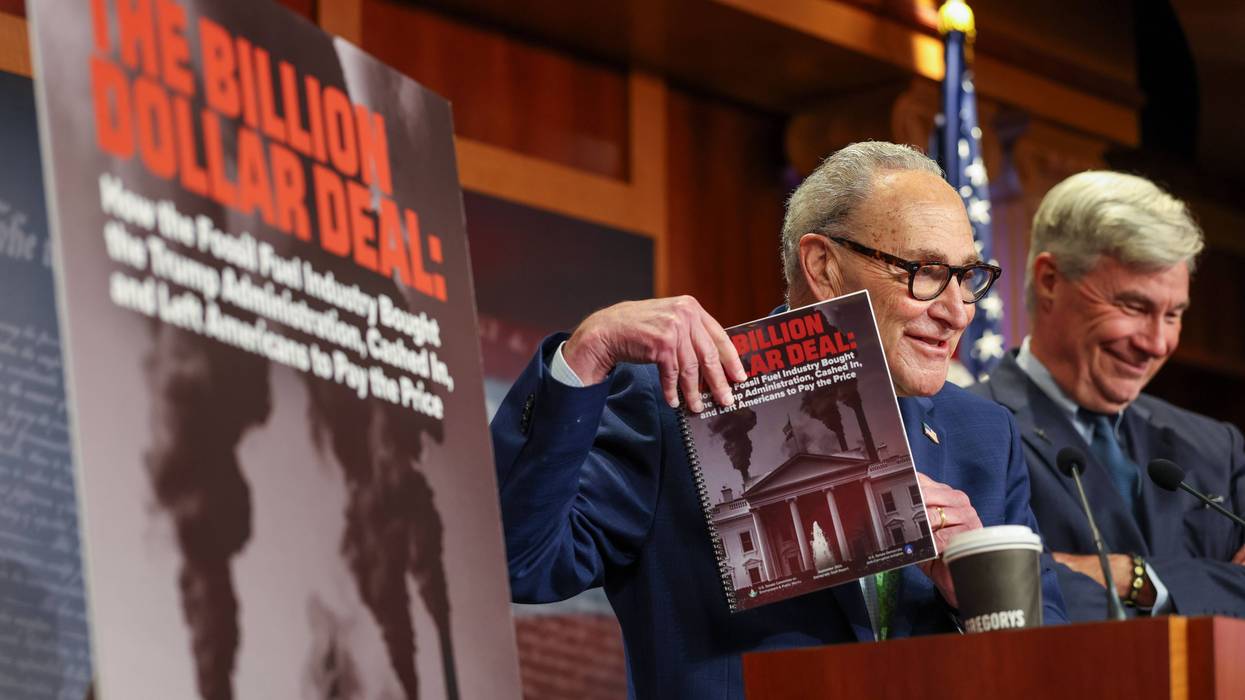
"The fossil fuel industry and their allies bought their way into the Trump White House with hundreds of millions of dollars in political donations, after Trump promised fossil fuel bigwigs at a Mar-a-Lago fundraiser that he’d do anything and everything they wanted, for the right price," Whitehouse said in a statement.
"Now, their minions run the government from the inside, driving up energy bills to deliver payouts to the donors that put Trump back in office," he continued. "Our new report exposes this old-fashioned corruption, by a thuggish government and a desperate industry, that is squeezing every last dollar out of Americans' pocketbooks while they still can."
The report is based on 19 investigations into Environmental Protection Agency (EPA) regulatory rollbacks, 13 probes of nine other agencies, and 13 investigations into 88 separate polluters. Investigators from Schumer's Anti-Corruption Working Group examined campaign finance filings, corporate earnings, and investor communications.
The document details how, in the aftermath of Trump's quid pro quo offer at the Mar-a-Lago fundraiser in 2024, fossil fuel executives, along with their corporate political action committees (PACs) and dark money groups, contributed an estimated $201 million to support Trump and allied Republican lawmakers—plus $19 million toward the inaugural fund.
"These figures capture only traceable donations," the report emphasizes. "Other substantial sums flowed to candidate Trump through 501(c)(4) organizations that are not legally required to disclose their contributors. Dark money groups—nonprofits and shell companies that do not reveal their donors—contributed over $1.9 billion into the 2024 elections, up from $1 billion in 2020."
The report names key figures from "the fossil fuel donor class" and includes their estimated contribution to Trump's latest election:
There's also former Liberty Energy CEO Chris Wright, who is now Trump's energy secretary and gave an estimated $795,000. According to the report, "Lobbyists say that many CEOs now keep Secretary Wright's personal phone number on speed dial."
Wright is among at least a dozen former oil executives and lobbyists Trump installed at the EPA and departments of Energy, the Interior, and Justice to systematically dismantle "the regulatory architecture built over decades to protect American families from pollution and climate change," the publication points out. "Those captured agencies delivered for the fossil fuel industry."
The report calls out not only Wright but also Trump's other "polluter worker bees," including EPA Administrator Lee Zeldin, Interior Secretary Doug Burgum, and various other officials at their agencies who have ties to polluting industries.
It also calls out the GOP-controlled Congress, which last year sent to Trump's desk the One Big Beautiful Bill Act, a law that includes "tens of billions in new and expanded direct subsidies to fossil fuel companies through tax breaks, royalty cuts, a suspension of the charge on methane pollution, and other giveaways. Combined with the subsidies already on the books, independent analysts estimate the industry will collect some $190 billion in tax breaks and subsidies over the next 10 years."
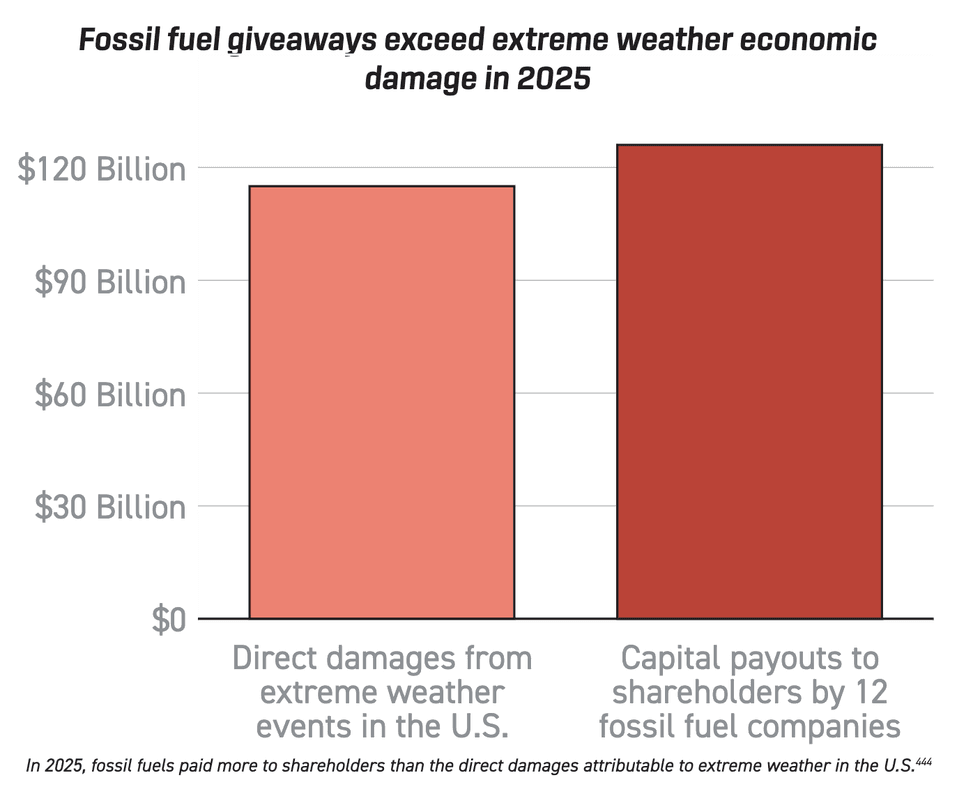
"The costs of these gifts to the fossil fuel industry fall on everyone else," the report stresses. "Climate-related disasters cost the United States at least $115 billion in direct damages in 2025 alone. Each year, the damages to public health from fossil fuel air pollution run at about $820 billion, or $2,500 per American, and contribute to approximately 91,000 premature deaths and 216,000 new cases of childhood asthma. Homeowners’ insurance has become unaffordable or unavailable across many parts of the country. These are just some of the existing costs associated with fossil fuel production and combustion."
"The Trump administration's regulatory rollbacks will drive them higher, as air and water pollution as well as climate change will all get worse," the document warns, as the fossil fuel-driven climate emergency worsens, with deadly consequences worldwide.
The report notes that "canceled and delayed wind and solar projects are also raising electricity prices for consumers in multiple states, sending billions to fossil fuel plants. And the EPA itself has estimated that the elimination of tailpipe emission standards will cost Americans a minimum of $580 billion in added fuel costs alone over the next three decades. Hundreds of thousands of jobs are being lost as the United States cedes its industrial competitiveness in clean energy technologies to China and Europe."
Trump also partnered with Israel to launch an illegal war on Iran—which has responded by restricting ship traffic through the the Strait of Hormuz, sending global fuel prices soaring. The publication highlights that "the 100 biggest oil and gas companies collectively earned an extra $30 million per hour in the first month of the Iran conflict alone—amounting to $23 billion in windfall profits—with $234 billion projected by year's end if oil prices remain near $100 a barrel."
"As the Trump administration's war in Iran drives up gas prices—with analysts warning crude prices could reach $200—American
consumers pay directly for the chaos that Big Oil's political investments helped purchase," the report warns. Brown University's Costs of War Project estimates the higher diesel and gasoline prices have so far cost Americans $115.7 billion, or $883 per household.
Trump's war is also filling his own pockets. CNBC estimated earlier this month that the president has made up to $4.4 million from his investments in fossil fuel companies—and as Common Dreams reported earlier this week, he continues to make related trades.
"Donald Trump will always choose self-enrichment over helping American families, and as this report reveals, his fossil fuel corruption is costing Americans billions," said Schumer. "Instead of using the presidency to address the affordability crisis, lower costs, and protect Americans' health and safety, Trump has used his power to deliver for his billionaire buddies in the fossil fuel industry. The message from this administration is clear: Big Oil gets the profits, and American families get the bill."
Released less than six weeks away from the midterm elections, Senate Democrats' report not only lays out a range of issues, but offers some fixes, including demands to tax the windfall profits of Big Oil, as well as legislation that would "shine a light behind the dark money front groups and shell organizations that fossil fuel interests use to hide their spending."
The report also calls for making polluters pay for planet-heating emissions and empowering lawsuits to hold them accountable. It further advocates for ending fossil fuel subsidies and directing that money to clean energy, consumer relief, and infrastructure resilience.
"The Trump administration is pumping public money into the fossil fuel industry and stripping public protections to pad the profits of some of the wealthiest corporations in the nation," David Arkush, director of Public Citizen's Climate Program, said in response to the report. "The campaign contributions to Donald Trump by Big Oil have paid dividends and have allowed the fossil fuel industry to continue to pollute our communities."
"This administration has ceded our nation's clean energy future to dirty energy and is doing its best to sacrifice the economy, public health, and the environment to Big Oil's profits," he added. "Every American family struggling with high costs is suffering because of the corrupt relationship between Donald Trump and the fossil fuel industry."