SUBSCRIBE TO OUR FREE NEWSLETTER
Daily news & progressive opinion—funded by the people, not the corporations—delivered straight to your inbox.
5
#000000
#FFFFFF
To donate by check, phone, or other method, see our More Ways to Give page.
Daily news & progressive opinion—funded by the people, not the corporations—delivered straight to your inbox.
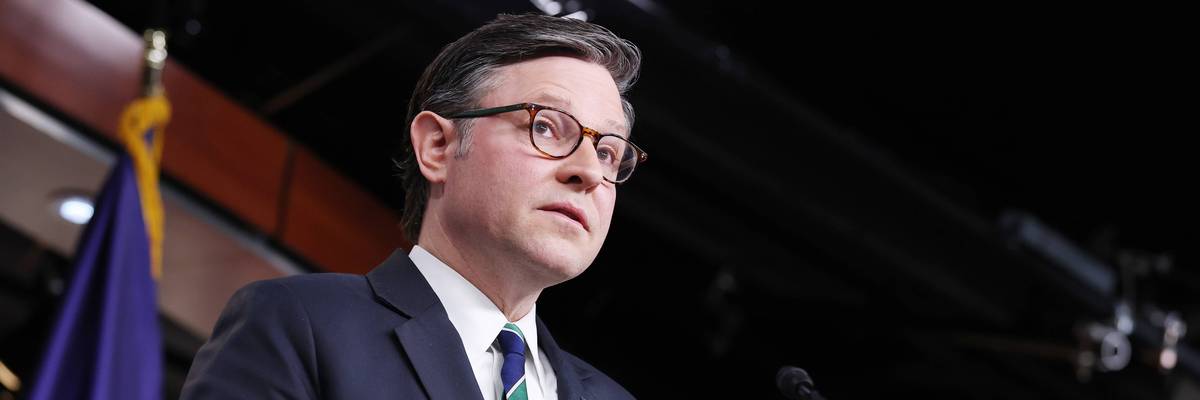
US Speaker of the House Mike Johnson (R-La.) speaks during a news conference on March 17, 2026 at the Capitol in Washington, DC.
"Republicans, Democrats, and independents all overwhelmingly want Congress to take serious action to protect privacy—in particular against AI and data brokers," said one campaigner.
With just a month until a key Foreign Intelligence Surveillance Act spying power expires, US House Speaker Mike Johnson was planning to try to push through reauthorization legislation next week, but the Louisiana Republican leader is now reportedly delaying the vote while "still dealing with a dozen or so Republican members who want reforms."
Privacy advocates and lawmakers across the political spectrum have long called for reforms to FISA's Section 702, which empowers the US government to surveil electronic communications of noncitizens located outside the United States to acquire foreign intelligence information, without a warrant.
Citing three unnamed sources familiar with discussions in the House of Representatives, Politico reported Friday that "with a GOP hard-liner revolt over warrantless surveillance threatening to tank the legislation," Johnson "will instead work through the remaining issues over the upcoming two-week recess and try to put the extension on the floor the week of April 14."
Welcoming the development, Demand Progress executive director Sean Vitka said in a statement that "Speaker Johnson is backing away from his plan to ram through a FISA reauthorization vote next week because he knows his members don't want it and the American people don't want it."
"Republicans, Democrats, and independents all overwhelmingly want Congress to take serious action to protect privacy—in particular against AI and data brokers—and oppose any efforts to rubber-stamp the government's warrantless mass surveillance powers as is," Vitka continued.
"Before any vote on reauthorizing FISA," he added, "Congress must first enact real protections for Americans' privacy, in particular by closing the data broker loophole to prevent the government from circumventing the courts and independent oversight through the purchase of Americans' private location, web browsing, and other sensitive information."
Various bills, including the bipartisan Security and Freedom Enhancement (SAFE) Act introduced last month by Sens. Dick Durbin (D-Ill.) and Mike Lee (R-Utah), would close the loophole that agencies use to buy their way around the Fourth Amendment to the US Constitution, which is supposed to protect Americans against unreasonable searches and seizures.
Demand Progress has endorsed that bill, and on Thursday partnered with the Project On Government Oversight and over 130 other artificial intelligence and civil rights groups for a letter urging Republican and Democratic congressional leaders to impose "much-needed privacy protections against government agencies' warrantless mass surveillance of people in the United States."
President Donald Trump and his pro-spying deputy chief of staff, Stephen Miller, have fought for a "clean" reauthorization, but the GOP has slim majorities in both chambers of Congress. In the House, Johnson can only afford to lose two votes, and in the Senate, most bills require at least some Democratic support to get to the president's desk.
The conduct of Trump's second administration has fueled calls for reform. Rep. Pramila Jayapal (D-Wash.), a member of the House Judiciary Committee, said in a Thursday statement that "as the Trump administration continues to run roughshod over our Constitution, we cannot continue to give them a further opening to sacrifice our civil liberties in the name of national security. We cannot give Stephen Miller a blank check to conduct domestic surveillance in violation of the Fourth Amendment."
"I have been working on essential reforms to FISA across administrations, and I have not wavered—whether it is a Democratic or Republican president," she noted. "This has always been a bipartisan issue for good reason. Americans across political parties care deeply about privacy and not being surveilled. Congress has a duty to protect those fundamental constitutional liberties. Any attempt to push forward a 'clean' reauthorization of Section 702 will put our private, sensitive data at risk."
Jayapal stressed that "this Trump administration has been particularly brazen in its use of domestic surveillance to suppress our constitutional rights and dissent. In just the last six weeks, the administration has blacklisted Anthropic for refusing to stand down on its requirement that its technology not be used for the mass surveillance of Americans, and we learned that the Department of Justice surveilled me—and likely many other members—while reviewing the Epstein files, seeking justice for survivors."
"In Minnesota, federal immigration agents have surveilled and intimidated US citizens exercising their First Amendment rights to document agents' unlawful actions," the congresswoman noted. "It is time to reform FISA, ensure our Fourth Amendment protections are guaranteed, and stop the government surveillance of Americans."
Dear Common Dreams reader, It’s been nearly 30 years since I co-founded Common Dreams with my late wife, Lina Newhouser. We had the radical notion that journalism should serve the public good, not corporate profits. It was clear to us from the outset what it would take to build such a project. No paid advertisements. No corporate sponsors. No millionaire publisher telling us what to think or do. Many people said we wouldn't last a year, but we proved those doubters wrong. Together with a tremendous team of journalists and dedicated staff, we built an independent media outlet free from the constraints of profits and corporate control. Our mission has always been simple: To inform. To inspire. To ignite change for the common good. Building Common Dreams was not easy. Our survival was never guaranteed. When you take on the most powerful forces—Wall Street greed, fossil fuel industry destruction, Big Tech lobbyists, and uber-rich oligarchs who have spent billions upon billions rigging the economy and democracy in their favor—the only bulwark you have is supporters who believe in your work. But here’s the urgent message from me today. It's never been this bad out there. And it's never been this hard to keep us going. At the very moment Common Dreams is most needed, the threats we face are intensifying. We need your support now more than ever. We don't accept corporate advertising and never will. We don't have a paywall because we don't think people should be blocked from critical news based on their ability to pay. Everything we do is funded by the donations of readers like you. When everyone does the little they can afford, we are strong. But if that support retreats or dries up, so do we. Will you donate now to make sure Common Dreams not only survives but thrives? —Craig Brown, Co-founder |
With just a month until a key Foreign Intelligence Surveillance Act spying power expires, US House Speaker Mike Johnson was planning to try to push through reauthorization legislation next week, but the Louisiana Republican leader is now reportedly delaying the vote while "still dealing with a dozen or so Republican members who want reforms."
Privacy advocates and lawmakers across the political spectrum have long called for reforms to FISA's Section 702, which empowers the US government to surveil electronic communications of noncitizens located outside the United States to acquire foreign intelligence information, without a warrant.
Citing three unnamed sources familiar with discussions in the House of Representatives, Politico reported Friday that "with a GOP hard-liner revolt over warrantless surveillance threatening to tank the legislation," Johnson "will instead work through the remaining issues over the upcoming two-week recess and try to put the extension on the floor the week of April 14."
Welcoming the development, Demand Progress executive director Sean Vitka said in a statement that "Speaker Johnson is backing away from his plan to ram through a FISA reauthorization vote next week because he knows his members don't want it and the American people don't want it."
"Republicans, Democrats, and independents all overwhelmingly want Congress to take serious action to protect privacy—in particular against AI and data brokers—and oppose any efforts to rubber-stamp the government's warrantless mass surveillance powers as is," Vitka continued.
"Before any vote on reauthorizing FISA," he added, "Congress must first enact real protections for Americans' privacy, in particular by closing the data broker loophole to prevent the government from circumventing the courts and independent oversight through the purchase of Americans' private location, web browsing, and other sensitive information."
Various bills, including the bipartisan Security and Freedom Enhancement (SAFE) Act introduced last month by Sens. Dick Durbin (D-Ill.) and Mike Lee (R-Utah), would close the loophole that agencies use to buy their way around the Fourth Amendment to the US Constitution, which is supposed to protect Americans against unreasonable searches and seizures.
Demand Progress has endorsed that bill, and on Thursday partnered with the Project On Government Oversight and over 130 other artificial intelligence and civil rights groups for a letter urging Republican and Democratic congressional leaders to impose "much-needed privacy protections against government agencies' warrantless mass surveillance of people in the United States."
President Donald Trump and his pro-spying deputy chief of staff, Stephen Miller, have fought for a "clean" reauthorization, but the GOP has slim majorities in both chambers of Congress. In the House, Johnson can only afford to lose two votes, and in the Senate, most bills require at least some Democratic support to get to the president's desk.
The conduct of Trump's second administration has fueled calls for reform. Rep. Pramila Jayapal (D-Wash.), a member of the House Judiciary Committee, said in a Thursday statement that "as the Trump administration continues to run roughshod over our Constitution, we cannot continue to give them a further opening to sacrifice our civil liberties in the name of national security. We cannot give Stephen Miller a blank check to conduct domestic surveillance in violation of the Fourth Amendment."
"I have been working on essential reforms to FISA across administrations, and I have not wavered—whether it is a Democratic or Republican president," she noted. "This has always been a bipartisan issue for good reason. Americans across political parties care deeply about privacy and not being surveilled. Congress has a duty to protect those fundamental constitutional liberties. Any attempt to push forward a 'clean' reauthorization of Section 702 will put our private, sensitive data at risk."
Jayapal stressed that "this Trump administration has been particularly brazen in its use of domestic surveillance to suppress our constitutional rights and dissent. In just the last six weeks, the administration has blacklisted Anthropic for refusing to stand down on its requirement that its technology not be used for the mass surveillance of Americans, and we learned that the Department of Justice surveilled me—and likely many other members—while reviewing the Epstein files, seeking justice for survivors."
"In Minnesota, federal immigration agents have surveilled and intimidated US citizens exercising their First Amendment rights to document agents' unlawful actions," the congresswoman noted. "It is time to reform FISA, ensure our Fourth Amendment protections are guaranteed, and stop the government surveillance of Americans."
With just a month until a key Foreign Intelligence Surveillance Act spying power expires, US House Speaker Mike Johnson was planning to try to push through reauthorization legislation next week, but the Louisiana Republican leader is now reportedly delaying the vote while "still dealing with a dozen or so Republican members who want reforms."
Privacy advocates and lawmakers across the political spectrum have long called for reforms to FISA's Section 702, which empowers the US government to surveil electronic communications of noncitizens located outside the United States to acquire foreign intelligence information, without a warrant.
Citing three unnamed sources familiar with discussions in the House of Representatives, Politico reported Friday that "with a GOP hard-liner revolt over warrantless surveillance threatening to tank the legislation," Johnson "will instead work through the remaining issues over the upcoming two-week recess and try to put the extension on the floor the week of April 14."
Welcoming the development, Demand Progress executive director Sean Vitka said in a statement that "Speaker Johnson is backing away from his plan to ram through a FISA reauthorization vote next week because he knows his members don't want it and the American people don't want it."
"Republicans, Democrats, and independents all overwhelmingly want Congress to take serious action to protect privacy—in particular against AI and data brokers—and oppose any efforts to rubber-stamp the government's warrantless mass surveillance powers as is," Vitka continued.
"Before any vote on reauthorizing FISA," he added, "Congress must first enact real protections for Americans' privacy, in particular by closing the data broker loophole to prevent the government from circumventing the courts and independent oversight through the purchase of Americans' private location, web browsing, and other sensitive information."
Various bills, including the bipartisan Security and Freedom Enhancement (SAFE) Act introduced last month by Sens. Dick Durbin (D-Ill.) and Mike Lee (R-Utah), would close the loophole that agencies use to buy their way around the Fourth Amendment to the US Constitution, which is supposed to protect Americans against unreasonable searches and seizures.
Demand Progress has endorsed that bill, and on Thursday partnered with the Project On Government Oversight and over 130 other artificial intelligence and civil rights groups for a letter urging Republican and Democratic congressional leaders to impose "much-needed privacy protections against government agencies' warrantless mass surveillance of people in the United States."
President Donald Trump and his pro-spying deputy chief of staff, Stephen Miller, have fought for a "clean" reauthorization, but the GOP has slim majorities in both chambers of Congress. In the House, Johnson can only afford to lose two votes, and in the Senate, most bills require at least some Democratic support to get to the president's desk.
The conduct of Trump's second administration has fueled calls for reform. Rep. Pramila Jayapal (D-Wash.), a member of the House Judiciary Committee, said in a Thursday statement that "as the Trump administration continues to run roughshod over our Constitution, we cannot continue to give them a further opening to sacrifice our civil liberties in the name of national security. We cannot give Stephen Miller a blank check to conduct domestic surveillance in violation of the Fourth Amendment."
"I have been working on essential reforms to FISA across administrations, and I have not wavered—whether it is a Democratic or Republican president," she noted. "This has always been a bipartisan issue for good reason. Americans across political parties care deeply about privacy and not being surveilled. Congress has a duty to protect those fundamental constitutional liberties. Any attempt to push forward a 'clean' reauthorization of Section 702 will put our private, sensitive data at risk."
Jayapal stressed that "this Trump administration has been particularly brazen in its use of domestic surveillance to suppress our constitutional rights and dissent. In just the last six weeks, the administration has blacklisted Anthropic for refusing to stand down on its requirement that its technology not be used for the mass surveillance of Americans, and we learned that the Department of Justice surveilled me—and likely many other members—while reviewing the Epstein files, seeking justice for survivors."
"In Minnesota, federal immigration agents have surveilled and intimidated US citizens exercising their First Amendment rights to document agents' unlawful actions," the congresswoman noted. "It is time to reform FISA, ensure our Fourth Amendment protections are guaranteed, and stop the government surveillance of Americans."