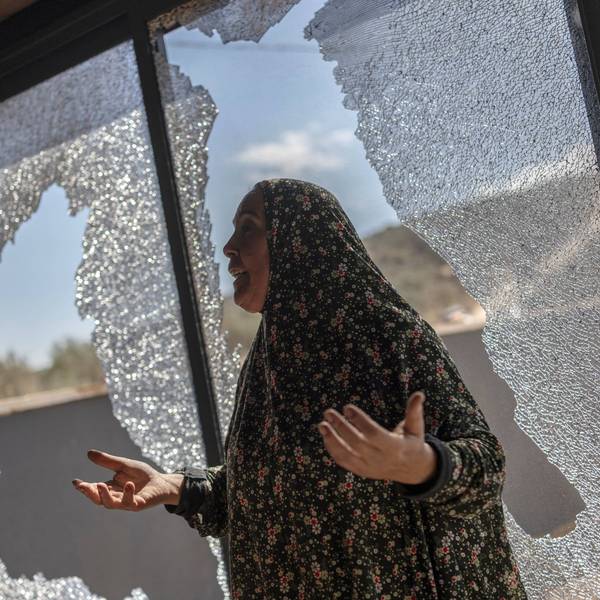
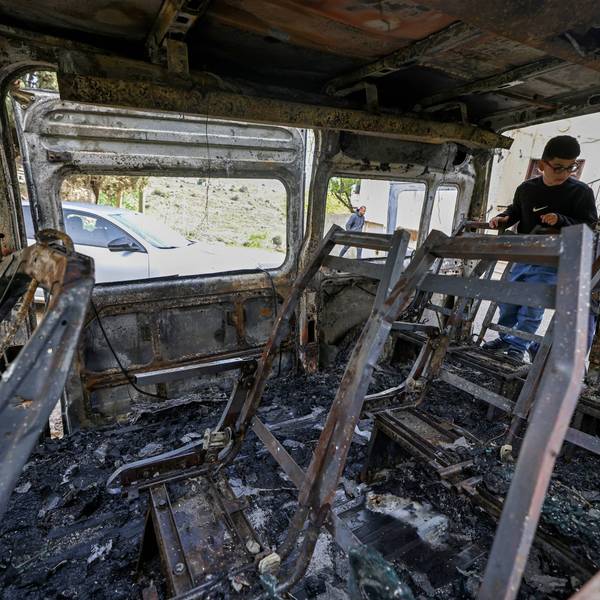

Cars are seen burning in the West Bank town of Sinjil on January 19, 2025 after attacks by Israeli settlers who oppose the cease-fire deal between Hamas and Israel.
Israeli Settlers Wage 'Vicious Terror Attacks' in West Bank Over Prisoner Releases
One human rights group said settlers aim "to impose a 'price tag' for the release of Palestinians from Israeli prisons."
A day after the cease-fire deal between Israel and Hamas took effect, the Israeli human rights organization B'Tselem said Monday that attacks by settlers in the West Bank—carried out with the "full cooperation" of Israeli soldiers, according to one rights group—were meant to "impose a 'price tag' for the release of Palestinians" as part of the truce.
West Bank residents shared accounts—backed up by footage that was verified by The New York Times—of masked Israeli settlers in the Israeli-occupied territory burning homes and vehicles on Sunday, with gangs of "dozens of men, some carrying slingshots," rampaging through at least three Palestinian villages.
The cease-fire deal reached last week was widely celebrated after more than 15 months of Israel's U.S.-backed assault on Gaza, which has killed at least 46,913 Palestinians.
But some on the far-right in Israel, including settlers in the West Bank, object to the release of Palestinians from Israeli prisons.
In the first phase of the agreement, 33 Israeli hostages are set to be released by Hamas, while 737 Palestinian prisoners being held in Israel and 1,167 Palestinians detained by the Israel Defense Forces (IDF) will be freed. On Sunday, the first three Israeli hostages and 90 Palestinians were released.
B'Tselem reported that a 15-year-old boy was killed in the West Bank town of Sabastiya by soldiers who "escorted" gangs of settlers on Sunday.
In Sinjil, the Times reported that dozens of men threw stones and set houses ablaze, injuring several people, including an 86-year-old man.
"People screamed as their homes were burning," a resident, Ayed Jafry, told the newspaper.
Villagers in Turmus Aya reported that Israeli police officers did not try to stop at least 20 masked settlers who entered the town and threw stones, and CCTV footage showed Israeli police cars in the area.
Ofer Cassif, a member of the Israeli Knesset who has expressed support for South Africa's genocide case against Israel at the International Court of Justice, called on the international community to "enforce accountability on its own and bring these violent, racist criminals to justice."
"If their flames of hatred will not be vanquished," said Cassif, "it will engulf us all."
We are at a crossroads
This country and this world are at a monumental crossroads. In a few short weeks, US voters will have an opportunity to beat back the forces of fascism and confront the billionaires who are rigging the economy, our media system, and our democracy, making it increasingly impossible for ordinary people to get by. We’re not just talking about the election. We’re talking about what must be done once these fascist elements are vanquished from power. We need a bolder set of solutions than what either major party has so far been willing to offer and a working-class movement ready to fight like hell for it. Trump didn't emerge from nowhere. The conditions that fueled MAGA authoritarianism were created by decades of radical neoliberal economic policies and a corrupt political system dominated by corporate interests. They slashed taxes on the super-rich, promising that the benefits would trickle down. They said giveaways to the corporate titans would make life more affordable for the rest of us. It was all bullshit. And when a bitter, betrayed populace searches for someone to blame, right-wing demagogues have little trouble finding scapegoats. People know when they're being lied to, but you won't hear any of this from the corporate media. Only independent journalism—powered and funded by people who believe in building a better world—can deliver truly trustworthy daily news. Our Fall Campaign is underway, and we need your help. To power our newsroom through the rest of the year, we need to raise $125,000 by midnight on October 31. So if you share our vision, please contribute whatever you can to sustain our work. |
A day after the cease-fire deal between Israel and Hamas took effect, the Israeli human rights organization B'Tselem said Monday that attacks by settlers in the West Bank—carried out with the "full cooperation" of Israeli soldiers, according to one rights group—were meant to "impose a 'price tag' for the release of Palestinians" as part of the truce.
West Bank residents shared accounts—backed up by footage that was verified by The New York Times—of masked Israeli settlers in the Israeli-occupied territory burning homes and vehicles on Sunday, with gangs of "dozens of men, some carrying slingshots," rampaging through at least three Palestinian villages.
The cease-fire deal reached last week was widely celebrated after more than 15 months of Israel's U.S.-backed assault on Gaza, which has killed at least 46,913 Palestinians.
But some on the far-right in Israel, including settlers in the West Bank, object to the release of Palestinians from Israeli prisons.
In the first phase of the agreement, 33 Israeli hostages are set to be released by Hamas, while 737 Palestinian prisoners being held in Israel and 1,167 Palestinians detained by the Israel Defense Forces (IDF) will be freed. On Sunday, the first three Israeli hostages and 90 Palestinians were released.
B'Tselem reported that a 15-year-old boy was killed in the West Bank town of Sabastiya by soldiers who "escorted" gangs of settlers on Sunday.
In Sinjil, the Times reported that dozens of men threw stones and set houses ablaze, injuring several people, including an 86-year-old man.
"People screamed as their homes were burning," a resident, Ayed Jafry, told the newspaper.
Villagers in Turmus Aya reported that Israeli police officers did not try to stop at least 20 masked settlers who entered the town and threw stones, and CCTV footage showed Israeli police cars in the area.
Ofer Cassif, a member of the Israeli Knesset who has expressed support for South Africa's genocide case against Israel at the International Court of Justice, called on the international community to "enforce accountability on its own and bring these violent, racist criminals to justice."
"If their flames of hatred will not be vanquished," said Cassif, "it will engulf us all."
- Israel's West Bank Assault Sparks 250% Surge in Killings of Palestinian Kids ›
- Killing of Woman Harvester Underscores 'War-Like' Israeli Assault on West Bank Olive Growers ›
- West Bank Pogrom 'Underscores Urgent Need to Dismantle Apartheid': Amnesty ›
- Aid Group Sounds Alarm Over 'Disturbing' Israeli Rampage in West Bank | Common Dreams ›
- Israel Delays Prisoner Release, Threatening Gaza Cease-Fire | Common Dreams ›
- Opinion | With the World's Eyes on Gaza, Israel Continues Its War on the West Bank | Common Dreams ›
A day after the cease-fire deal between Israel and Hamas took effect, the Israeli human rights organization B'Tselem said Monday that attacks by settlers in the West Bank—carried out with the "full cooperation" of Israeli soldiers, according to one rights group—were meant to "impose a 'price tag' for the release of Palestinians" as part of the truce.
West Bank residents shared accounts—backed up by footage that was verified by The New York Times—of masked Israeli settlers in the Israeli-occupied territory burning homes and vehicles on Sunday, with gangs of "dozens of men, some carrying slingshots," rampaging through at least three Palestinian villages.
The cease-fire deal reached last week was widely celebrated after more than 15 months of Israel's U.S.-backed assault on Gaza, which has killed at least 46,913 Palestinians.
But some on the far-right in Israel, including settlers in the West Bank, object to the release of Palestinians from Israeli prisons.
In the first phase of the agreement, 33 Israeli hostages are set to be released by Hamas, while 737 Palestinian prisoners being held in Israel and 1,167 Palestinians detained by the Israel Defense Forces (IDF) will be freed. On Sunday, the first three Israeli hostages and 90 Palestinians were released.
B'Tselem reported that a 15-year-old boy was killed in the West Bank town of Sabastiya by soldiers who "escorted" gangs of settlers on Sunday.
In Sinjil, the Times reported that dozens of men threw stones and set houses ablaze, injuring several people, including an 86-year-old man.
"People screamed as their homes were burning," a resident, Ayed Jafry, told the newspaper.
Villagers in Turmus Aya reported that Israeli police officers did not try to stop at least 20 masked settlers who entered the town and threw stones, and CCTV footage showed Israeli police cars in the area.
Ofer Cassif, a member of the Israeli Knesset who has expressed support for South Africa's genocide case against Israel at the International Court of Justice, called on the international community to "enforce accountability on its own and bring these violent, racist criminals to justice."
"If their flames of hatred will not be vanquished," said Cassif, "it will engulf us all."
- Israel's West Bank Assault Sparks 250% Surge in Killings of Palestinian Kids ›
- Killing of Woman Harvester Underscores 'War-Like' Israeli Assault on West Bank Olive Growers ›
- West Bank Pogrom 'Underscores Urgent Need to Dismantle Apartheid': Amnesty ›
- Aid Group Sounds Alarm Over 'Disturbing' Israeli Rampage in West Bank | Common Dreams ›
- Israel Delays Prisoner Release, Threatening Gaza Cease-Fire | Common Dreams ›
- Opinion | With the World's Eyes on Gaza, Israel Continues Its War on the West Bank | Common Dreams ›